
Low cost-high impact, affordable farming solutions for sustainable food security

Source: APO – Report:

.

The rising cost of agricultural inputs especially inorganic fertilizers, is one of the issues impeding production among small holder farmers in Malawi, therefore affecting food security. Due to land degradation, farmers who cannot afford inorganic fertilizer often harvest barely enough food for household consumption.

In response to the problem, the Food and Agriculture Organization of the United Nations (FAO) is implementing the Land Use Planning and Sustainable Land and Water Management for Improved Agricultural Productivity project, funded by the Government of Flanders. Under this project, FAO is promoting the use of low-cost sustainable land and water management practices such as production of organo-mineral fertilizers such as Mbeya, which is a homemade organic fertilizer made from locally available raw materials and a small amount of inorganic fertilizer.

Maganizo Lukhere hails from Mzimba district and is one of the farmers who adopted the use of Mbeya fertilizer. He gives a comparison of his family’s livelihood before and after adopting the low-cost agricultural technologies being promoted by FAO.

“Four years ago, we used to harvest 10 to 13 fifty kilograms bags of maize from a one-acre piece of land. The maize was never enough to sustain our family of eight until the next harvest. Since we started making and using Mbeya fertilizer, we harvest about 40 fifty kilograms bags of maize on the same piece of land,” said Maganizo.

He has since obtained another piece of wetland where he grows maize throughout the year under irrigation, using residual moisture, and uses Mbeya fertilizer and other low-cost soil and water management practices. “We are about to harvest this year’s crop, but we still have maize left over from last year’s harvest. In our household, lean months are a thing of the past. We have eliminated hunger,” said Maganizo.

For farmers in the community, Mbeya fertilizer is easy and cheaper to make. The ingredients required to make one 50 kg bag of Mbeya fertilizer are 21 kg of maize bran, 10 kg of pig dung, 10 kg of inorganic fertilizers, 10 kg of ash and 5 litres of water. One 50kg bag of mineral fertilizer produces five 50kg bags of Mbeya fertilizer.

Along with using Mbeya fertilizer, Maganizo has adopted other low-cost techniques that FAO promotes such as mulching, zero tillage, planting vetiver grass around maize fields and constructing swales for water harvesting. These techniques preserve soil moisture, reduce soil erosion and improve soil composition.

“A lot of small holder farmers are resource poor, and the cost of technology is one of the factors they consider before adoption,” said Harvey Nyirongo, Agriculture Extension Officer for Chasato section in Mzimba. He said now that more farmers are making and using Mbeya fertilizer, the community is more food secure.

– on behalf of Food and Agriculture Organization of the United Nations (FAO): Regional Office for Africa.
Seminar focusing on cultural heritage and identity

Source: APO – Report:

.

The Commission of Culture and Sports organized a seminar on cultural heritage and identity for over 150 members of traditional dance and music groups from the Southern Region on 18 August in Asmara.

At the seminar, Dr. Tsegay Medin, head of Archaeological Heritage Research at the Commission, gave a detailed briefing on the meaning and significance of culture, the tangible and intangible aspects of cultural heritage, and the role of heritage in consolidating national identity.

Highlighting the importance of cultural heritage in preserving identity, understanding the current situation, and envisioning the future, Dr. Tsegay said that archaeological findings from the prehistoric and historic eras, including the period of kingdoms and colonialism, have made a significant contribution to nurturing national identity.

Dr. Tsegay further stated that the Commission of Culture and Sports is making strong efforts in research, conservation, and transmission of cultural heritage. He noted, however, that ongoing damage and destruction of heritage sites remain the main challenges.

The participants held extensive discussions on the issues raised during the seminar and adopted several recommendations. These included intensifying efforts to repatriate heritage items held abroad and addressing the damage caused to ancient buildings under the pretext of renovation.

Lt. Col. Samuel Tsegay, head of Administration and Finance at the Commission of Culture and Sports, and Mr. Abraham Yohannes, Director General of Culture and Sports in the Southern Region, emphasized the significance of the seminar and called for its continuation.

– on behalf of Ministry of Information, Eritrea.

From genome to action: Building Sierra Leone’s next generation of genomic leaders for public health resilience beyond mpox

Source: APO – Report:

.

Sierra Leone has taken an important step in strengthening its public health system by hosting a two-week national workshop on DNA sequencing and bioinformatics from August 4 to August 15, 2025 in Freetown. The training, held under the theme “From Genome to Action: Enhancing Mpox Surveillance through Sequencing and Bioinformatics in Sierra Leone,” was supported by the World Health Organization (WHO). It focused on building the country’s capacity to track and understand diseases through genomic science, with mpox as a key focus, but also extending to other infectious diseases.

The training served as a mentorship program for 16 young scientists, 15 of whom had already received foundational genomics training with WHO support. This advanced phase transitioned them to mid-level genomic experts capable of sophisticated data analysis and interpretation to inform real-time public health interventions. The sessions were practical and hands-on, covering:

  • DNA sequencing: learning how to read and understand genetic material using Illumina platforms.

  • Bioinformatics analysis: interpreting genetic information to see how diseases spread and change.

  • Data stewardship: submitting results to international databases to support global knowledge.

  • Outbreak analytic: turning genetic information into actions that help control outbreaks.

The comprehensive program went beyond mpox, also covering diseases like Ebola, COVID-19, Lassa fever, HIV, and antimicrobial resistance. It also introduced broader tools that allow scientists to study different types of pathogens at once.  Already, the Central Public Health Reference Laboratory (CPHRL) is applying these skills in HIV-2 research. “This is mentorship in motion. We’re growing future genomic leaders from within,” said Doris Harding, Laboratory Lead at the National Public Health Agency (NPHA).

As of August 18, 2025, Sierra Leone had sequenced 10.1% (522 out of 5,154) of its confirmed mpox cases, meeting both national and continental targets of 8–10%. This progress shows how far the country has come, but also highlights the need to maintain momentum. By training participants from start to finish – sample collection to reporting, the workshop not only boosted mpox surveillance but also set the stage for sustainable genomic monitoring systems. “This is sustainability in action – building resilient systems by empowering the laboratory pillar,” emphasized Dr. Ameh George, WHO Representative to Sierra Leone.

Participants shared how the training had impacted them: “We are deeply grateful for this investment in capacity building. The opportunity has not only enriched our professional knowledge but has also given us confidence to contribute meaningfully to research and health systems,” said Abu Bakarr Sawaneh from Connaught lab. Vidalyn Folorunso, a Medical Laboratory Scientific Officer from CPHRL added, “Let us keep practicing, applying the knowledge gained, and making good use of it in our institutions.”

Allan Campbell, CPHRL Lead & DNA Sequencing Training Lead, highlighted the lasting benefits: “This mentorship-driven model not only meets today’s needs but also builds a pipeline of future genomic experts. By empowering local scientists with the ability to lead using data and speed, Sierra Leone is strengthening its role in regional and global health security—whether in Mpox, HIV, cancer, antimicrobial resistance, or Ebola.”

Walter Oguta, WHO AFRO EPI Analytics Specialist & Bioinformatics Training Lead, underscored the bigger picture: “The workshop was a pivotal step in embedding genomic science into Sierra Leone’s health system. By training a new generation of scientists, the country is now better positioned to respond to outbreaks with data-driven precision.”

The August 2025 workshop stands as a milestone in Sierra Leone’s public health journey. By combining mentorship, advanced training, and a focus on sustainability, it has built a new generation of scientists ready to lead the country’s response to present and future health threats. This effort marks the beginning of a stronger, data-driven foundation for health security in Sierra Leone.

– on behalf of World Health Organization – Sierra Leone.

Côte d’Ivoire – Chaines de valeurs vivrieres : la Banque Mondiale se felicite du developpement des activites des beneficiaires du Projet de Développement des Chaines de Valeur Vivrières (PDC2V)

Source: Africa Press Organisation – French

Au terme d’une visite dans le Sud-Est ivoirien, le mardi 12 août 2025, Tony Verheijen, responsable des opérations pour la Côte d’Ivoire, le Togo et la Guinée de la Banque mondiale, s’est félicité du développement des activités des bénéficiaires du Projet de Développement des Chaînes de Valeurs Vivrières (PDC2V).

Il s’agit en effet pour l’émissaire de l’institution de Bretton woods, principal bailleur du projet, d’apprécier les réalisations financées par le Fonds à Coûts Partagés (FCP). Ainsi, cette visite de terrain l’a successivement conduit à Alépé, Aboisso et Yaou, toutes des localités du Sud-Est de la Côte d’Ivoire.

À Alépé, la délégation a visité Kré Maxime, bénéficiaire du guichet B de la première cohorte du FCP pour le développement de Nourivoire, une unité moderne de production d’attiéké « Attiéké Choco ». Cette unité, ayant acquis des équipements de dernières générations grâce au financement du PDC2V, produit à ce jour, 250 tonnes d’attiéké destinées au marché local et à l’export. 

Le représentant de la Banque mondiale s’est par ailleurs rendu à Aboisso sur le site de Poly Élevage, une entreprise spécialisée dans la production d’alevins et d’aliments pour poissons à base de mouches soldats noires. Augustin Millan, exploitant de cette entreprise, ambitionne de produire 1,5 million d’alevins d’ici à la fin de l’année 2025. Il assure également le grossissement des poissons et des formations spécialisées ,  dispose aujourd’hui de 10 bacs hors sol, de 15 étangs (dont 10 réhabilités et 5 nouvellement construits) ainsi que  d’une retenue d’eau grâce à l’appui du PDC2V.

À la dernière étape de la tournée, à Yaou, la délégation a visité les installations de Group Eroveem-FY, gérée par Ezinlin Epse Yavo Bayo Euphrasie. Cette entreprise, spécialisée dans la transformation du manioc en attiéké et placali, a traité 545,9 tonnes de manioc entre août 2024 et juillet 2025 (396,2 tonnes d’attiéké et 149,6 tonnes de placali) et vend ses produits sur le marché national et à l’international. L’appui financier de la Banque mondiale lui a en outre permis de se moderniser avec l’acquisition d’un groupe électrogène, trois essoreurs, deux broyeurs et un séchoir, ainsi que l’achat de manioc. La délégation a encouragé l’entreprise à viser la certification ISO. 

Tony Verheijen a, au terme de cette visite de terrain, exprimé le satisfécit de la Banque mondiale à Mahamane Ouattara, représentant du coordonnateur du PDC2V, ainsi qu’aux bénéficiaires visités, quant à l’impact concret des investissements. 

La mission se poursuivra à Abengourou avec la visite d’autres bénéficiaires du Fonds à Coûts Partagés et du Centre de Développement du Vivier situé dans l’enceinte de l’école ERA-Est (École Régionale de l’Agriculture de l’Est).

Ce mécanisme de financement, mis en place par le PDC2V, vise à accompagner les acteurs agricoles dans leur professionnalisation.

Distribué par APO Group pour Portail Officiel du Gouvernement de Côte d’Ivoire.

Media files

Côte d’Ivoire – Prix national d’Excellence 2025 : Le ministre Adama Diawara felicite et encourage les laureats du sous-secteur enseignement superieur et recherche scientifique

Source: Africa Press Organisation – French

Les lauréats de la 12ème édition du Prix national d’Excellence (PNE) du sous-secteur Enseignement supérieur et Recherche scientifique ont été félicités et encouragés, le lundi 18 août 2025, par leur ministre de tutelle, Adama Diawara, à son Cabinet à Abidjan-Plateau.

Ces lauréats sont l’Institut national polytechnique Félix Houphouët-Boigny (INPHB) de Yamoussoukro (PNE de l’administration publique moderne la plus innovante), le professeur Inza Koné, professeur titulaire de zoologie et biologie animale à l’UFR Biosciences de l’Université Félix Houphouët-Boigny-UFHB- (PNE du meilleur enseignant-chercheur), le professeur Kouamé Jean-Eric Kouassi, enseignant-chercheur en orthopédie-traumatologie à l’UFR Sciences médicales de l’Université Alassane Ouattara de Bouaké (PNE de la meilleure action de valorisation de la recherche et de l’innovation), Rahessou Emmanuel-Marie Joseph Touré, étudiant en classes préparatoires aux grandes écoles (filières Mathématiques, Physiques et Sciences de l’ingénieur) à l’INPHB (PNE du meilleur étudiant).

Enfin, il s’agit du PNE du meilleur talent numérique et technologique attribué à Yacouba Diakité (coach), Othniel Kouamé N’dri (Esatic), Lewis Ba.u (Esatic) et Ismael Aziz Bakayoko (Université Polytechnique de Bingerville), qui ont remporté le premier prix mondial dans la spécialité Cloud à la prestigieuse compétition HUAWEI ICT 2025.

Le ministre Adama Diawara les a encouragés à continuer leurs efforts pour rester au sommet et être des modèles pour les autres: « Arriver au sommet, c’est difficile, certes, mais s’y maintenir est encore plus compliqué. Ce qu’on vous demande, c’est de tout faire pour vous maintenir au sommet. Aujourd’hui, votre mérite a été reconnu par la Nation. Vous êtes des modèles, des références, il faut que vous demeuriez tels ».

Porte-parole des lauréats, le directeur général de l’INPH, Moussa Diaby, a souligné que toutes ces récompenses matérialisent toutes les innovations et réformes entreprises par le ministre Adama Diawara dans son département: « Monsieur le ministre, nous vous présentons tous ces prix parce qu’il s’agit véritablement de prix remportés par des établissements d’enseignement sous votre tutelle et qui sont la matérialisation de toutes les réformes que vous avez entreprises, depuis ces dernières années, dans notre système d’enseignement supérieur et de recherche scientifique ».

Distribué par APO Group pour Portail Officiel du Gouvernement de Côte d’Ivoire.

Media files

Action humanitaire en République Centrafricaine (RCA) : entre progrès sécuritaires et manque de ressources

Source: Africa Press Organisation – French


Bangui a abrité, le 19 août 2025, une conférence-débat marquant la Journée mondiale de l’aide humanitaire, sur le thème « Action humanitaire en RCA au défi des ressources ». L’objectif était de sensibiliser l’opinion publique et de mobiliser un soutien accru à l’action humanitaire. L’événement a réuni des médias, des représentants de la société civile, des étudiants, des acteurs humanitaires locaux et internationaux, ainsi que des partenaires, dont la MINUSCA.

La Journée mondiale de l’aide humanitaire vise à dénoncer la banalisation des attaques contre les civils et les humanitaires, et à rappeler l’obligation de protection inscrite dans le droit international. Les participants ont appelé le gouvernement et les parties au conflit à garantir la sécurité des populations, du personnel humanitaire et des infrastructures essentielles.

Une situation en amélioration, mais encore fragile

D’après la Coordination humanitaire en République centrafricaine, 2,4 millions de personnes, soit 37,5 % de la population, demeurent extrêmement vulnérables en 2025. Ce chiffre, en baisse par rapport à 2024, reflète une amélioration progressive de la sécurité dans certaines localités.

« La situation humanitaire s’est améliorée grâce aux efforts conjoints du gouvernement et de ses partenaires, notamment la MINUSCA, qui œuvre à restaurer l’autorité de l’État », a indiqué Georgine Ouaby, chargée de mission au ministère de l’Action humanitaire. Elle a toutefois rappelé que les besoins restent criants dans plusieurs régions, en raison des attaques armées et des chocs climatiques.

Hommage aux humanitaires

Les humanitaires continuent d’opérer dans un contexte difficile marqué par des attaques contre les centres de santé et d’autres infrastructures vitales, limitant l’accès des populations aux services essentiels. Malgré cela, 548 000 personnes vulnérables ont reçu une assistance humanitaire au premier semestre 2025.

« Je tiens à rendre hommage à ces hommes et femmes qui se dévouent pour venir en aide aux plus vulnérables, dans la neutralité et l’impartialité », a déclaré Marie Roseline Bélizaire, coordonnatrice humanitaire par intérim pour la RCA. Elle a salué leur engagement dans un pays où les risques demeurent élevés pour les travailleurs humanitaires.

Le défi des ressources

L’un des sujets majeurs de la conférence a été la réduction des financements humanitaires. Le retrait de l’aide américaine, qui représentait près de 50 % de la réponse en 2024, a fortement impacté les capacités d’intervention.

Pour 2025, la communauté humanitaire estime avoir besoin de 326,1 millions de dollars pour venir en aide à 1,8 million de Centrafricains vulnérables, avec des priorités dans les secteurs de l’eau, de l’hygiène, de l’assainissement, de la sécurité alimentaire et de la santé.

La MINUSCA, conformément à son mandat, apporte un soutien à l’acheminement immédiat, complet, en toute sécurité et sans entrave de l’aide humanitaire.

Distribué par APO Group pour United Nations Multidimensional Integrated Stabilization Mission in the Central African Republic (MINUSCA).

Angola launches strategic initiative to strengthen public health communication

Source: APO – Report:

.

The Ministry of Health (MOH), the World Health Organization (WHO), and the United Nations Children’s Fund (UNICEF), with the support of the European Union, will hold a national training session on August 20 at the Journalist Training Center (CEFOJOR) dedicated to the role of the media in managing public health crises. 

The initiative will bring together journalists, institutional communicators, and strategic partners to reflect on the challenges of public health in Angola and reinforce the fundamental role of communication in saving lives, promoting healthy behaviors, and combating misinformation. 

This meeting marks the beginning of a joint effort to create the Health Communication Network in Angola, a collaborative platform that aims to strengthen the link between the media, health authorities, and international partners, promoting a more effective and coordinated response to health emergencies. 

In a context where Angola faces persistent challenges such as maternal and infant mortality, epidemic outbreaks, and the impacts of climate change, clear, accessible, and fact-based communication becomes a fundamental pillar of public health. The right information at the right time can make the difference between risk and protection, between doubt and confidence. 

The training will have around 60 participants, including professionals from public and private organizations, international correspondents, and institutional communicators. The program will include practical sessions, debates, and the sharing of tools to improve the quality and accountability of journalistic coverage of health issues. 

Through this initiative, the partners reaffirm their commitment to a more informed, healthier Angola that is better prepared to face current and future health challenges. 

– on behalf of World Health Organization (WHO) – Angola.

Once Rescued, Now a Rescuer

Source: APO – Report:

Found as a newborn by a vet in Kenya and adopted by a family from the UK, 31-year-old occupational therapist Becky Chaplin has come full circle. Today, she leads rehabilitation service on board the Global Mercy™, the world’s largest purpose-built civilian hospital ship operated by international charity Mercy Ships (MercyShips.org).

Becky’s story is one of resilience, identity, and service. Found abandoned and still attached to her umbilical cord, she was saved by a passing veterinarian and adopted at 7 weeks old by a British missionary couple.

“Mum said when she picked me up, she felt God was saying ‘this is your daughter,’” Becky said with a proud smile. “I’m Kenyan by birth but British by adoption.”

Raised between Kenya and the UK, she embraces her dual heritage and uses her unique perspective to bridge cultures in her work.

“Living in Kenya, I saw both sides,” she shared. “I was exposed to extreme poverty and the opportunities you can have with education. I was fortunate to be adopted into a family that gave me that opportunity.”

She received her early education in both countries, experiencing two school systems. At 10 years old, her family moved to the UK, where she continued her studies.

“I think I’ve got both cultures in me. I can relate to more than one group of people from different cultures.”

That awareness fueled her decision to become an occupational therapist. After working in UK hospitals, including in burn and hand therapy, Becky felt called to volunteer her skills abroad. In 2023, she joined Mercy Ships for a three-month sabbatical in Senegal.

“I absolutely loved it. I loved being back in an African country with people that look like me,” she said.

Today, as Rehabilitation Team Leader aboard the Global Mercy, Becky is part of a multinational volunteer crew providing free surgeries and medical training to help strengthen local healthcare systems. She leads post-operational rehabilitation for patients recovering from life-changing procedures; many of whom are children with server burns or congenital conditions.

Many patients have left a lasting impression on Becky. One of them is a 10-year-old girl from Senegal who had a contracture. “She made me work hard to disguise all the exercises within games,” said Becky. “So, we painted, drew, and stuck things up on the wall. That was impactful because it wasn’t easy. But there was a joy and satisfaction when we were able to get the movements that we wanted.”

As the Global Mercy embarks on its next chapter in Sierra Leone, Becky’s story embodies the mission of Mercy Ships, to bring hope and healing where it’s needed most.

To anyone contemplating service with Mercy Ships, Becky’s advice is simple: “If you want something that’s enriching, pushes you, and grows you, then it’s for you. You’re not just giving, you also learn a lot and receive a lot. I’d say, just step out in faith and you won’t be disappointed.”

– on behalf of Mercy Ships.

For more information about Mercy Ships, contact:
Email: International.media@mercyships.org   

ABOUT MERCY SHIPS:    

Mercy Ships operates hospital ships that deliver free surgeries and other healthcare services to those with little access to safe medical care. An international faith-based organization, Mercy Ships has focused entirely on partnering with nations in Africa for the past three decades. Working with in-country partners, Mercy Ships also provides training to local healthcare professionals and supports the construction of in-country medical infrastructure to leave a lasting impact. Each year, more than 2,500 volunteer professionals from over 60 countries serve on board the world’s two largest non-governmental hospital ships, the Africa Mercy® and the Global Mercy. Professionals such as surgeons, dentists, nurses, health trainers, cooks, and engineers dedicate their time and skills to accelerate access to safe surgical and anesthetic care. Mercy Ships was founded in 1978 and has offices in 16 countries as well as an Africa Service Center in Dakar, Senegal. For more information, visit MercyShips.org and follow @MercyShips on social media.  
 

Media files

.

Sauvée et sauveuse à la fois

Source: Africa Press Organisation – French

Trouvée à sa naissance, au Kenya, par un vétérinaire et adoptée par une famille britannique, Becky Chaplin, ergothérapeute de 31 ans, a bouclé la boucle. Aujourd’hui, elle dirige le service de rééducation à bord du Global Mercy, le plus grand navire-hôpital civil au monde, exploité par l’organisation humanitaire internationale Mercy Ships (MercyShips.org). 

L’histoire de Becky est celle de la résilience, de l’identité et de l’amour de son prochain. Abandonnée alors qu’elle était encore attachée à son cordon ombilical, elle a été sauvée par un vétérinaire de passage puis adoptée à l’âge de 7 semaines par un couple de missionnaires britanniques.

« Maman m’a dit que lorsqu’elle m’a prise dans ses bras, elle a senti que Dieu lui disait ‘C’est ta fille’, raconte Becky avec un sourire fier. « Je suis kenyane de naissance, mais britannique d’adoption. »

Élevée entre le Kenya et le Royaume-Uni, elle assume pleinement sa double identité qu’elle met à profit dans son travail en rapprochant les deux cultures.

« En vivant au Kenya, j’ai vu les deux facettes », confie-t-elle. « J’ai été confrontée à l’extrême pauvreté d’une part, et aux opportunités que peut offrir l’éducation d’autre part. Ma famille d’adoption m’a donné cette chance. »

À l’âge de 10 ans, sa famille a déménagé au Royaume-Uni, où elle a poursuivi ses études. 

« Je pense que j’ai les deux cultures en moi. Je peux m’identifier à des groupes de personnes de cultures différentes. »

Son parcours insolite a poussé Becky  à travailler dans le secteur médical, où elle a exercé dans des hôpitaux britanniques, notamment dans le domaine des brûlures et de la thérapie de la main.  Elle a ressenti le besoin de mettre ses compétences au service d’une cause à l’étranger. En 2023, elle a rejoint Mercy Ships pour un congé sabbatique de trois mois au Sénégal. 

« J’ai adoré cette expérience et j’ai adoré retourner dans un pays africain avec des gens qui me ressemblent », témoigne-t-elle. 

Aujourd’hui, en tant que responsable de l’équipe de rééducation à bord du Global Mercy, Becky fait partie d’un équipage multinational de bénévoles qui fournit des opérations chirurgicales gratuites et des formations médicales pour renforcer les systèmes de santé locaux. Elle dirige la rééducation postopératoire des patients qui se remettent d’interventions, dont beaucoup sont des enfants souffrant de brûlures graves ou de malformations congénitales. 

De nombreux patients ont laissé une impression forte à Becky. L’un d’eux est une fillette sénégalaise de 10 ans qui souffrait d’une contracture. « Elle m’a donné beaucoup de fil à retordre pour dissimuler tous les exercices dans des jeux », raconte Becky. « Nous avons donc peint, dessiné et collé des choses sur le mur. Ce n’était pas facile, mais la satisfaction est immense lorsque nous avons réussi à obtenir les mouvements souhaités. »

Alors que le Global Mercy entame sa troisième visite consécutive en Sierra Leone, l’histoire de Becky incarne la mission de Mercy Ships, apporter espoir et guérison aux plus démunis.

À tous ceux qui envisagent de s’engager auprès de Mercy Ships, Becky donne un conseil simple : « Si vous voulez vivre une expérience enrichissante, qui vous pousse à vous dépasser et vous fait grandir, alors venez nous rejoindre. Vous ne faites pas que donner, vous apprenez aussi beaucoup et recevez énormément en retour. Je vous dirais simplement : lancez-vous avec confiance, vous ne regretterez pas. »

Distribué par APO Group pour Mercy Ships.

Pour plus d’informations sur Mercy Ships, veuillez contacter :
Email: International.media@mercyships.org   

À PROPOS DE MERCY SHIPS :
Mercy Ships est une organisation humanitaire internationale qui déploie les deux plus grands navires-hôpitaux civils au monde, l’Africa Mercy et le Global Mercy, pour fournir des soins de santé gratuits et de première qualité aux plus démunis. L’ONG internationale soutient également le développement des systèmes de santé des pays hôtes par la formation des professionnels de la santé et la rénovation d’infrastructures. Fondé en Suisse en 1978 par Don et Deyon Stephens, Mercy Ships est intervenu dans 55 pays. A bord de ses navires, une moyenne de 2 500 bénévoles par an, issus de 60 pays, contribuent à l’œuvre de Mercy Ships. Des professionnels tels que chirurgiens, dentistes, personnel infirmier, formateurs dans le domaine de la santé, cuisiniers, marins, ingénieurs et agriculteurs dédient leur temps et leurs compétences à cette cause. Avec des bureaux dans 16 pays et un Centre opérationnel pour l’Afrique basé à Dakar, au Sénégal, Mercy Ships se met au service des nations en restaurant santé et dignité.
Rendez-vous sur MercyShips.org et suivez @MercyShips sur les réseaux sociaux. 

Media files

Hype and western values are shaping AI reporting in Africa: what needs to change

Source: The Conversation – Africa – By Sisanda Nkoala, Associate professor, University of the Western Cape

News media shape public understanding of artificial intelligence (AI) and influence how society interacts with these technologies. For many people, especially those who have not sought more knowledge about AI elsewhere, media platforms are a primary source of information.

This is particularly significant in Africa, where historical and socioeconomic contexts like colonial legacies and uneven technology transfer shape how AI is understood and adopted.

Consequently, the way African news media represent and frame AI carries weight in shaping broader public discourse.

To explore how African media report on AI, we, as media researchers, analysed 724 news articles about AI from 26 English-speaking African countries. These were published between 1 June 2022 and 31 December 2023. We looked at how these publications contributed to the hype about AI – exaggerated excitement, inflated expectations, and often sensationalised claims about what artificial intelligence can do.

Hype is often contrasted with the notion of something called an AI winter. This is a period of diminished interest and investment in AI technologies. It’s a cyclical trend that has been seen since AI’s inception in the 1950s. It manifests in exaggerated language, overly optimistic or pessimistic views and significant investments in AI.

Our study examined how AI was portrayed in African news media – whether it was exaggerated or overly optimistic. Media portrayal can influence policy, investment and public acceptance of new technologies. For example, in Germany it was found that positive media coverage of different fuels changed public perception in a positive way.

Our findings show a clear pattern in placement and authorship of articles. The most common placement of AI articles (36%) was in the technology section of publications, followed by general news (24%) and then the business section (19%). This shows that these publications mostly talk about AI as a practical tool that can solve problems and create economic opportunities. They highlight its usefulness and potential benefits, rather than exploring its social or ethical implications. Discussion of issues like employment, inequality and cultural values was largely missing.

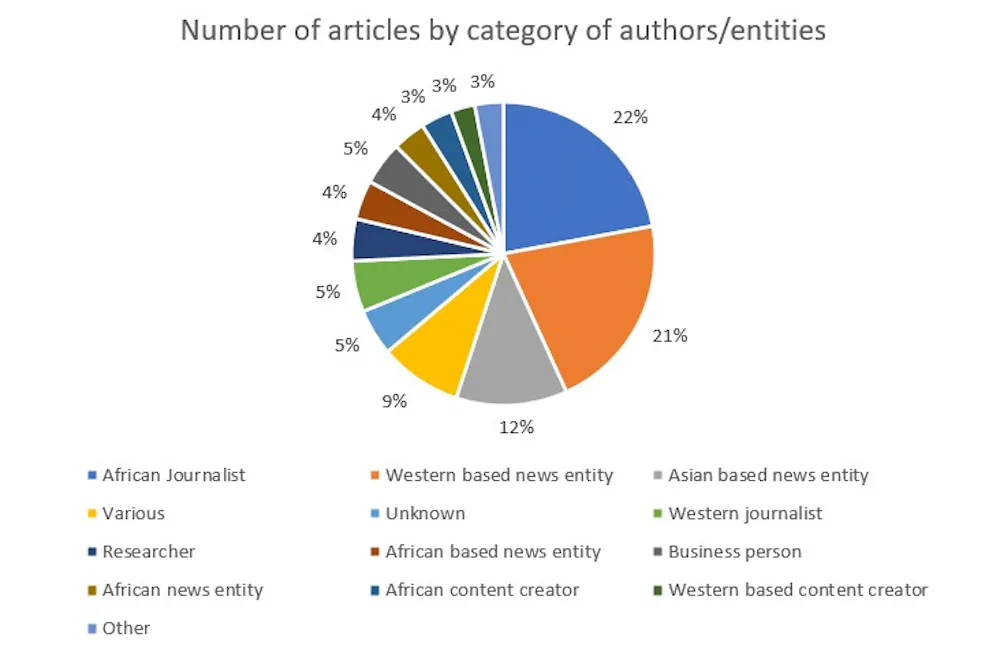
African journalists, news entities and content creators contributed some 29% of the articles. But western-based news entities (21%) and journalists (5%) had a considerable influence. Global news agencies like AFP (15%) and Reuters (6%), along with tech news providers like Research Snipers (13%), frequently wrote these pieces.

Only a small proportion of articles (4%) were written by researchers. This suggests that the voices of those directly engaged in AI research and development in Africa were muted. But they are crucial for a locally informed understanding.

To sum up the patterns:

  • practical benefits of AI are emphasised at the expense of social and ethical conversations

  • African perspectives on how AI should be developed and used are often overlooked in favour of a western, business-focused viewpoint.

Supplied

What words are used to describe AI?

We also analysed the words used most frequently. The frequent mention of Google, Microsoft and ChatGPT reflects the dominance of western tech giants in the AI landscape. Words like “he” and “his” appeared disturbingly frequently, while feminine pronouns weren’t among the top words. This indicates a bias towards male perspectives.

The scarcity of terms like Africa, African and African countries suggests that the coverage seldom regards specific African needs and challenges. This overlooks Africa’s growing AI ecosystem.

Supplied

We found three main themes around AI in African news:

  • AI’s transformative potential, for example for agriculture, administration, healthcare and economic growth

  • concerns about AI’s potential negative effects, the unknown and disruptive nature of AI

  • articles that offered a more balanced view and useful information, aiming to demystify AI tools and explain developments.

What this means for Africa

The dominance of technical and economic framing, often by western voices, might steer policy decisions towards uptake without adequate local consultation or ethical oversight. This might lead to policies that mirror global hype rather than community-specific needs.

The overemphasis on “tools” and “solutions” risks overlooking the broader effects of AI on employment, inequality and cultural values.

The lack of Afrocentric terms in the reporting contributes to a symbolic exclusion, where Africa’s specific needs and opportunities are marginalised.

Towards a more inclusive AI narrative

To encourage a more responsible and locally relevant AI journalism in Africa, African journalists and researchers should be empowered to report on and analyse this technology.

The range of voices should expand to include local researchers, policymakers and communities experiencing AI’s effects firsthand. This means balancing coverage of AI’s economic potential with sustained attention to its social, cultural and ethical implications. African media can resist one-dimensional hype and create a more inclusive and socially responsible conversation around AI.

– Hype and western values are shaping AI reporting in Africa: what needs to change
– https://theconversation.com/hype-and-western-values-are-shaping-ai-reporting-in-africa-what-needs-to-change-262551