The Chairperson of the African Union Commission, H.E. Mahmoud Ali Youssouf, has welcomed the overwhelming passage by the United States House of Representatives of a three-year extension of the African Growth and Opportunity Act (AGOA).
The Chairperson commends the bipartisan support demonstrated by Members of the U.S. House, reflecting the enduring commitment of the United States to strengthening trade, investment, and shared prosperity with African economies. “For over two decades, AGOA has served as a cornerstone of U.S.–Africa economic relations, supporting industrialisation, job creation, regional value chains, and inclusive growth across the continent,” said Mr. Youssouf.
He added that AGOA has been instrumental in fostering mutually beneficial economic ties and reinforcing Africa’s role as a reliable partner in global commerce.
As the bill proceeds to the United States Senate, the Chairperson appealed to the Senate to give favourable and timely consideration to the extension, in a spirit that upholds partnership, and shared strategic interests.
The African Union Commission reaffirms its commitment to working closely with the Government of the United States, Congress, and all stakeholders to ensure that AGOA continues to serve as a bridge for economic cooperation and a symbol of the enduring friendship between Africa and the American people.
Distributed by APO Group on behalf of African Union (AU).
The State of Qatar participated in the Fifth Consultative Meeting on Enhancing Coordination of Peace Initiatives and Efforts for Sudan, which took place in the Arab Republic of Egypt.
HE Director of the Arab Affairs Department at the Ministry of Foreign Affairs Nayef bin Abdullah Al Emadi represented the State of Qatar at the meeting.
This meeting comes as part of efforts to support pathways towards a peaceful solution in the Republic of Sudan and to strengthen coordination among concerned parties in a manner that contributes to achieving security and stability.
Distributed by APO Group on behalf of Ministry of Foreign Affairs of The State of Qatar.
Colonel Aliou Tine, the newly appointed force commander of the Economic Community of west African states (ECOWAS) Mission in the Gambia (ECOMIG), has pledged his commitment to refional security and supporting peaceful elections in close collaboration with Gmbian authorities and armed forces.
He made this pledge at a handing-and-taking-over ceremony at the ECOMIG Headquarters in Bakau on Thursday 8 January 2026, marking the official transfer of command from the outgoing Force Commander, Colonel Ndiagne Diouf.
The solemn ceremony was highlighted by the symbolic exchange of the ECOMIG command flag, signifying the transfer of authority and responsibility between the two senior officers. The event brought together high-level dignitaries, including the Senegalese High Commissioner to The Gambia, the National Security Adviser, representatives of the Chief of Defence Staff, senior officers of the Gambia Armed Forces, contingent commanders, as well as officers and men of ECOMIG.
In his acceptance remarks, Colonel Aliou Tine described his appointment as a great honour bestowed by ECOWAS and the Government of The Gambia.
He commended Colonel Diouf and his team for their achievements and pledged to preserve and build upon the legacy they have established. He also acknowledged the strategic importance of the forthcoming electoral period, reaffirming his commitment to supporting peaceful elections in close collaboration with Gambian authorities and armed forces.
In her remarks, Miata Lily French, ECOWAS Head of Mision, expressed gratitude to Colonel Diouf for his dedicated service to The Gambia and the sub-region. She noted that at a time when security challenges are increasing globally and regionally, ECOMIG’s role remains vital in ensuring stability and creating an environment conducive for economic growth.
Madam French reiterated that since its deployment in 2017, ECOMIG has played a central role in maintaining peace and supporting democratic governance in The Gambia. Colonel Tine was assured of full support from mission headquarters and contingent commanders to ensure a successful completion of the ECOMIG mandate.
The outgoing Force Commander Colonel Ndiagne Diouf reflected on his one-year tenure, expressing deep appreciation to the Government and people of The Gambia, ECOWAS authorities, and mission leadership for their unwavering support.
He highlighted key achievements of his command, including medical assistance to over 8,000 people, the conduct of more than 100 security missions, and over 40 joint patrols with Gambian security forces.
Distributed by APO Group on behalf of Economic Community of West African States (ECOWAS).
HH the Amir Sheikh Tamim bin Hamad Al-Thani received a written message from HE President of the Republic of Guinea Mamady Doumbouya, pertaining to enhancing bilateral relations and ways to support and develop them.
HE Minister of State at the Ministry of Foreign Affairs Dr. Mohammed bin Abdulaziz Al Khulaifi received the message during his meeting on Wednesday with HE Ambassador of the Republic of Guinea to Qatar Thierno Abdoulaye Sow.
Distributed by APO Group on behalf of Ministry of Foreign Affairs of The State of Qatar.
HH the Amir Sheikh Tamim bin Hamad Al-Thani received a written message from HE President of the Republic of Guinea Mamady Doumbouya, pertaining to enhancing bilateral relations and ways to support and develop them.
HE Minister of State at the Ministry of Foreign Affairs Dr. Mohammed bin Abdulaziz Al Khulaifi received the message during his meeting on Wednesday with HE Ambassador of the Republic of Guinea to Qatar Thierno Abdoulaye Sow.
The State of Qatar expresses its strong condemnation and denunciation of the attack that targeted a police vehicle in northwestern Pakistan, resulting in the deaths and injuries of several people.
The Ministry of Foreign Affairs reiterates the State of Qatar’s firm stance rejecting all forms of violence and terrorism, regardless of motives or causes.
The Ministry also extends the State of Qatar’s sincere condolences to the families of the victims, as well as to the government and people of Pakistan, wishing the injured a speedy recovery.
International energy companies SLB, NESR, and Delta United Group have signed on as Gold Sponsors of the Libya Energy & Economic Summit (LEES) 2026, underscoring growing private-sector confidence in Libya’s drive to expand production, modernize infrastructure and attract global investment. Taking place on January 24-26, the Summit will convene policymakers, operators and investors to align on strategy, forge partnerships and advance actionable energy projects across the country.
SLB, a global leader in energy technology and well services, brings decades of experience in drilling, completions, reservoir engineering and digital oilfield solutions. Its portfolio of advanced technologies – including next-generation wellbore optimization, real-time monitoring and enhanced recovery solutions – is aligned with Libya’s production ambitions and efforts to modernize infrastructure. SLB’s presence at LEES 2026 underscores the importance of innovation and operational excellence in achieving near- and long-term energy targets, and recently signed agreements with Libya’s National Oil Corporation to advance community development projects.
NESR, a global integrated energy services provider, brings a comprehensive suite of upstream, midstream and downstream capabilities to Libya. With expertise spanning well services, engineering, fabrication and project management, NESR has been at the forefront of delivering turnkey solutions across the MENA region. In August 2025, the company secured multiple production services contracts in Libya and Algeria with a combined value exceeding $100 million. Its participation at LEES 2026 highlights its commitment to supporting Libya’s production optimization efforts, particularly across brownfield redevelopment, marginal field development and large-scale upstream projects.
Delta United Group leverages a strong portfolio in energy infrastructure, logistics and project execution, offering solutions across the full oil and gas value chain. In Libya – where the company maintains a presence across approximately 90% of the oil market – Delta United Group’s experience in complex field operations, modular facilities and technical services positions it as a strategic partner for operators and investors seeking to accelerate production growth and enhance operational reliability. Its sponsorship reflects a commitment to aligning technical expertise with Libya’s national energy priorities.
LEES 2026 provides a high-level platform connecting policymakers, operators, investors and service providers, facilitating dialogue that translates strategy into execution. The sponsorship of SLB, NESR and Delta United Group reflects a shared recognition that Libya’s energy resurgence will be driven not only by resource potential, but by technology, expertise and strong industry partnerships.
Join industry leaders at the Libya Energy & Economic Summit 2026 in Tripoli and explore investment opportunities in one of North Africa’s most dynamic energy markets. LEES 2026 offers a premier platform for partnerships, innovation and sector growth. Visit www.LibyaSummit.com to secure your participation. To sponsor or participate as a delegate, please contact sales@energycapitalpower.com.
Gambian President Adama Barrow has appointed Cany Jobe as the new Director General of The Gambia Petroleum Commission, marking a significant milestone in the country’s efforts to advance its oil and gas sector. The appointment comes as The Gambia accelerates regulatory reform and acreage promotion to position itself as one of West Africa’s most attractive frontier exploration destinations.
Representing the voice of the African energy sector, the African Energy Chamber (AEC) welcomes the appointment of Cany Jobe as Director General, recognizing it as a vital step toward transforming The Gambia’s global investment profile. The Chamber believes Jobe will serve as the chief promoter of the country’s oil and gas sector, tasked with attracting international investment and positioning The Gambia as a world-class destination for upstream capital.
Jobe joins the Petroleum Commission with close to 18 years of international experience across the oil and gas value chain. She holds a Masters in Engineering from the University of Western Australia and a Masters in International Project Management from Glasgow Caledonian University. Prior to her appointment, she served as Director of Exploration & Production at the Gambia National Petroleum Corporation, where she was instrumental in upstream strategy development, data management and engagement with prospective investors. She has also held positions with regional and international institutions across Asia, Australia, West Africa and America, including roles with China Petroleum Corporation, Venezuela’s PDVSA and ECOWAS Commission as a national consultant. Now, with Jobe at the helm of the Petroleum Commission, The Gambia is signaling its readiness to compete for global exploration capital and take its place among West Africa’s next generation of oil and gas producers.
Her appointment comes at a pivotal moment in The Gambia’s energy development. Situated in the heart of the MSGBC basin, the country has a unique set of competitive advantages that make it a highly-attractive destination for frontier exploration and investment. These include attractive acreage, growing data coverage, strong geology as well as improving regulation. Despite these advantages, the country has yet to make a commercial oil discovery. The Gambia’s challenges with advancing exploration and development have had little to do with resources and more to do with investment. But recent moves promise to turn this trend around.
“Cany Jobe has taken on the big issues when it comes to The Gambia and Africa’s right to produce its oil and gas,” says NJ Ayuk, Executive Chairman, AEC, adding that she has stood up for her country and worked hard globally to advance the oil and gas industry believes in.
“I am confident she is going to work with the industry to attract investors to the country but also create an enabling environment for investors. I urge the international oil industry to support this strong ally by investing big in the country’s oil and gas industry,” he notes.
Under efforts to unlock the potential of its offshore acreage, The Gambia is actively opening its upstream sector to global exploration companies. The country currently has more than eight offshore blocks and two onshore blocks available for investment, positioning it as one of the most accessible frontier markets in West Africa. Approximately 80% of offshore seismic and geological data has already been acquired, significantly reducing exploration risk and enabling faster decision-making for operators considering entry into the market.
The Gambia’s investment proposition is further strengthened by its strategic location within the MSGBC Basin, one of the world’s most promising offshore hydrocarbon provinces. The basin has delivered world-class discoveries in neighboring countries, including Senegal’s Sangomar oilfield and the cross-border Greater Tortue Ahmeyim development shared by Senegal and Mauritania. Geological similarities across the basin underscore the potential for comparable discoveries in Gambian waters.
Beyond geology, regulatory reform is emerging as a key pillar of The Gambia’s upstream strategy. The government is in the process of finalizing a new Petroleum Exploration, Development & Production Bill aimed at enhancing transparency, efficiency and investor confidence. The legislation is expected to complement broader reforms to upstream regulations, aligning the country’s legal framework with international best practices and improving the overall operating environment for foreign investors. Against this backdrop, Jobe’s appointment becomes increasingly strategic, providing the experienced leadership required to translate The Gambia’s geological potential, growing data coverage and regulatory reforms into concrete exploration commitments and sustained upstream investment.
“Cany Jobe brings the right mix of technical expertise, international experience and strategic vision to position The Gambia as a competitive upstream destination. Her leadership will be instrumental in promoting the country’s acreage, engaging investors and ensuring that The Gambia fully capitalizes on its location in the MSGBC basin. This appointment demonstrates the government’s seriousness about attracting investment and building a world-class petroleum sector,” Ayuk states.
Source: The Conversation – Africa – By Niguss Gitaw Baraki, Postdoctoral scientist, George Washington University
Our prehistoric human ancestors relied on deliberately modified and sharpened stone tools as early as 3.3 million years ago. The selection of rock type depended on how easily the material could be flaked to the desired shape and form.
The resulting product proved invaluable for everyday tasks. Sharp-edged rock fragments were manufactured to suit various needs, including hunting and food processing.
The Stone Age period lasted from about 3.3 million years ago until the emergence of metalworking technologies. Throughout this time, diverse tool-making traditions flourished. Among them is the Oldowan tradition, one of the earliest technological systems created by our early ancestors. The tools are not shaped to have “fancy looks”. Still, they represent a huge step in human evolution. They show that our ancestors had begun modifying nature intentionally, creating tools with a purpose rather than just relying on naturally sharp stones.
Evidence from Homa Peninsula on the Kenyan side of Lake Victoria and Koobi Fora, Kenya’s Lake Turkana, places the origins of the Oldowan between 2.6 million and 2.9 million years ago at these sites. For nearly a million years, this technology stayed within Africa, becoming a key part of how early humans survived.
Over time, the knowledge of how to produce and use stone tools spread. By about 2 million years ago, Oldowan toolmaking had spread across north Africa and southern Africa. It eventually extended into Europe and Asia as our ancestors expanded their geographic range.
Oldowan technology timeline.Author supplied, Author provided (no reuse)
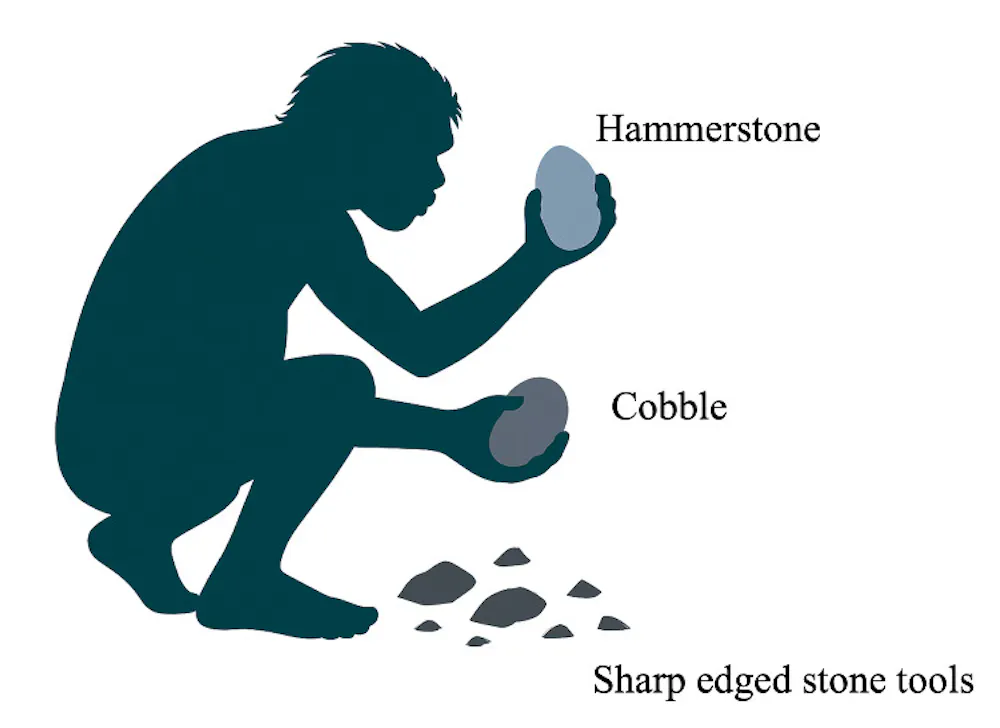
Although these tools appear basic, their manufacture required skill, planning, and a thorough understanding of stone fracture mechanics. Hominins made sharp flakes by striking rocks against other rocks to break them. The resulting sharp edges could then be used for butchering animals, processing plants, and breaking bones for marrow.
An illustration of early human ancestors making tools from natural rocks.source, Author provided (no reuse)
Until recently, the oldest known evidence of tool use found on the eastern shore of Lake Turkana, in Kenya, was dated to around 2 million years ago. The region is one of the world’s richest areas for early human fossils and archaeological remains, yet it lacked a secure, long-term sequence of early Oldowan occupation.
That picture has now changed dramatically.
We are researchers who study ancient life and landscapes, and we have now documented some of the oldest evidence yet of Oldowan tools. They are 2.75 million years old and come from East Turkana, at a site called Namorotukunan in Kenya. They are nearly 700,000 years older than other Oldowan sites from this part of Lake Turkana (and older than Oldowan tools from the Afar, Ethiopia, by about 150,000 years).
Namorotukunan: 300,000 Years of Innovation and Survival in Kenya.
At this site, there were three distinct archaeological horizons (layers of sediment that record separate events of tool making activities), spanning 300,000 years. But throughout this long period, during which the climate and landscape changed, our hominin ancestors continued to make and use the same kind of tools. Our findings tell us something about their ability to make choices that enabled them to adapt, survive and evolve.
A landscape in constant transition
Today, the Turkana Basin experiences hot, arid to semi-arid conditions with daily average temperature of around 35°C. The vegetation cover is heterogeneous and includes bushland, shrubland and sparse grasslands with distribution influenced by seasonal drainage systems and groundwater.
Namorotukunan hill, Marsabit District, Kenya. The site is named after this hill. This is an important place for the local community.source, Author provided (no reuse)
Between 3 million and 2 million years ago, the region experienced major landscape transformations due to strong climatic fluctuations. Evidence from Namorotukunan shows that it shifted from a lakeshore setting to a dry semidesert, then to open savannah, and eventually became submerged again as the lake expanded. Along its banks, early human ancestors gathered stones, striking them with precision to make stone fragments, sharp enough to use as implements that allowed them to access different types of foods.
Before approximately 2.8 million years ago, the Turkana Basin had lush floodplains with abundant standing water, palm trees, and wetland vegetation. Approximately 2.75 million years ago, the region began to dry out as grasslands expanded and subsequently replaced forests. Despite this increasing aridity, early toolmakers remained in the landscape. Our ancestors took advantage of river gravels that provided good-quality stone (especially chalcedony) for manufacturing sharp-edged stone tools.
By approximately 2.58 million years ago, the climate had become even drier and more variable. Nevertheless, early humans continued to produce the same style of tools, demonstrating technological persistence despite fluctuating environmental conditions.
At about 2.44 million years ago, semi-arid conditions persisted, followed by flooding of the lake, eventually submerging the region again. However, as landscapes changed once again, toolmakers continued to return to this same region, producing Oldowan tools that remained unchanged in form.
This persistence suggests that these early humans had developed a successful survival strategy that worked across a wide range of ecological settings.
Selecting and using the best rocks
The stone tools at Namorotukunan were not made from just any rock. Nearby outcrops offered a variety of raw materials, but early humans selected the most suitable types of rock for their needs. They chose high-quality stones that break easily to produce sharper edges.
This kind of selectivity suggests an understanding of how different rocks behaved during breakage and reflects the cognitive capabilities of the early humans who made and used these stone tools.
Understanding the functional importance of these stone tools from this site is crucial to evaluating their evolutionary significance.
One clue comes from a fossilised animal bone found at the site, bearing cut marks made by sharp-edged stone tools. These marks reveal that the toolmakers were cutting animal tissues and likely accessing meat or marrow from animal carcasses. Such evidence supports previous studies that early humans were beginning to rely more heavily on meat and marrow, a dietary shift that played a major role in human evolution. Eating meat may have provided critical calories and nutrients that fuelled the growth of larger brains. The tools might also have been used to dig for underground plant parts or process other foods.
This suggests that early hominins were experimenting with various ways of surviving in the ever-changing environment around them.
Adapting to instability
The technological continuity at the site shows that Oldowan toolmaking was more than a simple craft. It was a dependable survival strategy, one that likely became essential during dry periods, when plant foods were scarce and it was vital to eat meat and marrow.
The ability of the early toolmakers to select high-quality stone, produce sharp flakes, and return to familiar raw-material sources suggests a deep understanding of their landscapes. It allowed early hominins to survive ecological uncertainty over hundreds of generations.
This research would not have been possible without the continued support of the Daasanach community of Ileret, who welcome researchers onto their land each year, and the National Museums of Kenya, whose leadership and collaboration underpin archaeological and geological work across the Turkana Basin.
– Early humans relied on simple stone tools for 300,000 years in a changing east African landscape – https://theconversation.com/early-humans-relied-on-simple-stone-tools-for-300-000-years-in-a-changing-east-african-landscape-271433
Source: The Conversation – Africa – By Temitayo Isaac Odeyemi, Research fellow, International Development Department, University of Birmingham
Nigeria has built an impressive legal framework for disability rights. The challenge now is turning these commitments into consistent, lived realities for voters with disabilities. With elections in 2027, the country has an opportunity to show others what full electoral inclusion looks like.
Across Africa, citizens with disabilities continue to face barriers to voting, from high staircases and narrow doorways to uninformed officials and ballot papers they cannot read. Yet democratic participation is not a privilege. It is a right guaranteed under Article 29 of the UN Convention on the Rights of Persons with Disabilities.
Our research examined the experiences of people with disabilities during the 2019 elections. We found that challenges of braille ballot papers, transport restrictions and stigmatisation adversely affected their voting participation.
Since that election the government has enacted the Electoral Act 2022. This establishes some of the continent’s strongest guarantees for equal political participation.
Our follow-up research, which examined Nigeria’s 2023 elections, shows that new legal and institutional frameworks improved disability accessibility and participation. Gaps in implementation, staff training and polling-unit accessibility persist, however. The study outlines some ways to fill those gaps.
Put together, our research shows that Nigeria’s problem is not the absence of policy but the gap between commitment and execution. Laws must be translated into daily practice.
With credible data, structured training and genuine collaboration between the Independent National Electoral Commission and key actors, Nigeria can transform the 2027 elections for disabled people.
This article offers recommendations for enhanced inclusion of disabled people and for closing the disability gap in future elections.
Field interviews and focus-group discussions confirmed that assistive devices reached more polling units and that voters with disabilities were often given priority in queues.
Our follow-up research on the 2023 elections shows further improvement. The electoral commission’s engagement with disability groups became more systematic, priority voting was more consistently applied, and assistive tools were distributed more widely than in 2019. These changes helped more disabled voters participate.
Yet inclusion remains uneven. Our research shows that many polling units in both the 2019 and 2023 elections were inaccessible to wheelchair users. Some officials did not understand how to deploy assistive tools. Blind voters frequently reported receiving braille guides without prior orientation. And, most critically, the commission still does not maintain a reliable database of where voters with disabilities live. So materials are mis-allocated, and needs go unmet.
How other African democracies compare
Nigeria’s experience mirrors a broader continental challenge.
South Africa has gone furthest in implementing inclusive voting. The Independent Electoral Commission uses a universal ballot template that enables blind and low-vision voters to cast a secret ballot. It also allows advance voting for people with mobility impairments.
But challenges were still evident. These included getting information, staff training, physical access to polling stations, privacy, and availability of the ballot template.
Ghana follows closely. The Electoral Commission and partners such as Sightsavers and the Ghana Federation of Disability Organisations have institutionalised the Tactile Ballot Jacket, which embeds accessible voting into routine electoral administration rather than treating it as an ad-hoc arrangement.
They have also trained thousands of visually impaired voters and polling officials. Observation reports from the 2020 and 2024 elections found most centres accessible and procedures orderly.
Limitations were also reported, from polling station access to voter education and training of election officials.
Kenya has strong constitutional and legal frameworks but inconsistent delivery. Accessibility remains concentrated in urban areas, and data relating to disability is scarce.
Compared with these countries, Nigeria ranks high on legal ambition but low on operational consistency. The lesson from South Africa and Ghana is clear: sustained training, accurate data management, and collaboration with disability organisations are what works.
Bridging Nigeria’s inclusion gap before 2027
Nigeria should make six key reforms:
Map and publish disability data
Audit accessibility well before election day
Train every official
Standardise assistive tools and make them available in all states
Include people with disabilities as polling officials, party agents and accredited observers to normalise participation
Expand accessibility across the entire electoral cycle, from campaign materials and party manifestoes to voting and post-election information.
These measures are feasible within Nigeria’s existing electoral structure, and the ongoing overhaul of the Electoral Act offers a timely opportunity to strengthen alignment.
Changing attitudes: from charity to citizenship
Our research further showed that many Nigerians still interpret assistance to voters with disabilities as an act of kindness rather than a constitutional obligation.
Some polling officials described priority voting as a gesture of sympathy. Such attitudes reinforce the outdated charity model of disability and undercut the human-rights model embedded in Nigeria’s laws.
True inclusion means recognising persons with disabilities as equal citizens whose participation strengthens democracy itself. When accessible ballots, ramps and trained staff are in place, the message is powerful: every citizen counts.
Dr Afeez Kolawole Shittu, Political Science lecturer at the Federal College of Education (Special), Oyo, Nigeria is co-author of research underpinning this article and the article.
– Nigeria’s 2027 election can set a model for disability inclusion. Here’s how – https://theconversation.com/nigerias-2027-election-can-set-a-model-for-disability-inclusion-heres-how-270661