HE Minister of State at the Ministry of Foreign Affairs Dr. Mohammed bin Abdulaziz bin Saleh Al Khulaifi met on Tuesday with HE Secretary-General of the Commonwealth, Shirley Ayorko Botchwey, who is visiting the country. During the meeting, the two sides discussed avenues of cooperation between the State of Qatar and the Commonwealth and ways to enhance them, particularly in the fields of diplomacy and peacebuilding. They also exchanged views on a number of regional and international issues. The meeting was attended by Director-General of the Qatar Fund for Development (QFFD) Fahad bin Hamad Al Sulaiti.
Source: The Conversation – Africa – By Ernest Harsch, Researcher, Institute of African Studies, Columbia University
Mali, Burkina Faso, Niger, Guinea and Gabon have all suffered regime change in the last five years, led by men in military uniform.
Madagascar and Guinea-Bissau experienced the same fate in 2025. Benin looked to join the list in early December, but the civilian government held onto power – just.
The academic literature on coups in Africa has highlighted a wide range of influences and triggers. These include:
personal and institutional rifts within the armed forces
susceptibility to both elite manipulation and popular pressure
instigation by foreign powers against governments deemed hostile to their interests.
In a recent paper I added a further question: to what extent were democratic failings an element in the coups of the past six years?
In the paper I explored underlying shortcomings of Africa’s democracies as one major factor leading to military seizures. I focused on the recent coups in Mali, Guinea, Burkina Faso, Niger and Gabon.
I selected those cases because each of their takeovers was mounted against an elected civilian government. In some instances, I found, factors other than poor elections were also at play. The juntas in both Burkina Faso and Niger cited political defects of their elected, if somewhat ineffective, governments. But they mainly blamed their predecessors’ failure to put down growing jihadist insurgencies.
Insecurity was also a factor in Mali. But Mali, Guinea and Gabon all had elections commonly perceived to have been rigged or in violation of constitutional term limits. They provoked popular opposition which prompted officers to step in.
My main finding was thus that popular disappointment in elected governments was a prominent element. It established a more favourable context enabling officers to seize power with a measure of popular support.
That finding suggests that in order to better protect democracy in Africa, it is not sufficient to simply condemn military coups (as Africa’s regional institutions, such as the African Union and Economic Community of West African States, are quick to do). African activists, and some policymakers, have urged a step further: denouncing elected leaders who violate democratic rights or rig their systems to hang onto power.
If elected leaders were better held to account, then potential coup makers would lose one of their central justifications.
Problems are bigger than rigged polls
The problems, however, go beyond rigged polls, errant elected leaders, and violated constitutions. Many African governments, whether they are democratic or not, have great difficulty meeting citizens’ expectations, especially for improvements in their daily lives.
The deeper structural weaknesses of African states further contribute to hampering effective governance. As Ugandan anthropologist Mahmood Mamdani, Kenyan political scholar Ken Ochieng’ Opalo, and other African scholars have pointed out, those shortcomings include the externally oriented and fragmentary nature of the states inherited from colonial rule. These exclude many citizens from active political engagement and ensure government by unaccountable elites.
In particular, a neoliberal model of democracy has been widely adopted in Africa since the 1990s. That model insists that democracy be tethered to pro-market economic policies and greatly limit the size and activities of African states. That in turn hinders the ability of even well-elected governments to provide their citizens with security and services.
Conducting elections while continuing to subject African economies to the economic policy direction of the International Monetary Fund and World Bank has left them with a “choiceless democracy,” as Malawian economist Thandika Mkandawire termed it. That is, while voters may sometimes be able to change top leaders, they cannot alter basic economic policies. Such policies generally favour austerity and cutbacks over delivering jobs, education and healthcare.
So in addition to improving the quality of democratic systems on the continent, “coup proofing” African states will also require giving greater scope to popular input into real decision making, in both the political and economic spheres.
That will depend primarily on Africans themselves fighting for the democracies they want. Clearing the way for them means ending the all-too-common repression of street mobilisations and alternative views that displease the ruling elites.
Support for democracy
There may be general unhappiness with the flaws of Africa’s electoral systems. Surveys nevertheless demonstrate continued strong support for the ideals of democracy. Many ordinary Africans, moreover, are mobilising in various ways to advance their own conceptions of democratic practice.
For example, when the Macky Sall government in Senegal used repression and unconstitutional manoeuvres to try to prolong his tenure, tens of thousands mobilised in the streets in 2023-24 to block him and force an election that brought radical young oppositionists to power.
In Sudan, the community resistance committees that mobilised massively against the country’s military elites outlined an alternative vision of a people’s democracy encompassing national elections, decentralised local assemblies, and participatory citizen engagement.
Findings by the Afrobarometer research network, which has repeatedly polled tens of thousands of African citizens, provide solid grounds for hope. Surveys in 39 countries between 2021 and 2023 show that 66% of respondents still strongly preferred democracy to any alternative form of government.
For anyone committed to a democratic future for Africa, that is something to build on.
– Coups in Africa: how democratic failings help shape military takeovers – study – https://theconversation.com/coups-in-africa-how-democratic-failings-help-shape-military-takeovers-study-271565
Source: The Conversation – Africa – By Martin Mourre, Historien et anthropologue spécialisé dans les armées coloniales et postcoloniales en Afrique de l’Ouest, École des Hautes Études en Sciences Sociales (EHESS)
The Thiaroye camp near Dakar was a Senegalese army barracks housing African soldiers called “tirailleurs sénégalais” (Senegalese riflemen). It welcomed men returning from the European front of the second world war, where the riflemen had been held as German prisoners of war while serving on the side of France. They were waiting for their long-overdue back pay and bonuses.
But at dawn on 1 December 1944, they were shot by their own French officers. What should have been a time of celebration became a bloodbath. France sought to downplay or deny the massacre for many years.
In 2024, ahead of the 80th anniversary commemorations of the massacre, Senegal’s Prime Minister Ousmane Sonko appointed a commission to establish the truth of what happened, to ensure proper recognition and reparations for the victims, and to assert Senegal’s sovereignty to write its own history.
Chaired by Professor Mamadou Diouf of Columbia University, one of its tasks was to draft a new report (a white paper) on Thiaroye. This was presented to President Bassirou Diomaye Faye on 17 October 2025.
Martin Mourre, a historian and anthropologist specialising in colonial armies, has studied this issue and explains what the new report brings to light and why Thiaroye remains so sensitive.
What happened at Thiaroye?
On 21 November 1944, the first group of former prisoners of war arrived at the Thiaroye camp to be demobilised. They were owed substantial sums, mainly the back pay accumulated during their captivity.
The French army refused to give them what they were owed, even though the funds were reportedly available in Dakar.
On 27 November, tensions escalated, prompting the intervention of a senior officer. He planned a repression operation that, on 1 December, turned into a massacre.
Even though a number of questions remain unanswered, the event is fairly well documented. The main debate revived by the new report and echoed in the media focuses on two issues: the death toll and the burial site of the victims.
Regarding the death toll, one may rely on a literal reading of the archives, which consistently report 35 deaths (or 70 in one officer’s report, phrased in a particularly obscure way).
On this point, the white paper does not appear to go further than previous research, which supports a higher estimate of 300 to 400 deaths.
How has France responded to the Thiaroye issue over the years?
France actively sought to erase the events at Thiaroye. In the weeks following the tragedy, French officials declared, according to archival records, that adequate measures must be taken to hide these hours of madness. The language reveals a deliberate effort to downplay and conceal the atrocity.
This continued long after independence in 1960. One of the most infamous examples is the censorship of the acclaimed film The Camp at Thiaroye by Senegalese filmmakers Ousmane Sembène and Thierno Faty Sow, which failed to find distributors in France when it was released.
However, things began to change in the 2000s, particularly when President Abdoulaye Wade organised official commemorations of the massacre. For the first time, a special French ambassador attending the commemoration acknowledged the colonial army’s responsibility for the tragedy.
A more prominent gesture came in 2014 when President François Hollande visited the military cemetery. He delivered a speech and handed over a batch of archives to Senegalese President Macky Sall. He claimed – falsely, as it later turned out – that these represented all the documents France possessed on the massacre.
These archives were not available for analysis in Senegal until an executive order was issued by President Bassirou Diomaye Faye in 2024. The reason for the decade-long blockade was never adequately explained.
In 2024, President Emmanuel Macron went further than his predecessor by officially recognising events at Thiaroye as “a massacre”. A word his predecessor had avoided. Macron made this statement in a letter to Faye.
What new information does the report provide?
The main new element presented in the white paper is the initial outcome of archaeological excavations of the burial site, carried out by a team from Dakar’s Cheikh Anta Diop University. They have so far uncovered the remains of seven individuals.
All indications are that these men were victims of the massacre. Investigators highlighted the rushed and irregular nature of the graves and the burials, with bodies still dressed in military uniforms.
Senegalese Tirailleurs, 1940.RaBoe/Wikimedia Commons, CC BY-SA
French administrative records had offered no answers about where or how the victims were laid to rest. This left the question of potential mass graves unresolved and shrouded in uncertainty.
These new findings from the report verify that victims were buried at this site. They also challenge official French narratives. The investigation continues. The archaeological team plans to expand their search, believing that more remains may lie hidden across the site.
What momentum led to the search at the grave site?
The issue of excavations of this site has a longer history. In 2017, several pan-African organisations urged Senegalese authorities to carry out such searches at Thiaroye. Among them was the party of Ousmane Sonko, today prime minister of Senegal but then a member of parliament.
Ten years earlier, during the construction of a highway crossing part of the military camp, historian Cheikh Faty Faye had already raised the issue publicly. Faye, who died in 2021, had worked on Thiaroye since the 1970s. He was part of a tradition of activist-scholars connected to pan-Africanist movements.
Through decades of commemoration and organising, these groups transformed the cemetery into a site of collective memory.
The cemetery holds 202 graves, roughly 30 of which stand apart from the others. To my knowledge, no scientific work has traced its origins, but it likely dates back to the first world war, when the Thiaroye camp was built.
It’s located about 1km from the camp’s main entrance. It served as the burial ground for west African riflemen from Senegal and numerous other French colonial territories who died during training. Their remains were never repatriated.
If future research confirms that the recently discovered bodies belong to the men killed on 1 December, it would be an important step towards clarifying the death toll.
What else is important in this report?
While the white paper dedicates considerable attention to the death toll, it also signals an interest in recovering the individual life stories of the Thiaroye riflemen.
Yet in my view, a crucial question remains unaddressed: the distinctly colonial character of the violence itself.
This is a form of violence inherent to the colonial context, marked by racialisation, a sense of impunity, and the distance between the colony and mainland France.
The challenge today is no longer just to document what happened at Thiaroye. It is ensure that this history is passed on to future generations. Integrating it into school curricula – anchored in rigorous scholarly work – shows how understanding the past illuminates the present and helps build a collective memory on solid foundations.
– Thiaroye massacre: report on the French killing of Senegalese troops in 1944 exposes a painful history – https://theconversation.com/thiaroye-massacre-report-on-the-french-killing-of-senegalese-troops-in-1944-exposes-a-painful-history-271035
Source: The Conversation – Africa – By Kerstin Bree Carlson, Associate Professor International Law, Roskilde University
The Democratic Republic of Congo (DRC) has been called “the worst place on earth to be a woman” and “the rape capital of the world”. A 2014 survey estimated that 22% of women and 10% of men had experienced sexual violence during the conflict in the country’s east. After years of impunity, Roger Lumbala, a 67-year-old former member of parliament who once led a rebel group in eastern DRC, is facing trial for these crimes. He is charged in a French court with complicity in crimes against humanity, including summary executions, torture, rape, pillage and enslavement. Kerstin Bree Carlson, a scholar of international criminal law and transitional justice, explains the significance of this trial and the controversies it has sparked.
What is the special war crimes chamber in Paris? And what is ‘universal jurisdiction’?
Lumbala is being tried before a special war crimes tribunal in Paris because France exercises “universal jurisdiction” over international atrocity crimes like genocide, crimes against humanity and war crimes. These are the crimes that are the remit of the International Criminal Court (ICC). Because the ICC is designed to be a court of last resort, hearing international atrocity crimes only when states cannot or will not, all ICC member states must criminalise international atrocity crimes in their domestic criminal codes.
Although courts usually only try cases against their own citizens or which occur on their own territory, France’s “universal jurisdiction” law allows it to hear cases regarding atrocity crimes committed outside France by non-French nationals. The law restricts the application of universal jurisdiction to individuals residing in France who are citizens of countries that are ICC members. Prosecutors in France’s special war crimes unit (“OCLCH”) furthermore enjoy discretion over which cases they pursue.
Prosecutions unfold as they do for any criminal case in France: a claim made by the prosecutor is sent to an investigative judge. The judge examines the claim neutrally, weighing evidence of guilt and innocence, to determine whether to issue an indictment. These findings can be appealed. When the appeals are finalised, if the indictment stands, the indicted individuals are put on trial before a panel of judges and a jury who will determine guilt (and an eventual sentence).
In addition to prosecution and defence, victims can participate in the proceedings as “civil parties”. Civil parties are full participants; they may call witnesses, address the court through argumentation, and question witnesses brought by prosecution and defence.
Lumbala’s path to the Paris court
Lumbala’s trial opened on 12 November 2025. The indictment alleges that Lumbala conspired to and was complicit in the commission of crimes against humanity in relation to Operation “Effacer le tableau” (Wipe the Slate Clean). This was a military campaign that terrorised eastern Congo in 2002-3.
Lumbala has resided in France on and off since 2013. It was his application for asylum that put him on French authorities’ radar, and they opened an investigation into his alleged crimes in connection with his role as leader of a rebel group turned political party, Rally of Congolese Democrats and Nationalists (RCD-N). In late 2020, French authorities arrested him. Investigative judges issued an indictment against him in November 2023; that indictment was upheld by the appeals court in March 2024, leading to the opening of the trial. If convicted, Lumbala could face life imprisonment.
What is at stake in this trial?
Although a few low-level soldiers in the DRC have been tried, no high-ranking leader has been convicted for the pervasive practice of using rape as a weapon of war. A decade ago, one of Lumbala’s allies, Jean-Pierre Bemba, was prosecuted by the ICC for war crimes, including sexual violence committed in Central African Republic. Bemba’s 2016 conviction was widely celebrated as a victory for victims. His 2018 acquittal on appeal for procedural reasons was a bitter pill.
Technically, there is no problem; the trial may continue.
Symbolically, Lumbala’s absence deprives civil parties of the chance to address the defendant personally. For a victim, being able to face the alleged perpetrator as a rebalance of power is one of the purposes of trial, and contributes to justice; Lumbala’s absence may make the trial less fair for victims.
Without the participation of the defence, will the trial seem fair to others? For Lumbala and his team, who have been fighting France’s jurisdiction over this case for years, the move is in keeping with their general defence strategy of sowing doubt.
What this means for the court, and for the prosecution of universal jurisdiction cases more generally, is the larger question. If defendants can endanger judicial legitimacy by refusing to participate, it will not be the last time we see this strategy. Universal jurisdiction has been challenged in other countries: Belgium’s wide-reaching 1993 universal jurisdiction law was repealed in 2003 after a decade of practice. France’s more limited practice, akin to extraterritorial jurisdiction, is a test case for how individual countries can help support the work of the ICC. Although the ICC can investigate any case in or involving its member states, the unfulfilled arrest warrants against Russia’s Vladimir Putin and Israel’s Benjamin Netanyahu are a reminder of how difficult it can be for the ICC to take custody over defendants.
The greater significance of the Lumbala case is therefore what it may mean for France, or any country or institution, to prosecute atrocity crimes outside its borders, which will in turn have an impact on impunity for international atrocity crimes.
– Roger Lumbala is accused of horrific war crimes in DRC: can his trial in France bring justice? – https://theconversation.com/roger-lumbala-is-accused-of-horrific-war-crimes-in-drc-can-his-trial-in-france-bring-justice-270482
Source: The Conversation – Africa – By Julien Benoit, Associate professor in Vertebrate Palaeontology, University of the Witwatersrand
For over a century, the scientific literature has credited western missionaries with “discovering” fossils in Lesotho, the small, mountainous country surrounded by South Africa.
The narrative typically begins with figures like the French missionary Hermann Dieterlen, who, in 1885, reported unusual “petrified bird tracks” near the settlement of Morija. This account implies that earth sciences like the study of rocks and fossils arrived in Lesotho from Europe.
In contrast, our research supports the notion that the local people recognised, interpreted and explained these fossils before missionaries arrived. Our research focus is on the dinosaur bones and tracks of Lesotho, its geomythology (cultural explanations of geological phenomena), and indigenous palaeontology.
Our recent study revisits the private archives of French missionary and self-taught palaeontologist Paul Ellenberger (1919–2016). He lived in Lesotho from 1953 to 1970 as part of a three-generation missionary family. During this period, he documented various fossils and published his findings in scientific literature. After returning to France, he earned a PhD in palaeontology in the mid-1970s. His contributions laid the foundation for the study of animal fossil tracks and traces in southern Africa.
His notes reveal that the Basotho and San people in Lesotho not only noticed fossils but also integrated them into their culture as geomyths.
This matters beyond Lesotho. Scientific history has often portrayed African indigenous communities as passive background figures. Fossils were deemed “discovered” only when Europeans documented them, despite what local people already knew.
Revisiting Ellenberger’s archives corrects this imbalance. His notes support that indigenous knowledge informed scientific discovery. As some sciences grapple with their colonial legacies, narratives like this offer a path forward.
Fossils in Lesotho
Lesotho is part of the southern African main Karoo Basin, one of the world’s richest continental fossil archives. It is a record of several major evolutionary and environmental transitions. This includes the rise of dinosaurs after the end-Permian mass extinction some 252 million years ago.
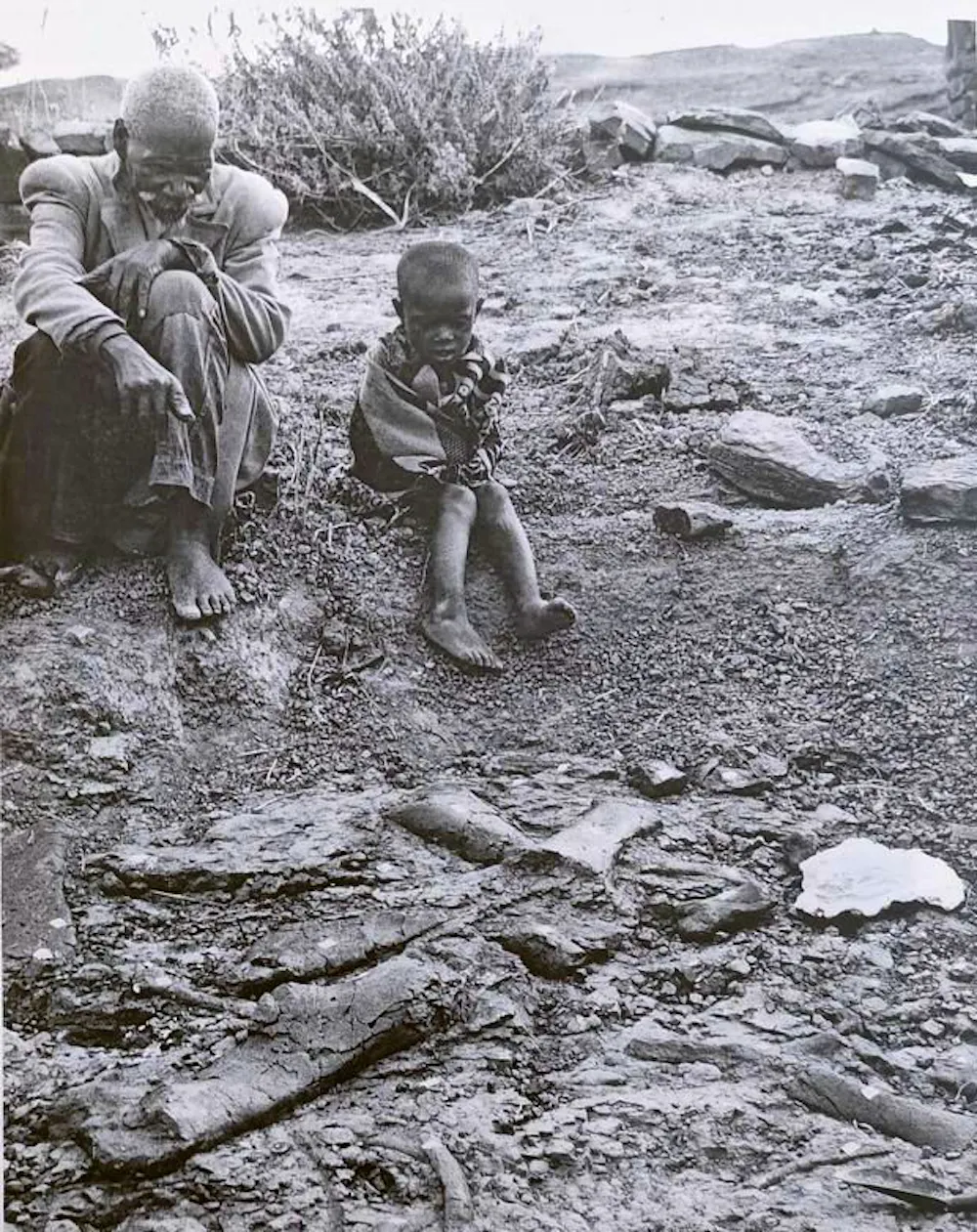
Unidentified Basotho person pointing at the Maphutseng dinosaur bones, circa 1955.Author unknown. With authorisation of the Morija Museum Archives, Author provided (no reuse)
Both body fossils and trace fossils have been found in Lesotho and its surroundings. Erosion of fossil-rich rocks exposes numerous dinosaur, amphibian and reptile trackways, fish trails and burrows, alongside full or partial skeletons and plant remains. Thus, fossils are part of Lesotho’s rugged landscape.
For the Basotho, giant bones eroding from the hills are not mere curiosities; they are referred to the Kholumolumo. This was an enormous, all-devouring mythical creature whose thunderous footsteps echoed across the landscape, leaving footprints behind.
This folktale aligns closely with the fossil record: skeletons and trackways, mostly of dinosaurs, which are prevalent in the sky-high exposures of the Maloti (or the Drakensberg, as the mountain range is known in South Africa).
The Kholumolumo myth serves as a cultural framework that preserves real observations of Lesotho’s fossil heritage over time. It’s an example of early citizen science – local people identifying recurring patterns in their environment and explaining them within their own cultural framework.
Ellenberger’s original archival materials reveal that this local knowledge was highly practical. When French palaeontologists arrived in 1955, they were guided to Maphutseng – now known for one of southern Africa’s richest dinosaur bone beds – by Samuel Motsoane. He was a local schoolteacher who had known the “stone bones” since childhood, in the 1930s.
Basotho chiefs visiting the Maphutseng excavation site in the 1970s.Ellenberger archive, with authorisation of the ISEM, University of Montpellier, Author provided (no reuse)
The San and the fossil footprints
The Basotho and San were among the first in southern Africa to examine giant footprints preserved in stone and ponder: what walked here?
The indigenous San people, who followed a hunter-gatherer way of life before their culture disappeared from Lesotho, were masters in the interpretation of tracks. They could identify the size, behaviour and movement of living animals from a single footprint. Ellenberger believed they applied these skills to fossil tracks as well.
His manuscripts describe rock art at Mokhali Cave that appears to depict a dinosaur footprint alongside bipedal creatures reminiscent of the three-toed dinosaur fossils preserved in nearby outcrops.
Ellenberger also noted that some San myths seemed to differentiate between the tracks of four-legged animals in the lowlands and those of two-legged animals higher in the mountains.
In southern Africa, fossil tracks of bipedal dinosaurs are found in higher rock layers only, where the rocks are younger. Lower rocks contain only quadrupedal trackways made by more primitive animals.
So the myths appear to demonstrate some level of understanding of the evolution of species.
Although this seems more speculative, his core observation remains valid: the San recognised patterns in the fossil record and integrated them into their worldview. They observed their land with precision long before formal palaeontology developed in the area.
Rethinking the narrative of ‘discoveries’
The diaries show that locals guided researchers to fossil sites. They recognised fossil bones and tracks as evidence of ancient animals, and preserved this understanding through stories that served as explanations.
Ellenberger himself valued this intellectual tradition: he spoke Sesotho fluently, collaborated with locals, and documented their insights respectfully. His notes credit half a dozen Basotho who discovered fossils of important scientific value.
The Mokhali rock shelter is the site near Leribe where the San painted a possible dinosaur footprint and some of the oldest known dinosaur reconstructions.Julien Benoit, Author provided (no reuse)
His notes show that the roots of awareness and interpretation of fossils in southern Africa predate European expeditions and reach into the deep sense of place held by the people living among these fossils since generations. Their interpretations were not “quaint myths” but sophisticated observations shaped by centuries of engagement with the land.
Acknowledging this enriches the scientific record, broadens our understanding of early palaeontology, and honours the contributions of communities whose insights led to important discoveries. Ellenberger has left us an empowering and inspiring legacy for the new generation of southern African palaeontologists.
– Fossil science owes a debt to indigenous knowledge: Lesotho missionary’s notes tell the story – https://theconversation.com/fossil-science-owes-a-debt-to-indigenous-knowledge-lesotho-missionarys-notes-tell-the-story-270431
The State of Qatar strongly condemns the raid carried out by Israeli occupation forces on the headquarters of the United Nations Relief and Works Agency for Palestine Refugees in the Near East (UNRWA) in occupied East Jerusalem, describing it as a blatant violation of international humanitarian law and a flagrant challenge to the will of the international community.
The Ministry of Foreign Affairs warns that Israel’s systematic targeting of UNRWA ultimately aims to dismantle the agency and deprive millions of Palestinians in Gaza, the West Bank, Jordan, Syria, and Lebanon of its essential services. The Ministry stresses the urgent need for the international community to stand firmly against this plan in order to prevent its catastrophic humanitarian consequences.
The Ministry reaffirms Qatar’s full support for UNRWA, based on the State’s firm position in backing the legitimate rights of the brotherly Palestinian people, foremost among them the right to establish an independent state along the 1967 borders with East Jerusalem as its capital.
Kenyan legislators chased down but failed to outrun their Ugandan counterparts as Parliament of Uganda registered successive wins in the long distance races during the first day involving athletics on Monday 8 December 2025.
Ugandan MPs, both in the men and women’s races, won the 1500 metres and a shorter 400 metres events held in Mandela National Stadium.
Hon. Julius Acon, an Olympian, took the 1500 metres race in 5:23.5, narrowly beating Kenya’s Titus Lotee (5:24.0). Kenya’s John Kagucha completed the podium with a third-place finish in 5:54.08.
Hon. Christine Akello won the women’s race clocking 8:30, followed by Kenya’s Hon. Phylis Barioo, Uganda’s Hellen Auma and Gorreth Namugga.
Benard Odoi (Uganda) won the men’s 400m, edging Rwanda’s Nyabyenda Damien; while Rwanda’s Germaine Mukabalisa produced a dominant run to take first place, with Christine Akello (Uganda) finishing second, and Abeja Suzan taking third.
Kenya’s Vincent Musau won hit 1 in the 100 metres followed by Uganda’s Patrick Ocan and Rwanda’s Nyabyenda Damien; while Benard Kitur led EALA’s Ali Machano, Rwanda’s Kanamugire James, and Uganda’s Tom Aza in hit 2.
In the women’s race, Kenya’s Catherine Omanyo took top spot, followed by Hellen Auma (Uganda), Germaine Mukabalisa (Rwanda) and Anna Adeke (Uganda).
Uganda continued its success on the track by clinching the women’s 4×100m relay, through Agnes Taka, Adeke, Akello and Hellen Auma. Kenyans won the men’s race as a baton drop saw the Ugandan men finish fourth.
Athletics Continue on Thursday.
Elsewhere, Hon. Twaha Kagabo’s first half penalty and a Hon. John Lematia’s strike in the 71st minute secured Uganda’s 2 – 1 win against their eastern neighbours at the MTN Omondi Stadium.
Kenya’s goal was scored in 87th minute of the game, with Hon. Letipila Eli Dominic putting the shot past Hon. Linos Ngompek, shortly before the final whistle.
Distributed by APO Group on behalf of Parliament of the Republic of Uganda.
The Portfolio Committee on Women, Youth and Persons with Disabilities met on Friday and agreed to shortlist 18 candidates to be interviewed to serve on the National Council on Gender Based Violence and Femicide.
The shortlisted candidates reflect a diverse background, representing South Africa’s demographics.
The committee received 403 applications submitted through various channels – online (322), email (80) and in person (1). Furthermore, the Committee noted that eight applications were submitted late, and 48 were identified as duplications.
The names of the shortlisted candidates along with CVs (in compliance with POPI Act) will be published on Parliament’s website. This will give civil society and the public at large an opportunity to comment on and engage with the shortlist, ensuring transparency and inclusivity throughout the selection process.
The closing date for comments from members of the public and civil society is 23 January 2026.
APO Group (www.APO-opa.com), the leading, multi-award-winning, pan-African communications consultancy and press release distribution service, is proud to announce that its Founder and Chairman, Nicolas Pompigne-Mognard (www.Pompigne-Mognard.com), has been appointed as Council Member of the Africa No Filter Foundation (www.AfricaNoFilter.org), incorporated in Mauritius.
Africa No Filter is a non-profit advocacy organisation that is shifting stereotypical narratives about Africa through storytelling that reflects a dynamic continent of progress, innovation, and opportunity. Under the leadership of executive director Moky Makura, the organisation has become a thought leader in narrative change, delivering grants, research, and advocacy that challenge outdated portrayals of Africa in global discourse.
With a vision of a world where the prevailing narrative within and about Africa is reflective of a progressive and dynamic continent, Africa No Filter works to ensure that Africa is seen and heard in all its complexity, potential, and diversity.
The Africa No Filter Council is responsible for governance, asset management, and ensuring the foundation’s objectives are met. Council Members operate in a capacity similar to a board of directors, guiding strategic direction and safeguarding the organisation’s mission.
A Franco-Gabonese entrepreneur named among the 100 Most Influential Africans in 2023 and 2024, Nicolas Pompigne-Mognard serves on multiple high-profile advisory boards and international committees. These include the Senior Advisory Board of the Canada-Africa Chamber of Business and the Leadership Council of the Africa Tech Festival, as well as the Advisory Boards of the African Energy Chamber, World Football Summit, Africa Hotel Investment Forum (AHIF), Critical Minerals Africa Group, Bloomberg New Economy Gateway Africa, Sports Africa Investment Summit, EurAfrican Forum, and All Africa Music Awards (AFRIMA). He is also a strategic advisor to the Chief Executive Officer of the Royal African Society of the United Kingdom, a strategic advisor to the EU-Africa Chamber of Commerce, and a special advisor to the President of Rugby Africa, the governing body of rugby in Africa.
Nicolas’ wholly-owned company, APO Group, is the premier award-winning Pan-African communications consultancy and press release distribution service. It serves more than 300 clients, including global giants such as Canon, Emirates, Nestlé, Western Union, UNDP, TikTok, Coca-Cola, NBA, NFL, and Marriott.
“Africa No Filter’s mission resonates deeply with my own purpose and the work we have done at APO Group for nearly two decades. My appointment as Council Member of the Africa No Filter Foundation reflects a natural alignment of values and a shared vision to reframe Africa’s narrative through authentic, impactful storytelling. I believe that changing how the world sees Africa starts with empowering Africans to tell their own stories of ambition, ingenuity, and possibility. I am honoured to join the Council of the Africa No Filter Foundation, and to deepen my commitment to reshaping perceptions of Africa, driving meaningful change, and amplifying the continent’s influence on the global stage,” said Nicolas Pompigne-Mognard, Founder and Chairman of APO Group.
The Council’s diverse expertise enables the foundation to address the multifaceted challenges of perception, funding initiatives that highlight African creativity, leadership, and lived realities.
Nicolas’s appointment underscores the shared commitment between APO Group and Africa No Filter to foster inclusive growth, inspire confidence, and place African stories at the centre of global conversations.
About APO Group:
Founded in 2007, APO Group (www.APO-opa.com) is the leading award-winning pan-African communications consultancy and press release distribution service. Renowned for our deep-rooted African expertise and expansive global perspective, we specialise in elevating the reputation and brand equity of private and public organisations across Africa. As a trusted partner, our mission is to harness the power of media, crafting bespoke strategies that drive tangible, measurable impact both on the continent and globally.
Our commitment to excellence and innovation has been recognised with multiple prestigious awards, including a PRovoke Media Global SABRE Award and multiple PRovoke Media Africa SABRE Awards. In 2023, we were named the Leading Public Relations Firm Africa and the Leading Pan-African Communications Consultancy Africa in the World Business Outlook Awards, and the Best Public Relations and Media Consultancy Agency of the Year South Africa in 2024 and again in 2025 in the same awards. In 2025, Brands Review Magazine acknowledged us as the Leading Communications Consultancy in Africa for the second consecutive year. They also named us the Best PR Agency and the Leading Press Release Distribution Platform in Africa in 2024. Additionally, in 2025, we were honoured with the Gold distinction for Best PR Campaign and Bronze in the Special Event category at the Davos Communications Awards.
APO Group’s esteemed clientele, which includes global giants such as Canon, Nestlé, Western Union, the UNDP, Network International, African Energy Chamber, Mercy Ships, Marriott, Africa’s Business Heroes, and Liquid Intelligent Technologies, reflects our unparalleled ability to navigate the complex African media landscape. With a multicultural team across Africa, we offer unmatched, truly pan-African insights, expertise, and reach across the continent. APO Group is dedicated to reshaping narratives about Africa, challenging stereotypes, and bringing inspiring African stories to global audiences, with our expertise in developing and supporting public relations campaigns worldwide uniquely positioning us to amplify brand messaging, enhance reputations, and connect effectively with target audiences.
It takes a village to shift a narrative — and Africa No Filter’s (https://AfricaNoFilter.org) village just got stronger.
Africa No Filter (ANF) today announced the formation of its inaugural Council: a collective of eight highly respected leaders whose expertise spans media, finance, philanthropy, law, advocacy and research. Their appointment signals a new chapter for the organisation, which is now an independent, African-led and registered entity in Mauritius after five years as a U.S-based project.
The ANF Council brings together people who have not only excelled in their fields, but who Moky Makura, Executive Director of Africa No Filter, deeply admires for the way they show up for the continent.
“Narratives shape everything, from policy and reputation to investment and opportunity,” Makura says. “As Africa No Filter steps into this new era of independence, this Council strengthens our governance and sharpens our strategic direction. These are people who understand the stakes, believe in Africa’s potential and are committed to ensuring that Africa tells its own, more truthful story.”
Over the last five years, Africa No Filter has committed more than US$7.5 million to the African creative and media ecosystem, supporting storytellers, researchers and platforms that challenge reductive, outdated portrayals of the continent.
Its work has attracted some of the world’s most influential funders, including the Gates Foundation and the Mastercard Foundation, alongside its founding funders – the Ford Foundation, Luminate and the Hilton Foundation, Hewlett Foundation, and Mellon Foundation – who continue to support ANF’s mission to shift global narratives about Africa.
At this pivotal moment, the Council will serve as a strategic sounding board and leadership body, strengthening governance, accelerating impact and expanding the organisation’s reach on the continent and beyond.
The members of the 2025 Africa No Filter Council are:
Richard Addy — a multi-award-winning strategist and co-founder of international audience strategy consultancy AKAS, recognised as one of the world’s Top 100 media experts.
Nousrath Bhugeloo — a seasoned senior executive in financial services and Executive Director and Chairperson at Nexus Global Financial Services.
Yacine Djibo — Founder and Executive Director of Speak Up Africa, whose advocacy has reshaped policy conversations on health, sanitation and sustainable development across the continent.
Ferdinand Mokete — Director at KPMG South Africa and MBA lecturer at Wits Business School, representing the next frontier of African economic leadership and governance excellence.
Françoise Moudouthe — CEO of the African Women’s Development Fund and founder of Eyala, an online platform amplifying African feminist voices.
Nicolas Pompigne-Mognard — Franco-Gabonese entrepreneur and founder of APO Group, an award-winning pan-African communications consultancy and press release distribution service, listed among the Top 100 Most Influential Africans in 2023 and 2024.
Anshi Saminaden — Senior Legal Counsel at the African Leadership University, renowned for her leadership in institutional governance, negotiation and investment management.
Natasha Kofoworola Quist — Founder of Quest Advisory Africa, with over 25 years’ experience spanning humanitarian work, conservation, philanthropy and the private sector.
Each member brings a distinct lens, yet all share a common conviction: that Africa’s story must be told more fully, more fairly and by Africans themselves.
Yacine Djibo believes the future narrative must finally reflect reality — “a continent of creativity, innovation and possibility, where African voices define the story and inspire confidence, investment and ownership from within and beyond the continent.”
For Nicolas Pompigne-Mognard, countering stereotypes is not only ethical, but strategic. By promoting authentic stories of progress, he says, “the media can unlock investment and help transform Africa’s economic prospects.”
Anshi Saminaden echoes this, pointing to the power of authentic storytelling to “direct investment and support to where they are most needed, unlocking Africa’s human power and transformation.”
Nousrath Bhugeloo noted that strong governance is part of how Africa tells its story, and that ANF’s commitment to building resilient, African-led institutions is as important as the narratives it amplifies.
With strengthened governance, expanded continental expertise and a growing global footprint, Africa No Filter’s transition to an independent entity marks far more than an organisational change. It is a statement of intent: a new era in which Africa commands its own narrative, on its own terms.
Distributed by APO Group on behalf of Africa No Filter.
About Africa No Filter:
Africa No Filter is an advocacy organisation dedicated to shifting stereotypical narratives about Africa by supporting storytelling that reflects a dynamic continent of progress, innovation and opportunity. It exists to counter narratives that reduce Africa to poor leadership, poverty, corruption, disease and conflict, and to amplify more accurate, balanced and empowering stories. For more information, visit www.AfricaNoFilter.org.