President appoints new DHET Minister, Deputy Minister

Source: Government of South Africa

Monday, July 21, 2025

President Cyril Ramaphosa has removed Dr Nobuhle Nkabane from the role of Minister of Higher Education and Training and has appointed Buti Manamela as Minister of the portfolio.

Manamela was until this appointment serving as Deputy Minister of Higher Education and Training, a role he held from the 6th administration.

The announcement was made in a statement issued by The Presidency on Monday night.

“Consequently, President Ramaphosa has in terms of Section 93 (b) of the Constitution appointed Dr Nomusa Dube-Ncube, Deputy Minister of Higher Education and Training. 

“Dr Dube’s long government leadership experience includes serving as MEC for Cooperative Government and Traditional Affairs and Premier of the Province of KwaZulu-Natal, amongst other roles,” said the President’s office.

Section 93 (b) empowers the President to appoint no more than two Deputy Ministers from outside the Assembly. 

Last month, the President had requested that Nkabane provide him with a detailed report on the decorum and substance of her engagement with Parliament. This followed media commentary on her appearance before the Portfolio Committee on Higher Education and Training on 30 May 2025. 

READ I Minister requested to provide a report on decorum in Parliament 

The Minister was seen in a viral video on social media eating while responding to a question from the Chairperson of the Higher Education committee, Tebogo Letsie. 

President Ramaphosa said at the time that the request for the report was in view of the President’s expectation that Ministers, Deputy Ministers and senior executives in the public sector conduct themselves professionally, transparently and cordially in engaging with Parliament and other accountability institutions. – SAnews.gov.za

In Mékro, in central Côte d’Ivoire, sustainable agriculture is giving hope to an entire community

Source: APO

Day breaks in Mékro, some 300 km from Abidjan, in central Côte d’Ivoire. The first rays of sun announce the start of what promises to be another sweltering day in a region known for its intense heat. Some women return from the backwaters bringing water to supply the family beehives. Others, armed with brooms made from palm leaves, begin sweeping the compounds, clearing away fallen leaves and scraps from the previous day’s meals.

A little farther off, domestic animals gradually emerge from their pens, joining the morning hustle and bustle that breathes life back into Mékro’s daily routine. In this area of high food crop production, yams, rice and cassava are produced in abundance. Yet despite its agricultural riches, Mékro has long remained in the shadows, unlike other places.

For years, farmers here relied on age-old techniques passed down through generations—methods that limited yields and left the population in a state of chronic vulnerability.

That morning, Koffi Kouakou Charles, known as “KKC,” sharpened his machete, the basic tool he uses to clear his field, under the watchful eyes of his seven children. At 30 years old, he mounted his bicycle and headed to Abokouassikro, five km away, where he has cultivated yams for several years.

In the past, Koffi grew “Kouba” yams, a popular local variety. Reflecting on those days, he recalls how traditional farming techniques learned and passed down from his ancestors, failed to reward his hard work. “Frankly, the work was exhausting. On top of that, we were using old-fashioned techniques. Despite our efforts, the harvests were poor. It was really hard,” sighs Koffi.

Hope restored

In the first half of 2024, his plight worsened when an epidemic known as the peste des petits ruminants (PPR) struck the village and wiped out his hens and goats. Hurting from this new financial blow, Koffi turned to the Project to Improve the Livelihoods of Smallholders and Women (PREMOPEF) (https://apo-opa.co/40ujK40) to regain hope.

Set up by the government of Côte d’Ivoire, the project is funded by the Global Agriculture and Food Security Program (GAFSP) (https://apo-opa.co/4lEIa36) and the African Development Fund (https://apo-opa.co/4o1986y), the concessional financing window of the African Development Bank Group. Its objective is to contribute to improving first, food and nutrition security and secondly, resilience to the effects of climate change among smallholder farmers, women and young people in the N’Zi region.

The project is focused on three agricultural crops: yams, cassava and vegetables, as well as traditional poultry farming, and aims to improve the living conditions of 60,000 vulnerable people, 50 percent of whom are women and 35 percent young people.

At the “Farmer Training Field,” one of the project’s initiatives, Koffi and his fellow project beneficiaries were introduced to agroecological techniques for yam production and conservation. Thanks to the training, Koffi has turned his back on “Kouba” yams and old production practices in favour of new varieties called “Anader” and “Cameroun” (also known as “R3” and “C15”), which are more climate-resistant and productive. 

A twofold increase in yield

From his first harvest in December 2024, Koffi’s yam yield doubled—from two to four tonnes on the same plot of land. Thinking ahead, he reserved three-quarters of the harvest for his family’s consumption and seed stock for the next season. The remaining quarter was sold at the local market in Mékro, earning him 125,000 CFA francs (around USD 250)—a significant windfall in this rural region.

“Before, I was just focused on surviving,” Koffi says. “Today, thanks to this project, I can think about my children’s future and even expand my farm.” Energized by his progress, Koffi is now determined to scale up and become one of the region’s leading yam producers. The prospect of mechanizing his work excites him. “I’m thinking of buying a ridging machine and a seed drill to make fieldwork easier and increase my yield,” he says confidently.

“The Project to Improve the Livelihoods of Smallholders and Women is a powerful tool for reducing household vulnerability and strengthening resilience to economic and environmental shocks,” says Ceserd Waba Akpaud, the project coordinator.

“PREMOPEF reflects our commitment to transforming rural communities through sustainable, farmer-focused solutions. By applying innovative approaches, we’re putting agriculture at the center of inclusive development,” adds Philip Boahen, GAFSP project coordinator at the African Development Bank.

To further boost his productivity, Koffi also envisions large-scale storage facilities to cut post-harvest losses. He’s planning to diversify his activities too. After losing his livestock to PPR—a disease he attributes to a lack of proper training—he intends to relaunch his poultry business using improved, safer methods. He is now exploring livestock training courses to build the necessary skills.

“It’s also a chance for me to make up for the schooling I missed,” he says, determined to turn past setbacks into opportunities.

With the knowledge he’s gained and the positive impact of the project, a new horizon is opening—not just for Koffi, but for the people of Mékro and the broader economy of the N’Zi region.

Distributed by APO Group on behalf of African Development Bank Group (AfDB).

Media files

.

Liberia: President Boakai Hails the Kingdom of Belgium on its National Day Observance

Source: APO


.

The President of the Republic of Liberia, His Excellency President Joseph Nyuma Boakai, Sr., has sent a congratulatory message to His Majesty King Philippe, King of the Kingdom of Belgium on the occasion of Belgium’s National Day on July 21, 2025.

According to a Foreign Ministry release, President Boakai, on behalf of the Republic of Liberia and in his own name, extended warmest congratulations and best wishes to the Kingdom of Belgium as they commemorate their National Day.

The Liberian leader indicated that the occasion provides an opportunity to celebrate the enduring values of unity, democracy and prosperity that Belgium has long upheld. 

He noted that his government cherishes the long-lasting bonds of friendship and cooperation between the two nations which is built on mutual respect and shared aspirations for peace, development and global solidarity. 

President Boakai stressed that as the Belgian people mark this important day, Liberia joins in honoring their rich history, cultural heritage and remarkable achievements. 

“May the future bring continued progress, united, and the well-being to your nation and people”, the Liberia President stated. 

He then extended best wishes for His Majesty personal well-being, and for the people of Belgium sustained prosperity.

Distributed by APO Group on behalf of Ministry of Foreign Affairs of Liberia.

United Nations Mission in South Sudan (UNMISS)-supported vocational training for prisoners builds hope for a better future

Source: APO


.

It’s a good day at the Kuajok prison—a baby has been born, and this tiny little life is emblematic of the positive impact prison reforms, particularly vocational training, has been having on the lives of inmates.

As a visiting team from the United Nations Mission in South Sudan (UNMISS) traversed the prison corridors, male prisoners are singing popular songs. In a few minutes, they’ll be heading to a class in accounting.

Their female counterparts are engaged in tailoring lessons.

The Deputy Director of the prison, Joseph Akol Lual, says that these trainings, which were funded by the UN Peacekeeping mission in 2023, have greatly helped build morale and motivation among inmates.

“Our main purpose as a prison facility is to ensure that those incarcerated are treated with dignity and they have an opportunity to become productive members of society upon completion of their sentences,” he explains.

“By learning new skills, prisoners are becoming more confident in their ability to make a living once they are released. This feeling of being economically empowered fuels them every day.” 

Mr Lual’s words resonate with those participating in this skills programme.

“I love designing clothes and making them. So, I pay great attention to my tailoring classes here. When I finish my time in prison, I’m confident that I can start my own small business and make women feel beautiful in my creations,” said a female inmate who prefers not to be named.

Women serving time in the Kuajok prison have been supported by the UN Peacekeeping mission in other ways as well, particularly through the construction of a perimeter wall separating male and female prison quarters.

“We were approached by prison authorities to help ensure that women inmates were not at risk of sexual violence and we funded the construction of a perimeter wall to give female prisoners privacy and safety through our Quick Impact Projects programme. We also trained women prisoners to contribute to the building of their own space,” says Precious Chinamasa, an UNMISS Corrections Officer, who facilitated the project.

Today, the women and men detained at this prison have compounds that are characterized by spaciousness and safety. Weather permitting, they also cultivate basic crops in case local vendors are unable to deliver essential food items, a common situation, especially during the rainy season. 

Such sustainable steps to reform prisons go a long way to ensure that when it’s time for their release, prisoners can look forward to reintegrating fully into their families and communities.

Distributed by APO Group on behalf of United Nations Mission in South Sudan (UNMISS).

Afreximbank Annual Meetings record project preparation deals expected to unlock about US$ 1.0 billion in investments

Source: APO

The 32nd Annual Meetings of African Export-Import Bank (Afreximbank) (www.Afreximbank.com), also known as AAM2025, witnessed a flurry of deal signings with four project preparation transactions signed between the Bank and various entities that are expected to unlock investments valued at about US$ 1.0 billion.

In an agreement signed by Mrs. Kanayo Awani, Executive Vice President, Intra-African Trade and Export Development, for Afreximbank, and Mrs. Temwani Simwaka, CEO, for NBS Bank Plc (NBS), Malawi, the two institutions executed a Joint Project Preparation Facility Framework Agreement under which they will pool resources to provide early project preparatory financing to progress projects in Malawi from pre-feasibility stage to bankability in a timely manner.

As set out in the agreement, Afreximbank and NBS will support public and private sector investors by availing financing and technical support services to de-risk projects in priority sectors, including energy, transport and logistics, logistical platforms (such as special economic zones and industrial parks), manufacturing, agro-processing, hospitality and tourism, extractives, solid minerals, and services (such as ICT, healthcare, and creative economy). Embedded in the framework agreement is a capacity building programme that will empower NBS staff to undertake project preparation activities in the medium term.

Afreximbank and NBS expect to bring onstream investments of about US$ 300 million in Malawi in the near term.

In another transaction, Afreximbank signed a US$ 4.4-million Project Preparation Facility Agreement in favour of Med Aditus Pharmaceutical Kenya Limited. The facility will be deployed to finance the preparation of feasibility and bankability studies towards the development of a state-of-the-art fill and finish pharmaceutical manufacturing plant, with a production capacity of at least two billion tablets and capsules per annum, located in Kibos, Kisumu County, Kenya.

The project will improve access to quality, affordable life-saving medicines across the Great Lakes region, contributing to better health outcomes in a region that contends with heavy loads of infectious and other diseases. The project will also facilitate medical and manufacturing blockchain technology transfer to Africa, supporting the long-term growth and strengthening the wider region’s health sector. The project preparation facility will bring onstream assets of about US$ 40 million.

Mrs. Kanayo Awani, Executive Vice President, Intra-African Trade and Export Development, signed the agreement on behalf of Afreximbank while Dr. Dhiren Thakker, Founder and CEO of Med Aditus Pharma, signed for his company.

Afreximbank also signed a Heads of Terms agreement for a US$4.4-million project preparation facility in favour of Green Hybrid Power Private Limited. The facility will be deployed towards the preparation of bankability and feasibility studies and procurement of transaction advisors for a 1-Gigawatt (GW) hybrid floating solar photovoltaic power system on Lake Kariba, Zimbabwe.

The project, to be implemented in two phases, includes a pilot phase targeting a generation capacity of 500 MW to be sold wholly to the Intensive Energy Users Group, a consortium of blue-chip industrial and mining energy users in Zimbabwe, under a “take-or-pay” 20-year power purchase agreement with a cost-reflective tariff. The project is expected to supply affordable and reliable power that will support value-addition and beneficiation of Zimbabwe’s minerals, thereby boosting the country’s foreign exchange earnings.

The project preparation facility will unlock an investment estimated at US$ 350 million.

Signing the agreement were Mrs. Kanayo Awani, Executive Vice President, Intra-African Trade and Export Development, on behalf of Afreximbank, and Mr. Eddie Cross, Chairman, for Green Hybrid Power Private Limited.

Afreximbank, in addition, signed a Project Preparation Facility Heads of Terms Agreement of US$ 4.0 million in favour of Proton Energy Limited, a Nigerian independent power producer. The facility will be deployed towards financing the preparation of feasibility studies and procurement of transaction advisory services for the development of a grid-connected gas-fired power plant with a nameplate capacity of 500 MW in Sapele, Nigeria. The project will commence with an initial generation capacity of 150 MW.

The project will evacuate the electricity generated primarily to Eko Electricity Distribution Company under a 20-year power purchase agreement with a cost-reflective tariff.

The facility is expected to bring on stream assets estimated at US$ 300 million.

Signing the agreement were Mrs. Kanayo Awani, Executive Vice President, Intra-African Trade and Export Development, on behalf of Afreximbank, and Mr. Oti Ikomi, Executive Vice Chairman and CEO, for Proton Energy Limited.

AAM2025 took place from 25 to 28 June and attracted an estimated 8,000 participants, including presidents, prime ministers, ministers and business leaders, from across Africa, the Caribbean and beyond. It ended with the Annual General Meeting of Shareholders where Dr. George Elombi was appointed the next President of the Bank who succeeds Prof. Benedict Oramah whose tenure is ending after two five-year terms in the position.

Distributed by APO Group on behalf of Afreximbank.

Media Contact:
Vincent Musumba
Communications and Events Manager (Media Relations)
Email: press@afreximbank.com

Follow us on:
X: https://apo-opa.co/44Siid2
Facebook: https://apo-opa.co/40t0h3A
LinkedIn: https://apo-opa.co/44SigSs
Instagram: https://apo-opa.co/4lDQ0dk

About Afreximbank:
African Export-Import Bank (Afreximbank) is a Pan-African multilateral financial institution mandated to finance and promote intra- and extra-African trade. For over 30 years, the Bank has been deploying innovative structures to deliver financing solutions that support the transformation of the structure of Africa’s trade, accelerating industrialisation and intra-regional trade, thereby boosting economic expansion in Africa. A stalwart supporter of the African Continental Free Trade Agreement (AfCFTA), Afreximbank has launched a Pan-African Payment and Settlement System (PAPSS) that was adopted by the African Union (AU) as the payment and settlement platform to underpin the implementation of the AfCFTA. Working with the AfCFTA Secretariat and the AU, the Bank has set up a US$10 billion Adjustment Fund to support countries effectively participating in the AfCFTA. At the end of December 2024, Afreximbank’s total assets and contingencies stood at over US$40.1 billion, and its shareholder funds amounted to US$7.2 billion. Afreximbank has investment grade ratings assigned by GCR (international scale) (A), Moody’s (Baa2), China Chengxin International Credit Rating Co., Ltd (CCXI) (AAA), Japan Credit Rating Agency (JCR) (A-) and Fitch (BBB-). Afreximbank has evolved into a group entity comprising the Bank, its equity impact fund subsidiary called the Fund for Export Development Africa (FEDA), and its insurance management subsidiary, AfrexInsure (together, “the Group”). The Bank is headquartered in Cairo, Egypt.

For more information, visit: www.Afreximbank.com

Media files

.

Introducing Alvenco Advisory: Guiding Strategic Investment in Namibia’s Energy Future

Source: APO

With Namibia set to start oil production by 2029, the country is witnessing a surge in global investments across its exploration and production landscape. From global energy majors to leading independents to regional energy companies and financiers, energy firms are ramping up their investments in what is poised to become the next major African producer. As international investors navigate Namibia’s evolving energy and mining industries, the newly-launched Alvenco Advisory will support companies as they expand their presence across the southern African country.  

Spearheaded by Namibia’s former-Minister of Mines and Energy Tom Alweendo, Alvenco Advisory represents the partner of choice for global companies seeking to make forays into Namibia. As a strategic advisory firm, Alvenco Advisory is committed to shaping investments that are profitable, inclusive and sustainable. The company will work closely with government stakeholders and global companies, aligning closely with the country’s energy goals by offering policy and regulatory support, strong alignment with national priorities, local stakeholder engagement and ESG focus as well as strategies for shared value and long-term returns. As Namibia embarks on its next chapter of energy development Alvenco Advisory has emerged as a strong partner for global investors.

The launch of Alvenco Advisory comes as Namibia accelerates the development of offshore oil and gas discoveries made in the Orange Basin. TotalEnergies targets a final investment decision for its Venus discovery in 2026, with first oil expected in 2029. Galp is making progress with the development of the Mopane field following a string of positive results at exploration wells drilled in 2024 and 2025. The latest of these – the Mopane 3S well – revealed the presence of light oil and gas condensate. On the exploration front, Rhino Resources is making strides towards field development following a discovery at the Capricornus-1X well in April 2025 and the confirmation of a hydrocarbon reservoir at the Sagittarius-1X well in February 2025. Halliburton is set to drill two exploration wells at Block 2914 in PEL 85 while Stamper Oil & Gas Corp is also pursuing exploration projects in the Orange and Lüderitz Basins. Chevron is spearheading exploration in the Walvis Basin following its acquisition of an 80% stake in Blocks 2112B and 2212A. These investments seek to unlock a new hydrocarbon province in southern Africa.

Namibia’s energy transformation comes not only from its oil and gas industry but its bold steps into green hydrogen. The country seeks to reach green hydrogen volumes of between 10-15 million tons per annum by 2050 and is working closely with global partners to achieve this goal. Major projects include the country’s flagship $10 billion flagship Hyphen Hydrogen Energy project – targeting 350,000 tons of green hydrogen annually – and the Daures Green Hydrogen Village – targeting 700,000 tons per annum after 2032. In addition to Hyphen, Namibia is already producing hydrogen from the Hylron Oshivela Project. The project started operations in March 2025, producing green hydrogen using 12 MW of electrolyzer capacity.  Meanwhile, a partnership between the European Union and Namibia – forged in early 2025 – is set to drive up to $12 billion in European private investments into the country in support of its green hydrogen goals. As this investment flows into Namibia, Alvenco Advisory stands ready to support companies as they navigate policy, national priorities and local stakeholder engagement.

“Namibia is on the cusp of extraordinary change. With major oil discoveries and bold steps into green hydrogen, we have a unique opportunity and responsibility to ensure that our natural resources uplift all Namibians. Alvenco Advisory will not only support global investors in Namibia, but ensure their investments unlock tangible opportunities for the people of Namibia. At Alvenco Advisory, we are committed to driving inclusive and sustainable projects. We are here to align the goals of governments and investing companies – if you’re investing in Namibia or thinking about it let’s talk,” states Alweendo.  

Alweendo has held various positions in Namibia, including Governor of the Bank of Namibia, Director General of the National Planning Commission and Minister in Charge of the National Planning Commission. In 2018, he was appointed Minister of Mines and Energy. His term ended in 2025. In this role, he oversaw all of the country’s major oil discoveries, and since these milestones, has maintained investor confidence through competitive policies, engagement with international operators and flexible investment structures. This laid the foundation for future growth across the market, setting the country up for continued success in the oil, gas and broader energy sectors.

To learn more about Alvenco Advisory, visit www.AlvencoAdvisory.com.

Distributed by APO Group on behalf of African Energy Chamber.

Media files

.

Africa’s minerals are being bartered for security: why it’s a bad idea

Source: The Conversation – Africa – By Hanri Mostert, SARChI Chair for Mineral Law in Africa, University of Cape Town

A US-brokered peace deal between the Democratic Republic of Congo (DRC) and Rwanda binds the two African nations to a worrying arrangement: one where a country signs away its mineral resources to a superpower in return for opaque assurances of security.

The peace deal, signed in June 2025, aims to end three decades of conflict between the DRC and Rwanda.

A key part of the agreement binds both nations to developing a regional economic integration framework. This arrangement would expand cooperation between the two states, the US government and American investors on “transparent, formalized end-to-end mineral chains”.

Despite its immense mineral wealth, the DRC is among the five poorest countries in the world. It has been seeking US investment in its mineral sector.

The US has in turn touted a potential multi-billion-dollar investment programme to anchor its mineral supply chains in the traumatised and poor territory.

The peace that the June 2025 deal promises, therefore, hinges on chaining mineral supply to the US in exchange for Washington’s powerful – but vaguely formulated – military oversight.

The peace agreement further establishes a joint oversight committee – with representatives from the African Union, Qatar and the US – to receive complaints and resolve disputes between the DRC and Rwanda.

But beyond the joint oversight committee, the peace deal creates no specific security obligations for the US.

The relationship between the DRC and Rwanda has been marred by war and tension since the bloody First (1996-1997) and Second (1998-2003) Congo wars. At the heart of much of this conflict is the DRC’s mineral wealth. It has fuelled competition, exploitation and armed violence.

This latest peace deal introduces a resources-for-security arrangement. Such deals aren’t new in Africa. They first emerged in the early 2000s as resources-for-infrastructure transactions. Here, a foreign state would agree to build economic and social infrastructure (roads, ports, airports, hospitals) in an African state. In exchange, it would get a major stake in a government-owned mining company. Or gain preferential access to the host country’s minerals.

We have studied mineral law and governance in Africa for more than 20 years. The question that emerges now is whether a US-brokered resources-for-security agreement will help the DRC benefit from its resources.

Based on our research on mining, development and sustainability, we believe this is unlikely.

This is because resources-for-security is the latest version of a resource-bartering approach that China and Russia pioneered in countries such as Angola, the Central African Republic and the DRC.

Resource bartering in Africa has eroded the sovereignty and bargaining power of mineral-rich nations such as the DRC and Angola.

Further, resources-for-security deals are less transparent and more complicated than prior resource bartering agreements.

DRC’s security gaps

The DRC is endowed with major deposits of critical minerals like cobalt, copper, lithium, manganese and tantalum. These are the building blocks for 21st century technologies: artificial intelligence, electric vehicles, wind energy and military security hardware. Rwanda has less mineral wealth than its neighbour, but is the world’s third-largest producer of tantalum, used in electronics, aerospace and medical devices.

For almost 30 years, minerals have fuelled conflict and severe violence, especially in eastern DRC. Tungsten, tantalum and gold (referred to as 3TG) finance and drive conflict as government forces and an estimated 130 armed groups vie for control over lucrative mining sites. Several reports and studies have implicated the DRC’s neighbours – Rwanda and Uganda – in supporting the illegal extraction of 3TG in this region.

The DRC government has failed to extend security over its vast (2.3 million square kilometres) and diverse territory (109 million people, representing 250 ethnic groups). Limited resources, logistical challenges and corruption have weakened its armed forces.

This context makes the United States’ military backing enormously attractive. But our research shows there are traps.

What states risk losing

Resources-for-infrastructure and resources-for-security deals generally offer African nations short-term stability, financing or global goodwill. However, the costs are often long-term because of an erosion of sovereign control.

Here’s how this happens:

Examples of loss or near-loss of sovereignty from these sorts of deals abound in Africa.

For instance, Angola’s US$2 billion oil-backed loan from China Eximbank in 2004. This was repayable in monthly deliveries of oil, with revenues directed to Chinese-controlled accounts. The loan’s design deprived Angolan authorities of decision-making power over that income stream even before the oil was extracted.

These deals also fragment accountability. They often span multiple ministries (such as defence, mining and trade), avoiding robust oversight or accountability. Fragmentation makes resource sectors vulnerable to elite capture. Powerful insiders can manipulate agreements for private gain.

In the DRC, this has created a violent kleptocracy, where resource wealth is systematically diverted away from popular benefit.

Finally, there is the risk of re-entrenching extractive trauma. Communities displaced for mining and environmental degradation in many countries across Africa illustrate the long-standing harm to livelihoods, health and social cohesion.

These are not new problems. But where extraction is tied to security or infrastructure, such damage risks becoming permanent features, not temporary costs.

What needs to change

Critical minerals are “critical” because they’re hard to mine or substitute. Additionally, their supply chains are strategically vulnerable and politically exposed. Whoever controls these minerals controls the future. Africa must make sure it doesn’t trade that future away.

In a world being reshaped by global interests in critical minerals, African states must not underestimate the strategic value of their mineral resources. They hold considerable leverage.

But leverage only works if it is wielded strategically. This means:

  • investing in institutional strength and legal capacity to negotiate better deals

  • demanding local value creation and addition

  • requiring transparency and parliamentary oversight for minerals-related agreements

  • refusing deals that bypass human rights, environmental or sovereignty standards.

Africa has the resources. It must hold on to the power they wield.

– Africa’s minerals are being bartered for security: why it’s a bad idea
– https://theconversation.com/africas-minerals-are-being-bartered-for-security-why-its-a-bad-idea-260594

Ghana has a rare treasure, a crater made when a meteor hit Earth: why it needs to be protected

Source: The Conversation – Africa – By Marian Selorm Sapah, Senior lecturer, University of Ghana

Impact craters are formed when an object from space such as a meteoroid, asteroid or comet strikes the Earth at a very high velocity. This leaves an excavated circular hole on the Earth’s surface.

It is a basic geological process that has shaped the planets from their formation to today. It creates landscapes and surface materials across our solar system. The moon is covered with them, as are planets like Mercury, Mars and Venus. On Earth, impacts have influenced the evolution of life and even provided valuable mineral and energy resources. However, very few of the impact craters on Earth are visible because of various processes that obscure or erase them.

Most of the recognised impact craters on Earth are buried under sediments or have been deeply eroded. That means they no longer preserve their initial forms.

The Bosumtwi impact crater in Ghana is different, however. It is well preserved (not deeply eroded or buried under sediments). Its well-defined, near-circular basin, filled by a lake, is surrounded by a prominent crater rim that rises above the surface of the lake and an outer circular plateau. This makes it a target for several research questions.

As an Earth scientist, I joined a research team from 2019 to better understand the morphology of the crater. We carried out a morphological analysis of the crater (a study of its form, structure and geological features).

This study concluded that the activities of illegal miners are a threat to the sustainability of the crater. We also discovered that the features of the Bosumtwi impact crater can be considered as a terrestrial representation for a special type of impact crater known as rampart craters. These are common on the planets Mars and Venus and are found on icy bodies of the outer solar system (like Ganymede, Europa, Dione, Tethys and Charon).

For future studies, the Bosumtwi impact crater can be used to help understand how rampart craters form on Mars and Venus. So the Bosumtwi impact crater should be protected and preserved.


Read more: Curious Kids: Why are there so few impact craters on Earth?


The crater

The Bosumtwi impact crater is in Ghana’s mineral-rich Ashanti gold belt. It is the location of the only natural inland lake in Ghana. As one of the world’s best-preserved young meteorite impact craters it is designated as an International Union of Geological Sciences geoheritage site.

It is one of only 190 confirmed impact crater sites worldwide, one of only 20 on the African continent. Its lake is one of six meteoritic lakes in the world, recognised for their outstanding scientific value.

Satellite view of the Bosumtwi Impact Crater showing areas of Artisanal and Small scale Gold Mining activities. David Baratoux

At almost 1.07 million years old, the crater offers unparalleled opportunities for studying impact processes, climate history and planetary evolution. It’s an irreplaceable natural laboratory for researchers and educators.

Beyond its scientific importance, the crater holds cultural significance for the Ashanti people of Ghana. The lake at its centre serves as a sacred site and spiritual landmark. The crater’s breathtaking landscape also supports eco-tourism and local livelihoods, contributing to Ghana’s economic development while maintaining exceptional aesthetic value.

The research

As part of further research work on the 2019 study, in 2025 we have discovered through field work and satellite data analysis that illegal artisanal mining is prevalent in the area and threatening the crater. This refers to informal, labour-intensive extraction of minerals, primarily gold. It is conducted by individuals or small groups using basic tools and rudimentary machinery. The use of toxic chemicals such as mercury and cyanide, and practices such as river dredging, cause severe environmental harm.

Illegal miners are encroaching on and around the crater rim, posing severe threats to its environment and sustainability. Their activities have become more prevalent over the course of less than 10 years, indicating a growing problem. If unchecked, it could lead to irreversible damage to the crater.

These mining operations risk contaminating the lake with toxic heavy metals. The consequences of these are grave. They include destroying critical geological evidence, accelerating deforestation, and degrading the land. All this damages the crater’s scientific, cultural and economic value.

The International Union of Geological Sciences geoheritage designation of the crater underscores the urgent need for protection measures. The loss of this rare geological wonder would represent not just a national tragedy for Ghana, but a blow to global scientific heritage.

Immediate action is required. This includes enhanced satellite monitoring (tracking illegal mining, deforestation and environmental changes) using optical imagery (such as Sentinel-2, Landsat, PlanetScope). These tools can detect forest loss, identify mining pits and sediment runoff, and analyse changes over time.

Stricter enforcement of mining bans, and community engagement programmes, will help preserve the Bosumtwi impact crater’s unique attributes for future generations of scientists, students, tourists and local communities who depend on its resources.

– Ghana has a rare treasure, a crater made when a meteor hit Earth: why it needs to be protected
– https://theconversation.com/ghana-has-a-rare-treasure-a-crater-made-when-a-meteor-hit-earth-why-it-needs-to-be-protected-260600

African media are threatened by governments and big tech – book tracks the latest trends

Source: The Conversation – Africa – By Hayes Mabweazara, Senior Lecturer in Sociological & Cultural Studies (Media, Culture & Society), University of Glasgow

Media capture happens when media outlets lose their independence and fall under the influence of political or financial interests. This often leads to news content that favours power instead of public accountability.

Media Capture in Africa and Latin America: Power and Resistance is a new book edited by news media scholars Hayes Mawindi Mabweazara and Bethia Pearson. It explores how this dynamic plays out in the global south and how journalists and citizens are resisting it. We asked them four questions.


What is media capture and how has it reshaped itself in recent times?

Media capture describes how media outlets are influenced, manipulated or controlled by powerful actors – often governments or large corporations – to serve their interests. It’s an idea that helps us understand how powerful groups in society can have a negative influence on news media. While this idea isn’t new, what has changed is how subtly and pervasively it now operates.

These groups include big technology organisations that own digital media platforms – such as X, owned by xAI (Elon Musk), and Instagram and Facebook, owned by Meta. But it’s also important to consider Google as a large search engine that shapes the news content and audience of many other platforms.

Palgrave Macmillan

This matters because the media are important for the functioning of democratic societies. Ideally, they provide information, represent different groups and issues in society, and hold powerful actors to account.

For example, one of the key roles of the media is to provide accurate information for citizens to be able to decide how to vote in elections. Or to decide what they think about important issues. One big concern, then, is the effect of inaccurate or biased information on democracy.

Or it might be that accurate information is harder to access because algorithms and platforms make it easier to access inaccurate or biased information. These can be intended and unintended consequences of the technology itself, but algorithms can amplify misinformation and fake news – especially if this content has the potential to go viral.

So, what’s particular about media capture in the global south?

This is a really interesting question that is still being investigated, but we have some ideas.

First of all, it’s useful to know that media capture scholarship from the global north emerged around the time of the 2008 financial crisis. The influence of financial institutions on business journalists was one of the first areas of study. Since then, research in the US has focused on the capture of government-funded media organisations like Voice of America. And on how digital platforms like Google and Facebook can lead to capture.

In the global south, scholars have drawn attention to the importance of large media corporations in understanding media capture. For example, in Latin America, there’s a high level of what’s called “media concentration”. This is when many media outlets are owned by a few companies. These companies often own companies in other sectors, which means that critical reporting on business interests presents a conflict of interest.


Read more: Public trust in the media is at a new low: a radical rethink of journalism is needed


But to focus on Africa, scholars have drawn attention to governments as a source of pressure on journalists and editors. This can be through direct pressure or what we might call “covert” pressure. Withholding advertising that helps to fund media outlets is an example, or offering financial incentives to stop investigating certain topics.

Researchers are also concerned about the influence of big tech in Africa. Digital platforms like Google and Facebook can shape the news and information that citizens have access to.

Can you share some of the studies from the book?

Our book includes many interesting studies – from Colombia, Brazil and Mexico in Latin America to Ethiopia and Morocco in Africa. We’ll share a few African cases here to give an overview of the issues.

The book’s contribution on Ghana warns us that although more overt “old” types of media capture may have subsided, transitional democracies can feature messier, more nuanced forms of media control. This can be evident in government pressures and through capture of regulators.

In the Morocco chapter, we see the threat to media freedom presented by digital platforms owned by global tech giants. This is known as “infrastructural capture”. It means news organisations become dependent on tech giants to set the rules of the game for democratic communication.

Another compelling case is Nigeria, where researchers explore ties between media ownership and political patronage. The authors argue that the Nigerian press is failing in its democratic duty because of its reliance on advertising and sponsorship income from the state. Added to this are ineffective regulatory mechanisms and close relationships with some big businesses that own newspapers and printing presses.

How can media capture be resisted in the global south?

The studies in the book show some ways forward and we do think it’s important to be optimistic! Resistance takes many forms. Sometimes it comes through legal and policy reform aimed at increasing transparency and media diversity. In other cases, it’s driven by social movements, investigative journalists and independent media who continue to operate under pressure.

The chapter on Uganda shows that journalist groups working with media advocacy organisations can strategically act to resist government media capture and harmful regulations. For example, to push back against one legislative change, several groups formed a temporary network called Article 29 (named after the article in the Ugandan constitution protecting free speech) and the African Centre for Media Excellence produced a report criticising the proposed changes.


Read more: Western media outlets are trying to fix their racist, stereotypical coverage of Africa. Is it time African media did the same?


One of the chapters on Ghana also shows how networks such as journalists, media associations, human rights groups and legal organisations can mobilise to push back against government influence. Organisations including the Ghana Journalists Association and Ghana Independent Broadcasters Association have played key roles in, for example, taking the media regulator to court to overturn laws that would have led to censorship. These findings are echoed in Latin America, where research on Mexico and Colombia also found professional journalism to be a strong source of resistance.

The conversation must also include rethinking how we define capture itself. If we frame it only as total control, we risk missing the everyday ways influence operates – and the spaces where it can be resisted. We would also say it’s really important that citizens are aware and alert to the issues when they think about how they access news media and what platforms they use. This is sometimes called “media literacy” and is about people being more knowledgeable about where trustworthy news comes from.


You can listen to a podcast about the book over here.

– African media are threatened by governments and big tech – book tracks the latest trends
– https://theconversation.com/african-media-are-threatened-by-governments-and-big-tech-book-tracks-the-latest-trends-258017

Johannesburg’s creative hubs are booming: how artists are rejuvenating a failing inner city

Source: The Conversation – Africa – By Mariapaola McGurk, Lecturer in Innovation & Entrepreneurship, University of Auckland, Waipapa Taumata Rau

Johannesburg is weathering a storm of crises. Nowhere is its complex tangle of challenges more visible than in the inner city, where crime, overcrowding, and infrastructure collapse – such as roads literally exploding – paint a grim picture. Cultural institutions haven’t been spared either, with long-standing landmarks like the Johannesburg Art Gallery caught in cycles of neglect and crisis.


Read more: South Africa doesn’t need new cities: it needs to focus on fixing what it’s got


Yet, while many avoid the inner city or speak only of its decline, the creative and cultural practitioners of Johannesburg never left. In fact, artists, architects, fashion designers, animators, musicians and the like have been hard at work. They’re building, dreaming and shaping a new urban reality that could become the beacon of hope this city needs.

As a researcher and visual artist, I recently completed a PhD study that focused on Johannesburg’s cultural and creative industries. My research revealed that a clear understanding of the existing structures and dynamics within this industry is essential for developing effective strategies to strengthen its role in local economic development.

Here I explore one such opportunity: creative hubs. I argue that they represent a low-hanging fruit for the inner city’s growth and revitalisation.

Urban renewal

Numerous articles have explored strategies for the city’s economic development and urban renewal. One group of scholars recently outlined four critical focus areas: coordinated efforts across government levels; an active civil society; a shift in political culture; and restored leadership in a revitalised administration.

These are vital interventions, but they still beg a deeper question. What is the new “gold” of the “City of Gold”, the mining town founded in 1886 and on track to become a megacity by 2030?

Work by artist Candice Kramer at Bag Factory Artists Studios. Mark Straw

What is it that truly sets Johannesburg apart, nationally and globally? What strengths already exist that, if nurtured, could help address the city’s challenges? The answer may not lie in building something entirely new, but in recognising and investing in what already thrives. The city’s people, its culture, and its extraordinary creativity.

In 2004, Unesco launched the Creative Cities Network. Today it comprises 246 cities in 80 member states. South Africa has three cities in the network: Cape Town (design), Durban (literature) and Overstrand (gastronomy). Johannesburg has never applied to belong.

Cities are acknowledging the economic and social value of the cultural and creative industries, particularly in addressing challenges such as youth unemployment, micro-enterprise growth, equity and community development.

Artist Mankebe Seakoe at Contra Fair. Mark Straw

Yet cities globally are grappling with how to retain creative professionals. This is the case in cities like Toronto, Sydney, Los Angeles, Cologne or Barcelona. Rising property prices, the redevelopment of industrial areas into commercial or luxury spaces, and short-term rental agreements are displacing these professionals from the urban cores they help energise. Cities are coming up with incentives and programmes to correct this.

A recent World Cities Cultural Forum report offers a solution in the form of Creative Land Trusts. These permanently hold land and assets at affordable rates for creatives. They take property out of speculative real estate markets. They’re designed to support not galleries or theatres, but the studios and workspaces where creative production actually happens.

Similar initiatives are happening in London, Helsinki and San Francisco.

Mapping Johannesburg’s creative hubs

Unlike cities that are trying to reverse the exodus of creatives, Johannesburg’s inner city has seen a recent surge in creative hub development.

A creative hub is a physical or digital space (in this case physical) designed to bring together cultural and creative professionals for studio space, collaboration, networking and the exchange of ideas.

Some creative hubs offer gallery spaces. Mark Straw

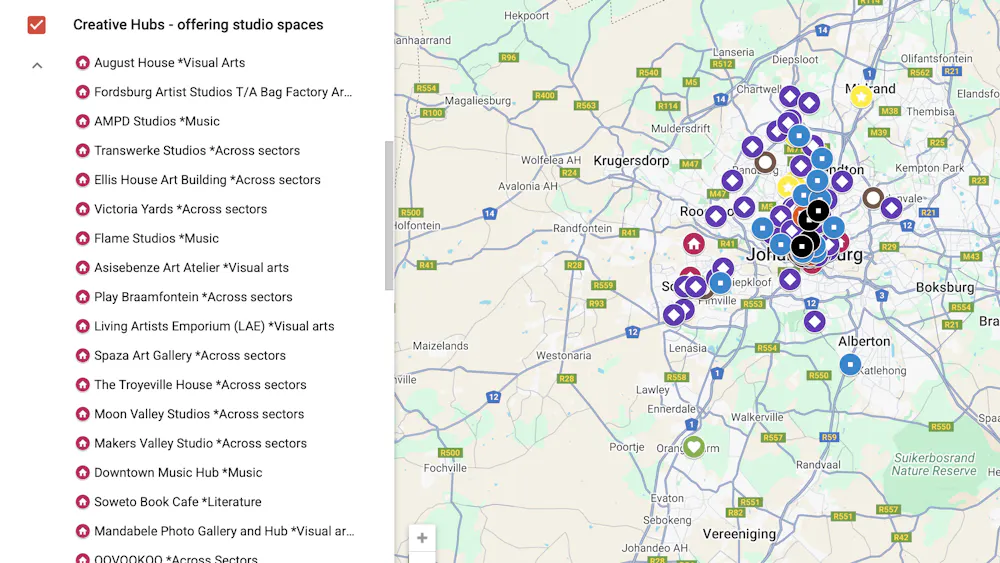
Over the last year, 21 creative hubs have been mapped in the city, the majority newly established. Notable examples include Transwerke Studios, Asisebenze Art Atelier, Victoria Yards and Oovookoo. Remarkably, 19 of the 21 hubs identified in my open-source mapping process are in the inner city. Only two are government run – Transwerke and Downtown Music Hub.

Across Johannesburg, creative hubs buzz with independent activity, yet share a common commitment to cultivating talent, business support and community impact. They are evidence of innovative partnerships between creatives and property developers.

Mapping Johannesburg’s creative hubs. Google Maps/Mariapaola McGurk

Inside these spaces, artists and creatives get opportunities through gallerist and investor visits (access to markets). They build practical and entrepreneurial skills through tailored workshops. And they collaborate on projects that place social upliftment at their heart.

Some hubs focus on offering studio spaces, while others extend their reach beyond their walls, blending artistic expression with community development and public engagement.

By actively building community and opportunity, creative hubs are becoming

lighthouses for the new urban economy.

They are small business incubators, urban beautification engines and potential cultural tourism hotspots. An event like Contra Fair opens the doors of art studio hubs once a year. Entrepreneur and social activist Tebogo Moalusi has now taken the lead in the establishment of Creative20. This will become a platform for revitalising Johannesburg’s creative cities campaign.

Neglected by the city

And yet the cultural and creative industries remain almost entirely absent from the city’s strategic planning. The Johannesburg 2040: Growth and Development Strategy fails even to mention the sector.

Bag Factory Artists Studios hosting a public event. Mark Straw

This is despite Gauteng, the province that houses Johannesburg, being the epicentre of South Africa’s creative economy. It contributes 46.3% of the industry’s gross domestic product and generates the highest employment impact. Johannesburg hosts the majority of creative businesses in the province.


Read more: The real Johannesburg: 6 powerful photos from a gritty new book on the city


The Gauteng 2030 Strategy highlights three high-growth sectors: agro-processing, cultural and creative industries, and high-tech/knowledge sectors, including digital and gaming. Two of these directly involve the creative economy. Yet there’s been little effort to integrate them into Johannesburg’s urban development agenda.

If Johannesburg is serious about inclusive economic development and sustainable urban growth, it must recognise and invest in the cultural and creative industries which are already thriving within its borders.

– Johannesburg’s creative hubs are booming: how artists are rejuvenating a failing inner city
– https://theconversation.com/johannesburgs-creative-hubs-are-booming-how-artists-are-rejuvenating-a-failing-inner-city-260224