African Island States Advance Ocean Partnerships and Finance Innovation at United Nations (UN) Ocean Conference


Download logo

In a high-profile gathering during the Third United Nations Ocean Conference (UNOC3), the African Island States Climate Commission (AISCC), in partnership with the United Nations Economic Commission for Africa (ECA) and the Indian Ocean Commission (IOC), convened a High-Level Dialogue aimed at strengthening ocean partnerships and mobilizing innovative finance to support sustainable development across African Small Island Developing States. With participation from ministers, ambassadors, and senior officials representing island nations, United Nations agencies, and global development partners, the Dialogue marked a significant step toward aligning regional leadership, blue economy priorities, and climate finance strategies in pursuit of Sustainable Development Goal 14 (SDG14).

Held as an official side event in the UNOC3 Blue Zone, the Dialogue was guided by the theme “Strengthening Ocean Partnerships for Resilience and Sustainable Finance: Charting a Blue Future for African Island States and AIS SIDS.”

Discussions emphasized the unique vulnerabilities of African Island States, the need for coordinated climate and ocean governance, and the urgency of unlocking scalable, long-term financing solutions tailored to the needs of island nations.

Opening the event, Flavien Joubert, Chair of the AISCC and Minister of Agriculture, Climate Change and Environment for the Republic of Seychelles, described the conference as a unique opportunity for African Island States and Small Islands Developing States (SIDS) to demonstrate global leadership on ocean sustainability. He called for stronger cooperation across SIDS regions and emphasized the central role of the AISCC as an innovative platform for climate action and diplomacy. Minister Joubert highlighted existing partnerships with ECA, IOC, and the Green Climate Fund (GCF) as examples of how African island nations are working together to mobilize resources and build collective resilience. He reaffirmed Seychelles’ commitment to lead the AISCC in a spirit of solidarity and inclusion, “ensuring no island state is left behind.”

United Nations Under-Secretary-General for Economic and Social Affairs, Li Junhua, who served as Secretary-General of both the UNOC3 and the Fourth International Conference on SIDS (SIDS4), reiterated the UN’s full support for African SIDS. He noted that the Monitoring and Evaluation Framework for the Antigua and Barbuda Agenda for SIDS (ABAS) is nearing completion, and that work is underway to establish governance mechanisms for implementing the Multidimensional Vulnerability Index (MVI). Li also pointed to reforms in the SIDS Partnership Framework as part of ongoing efforts to ensure more effective and accountable cooperation with the international community.

Nassim Oulmane, Head of the Natural Resources, Green and Blue Economy Section at ECA, stated in his welcoming remarks that this Dialogue builds on momentum from key AISCC high-level events convened at the UNFCCC COP28, COP29, African Climate Summit, and 4th International SIDS Conference. He held that the region must continue strengthening regional and international cooperation, and unlock innovative, scalable solutions through tools like blue bonds and debt-for-ocean swaps, and other innovative mechanisms. “ECA, in partnership with AISCC, is proud to support initiatives like the RESIslands project, funded by the GCF,” he said. “Together, we are advancing integrated approaches to promote ocean health, sustainable development, and climate resilience—leaving no one behind.”

In the ministerial panel, national leaders from across the region provided a grounded view of both challenges and opportunities. Nilda Borges da Mata, Minister of Environment, Youth and Sustainable Tourism of São Tomé and Príncipe, said that unity among African SIDS is key to advancing sustainable development.

“When we speak with one voice, we gain strength. When we share knowledge, we gain resilience. And when we cooperate, we attract the resources we need,” she said. Borges da Mata reaffirmed her country’s support for the AISCC as a critical platform to promote regional cooperation on climate and ocean priorities.

Guinea-Bissau’s Minister of Environment, Biodiversity and Climate Action, Viriato Soares Cassamá, announced that his country will host the next Ministerial Meeting of the AISCC later this year. He revealed the upcoming meeting as a decisive moment for the AISCC to launch a Joint Declaration on Oceans and Climate, a Sustainable Finance Action Plan, and new governance mechanisms that include women, youth, and local voices.

Maria Ebiaca Moete, State Secretary of Finance, Planning and Economic Development of Equatorial Guinea, emphasized the importance of investment in locally led, community-based solutions. “We see the RESIslands Initiative as a key platform to channel investment into sustainable, locally led projects,” she said. Moete also called for the creation of a dedicated international funding mechanism for island states and urged development partners to design financing instruments that are simpler, more flexible, and more accessible for vulnerable island economies.

Fabrice David, Junior Minister of Agro-Industry, Food Security, Blue Economy, and Fisheries of Mauritius, called for a shift in perception of SIDS from fragile to formidable. “This is a critical moment for SIDS to show leadership as Big Ocean States,” he said. “SDG14 remains the most underfunded of all global goals. That must change.” Minister David introduced the Blue Finance Hub initiative, developed with support from the Africa Natural Capital Alliance (ANCA) and FSD Africa, which he described as a promising model for catalyzing nature-positive investments in the blue economy, with potential for replication across other African island nations.

The panel featured senior-level participation from Cabo Verde and Madagascar, too. In addition to the governmental interventions, the event included the United Nations Secretary-General Special Envoy for the Ocean, the Deputy Secretary-General of the Organisation for Economic Co-operation and Development (OECD), the UN Resident Coordinator in Cabo Verde, as well as senior speakers from the Indian Ocean Commission, the Green Climate Fund, the African Union Development Agency (AUDA-NEPAD), the SIDS Hub at the Foreign, Commonwealth & Development Office of the United Kingdom, and the ANCA Secretariat of FSD Africa.

Throughout the High-Level Dialogue, speakers stressed the urgency of rethinking the global financial system to respond more effectively to the realities of island nations, and the need for AIS SIDS to have a stronger voice in shaping international ocean and climate frameworks. The meeting reaffirmed the role of the AISCC as a unifying body for African Island States, driving forward shared strategies on SDG 14 and building a sustainable, climate-resilient blue future through partnership, innovation, and action.

Distributed by APO Group on behalf of United Nations Economic Commission for Africa (ECA).

67th Economic Community of West African States (ECOWAS) Summit: H.E. Julius Maada bio, President of Sierra Leone, is the new chairman of the Authority of Heads of State and Government for a one-year term


Download logo

The Authority of Heads of State and Government of the Economic Community of West African States (ECOWAS) held its Sixty-Seventh Ordinary Session, today, 22 June 2025, in Abuja, Nigeria.

During the Session, the Heads of State considered the report of the 94th Ordinary Session of the Council of Ministers, and reports on the State of the Community, the Security and Political Situations in the Region, among others.

H.E. Dr. Omar Alieu Touray, President of the ECOWAS Commission, warmly welcomed ECOWAS leaders while paying tribute to Nigeria’s leadership and hospitality under H.E. President Bola Ahmed Tinubu’s Chairmanship of the Authority.

Dr. Touray highlighted ECOWAS’s achievements over the past 50 years, reaffirming its standing as Africa’s most advanced Regional Economic Community despite ongoing challenges. He stressed that dialogue with the three member states that have withdrawn is progressing positively, and he called for stronger support for the region’s private sector to drive sustainable growth, job creation, and deeper integration. He paid tribute to ECOWAS’s Founding Fathers for laying the foundation for unity and regional cooperation.

In his opening statement, H.E. Bola Ahmed Tinubu, President of the Federal Republic of Nigeria and Chair of the Authority of ECOWAS Heads of State and Government, reflected on ECOWAS’s remarkable achievements for the past 50 years while urging leaders to confront persistent security threats. He emphasized that no single country could tackle terrorism, violent extremism, and cross-border crimes alone, and called for stronger coordination, political will, and decisive collective action to safeguard peace and stability across West Africa.

“While celebrating our achievements over the past 50 years, we must also confront the challenges that continue to impede our aspirations; like the security threats, violent extremism and other cross-border crimes that continue to widen and deepen in their intensity. No single Nation 

can address these challenges alone. We must rethink coordination, amplify political will, and prioritise a collective approach to security. We must act decisively on the fight against terrorism to serve as instrument for peace and stability for our region”, he stressed.

H.E. Leonardo Santos Simão, Special Representative of the UN Secretary-General for West Africa and the Sahel (UNOWAS), in his statement, conveyed the UN Secretary-General’s warm greetings and reiterated the United Nations’ commitment to supporting peace, security, and regional integration in West Africa. He highlighted the UN’s active diplomatic engagement across the region and underscored the urgent need for collective action against terrorism, which remains the most significant threat to stability.

In his message, H.E. Mahmoud Ali Youssouf, Chairperson of the African Union Commission, delivered by H.E. Ambassador Bankole Adeoye, Commissioner for Political Affairs, Peace and Security of the African Union Commission, conveyed heartfelt congratulations to ECOWAS leaders and citizens on the 50th anniversary of ECOWAS. He celebrated ECOWAS’s legacy as a symbol of unity, resilience, and regional integration since its founding in 1975.

Looking ahead, the AU Chairperson urged a united and coordinated response to pressing challenges, including terrorism, violent extremism, and unconstitutional changes of government, while deepening efforts to tackle poverty and inequality. He reaffirmed the AU’s unwavering support for ECOWAS and called for a people-centred Community where youth and women lead regional transformation through innovation, technology, and quality education.

The Authority of ECOWAS Heads of State and Government at the end of the Summit elected H.E. Julius Maada Bio, President of the Republic of Sierra Leone as the Chairman of the Authority to replace H.E. Bola Ahmed Tinubu, President of the Federal Republic of Nigeria, whose tenure came to an end. A communique will be issued at the end of the Summit.

Distributed by APO Group on behalf of Economic Community of West African States (ECOWAS).

Food and Agriculture Organization of the United Nations (FAO) and International Plant Protection Convention (IPPC) launch second phase of the Africa Phytosanitary Programme

The Food and Agriculture Organization of the United Nations (FAO) and the International Plant Protection Convention (IPPC), in collaboration with the Government of South Africa, represented by the Department of Agriculture, launched the second phase of the Africa Phytosanitary Programme (APP) today – representing a major effort to stop the spread of plant pests and diseases in Africa using cutting-edge digital tools.

The launch event was hosted by the Government of South Africa and brought together over 50 phytosanitary specialists from nine countries: Algeria, Cape Verde, Chad, the Republic of Congo, Liberia, Malawi, Senegal, South Africa and Tunisia. They will participate in a weeklong Train-the-Trainer (ToT) workshop in advanced pest surveillance techniques, including the use of customised digital tools and applications for monitoring, detecting and reporting major pests of economic, regulatory and environmental importance in Africa. Participants will receive state-of-the-art tablets for geospatial pest surveillance, use field survey protocols developed by technical experts, and undertake practical sessions using the pest survey tools.

“Africa stands at a turning point. With immense biodiversity, rising agricultural productivity, and growing opportunities under the African Continental Free Trade Area (AfCFTA), we are well-positioned to become a global leader in the trade of high-quality plant products. But this vision can only be achieved if we ensure that the movement of plants and plant products is safe, traceable, and fully compliant with international phytosanitary standards” said John Henry Steenhuisen, Honourable Minister of Agriculture, in South Africa, in remarks read on his behalf by Jan Hendrik Venter, South Africa’s Director of Plant Health.

“Well-trained, well-equipped plant health officials across the continent are our best line of defence in maintaining pest-free or low-prevalence status, an essential condition for accessing these lucrative markets”, he added.

The first and pilot phase of APP started in 2023, engaging phytosanitary specialists from Cameroon, Democratic Republic of Congo, Egypt, Guinea-Bissau, Kenya, Mali, Morocco, Sierra Leone, Uganda, Zambia and Zimbabwe. Phase 2 builds on achievements made in the pilot phase and aims to train plant health officers, who upon their return to their countries will teach their peers in the national plant protection organisations (NPPOs) and other government stakeholders on the use of the APP suite of digital tools.

“We are building a critical mass of phytosanitary inspectors, technicians and officers across Africa by equipping plant health officers with the tools and skills to prevent and address major plant pest threats, that ultimately jeopardize food security, agricultural trade, economic growth and the environment”, said Beth Bechdol, FAO Deputy Director-General and Officer-in-Charge of the IPPC, in her video message.

Funded through generous contributions from the European Union and the United Kingdom of Great Britain and Northern Ireland, APP phase two builds on support from the United States Department of Agriculture (USDA), Animal and Plant Health Inspection Service (APHIS) which funded phase one in 2023. FAO and the IPPC are working to replicate and scale up the benefits from APP to more African countries and other regions. 

Mitigating the pest problem in Africa

Worldwide, plant pests destroy about 40 percent of crop yields, resulting in approximately USD 220 billion in economic losses[1]. In Africa, the impacts of climate change are worsening  the problem, with invasive pests – such as, fruit flies, false codling moth, maize lethal necrosis disease, citrus greening and fall armyworm – causing major damages. Fall armyworm alone is estimated to cause the highest yield loss in Africa – USD 9.4 billion annually –, based on data from the Centre for Agriculture and Bioscience International (CABI). 

The African Union’s Plant Health Strategy for Africa highlights that limited technical capability remains a key barrier to achieving sustainable agriculture on the continent. Through APP, FAO, the IPPC and partners aim to strengthen plant health systems and build national phytosanitary capacity across Africa.

Distributed by APO Group on behalf of Food and Agriculture Organization of the United Nations (FAO): Regional Office for Africa.

Media files

Download logo

Cabo Verde: Unlocking Inclusive Growth Through Increased Resilience and Equal Opportunities


Download logo

Cabo Verde’s economy continues on a strong recovery path, according to the latest Cabo Verde Economic Update 2025, released today by the World Bank. Real GDP in Cabo Verde grew by 7.3% in 2024, supported by robust tourism activity and a modest recovery in agriculture. However, while the country has made notable strides – particularly in macroeconomic management, debt reduction, and poverty alleviation – key vulnerabilities remain. These include reliance on tourism, exposure to external shocks, and fiscal pressures from state-owned enterprises (SOEs).

The report, titled Unlocking Women’s Economic Potential, analyses the country’s economic growth projections, highlights progress on poverty alleviation, and outlines the structural reforms needed to ensure sustained and inclusive growth. The report also includes a special topic, focused on leveraging women’s economic potential.

“Cabo Verde’s recovery is a testament to the resilience of its people and institutions. But to transform this rebound into lasting and inclusive prosperity, bold reforms are needed – particularly to improve SOE governance, support women’s economic participation, and diversify the economy,” said Indira Campos, World Bank Resident Representative for Cabo Verde.

The report notes that inflation dropped to 1% in 2024 – its lowest level in recent years – helping to bring poverty down to 14.4% ($3.65 a day 2017PPP line). Public investment execution increased, debt levels continued to decline, and the current account posted a surplus for the first time in four years.

Looking ahead, GDP growth is projected at 5.9% in 2025, with poverty expected to fall further. However, the report warns that global uncertainties, commodity price shocks, and climate risks could affect the pace of growth and reform. Among the recommendations, the report calls for accelerated efforts to improve SOE performance, prudence in creating new ventures, and for maintaining fiscal discipline while investing in high-impact projects.

The report highlights the critical need for policies to ensure growth is inclusive. Despite progress in education and health, Cabo Verdean women continue to face labor market barriers. The report finds that closing gender gaps in employment and earnings could boost GDP by up to 12.2% in the long-term.

To achieve this, the report recommends:

  • Expanding access to childcare and flexible work arrangements.
  • Promoting women’s skills in science, technology, engineering, and mathematics (STEM), as well as in technical and vocational education and training.
  • Tackling employer discrimination and transforming social norms.

By aligning reform efforts with inclusive policies, Cabo Verde has a unique opportunity to strengthen resilience, empower more citizens – especially women – and build a more sustainable and equitable future,” said Anna Carlotta Massingue, Senior Country Economist.

Distributed by APO Group on behalf of The World Bank Group.

Morocco: Foreign Minister Receives Comorian Peer, Bearer of Written Message from Comores President to His Majesty the King

Source: Africa Press Organisation – English (2) – Report:

Download logo

The Minister of Foreign Affairs, African Cooperation and Moroccan Expatriates, Mr. Nasser Bourita, received, on Monday in Rabat, the Minister of Foreign Affairs and International Cooperation of the Union of the Comoros, Mbae Mohamed, bearer of a written message to His Majesty King Mohammed VI from Comorian President Azali Assoumani.

The two ministers tackled various bilateral cooperation areas and discussed topics of common interest.

– on behalf of Kingdom of Morocco – Ministry of Foreign Affairs, African Cooperation and Moroccan Expatriates.

Morocco: His Majesty the King Congratulates Grand Duke, Grand Duchess of Luxembourg on National Day

Source: Africa Press Organisation – English (2) – Report:

Download logo

His Majesty King Mohammed VI sent a congratulatory message to their Royal Highnesses Grand Duke Henri and Grand Duchess Maria Teresa of Luxembourg on the occasion of their country’s national day.

In this message, the Sovereign extends His best wishes for happiness to their Royal Highnesses and prosperity to the people of Luxembourg.

On this occasion, His Majesty the King expresses His esteem for the friendship ties uniting Morocco and the Grand Duchy of Luxembourg.

– on behalf of Kingdom of Morocco – Ministry of Foreign Affairs, African Cooperation and Moroccan Expatriates.

Empowering solutions for South Africa’s energy future


Download logo

Electricity Expo Africa 2025 (www.ElectricityExpoAfrica.com) is set to convene South Africa’s leading minds and innovators in the energy sector, offering a critical platform for tangible solutions to the nation’s power crisis. Taking place from 19 to 21 August 2025 at the Johannesburg Expo Centre, this inaugural event arrives at a pivotal moment as the country grapples with persistent energy instability. 

Themed ‘Empowering Solutions for South Africa’s Energy Future’, the Expo will address national grid constraints, accelerate the adoption of renewable energy, promote off-grid innovation, mitigate load shedding, and modernise infrastructure and regulation. 

Organised by the Electrical Contractors Association (SA) and the South African Electrical Workers Association (SAEWA) and proudly endorsed by the National Bargaining Council for the Electrical Industry, Electricity Expo Africa 2025 (https://apo-opa.co/4egPsr8) is a focused space for stakeholders committed to real-world impact. 

“Electricity is the engine of development. This Expo is more than just an industry gathering – it’s a national imperative, a call to action for every stakeholder invested in South Africa’s future,” said Jimmy Turner, Chairperson of Electricity Expo Africa. “We are uniting solution-providers, policymakers, and communities to collectively transform South Africa’s energy landscape from one of scarcity to one of reliability and abundance.” 

Three Pillars of Focus 

1. Confronting the National Grid Crisis 

South Africa’s ageing grid requires urgent intervention. At the heart of the Expo is a drive to modernise infrastructure through automation, smart diagnostics, and maintenance innovations. By gathering grid experts and transmission specialists, the event will foster knowledge exchange on how to prevent failures and accelerate national upgrade projects. 

This effort supports the National Energy Action Plan, which aims to restore Eskom’s reliability and accelerate the development of new power capacity. 

“Ending load shedding requires more than just talk; it demands real tools, smart systems, and urgent implementation of practical solutions,” emphasised Turner. “This Expo will present actionable answers – from cutting-edge grid technologies that bolster resilience to policy reforms that streamline infrastructure development. It’s about turning challenges into opportunities for growth.” 

2. Accelerating Renewable and Off-Grid Solutions 

South Africa’s energy future depends on a diversified generation mix. With the rapid rise of solar adoption – from 2,300 MW in 2022 to over 5,400 MW by early 2024 – the Expo will highlight solar PV, wind, and battery storage technologies that enable homes, businesses, and municipalities to generate electricity independently and reduce their reliance on the national grid. 

Over 130 IPP projects, totalling roughly 22,500 MW, are also in the pipeline. At the Expo, both large-scale and decentralised innovations will be on display, including off-grid and mini-grid solutions for rural and high-risk areas. 

Attendees will engage directly with tech developers and solution providers, demonstrating the tools needed to power communities and commercial hubs even in the absence of national supply. 

3. Innovation in Policy, Infrastructure, and Regulation 

The recent Electricity Regulation Amendment Act marks a new era for South Africa’s electricity sector, introducing reforms such as an independent transmission system operator and a competitive power market. But policy must match pace with technology. 

Electricity Expo Africa 2025 (https://apo-opa.co/4kYvdAY) will feature high-level discussions with government, regulators, and industry leaders. Topics include streamlining licences for renewables, energy storage incentives, updated grid codes, and infrastructure financing – crucial considering the estimated R390 billion needed for national grid expansion. 

“We are not just showcasing innovation; we are driving a national movement towards a resilient, inclusive electricity system,” added Turner. “Electricity Expo Africa 2025 is where solutions become action, fostering the collaboration between government, industry, and civil society that is essential for a truly sustainable energy future.” 

Who Needs to Be There 

Electricity Expo Africa 2025 will host over 150 exhibitors and more than 60 expert speakers, creating a platform for high-impact visibility and engagement. Key participants will include: 

  • Policymakers and Energy Officials – Sharing reforms and strategic plans. 
  • Municipal Utility Leaders – Highlighting local innovation and micro-grids. 
  • Renewable Energy Innovators – Showcasing new generation technologies. 
  • Grid Technology and Storage Providers – Presenting advanced smart-grid systems. 
  • Financing and Infrastructure Partners – Exploring capital mobilisation and PPPs. 
  • Community Energy Access Organisations – Championing equitable power access. 

This expansive programme creates a rare opportunity for businesses to place their innovations at the centre of national dialogue and development. 

Turner underscores the dual opportunity for exhibitors: “Exhibiting at Electricity Expo Africa 2025 is more than a marketing opportunity – it’s a chance to fuel your company’s growth and help power South Africa’s energy transformation. We encourage businesses large and small to showcase their innovations at the Expo, where they can build valuable relationships and play a role in securing the nation’s energy future.” 

Event details: 

Distributed by APO Group on behalf of Electricity Expo Africa (EEA).

Issued By: The Lime Envelope 
On Behalf Of: Electricity Expo Africa 

For Media Information: 
Kerry Oliver 
Telephone: 082 927 9470 
E-mail: kerry@thelime.co.za  

African Energy Week (AEW) 2025 Promotes Africa-Centric Energy Transition with Dedicated Program Track

The African Energy Week (AEW): Invest in African Energies conference – taking place on September 29 to October 3 in Cape Town – is organized under a mandate to make energy poverty history by 2030. As such, the event connects financiers with African projects, promoting energy development across the entire energy sector and its value chain. A dedicated Energy Transition Track at this year’s event offers attendees insight into the continent’s energy transition strategy, with panel discussions covering a series of topics, from natural gas as a clean cooking fuel to carbon capture and storage solutions to green hydrogen and renewable energy rollout.

AEW: Invest in African Energies is the platform of choice for project operators, financiers, technology providers and government, and has emerged as the official place to sign deals in African energy. Visit www.AECWeek.com for more information about this exciting event.

With over 900 million people living without access to clean cooking solutions in Africa, many countries are adopting bold strategies to advance the adoption of natural gas products such as LPG. Kenya, for example is rolling out LPG expansion, electric cooking and bioethanol alternatives with support from private sector investment, Tanzania is integrating clean cooking solutions into its national electrification plan and broader energy transition strategy while Ghana has adopted a multi-pronged approach, enhancing LPG affordability and scalability. The AEW: Invest in African Energies 2025 Energy Transition Track will feature panel discussions focused on Africa’s burgeoning LPG market. Sessions include From Firewood to Freedom: Promoting Clean Cooking in Africa; Monetizing LPG to Enhance the Value of the Barrel in Africa’s Inland Markets; and Gas-to-Liquids Market Opportunities in Africa.

Given the pressing energy access challenges faced across the continent, Africa has long-advocated for an energy transition strategy that takes into account the continent’s energy and climate needs. In this regard, many countries are pursuing a just transition, which utilizes a variety of solutions from low-carbon oil to non-associated gas to renewable energy and integrated power systems. According to the International Energy Agency, meeting Africa’s energy demand will require annual investments to more than double by 2030, reaching $240 billion annually. The Energy Transition Track at AEW: Invest in African Energies 2025 not only offers a platform to discuss Africa’s just transition strategy, but lays out strategic investment prospects across the entire energy value chain. Sessions include Just Energy Transition Dialogue: Harnessing Africa’s Resource Wealth to Establish Energy Sovereignty; Forging the Path for a Green Hydrogen Economy: Shifting from Planning to Meeting Global Market Demands; and Overcoming Infrastructure Gaps: Innovations in Road, Rail and Transport Connectivity Across Africa.

The AEW: Invest in African Energies 2025 Energy Transition Track goes beyond promoting investments in energy projects to include strategic sessions on local content, inclusive participation and collaborative leadership. With a rapidly growing population, increased urbanization and soon-to-be the world’s largest workforce, Africa requires strategic commitments by governments and companies to accelerate capacity building, skills development and inclusive work practices. By 2050, Africa’s population is projected to increase to 2.5 billion people. As such, local content will serve as a catalyst for sustainable and equitable development. During the event, sessions will address these topics, including Energy Security in Africa: Why Women’s Participation in Africa’s Resource Governance Matters; From Start-Ups to Scale-Ups: Why SMEs are Africa’s Game Changers; and Collaborative Leadership: Operator Strategies for Local Content Development.

The Energy Transition Track will also feature an Invest in Uganda session, which offers exclusive insight into the country’s $10 billion energy portfolio, comprising a mix of hydrocarbon, infrastructure and renewable energy projects. The discussion will unpack how supportive policies, a stable regulatory environment and untapped resources have made the country an attractive market to invest in. Beyond panel discussions, the track will also feature a series of Fireside Chats. These sessions aim to provide insight into the respective investment strategies of various companies, with discussions paving the way for collaborations and deals. 

“AEW: Invest in African Energies 2025 takes place under a mandate to make energy poverty history, and as such, advocates for a just energy transition which encompasses the development of a variety of energy sources. The Energy Transition Track serves as a catalyst for this goal by uniting players from the renewable energy, natural gas, regulatory and infrastructure sectors to discuss strategies for securing investment and advancing projects in Africa,” states Verner Ayukegba, Senior Vice President, African Energy Chamber.

Distributed by APO Group on behalf of African Energy Chamber.

Media files

Download logo

President Ruto, Samaila Zubairu and Africa’s Top Chief Executive Officer’s (CEO) to Headline The Africa Debate in London

Invest Africa (www.InvestAfrica.com) is pleased to announce Africa Finance Corporation (AFC) as Headline Partner for the 11th edition of The Africa Debate, taking place on Wednesday, 2 July 2025 at the Guildhall, in the heart of the City of London.

This year’s theme — “Harnessing Natural Capital for Growth” — seeks to interrogate how Africa can transform the scale and structure of investment around its most enduring assets: from its critical minerals and fertile land to its human ingenuity and demographic dynamism.

Now firmly established as the UK’s premier forum for Africa-focused investment dialogue, The Africa Debate will convene over 700 senior decision-makers from across government, finance, and industry for a full day of high-level exchanges. Through keynote addresses, ministerial dialogues, and curated sector debates, the programme will explore how to turn extractive advantage into structural transformation — mobilising green industrialisation, digital infrastructure, intra-African trade, and new financial instruments to drive inclusive, climate-smart growth.

This year’s speaker line-up reflects the extraordinary breadth of voices shaping Africa’s next chapter, from heads of state to the stewards of global capital. Highlights include: H.E. William Ruto, President of the Republic of Kenya; H.E. Hailemariam Desalegn Boshe, Former Prime Minister of Ethiopia; Board Chair, TradeMark Africa; H.E. Wamkele Mene, Secretary-General, African Continental Free Trade Area Secretariat; Benedict Oramah, President, Afreximbank; Samaila Zubairu, President & CEO, Africa Finance Corporation; Abebe Aemro Selassie, Director, African Department, International Monetary Fund; Solomon Quaynor, Vice President for Private Sector, Infrastructure & Industrialisation, African Development Bank; Strive Masiyiwa, Founder & Chair, Econet Wireless; Duncan Wanblad, CEO, Anglo American; Wale Tinubu, CEO, Oando Plc; Monique Gieskes, CEO, PHC; Marie-Chantal Kaninda, President, Glencore DRC; and more. The full programme is now available to view here (http://apo-opa.co/4ljJqbx), with detailed sessions on value chain transformation, blended finance, regional infrastructure, and Africa’s positioning in a multipolar global economy.

Samaila Zubairu, President and CEO of Africa Finance Corporation, commented: “Natural capital is only as valuable as the systems that refine, protect, and elevate it. At AFC, we believe that infrastructure is the bridge between Africa’s resource richness and the continent’s ability to rapidly industrialise and take its rightful place on the global stage. Our partnership with Invest Africa and The Africa Debate underscores the need for thoughtful, long-term capital — deployed strategically — to unlock the continent’s full economic potential. We are proud to support a platform that challenges assumptions and catalyses bold, bankable solutions.”

Chantelé Carrington, CEO of Invest Africa, added: “Africa’s path to prosperity must be built not on extraction, but on transformation. This year’s theme compels us to ask harder questions about how we steward the continent’s assets — human, natural, and institutional — in a world shaped by climate change, technological disruption, and shifting geopolitical priorities. With AFC’s visionary leadership, we are honoured to convene a dialogue that is ambitious in scope, rigorous in thought, and focused on meaningful outcomes.”

Confirmed Sponsors of The Africa Debate Include: Africa Finance Corporation (Headline Partner), Absa Group, Afreximbank, FirstBank UK Limited, Invest KZN, Standard Chartered, Standard Bank Group, Plantations et Huileries du Congo, Lagos Free Zone (Tolaram), Octopus Energy, ServiceNow, Stellar Developments, Spiro, Safaricom, Premier Invest, Remittances Hub, S-RM, DLA Piper, and London Stock Exchange Group.

To register as a delegate for The Africa Debate, please visit: https://apo-opa.co/4efWGM0. Places are limited and advance registration is essential.

Distributed by APO Group on behalf of Invest Africa.

For more information or media enquiries, please contact:
Pippa van Breda

Marketing & Communications Manager
Invest Africa
T: +44 2037 305 035
E: pippa.vanbreda@investafrica.com

About The Africa Debate:
The Africa Debate is London’s premier investment forum dedicated to shaping the future of African trade, investment, and economic transformation. Now in its 11th year, the event serves as a critical platform for global businesses, investors, policymakers, and thought leaders to engage in high-level discussions on Africa’s evolving role in the global economy.

About Invest Africa:
Invest Africa is a leading pan-African business platform that promotes trade and investment across the continent. With a 60-year heritage and a network of over 400 global members, Invest Africa provides trusted intelligence, strategic connections, and high-level convenings to support business success across African markets.

About Africa Finance Corporation:
Africa Finance Corporation is Africa’s leading multilateral finance institution, focused on bridging the continent’s infrastructure gap through innovative, commercially viable, and sustainable investments.

Media files

Download logo

Which African countries are flourishing? Scientists have a new way of measuring well-being

Source: The Conversation – Africa – By Victor Counted, Associate Professor of Psychology, Regent University

What does it mean to live a good life? Psychologists and social scientists have been focusing on a new idea called flourishing – a sense of well-being that goes beyond just happiness or success. It’s about your whole life being good, including how you interact with other people and your community. So then, how do Africans fare when it comes to flourishing?

Victor Counted is a psychological scientist whose research across 40 African countries offers a data-rich rethinking of flourishing on the continent. His findings challenge the dominant narrative that Africa is “lagging behind” in development by showing a more nuanced picture of what it means to live a good life. We asked him more.


What is flourishing?

Flourishing is more than economic growth or individual happiness. It’s a multidimensional state of being that reflects how people feel about their lives and how well their lives are actually going. So it also measures people’s values within their community.

The idea of well-being often carries a Eurocentric emphasis on the individual – personal satisfaction, autonomy, achievement. Flourishing accounts for how whole a person is in relation to their environment.

It includes the social, spiritual and ecological contexts in which one lives. So, it’s not just about how one feels, but how one lives – fully, meaningfully and in a satisfying relationship with the world around us.

What’s the Global Flourishing Study?

The Global Flourishing Study tries to measure global patterns of human flourishing. It’s an ongoing five-year longitudinal study in over 200,000 participants across 22 countries.

I was one of the team of global scholars brought together to examine the trends on what it means to live well across cultures and life circumstances.


Read more: What makes people flourish? A new survey of more than 200,000 people across 22 countries looks for global patterns and local differences


The study identifies six key dimensions of flourishing:

  • Happiness and life satisfaction
  • Mental and physical health
  • Meaning and purpose
  • Character and virtue
  • Close social relationships
  • Financial and material stability

Participants rate how they’re doing in each of these areas on a scale from 0 to 10. Further questions capture experiences related to trust, loneliness, hope, resilience, and other related well-being variables.


CC BY-ND

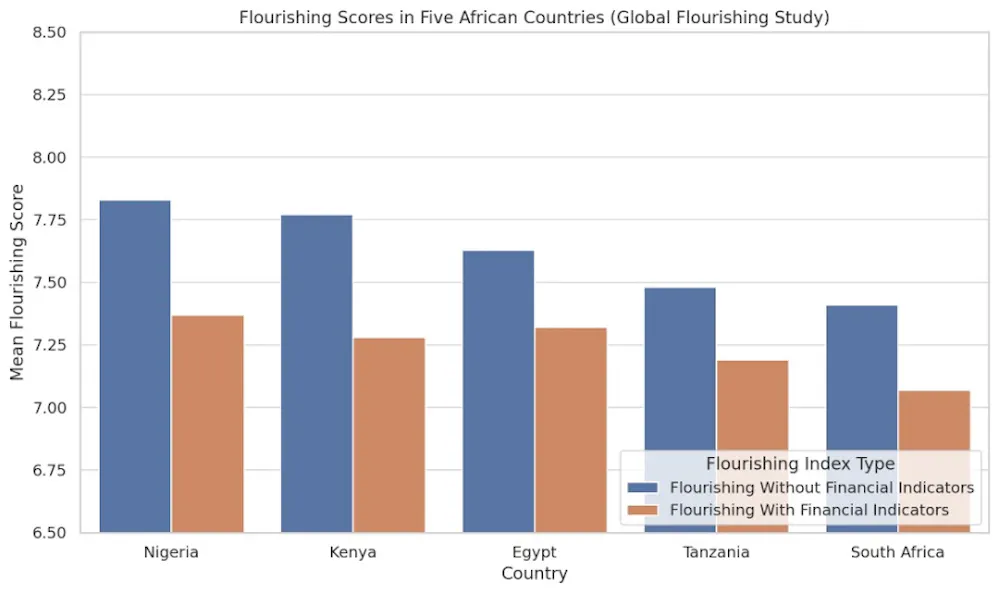
Of the 22 nations, five were African: Nigeria, Kenya, South Africa, Tanzania and Egypt.

While these countries didn’t top the global rankings (Indonesia and Mexico did), Nigeria, Kenya and Egypt all reported relatively high flourishing scores, especially when well-being was considered apart from financial status.


Courtesy Victor Counted

Nigeria, for example, ranked 5th globally in flourishing scores that excluded financial indicators – ahead of many wealthier nations. Nigerians indicated strengths in social relationships, character and virtues (like forgiveness or helping others). But potential areas of growth included financial well-being, housing, ethnic discrimination and education.

Overall, this suggests that while material resources matter, they’re not the only thing that determines well-being. Kenya ranked 7th, Egypt 10th, Tanzania 11th and South Africa 13th. Each showed unique strengths in areas like meaning, social connection or mental health.

You did a separate study on flourishing in Africa. What did you find?

In a 2024 study we analysed data from the Gallup World Poll (2020–2022) to explore 38 indicators of well-being across 40 African countries.

This study offered a more detailed and culture-sensitive picture of how Africans experience and prioritise flourishing. The dimensions explored were derived from both local and universal sources, allowing for regionally relevant insights.

We found that African populations often score high in meaning, character and social relationships – despite economic hardship. This offers an important corrective to western assumptions about well-being.

Some of our key findings were:

● There is significant diversity between and within African countries. Mauritius consistently ranked highest in life evaluations (overall satisfaction with their lives), while countries like Sierra Leone and Zimbabwe scored lowest.

● East African countries such as Rwanda and Ethiopia showed strong performance in social well-being indicators (like feeling respected or learning new things daily) even when economic indicators were low.

● Countries in West Africa, such as Senegal and Ghana, scored high in emotional well-being, with many people reporting positive daily emotions like enjoyment and laughter.

● Southern African nations, despite challenges like income inequality, displayed resilience through strong community ties and cultural practices rooted in the philosophy of ubuntu.

The results reinforced that flourishing in Africa cannot only be reduced to gross domestic product (GDP) per capita (a measure of the average economic output per person in a country) – nor to western norms of success.

What can African countries focus on to flourish?

In my view, the path to greater flourishing lies in embracing local knowledge and investing in culturally relevant development priorities. Instead of following western pathways – centred on individual advancement – Africa can model alternative flourishing pathways that reflect what matters most to African people.

1. Prioritise local knowledge systems

African ideas about a connected society – like ubuntu (southern Africa), ujamaa (east Africa), teranga or wazobia (west Africa), and al-musawat wal tarahum (north Africa) teach people to care for each other and live in peace. These values help people live meaningful lives and can inform leadership and legislation.

2. Redefine development metrics

Western development models focus on individual achievement, economic output and material consumption. GDP per capita fails to capture the everyday realities and aspirations of African communities. We should also measure things like how happy people are, how hopeful they feel about the future, how strong and resilient their communities are, and how clean, safe and dignifying their living environments are.

This is not a new idea – for years development scholars have called for a shift away from narrow economic indicators toward a focus on human dignity, agency, and the real opportunities people have to pursue the lives they value. What’s new is the growing availability of data and the momentum to take these alternative metrics seriously in shaping national policies and priorities.

3. Invest in education for character development

Quality education is essential to unlocking the continent’s potential to flourish. But Africa needs more than just academic skills and workforce readiness – it needs a strategy for intentional development of values and habits that shape how a person thinks, feels, and acts with integrity.

Part of the problem lies in how the humanities – fields like history, literature, philosophy, and religious studies – are often undervalued or underfunded in education systems. But it is precisely these disciplines that nurture moral imagination, critical reflection, and civic responsibility. We need educational models that form not just workers, but whole persons – people who can think ethically, act responsibly, and lead with character in their communities.


Read more: What makes a person seem wise? Global study finds that cultures do differ – but not as much as you’d think


What does Africa offer the world in terms of flourishing?

Africa is not waiting to be saved. Across the continent, people are building communities of care, cultivating joy amid hardship, and passing on values of unity, faith, and compassion. This is what development looks like when rooted in human dignity.

Africa flourishing goals offer an alternative vision for development – one that starts with what Africa already has, not what it lacks. These are locally emic aspirations for well-being. They are shaped by Africa’s indigenous knowledge systems, cultural values, and religious/spiritual traditions. Pursuing these goals means prioritising wholeness over wealth, community over consumption, and resilience over rescue.

The continent has so much to offer the world: wisdom, strong community values, and ways of staying resilient and living fully even in hard times. But many of these local insights are missing in the global science of well-being.

– Which African countries are flourishing? Scientists have a new way of measuring well-being
– https://theconversation.com/which-african-countries-are-flourishing-scientists-have-a-new-way-of-measuring-well-being-257458