Le Groupe de coordination arabe (GCA) (https://TheACG.org/) a tenu une réunion technique périodique de ses chefs d’opérations les 8 et 9 décembre 2025 à Riyad, en Arabie saoudite, afin d’examiner les initiatives communes et les projets de développement. Cette réunion, organisée dans le cadre des activités courantes, a permis de faire le point sur les travaux en cours, de présenter des rapports d’étape et de la mise en œuvre les directives techniques.
Organisée par le Programme du Golfe arabe pour le développement (AGFUND), la réunion a rassemblé des représentants et des experts de haut niveau de toutes les institutions membres du GCA. Les participants ont examiné l’avancement des programmes en cours, exploré de nouvelles pistes de collaboration et défini les priorités essentielles pour accélérer le développement durable dans les pays membres et partenaires.
Les discussions ont porté sur le renforcement des mécanismes de financement conjoints, la promotion de l’innovation dans la coopération au développement et le développement de programmes de résilience climatique et sociale conformes aux Objectifs de développement durable (ODD). Le groupe a également donné suite à des engagements antérieurs, notamment aux réunions virtuelles tenues le 27 novembre avec le Fonds vert pour le climat et le Centre régional pour les énergies renouvelables et l’efficacité énergétique, qui visaient à nouer de nouveaux partenariats avec des partenaires potentiels afin d’atteindre des objectifs communs.
La réunion a mis en lumière plusieurs sujets clés, dont le Prix Abdellatif Y. Al-Hamad pour le développement dans le monde arabe, Le Prix International du Prince Talal pour le Développement Humain, le rapport consultatif du Groupe sur ses orientations stratégiques futures et les résultats des célébrations du 50e anniversaire du GCA, qui se sont tenues en octobre à Washington, D.C. Les représentants ont souligné l’importance de la solidarité, du partage des connaissances et d’une action coordonnée pour relever les nouveaux défis mondiaux et renforcer l’impact collectif du Groupe.
Les conclusions de la réunion contribueront à orienter et à renforcer l’engagement du GCA en faveur de partenariats efficaces, de financements innovants et du développement durable à l’échelle mondiale.
Distribué par APO Group pour Arab Coordination Group (ACG).
The Arab Coordination Group (ACG) (https://TheACG.org/) convened a periodic technical meeting of Heads of Operations on December 8–9, 2025, in Riyadh, Saudi Arabia, to discuss joint initiatives and development projects. The meeting served as a routine session to continue ongoing work, deliver progress reports, and implement directives at the technical level.
Hosted by the Arab Gulf Programme for Development (AGFUND), the meeting brought together senior representatives and experts from all ACG member institutions. Participants reviewed progress on ongoing programs, explored new opportunities for collaboration, and agreed on key priorities to accelerate sustainable development across member and partner countries.
Discussions focused on enhancing joint financing mechanisms, promoting innovation in development cooperation, and advancing climate resilience and social programs aligned with the Sustainable Development Goals (SDGs). The group also followed up on prior engagements, including virtual meetings held on November 27 with the Green Climate Fund and the Regional Center for Renewable Energy and Energy Efficiency, aimed at fostering new partnerships with potential partners to achieve shared objectives.
The meeting highlighted several key topics, including the Abdlatif Y. Al-Hamad Development Award in the Arab World, Prince Talal International Prize for Human Development, the Group’s Advisory Report on future strategic directions, and outcomes from ACG’s 50th Anniversary Celebration, held in October in Washington, D.C. Representatives emphasized the importance of solidarity, shared learning, and coordinated action to address emerging global challenges and strengthen the Group’s collective impact.
The outcomes of the meeting will help guide and reinforce the ACG’s commitment to effective partnerships, innovative financing, and sustainable development globally.
Distributed by APO Group on behalf of Arab Coordination Group (ACG).
About the Arab Coordination Group (ACG):
The Arab Coordination Group (ACG) is a strategic alliance that provides a coordinated response to development finance. Since its establishment in 1975, the ACG has been instrumental in developing economies and communities for a better future, providing more than 13,000 development loans to over 160 countries around the globe. The ACG works across the globe to support developing nations and create a lasting, positive impact. The Arab Coordination Group (ACG) is considered one of the most important and effective development partnerships at the international level. The group actively works to adopt the best global practices in sustainable development work. It also aims to align the efforts of these institutions to achieve convergence and harmonization in the policies governing their financing operations.
The Group comprises 10 national, Arab regional, and international institutions, including the Abu Dhabi Fund for Development, the Arab Bank for Economic Development in Africa, the Arab Fund for Economic and Social Development, the Arab Gulf Programme for Development, the Arab Monetary Fund, the Islamic Development Bank, the Kuwait Fund for Arab Economic Development, the OPEC Fund for International Development, the Qatar Fund for Development and the Saudi Fund for Development. www.TheACG.org
HE Minister of State at the Ministry of Foreign Affairs Dr. Mohammed bin Abdulaziz bin Saleh Al Khulaifi met on Tuesday with HE Secretary-General of the Commonwealth, Shirley Ayorko Botchwey, who is visiting the country. During the meeting, the two sides discussed avenues of cooperation between the State of Qatar and the Commonwealth and ways to enhance them, particularly in the fields of diplomacy and peacebuilding. They also exchanged views on a number of regional and international issues. The meeting was attended by Director-General of the Qatar Fund for Development (QFFD) Fahad bin Hamad Al Sulaiti.
Source: The Conversation – Africa – By Ernest Harsch, Researcher, Institute of African Studies, Columbia University
Mali, Burkina Faso, Niger, Guinea and Gabon have all suffered regime change in the last five years, led by men in military uniform.
Madagascar and Guinea-Bissau experienced the same fate in 2025. Benin looked to join the list in early December, but the civilian government held onto power – just.
The academic literature on coups in Africa has highlighted a wide range of influences and triggers. These include:
personal and institutional rifts within the armed forces
susceptibility to both elite manipulation and popular pressure
instigation by foreign powers against governments deemed hostile to their interests.
In a recent paper I added a further question: to what extent were democratic failings an element in the coups of the past six years?
In the paper I explored underlying shortcomings of Africa’s democracies as one major factor leading to military seizures. I focused on the recent coups in Mali, Guinea, Burkina Faso, Niger and Gabon.
I selected those cases because each of their takeovers was mounted against an elected civilian government. In some instances, I found, factors other than poor elections were also at play. The juntas in both Burkina Faso and Niger cited political defects of their elected, if somewhat ineffective, governments. But they mainly blamed their predecessors’ failure to put down growing jihadist insurgencies.
Insecurity was also a factor in Mali. But Mali, Guinea and Gabon all had elections commonly perceived to have been rigged or in violation of constitutional term limits. They provoked popular opposition which prompted officers to step in.
My main finding was thus that popular disappointment in elected governments was a prominent element. It established a more favourable context enabling officers to seize power with a measure of popular support.
That finding suggests that in order to better protect democracy in Africa, it is not sufficient to simply condemn military coups (as Africa’s regional institutions, such as the African Union and Economic Community of West African States, are quick to do). African activists, and some policymakers, have urged a step further: denouncing elected leaders who violate democratic rights or rig their systems to hang onto power.
If elected leaders were better held to account, then potential coup makers would lose one of their central justifications.
Problems are bigger than rigged polls
The problems, however, go beyond rigged polls, errant elected leaders, and violated constitutions. Many African governments, whether they are democratic or not, have great difficulty meeting citizens’ expectations, especially for improvements in their daily lives.
The deeper structural weaknesses of African states further contribute to hampering effective governance. As Ugandan anthropologist Mahmood Mamdani, Kenyan political scholar Ken Ochieng’ Opalo, and other African scholars have pointed out, those shortcomings include the externally oriented and fragmentary nature of the states inherited from colonial rule. These exclude many citizens from active political engagement and ensure government by unaccountable elites.
In particular, a neoliberal model of democracy has been widely adopted in Africa since the 1990s. That model insists that democracy be tethered to pro-market economic policies and greatly limit the size and activities of African states. That in turn hinders the ability of even well-elected governments to provide their citizens with security and services.
Conducting elections while continuing to subject African economies to the economic policy direction of the International Monetary Fund and World Bank has left them with a “choiceless democracy,” as Malawian economist Thandika Mkandawire termed it. That is, while voters may sometimes be able to change top leaders, they cannot alter basic economic policies. Such policies generally favour austerity and cutbacks over delivering jobs, education and healthcare.
So in addition to improving the quality of democratic systems on the continent, “coup proofing” African states will also require giving greater scope to popular input into real decision making, in both the political and economic spheres.
That will depend primarily on Africans themselves fighting for the democracies they want. Clearing the way for them means ending the all-too-common repression of street mobilisations and alternative views that displease the ruling elites.
Support for democracy
There may be general unhappiness with the flaws of Africa’s electoral systems. Surveys nevertheless demonstrate continued strong support for the ideals of democracy. Many ordinary Africans, moreover, are mobilising in various ways to advance their own conceptions of democratic practice.
For example, when the Macky Sall government in Senegal used repression and unconstitutional manoeuvres to try to prolong his tenure, tens of thousands mobilised in the streets in 2023-24 to block him and force an election that brought radical young oppositionists to power.
In Sudan, the community resistance committees that mobilised massively against the country’s military elites outlined an alternative vision of a people’s democracy encompassing national elections, decentralised local assemblies, and participatory citizen engagement.
Findings by the Afrobarometer research network, which has repeatedly polled tens of thousands of African citizens, provide solid grounds for hope. Surveys in 39 countries between 2021 and 2023 show that 66% of respondents still strongly preferred democracy to any alternative form of government.
For anyone committed to a democratic future for Africa, that is something to build on.
– Coups in Africa: how democratic failings help shape military takeovers – study – https://theconversation.com/coups-in-africa-how-democratic-failings-help-shape-military-takeovers-study-271565
Source: The Conversation – Africa – By Martin Mourre, Historien et anthropologue spécialisé dans les armées coloniales et postcoloniales en Afrique de l’Ouest, École des Hautes Études en Sciences Sociales (EHESS)
The Thiaroye camp near Dakar was a Senegalese army barracks housing African soldiers called “tirailleurs sénégalais” (Senegalese riflemen). It welcomed men returning from the European front of the second world war, where the riflemen had been held as German prisoners of war while serving on the side of France. They were waiting for their long-overdue back pay and bonuses.
But at dawn on 1 December 1944, they were shot by their own French officers. What should have been a time of celebration became a bloodbath. France sought to downplay or deny the massacre for many years.
In 2024, ahead of the 80th anniversary commemorations of the massacre, Senegal’s Prime Minister Ousmane Sonko appointed a commission to establish the truth of what happened, to ensure proper recognition and reparations for the victims, and to assert Senegal’s sovereignty to write its own history.
Chaired by Professor Mamadou Diouf of Columbia University, one of its tasks was to draft a new report (a white paper) on Thiaroye. This was presented to President Bassirou Diomaye Faye on 17 October 2025.
Martin Mourre, a historian and anthropologist specialising in colonial armies, has studied this issue and explains what the new report brings to light and why Thiaroye remains so sensitive.
What happened at Thiaroye?
On 21 November 1944, the first group of former prisoners of war arrived at the Thiaroye camp to be demobilised. They were owed substantial sums, mainly the back pay accumulated during their captivity.
The French army refused to give them what they were owed, even though the funds were reportedly available in Dakar.
On 27 November, tensions escalated, prompting the intervention of a senior officer. He planned a repression operation that, on 1 December, turned into a massacre.
Even though a number of questions remain unanswered, the event is fairly well documented. The main debate revived by the new report and echoed in the media focuses on two issues: the death toll and the burial site of the victims.
Regarding the death toll, one may rely on a literal reading of the archives, which consistently report 35 deaths (or 70 in one officer’s report, phrased in a particularly obscure way).
On this point, the white paper does not appear to go further than previous research, which supports a higher estimate of 300 to 400 deaths.
How has France responded to the Thiaroye issue over the years?
France actively sought to erase the events at Thiaroye. In the weeks following the tragedy, French officials declared, according to archival records, that adequate measures must be taken to hide these hours of madness. The language reveals a deliberate effort to downplay and conceal the atrocity.
This continued long after independence in 1960. One of the most infamous examples is the censorship of the acclaimed film The Camp at Thiaroye by Senegalese filmmakers Ousmane Sembène and Thierno Faty Sow, which failed to find distributors in France when it was released.
However, things began to change in the 2000s, particularly when President Abdoulaye Wade organised official commemorations of the massacre. For the first time, a special French ambassador attending the commemoration acknowledged the colonial army’s responsibility for the tragedy.
A more prominent gesture came in 2014 when President François Hollande visited the military cemetery. He delivered a speech and handed over a batch of archives to Senegalese President Macky Sall. He claimed – falsely, as it later turned out – that these represented all the documents France possessed on the massacre.
These archives were not available for analysis in Senegal until an executive order was issued by President Bassirou Diomaye Faye in 2024. The reason for the decade-long blockade was never adequately explained.
In 2024, President Emmanuel Macron went further than his predecessor by officially recognising events at Thiaroye as “a massacre”. A word his predecessor had avoided. Macron made this statement in a letter to Faye.
What new information does the report provide?
The main new element presented in the white paper is the initial outcome of archaeological excavations of the burial site, carried out by a team from Dakar’s Cheikh Anta Diop University. They have so far uncovered the remains of seven individuals.
All indications are that these men were victims of the massacre. Investigators highlighted the rushed and irregular nature of the graves and the burials, with bodies still dressed in military uniforms.
Senegalese Tirailleurs, 1940.RaBoe/Wikimedia Commons, CC BY-SA
French administrative records had offered no answers about where or how the victims were laid to rest. This left the question of potential mass graves unresolved and shrouded in uncertainty.
These new findings from the report verify that victims were buried at this site. They also challenge official French narratives. The investigation continues. The archaeological team plans to expand their search, believing that more remains may lie hidden across the site.
What momentum led to the search at the grave site?
The issue of excavations of this site has a longer history. In 2017, several pan-African organisations urged Senegalese authorities to carry out such searches at Thiaroye. Among them was the party of Ousmane Sonko, today prime minister of Senegal but then a member of parliament.
Ten years earlier, during the construction of a highway crossing part of the military camp, historian Cheikh Faty Faye had already raised the issue publicly. Faye, who died in 2021, had worked on Thiaroye since the 1970s. He was part of a tradition of activist-scholars connected to pan-Africanist movements.
Through decades of commemoration and organising, these groups transformed the cemetery into a site of collective memory.
The cemetery holds 202 graves, roughly 30 of which stand apart from the others. To my knowledge, no scientific work has traced its origins, but it likely dates back to the first world war, when the Thiaroye camp was built.
It’s located about 1km from the camp’s main entrance. It served as the burial ground for west African riflemen from Senegal and numerous other French colonial territories who died during training. Their remains were never repatriated.
If future research confirms that the recently discovered bodies belong to the men killed on 1 December, it would be an important step towards clarifying the death toll.
What else is important in this report?
While the white paper dedicates considerable attention to the death toll, it also signals an interest in recovering the individual life stories of the Thiaroye riflemen.
Yet in my view, a crucial question remains unaddressed: the distinctly colonial character of the violence itself.
This is a form of violence inherent to the colonial context, marked by racialisation, a sense of impunity, and the distance between the colony and mainland France.
The challenge today is no longer just to document what happened at Thiaroye. It is ensure that this history is passed on to future generations. Integrating it into school curricula – anchored in rigorous scholarly work – shows how understanding the past illuminates the present and helps build a collective memory on solid foundations.
– Thiaroye massacre: report on the French killing of Senegalese troops in 1944 exposes a painful history – https://theconversation.com/thiaroye-massacre-report-on-the-french-killing-of-senegalese-troops-in-1944-exposes-a-painful-history-271035
Source: The Conversation – Africa – By Kerstin Bree Carlson, Associate Professor International Law, Roskilde University
The Democratic Republic of Congo (DRC) has been called “the worst place on earth to be a woman” and “the rape capital of the world”. A 2014 survey estimated that 22% of women and 10% of men had experienced sexual violence during the conflict in the country’s east. After years of impunity, Roger Lumbala, a 67-year-old former member of parliament who once led a rebel group in eastern DRC, is facing trial for these crimes. He is charged in a French court with complicity in crimes against humanity, including summary executions, torture, rape, pillage and enslavement. Kerstin Bree Carlson, a scholar of international criminal law and transitional justice, explains the significance of this trial and the controversies it has sparked.
What is the special war crimes chamber in Paris? And what is ‘universal jurisdiction’?
Lumbala is being tried before a special war crimes tribunal in Paris because France exercises “universal jurisdiction” over international atrocity crimes like genocide, crimes against humanity and war crimes. These are the crimes that are the remit of the International Criminal Court (ICC). Because the ICC is designed to be a court of last resort, hearing international atrocity crimes only when states cannot or will not, all ICC member states must criminalise international atrocity crimes in their domestic criminal codes.
Although courts usually only try cases against their own citizens or which occur on their own territory, France’s “universal jurisdiction” law allows it to hear cases regarding atrocity crimes committed outside France by non-French nationals. The law restricts the application of universal jurisdiction to individuals residing in France who are citizens of countries that are ICC members. Prosecutors in France’s special war crimes unit (“OCLCH”) furthermore enjoy discretion over which cases they pursue.
Prosecutions unfold as they do for any criminal case in France: a claim made by the prosecutor is sent to an investigative judge. The judge examines the claim neutrally, weighing evidence of guilt and innocence, to determine whether to issue an indictment. These findings can be appealed. When the appeals are finalised, if the indictment stands, the indicted individuals are put on trial before a panel of judges and a jury who will determine guilt (and an eventual sentence).
In addition to prosecution and defence, victims can participate in the proceedings as “civil parties”. Civil parties are full participants; they may call witnesses, address the court through argumentation, and question witnesses brought by prosecution and defence.
Lumbala’s path to the Paris court
Lumbala’s trial opened on 12 November 2025. The indictment alleges that Lumbala conspired to and was complicit in the commission of crimes against humanity in relation to Operation “Effacer le tableau” (Wipe the Slate Clean). This was a military campaign that terrorised eastern Congo in 2002-3.
Lumbala has resided in France on and off since 2013. It was his application for asylum that put him on French authorities’ radar, and they opened an investigation into his alleged crimes in connection with his role as leader of a rebel group turned political party, Rally of Congolese Democrats and Nationalists (RCD-N). In late 2020, French authorities arrested him. Investigative judges issued an indictment against him in November 2023; that indictment was upheld by the appeals court in March 2024, leading to the opening of the trial. If convicted, Lumbala could face life imprisonment.
What is at stake in this trial?
Although a few low-level soldiers in the DRC have been tried, no high-ranking leader has been convicted for the pervasive practice of using rape as a weapon of war. A decade ago, one of Lumbala’s allies, Jean-Pierre Bemba, was prosecuted by the ICC for war crimes, including sexual violence committed in Central African Republic. Bemba’s 2016 conviction was widely celebrated as a victory for victims. His 2018 acquittal on appeal for procedural reasons was a bitter pill.
Technically, there is no problem; the trial may continue.
Symbolically, Lumbala’s absence deprives civil parties of the chance to address the defendant personally. For a victim, being able to face the alleged perpetrator as a rebalance of power is one of the purposes of trial, and contributes to justice; Lumbala’s absence may make the trial less fair for victims.
Without the participation of the defence, will the trial seem fair to others? For Lumbala and his team, who have been fighting France’s jurisdiction over this case for years, the move is in keeping with their general defence strategy of sowing doubt.
What this means for the court, and for the prosecution of universal jurisdiction cases more generally, is the larger question. If defendants can endanger judicial legitimacy by refusing to participate, it will not be the last time we see this strategy. Universal jurisdiction has been challenged in other countries: Belgium’s wide-reaching 1993 universal jurisdiction law was repealed in 2003 after a decade of practice. France’s more limited practice, akin to extraterritorial jurisdiction, is a test case for how individual countries can help support the work of the ICC. Although the ICC can investigate any case in or involving its member states, the unfulfilled arrest warrants against Russia’s Vladimir Putin and Israel’s Benjamin Netanyahu are a reminder of how difficult it can be for the ICC to take custody over defendants.
The greater significance of the Lumbala case is therefore what it may mean for France, or any country or institution, to prosecute atrocity crimes outside its borders, which will in turn have an impact on impunity for international atrocity crimes.
– Roger Lumbala is accused of horrific war crimes in DRC: can his trial in France bring justice? – https://theconversation.com/roger-lumbala-is-accused-of-horrific-war-crimes-in-drc-can-his-trial-in-france-bring-justice-270482
A Associação Africana de Companhias Aéreas (AFRAA) anuncia um marco transformador na aviação africana com a implantação operacional total do Espaço Aéreo de Rota Livre (FRA) na Região da África Ocidental e Central (WACAF), a partir do dia 30 de Outubro de 2025.
Esta conquista histórica, que surge na sequência de testes bem-sucedidos iniciados em Novembro de 2023, permitirá que qualquer companhia aérea planeie e realize voos directos em rotas preferidas pelo utilizador (UPR), aumentando significativamente a eficiência e a sustentabilidade das viagens aéreas em todo o continente.
As rotas preferidas pelo utilizador permitem que as companhias aéreas realizem voos pelas rotas mais eficientes em termos de combustível e mais oportunas com base nas condições actuais, em vez de terem de seguir rotas fixas e convencionais, dando aos pilotos mais flexibilidade e permitindo-lhes ajustar-se a factores como o tempo e os ventos, levando a uma redução do consumo de combustível, tempos de voo mais curtos e menores emissões de carbono.
O Banco Africano de Exportação e Importação (Afreximbank) tem apoiado a iniciativa do Espaço Aéreo de Rota Livre desde o início dos testes em 2023, de acordo com o seu Memorando de Entendimento com a AFRAA e em conformidade com o Plano Global de Navegação Aérea da Organização da Aviação Civil Internacional e as conclusões do Grupo Regional de Planificação e Implementação do Espaço Aéreo de Rota Livre África-Índia (AFI).
A implantação do Espaço Aéreo de Rota Livre representa um passo decisivo resultante de um esforço de colaboração entre operadores aéreos e Prestadores de Serviços de Navegação Aérea (ANSP), que chegaram a um consenso num workshop conjunto em Dakar, Senegal, para concluir a fase de testes e passar à implementação total
“A implementação do Espaço Aéreo de Rota Livre na Região WACAF é uma virada de jogo para a aviação africana”, disse o Sr. Abdérahmane Berthé, Secretário-Geral da AFRAA. “Isto é uma prova do que podemos alcançar através da colaboração. Ao reduzir os tempos de voo e o consumo de combustível, não só estamos a aumentar a competitividade e a rentabilidade das nossas companhias aéreas, como estamos igualmente a assumir um compromisso significativo com a sustentabilidade ambiental. Expressamos a nossa profunda gratidão ao Afreximbank e a todas as partes interessadas que nos acompanharam no seu compromisso inabalável com esta visão: os Prestadores de Serviços de Navegação Aérea (ANSP) da África Ocidental e Central, a Agência para a Segurança da Navegação Aérea em África e Madagáscar (ASECNA), a Autoridade de Aviação Civil do Gana (GCAA), a Agência de Gestão do Espaço Aéreo da Nigéria (NAMA), Regulação do Tráfego Aéreo (RVA), Região de Informação de Voo Roberts (Roberts FIR), Associação Internacional de Transportes Aéreos (IATA), Organização da Aviação Civil Internacional (OACI) e Organização de Serviços de Navegação Aérea Civil (CANSO).
Ao comentar sobre a iniciativa do Espaço Aéreo de Rota Livre, a Sr.ª Kanayo Awani, Vice-Presidente Executiva para o Comércio Intra-Africano e Desenvolvimento das Exportações do Afreximbank, afirmou: “Serviços aéreos eficientes, seguros e bem regulamentados são fundamentais para facilitar o comércio intra-africano, o turismo e a conectividade, em linha com os objectivos do Mercado Único Africano de Transportes Aéreos (SAATM) e da Zona de Comércio Livre Continental Africana (ZCLCA). O Afreximbank está totalmente empenhado em apoiar a implementação plena do SAATM e o estabelecimento de uma indústria aeronáutica eficaz e eficiente através de uma série de instrumentos de financiamento, incluindo a sua plataforma de locação de aeronaves, bem como intervenções de facilitação do comércio.
Benefícios Substanciais para as Companhias Aéreas Participantes
Numa demonstração poderosa do potencial da iniciativa, seis (6) companhias aéreas africanas líderes, incluindo a Ethiopian Airlines, Kenya Airways, EGYPTAIR, Royal Air Maroc, RwandAir e ASKY Airlines, receberam aprovação para as rotas preferidas pelo utilizador, conectando 30 pares de cidades importantes. Prevê-se que a mudança para as rotas preferidas pelo utilizador gere retornos anuais significativos para as companhias aéreas participantes, incluindo a poupança de mais de 1393 horas de voo acumuladas, a redução de 5000 toneladas métricas de consumo de combustível e, consequentemente, a prevenção de cerca de 16.000 toneladas métricas de emissões de CO² e uma redução nos custos anuais de combustível de cerca de 15 milhões de dólares americanos.
Um Espaço Aéreo de Rotas Livres para todos
Fundamentalmente, o espaço aéreo da WACAF está agora aberto para rotas livres. A partir do dia 30 de Outubro de 2025, qualquer companhia aérea poderá planificar e operar rotas preferenciais do utilizador. Os Prestadores de Serviços de Navegação Aérea da região comprometeram-se a aprovar as novas rotas preferenciais do utilizador solicitadas no prazo de 48 horas. Além disso, após o trabalho administrativo final dos 24 Estados da WACAF, este processo será ainda mais simplificado, deixando de ser necessárias aprovações para novos pedidos de rotas preferenciais do utilizador a partir de meados de 2026.
Uma visão continental para o futuro
O sucesso na WACAF abre caminho para a próxima fase da integração continental. O foco para 2026 passará a ser o espaço aéreo da África Oriental e Austral (ESAF) para concluir os testes e alcançar uma implementação de um Espaço Aéreo de Rotas Livres semelhante. A região está igualmente empenhada em desenvolver uma plataforma de coordenação com base na web para simplificar as operações das companhias aéreas e dos Prestadores de Serviços de Navegação Aérea.
Distribuído pelo Grupo APO para Afreximbank.
Contacto :
Para mais informações, queira, por favor, contactar: AFRAA: afraa@afraa.org
Sobre a AFRAA:
A Associação Africana de Companhias Aéreas, conhecida igualmente pela sigla AFRAA, é uma associação comercial de companhias aéreas dos Estados-Membros da União Africana (UA). Fundada em Acra, Gana, em Abril de 1968, e com sede em Nairobi, Quénia, a missão da AFRAA é a de promover, servir as companhias aéreas africanas e defender a indústria da aviação africana. A Associação tem como visão uma indústria de transporte aéreo sustentável, interligada e acessível em África, onde as companhias aéreas africanas se tornam os principais intervenientes e motores do desenvolvimento económico africano. Os membros da AFRAA abrangem todo o continente e incluem todos os principais operadores intercontinentais africanos. Os membros da Associação representam mais de 85% do tráfego internacional total transportado pelas companhias aéreas africanas.
Sobre o Afreximbank:
O Banco Africano de Exportação e Importação (Afreximbank) é uma instituição financeira multilateral pan-africana com mandato para financiar e promover o comércio intra e extra-africano. Há mais de 30 anos que o Banco utiliza estruturas inovadoras para oferecer soluções de financiamento que apoiam a transformação da estrutura do comércio africano, acelerando a industrialização e o comércio intra-regional, impulsionando assim a expansão económica em África. Apoiante firme do Acordo de Comércio Livre Continental Africano (ACLCA), o Afreximbank lançou um Sistema Pan-Africano de Pagamento e Liquidação (PAPSS) que foi adoptado pela União Africana (UA) como plataforma de pagamento e liquidação para sustentar a implementação da ZCLCA. Em colaboração com o Secretariado da ZCLCA e a UA, o Banco criou um Fundo de Ajustamento de 10 mil milhões de dólares para apoiar os países que participam de forma efectiva na ZCLCA. No final de Dezembro de 2024, o total de activos e contingências do Afreximbank ascendia a mais de 40,1 mil milhões de dólares e os seus fundos de accionistas a 7,2 mil milhões de dólares. O Afreximbank tem notações de grau de investimento atribuídas pela GCR (escala internacional) (A), Moody’s (Baa2), China Chengxin International Credit Rating Co., Ltd (CCXI) (AAA), Japan Credit Rating Agency (JCR) (A-) e Fitch (BBB-). O Afreximbank evoluiu para uma entidade de grupo que inclui o Banco, a sua subsidiária de fundo de impacto de acções, denominada Fundo para o Desenvolvimento das Exportações em África (FEDA), e a sua subsidiária de gestão de seguros, AfrexInsure (em conjunto, “o Grupo”). O Banco tem a sua sede em Cairo, Egipto.
Para mais informações, visite: www.Afreximbank.com.
L’Association des compagnies aériennes africaines (AFRAA) a franchi une étape décisive dans la transformation de l’aviation africaine avec le déploiement opérationnel complet de l’espace aérien à routes libres (FRA) dans la région d’Afrique occidentale et centrale (WACAF), effectif le 30 octobre 2025.
Cette avancée historique, faisant suite à des essais concluants lancés en novembre 2023, permettra à toutes les compagnies aériennes de planifier et d’exploiter davantage de routes directes privilégiées par les usagers (UPR), améliorant ainsi considérablement l’efficacité et la durabilité du transport aérien sur le continent.
Les UPR permettent aux compagnies aériennes de suivre les itinéraires les plus économes en carburant et les plus rapides en fonction des conditions actuelles, plutôt que de devoir suivre des itinéraires fixes et conventionnels. Les pilotes bénéficient ainsi d’une plus grande flexibilité et peuvent s’adapter à des facteurs tels que la météo et les vents, ce qui se traduit par une réduction de la consommation de carburant, des temps de vol plus courts et des émissions de carbone plus faibles.
La Banque Africaine d’Import-Export (Afreximbank) soutient l’initiative FRA depuis le début des essais en 2023, conformément à son protocole d’accord avec l’AFRAA, au plan mondial de navigation aérienne de l’Organisation de l’aviation civile internationale et aux conclusions du Groupe régional de planification et de mise en œuvre du FRA Afrique-Inde (AFI).
Le déploiement du FRA représente une étape décisive résultant d’un effort de collaboration entre les exploitants aériens et les prestataires de services de navigation aérienne (ANSP) qui sont parvenus à un consensus lors d’un atelier conjoint à Dakar, au Sénégal, pour conclure la phase d’essai et passer à la mise en œuvre complète.
« La mise en œuvre de l’espace aérien à route libre dans la région de la WACAF change la donne pour l’aviation africaine », a déclaré M. Abdérahmane Berthé, Secrétaire général de l’AFRAA. « Cela témoigne de ce que nous pouvons accomplir grâce à la collaboration. En réduisant les temps de vol et la consommation de carburant, nous renforçons non seulement la compétitivité et la rentabilité de nos compagnies aériennes, mais nous nous engageons également de manière significative en faveur de la durabilité environnementale. Nous exprimons notre profonde gratitude à Afreximbank et à toutes les parties prenantes pour leur accompagnement et leur engagement sans faille envers cette vision : les prestataires de services de navigation aérienne (ANSP) d’Afrique occidentale et centrale, l’Agence pour la sécurité de la navigation aérienne en Afrique et à Madagascar (ASECNA), l’Autorité de l’aviation civile du Ghana (GCAA), l’Agence nigériane de gestion de l’espace aérien (NAMA), la Régie des Voies Aériennes (RVA), la Région d’information de vol Roberts (Roberts FIR), l’Association internationale du transport aérien (IATA), l’Organisation de l’aviation civile internationale (OACI) et l’Organisation des services de navigation aérienne civile (CANSO).
Kanayo Awani, Vice-présidente exécutive d’Afreximbank, en charge de la Banque du commerce intra-africain et de développement des exportationsa déclaré : « Des services aériens efficaces, sûrs et bien réglementés sont essentiels pour faciliter le commerce intra-africain, le tourisme et la connectivité, conformément aux objectifs du Marché unique du transport aérien africain (SAATM) et de la Zone de libre-échange continentale africaine (ZLECAf). Afreximbank s’engage pleinement à soutenir la mise en œuvre intégrale du SAATM et la mise en place d’une industrie aéronautique efficace et efficiente grâce à une gamme d’instruments de financement, y compris sa plateforme de location d’aéronefs et ses interventions visant à faciliter les échanges commerciaux.
Avantages substantiels pour les compagnies aériennes participantes
Dans une démonstration éloquente du potentiel de cette initiative, six grandes compagnies aériennes africaines, dont Ethiopian Airlines, Kenya Airways, EGYPTAIR, Royal Air Maroc, RwandAir et ASKY Airlines, ont obtenu l’autorisation de mettre en place des UPR reliant 30 paires de villes clés. Le passage aux UPR devrait générer des rendements annuels importants pour les compagnies aériennes participantes, notamment plus de 1 393 heures de vol cumulées économisées, réduisant ainsi 5 000 tonnes métriques de consommation de carburant et évitant quelque 16 000 tonnes métriques d’émissions de CO2, tout en diminuant les coûts annuels du carburant d’environ 15 millions de dollars.
Un espace aérien à route libre pour tous
Il est essentiel de noter que l’espace aérien WACAF est désormais ouvert aux routes libres. À compter du 30 octobre 2025, toute compagnie aérienne pourra planifier et exploiter des routes privilégiées par les usagers. Les prestataires de services de navigation aérienne (ANSP) de la région se sont engagés à approuver les nouvelles demandes d’UPR dans un délai de 48 heures. De plus, à l’issue des dernières formalités administratives des 24 États membres de la WACAF, ce processus sera encore simplifié, les nouvelles demandes d’UPR ne nécessitant plus d’approbation à partir de la mi-2026.
Une vision continentale de l’avenir
Le succès rencontré par la WACAF ouvre la voie à la prochaine phase d’intégration continentale. En 2026, l’accent sera mis sur l’espace aérien de l’Afrique orientale et australe (FASR) afin de conclure les essais et de réaliser une mise en œuvre similaire de la FRA. La région s’est également engagée à développer une plateforme de coordination en ligne pour simplifier les opérations des compagnies aériennes et des fournisseurs de services de navigation aérienne.
Distribué par APO Group pour Afreximbank.
Contact :
Pour de plus amples informations, veuillez contacter : AFRAA : afraa@afraa.org
À propos du AFRAA :
L’Association des compagnies aériennes africaines, également connue sous son acronyme AFRAA, est une association professionnelle regroupant les compagnies aériennes des États membres de l’Union africaine (UA). Fondée à Accra, au Ghana, en avril 1968, et ayant son siège à Nairobi, au Kenya, l’AFRAA a pour mission de promouvoir et de servir les compagnies aériennes africaines et de défendre l’industrie aéronautique africaine. L’Association rêve d’une industrie du transport aérien durable, interconnectée et abordable en Afrique, où les compagnies aériennes africaines deviendraient des acteurs clés et des moteurs du développement économique africain. Les membres de l’AFRAA proviennent de tout le continent et comprennent tous les principaux opérateurs intercontinentaux africains. Les membres de l’association représentent plus de 85 % du trafic international total assuré par les compagnies aériennes africaines.
À propos d’Afreximbank :
La Banque Africaine d’Import-Export (Afreximbank) est une institution financière multilatérale panafricaine dédiée au financement et à la promotion du commerce intra et extra-africain. Depuis 30 ans, Afreximbank déploie des structures innovantes pour fournir des solutions de financement qui facilitent la transformation de la structure du commerce africain et accélèrent l’industrialisation et le commerce intrarégional, soutenant ainsi l’expansion économique en Afrique. Fervente défenseur de l’Accord sur la Zone de Libre-Échange Continentale Africaine (ZLECAf), Afreximbank a lancé les le Système panafricain de paiement et de règlement (PAPSS) qui a été adopté par l’Union africaine (UA) comme la plateforme de paiement et de règlement devant appuyer la mise en œuvre de la ZLECAf. En collaboration avec le Secrétariat de la ZLECAf et l’UA, la Banque a mis en place un Fonds d’ajustement de 10 milliards de dollars US pour aider les pays à participer de manière effective à la ZLECAf. À la fin de décembre 2024, le total des actifs et des garanties de la Banque s’élevait à environ 40,1 milliards de dollars US et les fonds de ses actionnaires s’établissaient à 7,2 milliards de dollars US. Afreximbank est notée A par GCR International Scale, Baa2 par Moody’s, AAA par China Chengxin International Credit Rating Co., Ltd (CCXI), A- par Japan Credit Rating Agency (JCR) et BBB par Fitch. Au fil des ans, Afreximbank est devenue un groupe constitué de la Banque, de sa filiale de financement à impact appelée Fonds de développement des exportations en Afrique (FEDA), et de sa filiale de gestion d’assurance, AfrexInsure, (les trois entités forment « le Groupe »). La Banque a son siège social au Caire, en Égypte.
Source: The Conversation – Africa – By Julien Benoit, Associate professor in Vertebrate Palaeontology, University of the Witwatersrand
For over a century, the scientific literature has credited western missionaries with “discovering” fossils in Lesotho, the small, mountainous country surrounded by South Africa.
The narrative typically begins with figures like the French missionary Hermann Dieterlen, who, in 1885, reported unusual “petrified bird tracks” near the settlement of Morija. This account implies that earth sciences like the study of rocks and fossils arrived in Lesotho from Europe.
In contrast, our research supports the notion that the local people recognised, interpreted and explained these fossils before missionaries arrived. Our research focus is on the dinosaur bones and tracks of Lesotho, its geomythology (cultural explanations of geological phenomena), and indigenous palaeontology.
Our recent study revisits the private archives of French missionary and self-taught palaeontologist Paul Ellenberger (1919–2016). He lived in Lesotho from 1953 to 1970 as part of a three-generation missionary family. During this period, he documented various fossils and published his findings in scientific literature. After returning to France, he earned a PhD in palaeontology in the mid-1970s. His contributions laid the foundation for the study of animal fossil tracks and traces in southern Africa.
His notes reveal that the Basotho and San people in Lesotho not only noticed fossils but also integrated them into their culture as geomyths.
This matters beyond Lesotho. Scientific history has often portrayed African indigenous communities as passive background figures. Fossils were deemed “discovered” only when Europeans documented them, despite what local people already knew.
Revisiting Ellenberger’s archives corrects this imbalance. His notes support that indigenous knowledge informed scientific discovery. As some sciences grapple with their colonial legacies, narratives like this offer a path forward.
Fossils in Lesotho
Lesotho is part of the southern African main Karoo Basin, one of the world’s richest continental fossil archives. It is a record of several major evolutionary and environmental transitions. This includes the rise of dinosaurs after the end-Permian mass extinction some 252 million years ago.
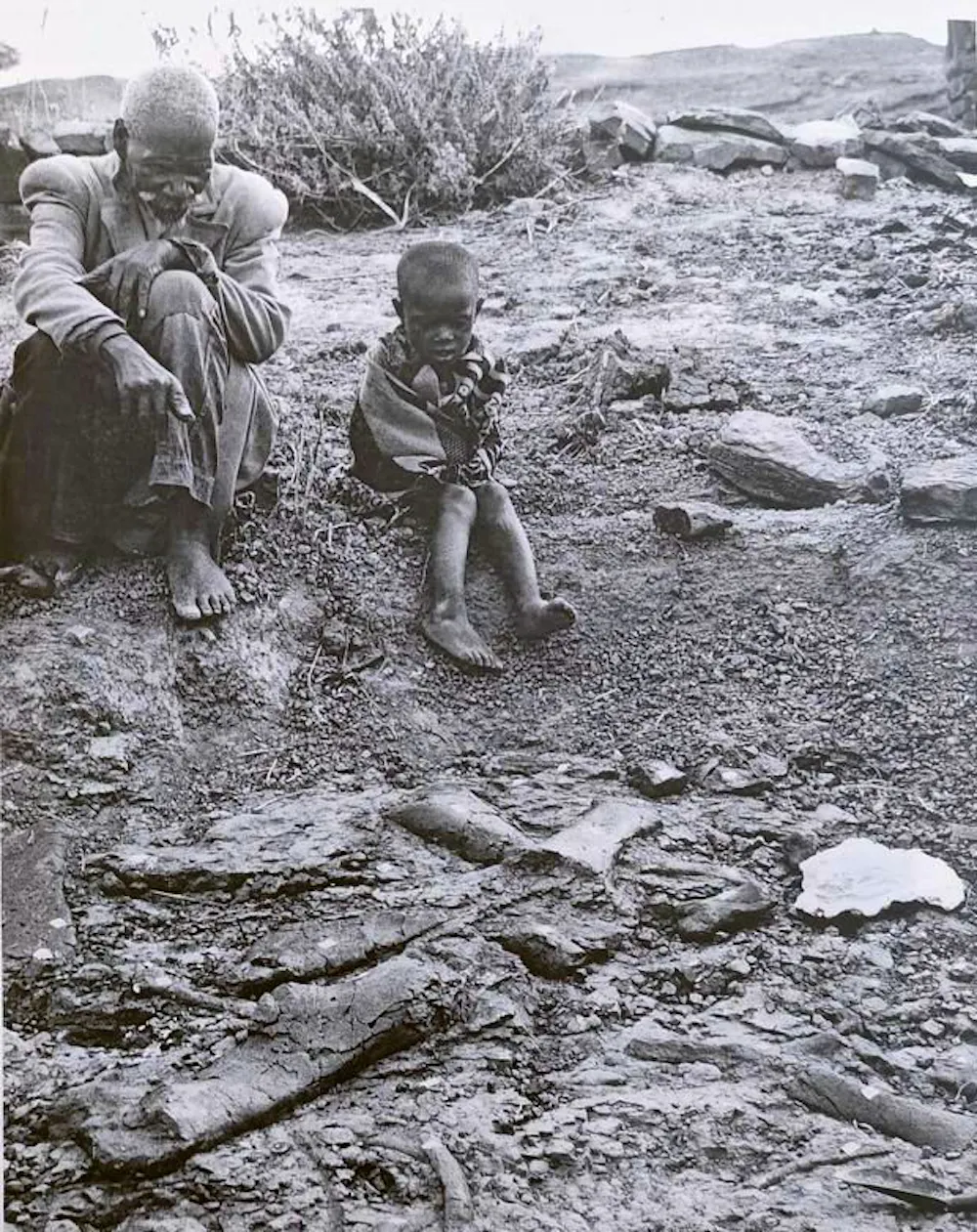
Unidentified Basotho person pointing at the Maphutseng dinosaur bones, circa 1955.Author unknown. With authorisation of the Morija Museum Archives, Author provided (no reuse)
Both body fossils and trace fossils have been found in Lesotho and its surroundings. Erosion of fossil-rich rocks exposes numerous dinosaur, amphibian and reptile trackways, fish trails and burrows, alongside full or partial skeletons and plant remains. Thus, fossils are part of Lesotho’s rugged landscape.
For the Basotho, giant bones eroding from the hills are not mere curiosities; they are referred to the Kholumolumo. This was an enormous, all-devouring mythical creature whose thunderous footsteps echoed across the landscape, leaving footprints behind.
This folktale aligns closely with the fossil record: skeletons and trackways, mostly of dinosaurs, which are prevalent in the sky-high exposures of the Maloti (or the Drakensberg, as the mountain range is known in South Africa).
The Kholumolumo myth serves as a cultural framework that preserves real observations of Lesotho’s fossil heritage over time. It’s an example of early citizen science – local people identifying recurring patterns in their environment and explaining them within their own cultural framework.
Ellenberger’s original archival materials reveal that this local knowledge was highly practical. When French palaeontologists arrived in 1955, they were guided to Maphutseng – now known for one of southern Africa’s richest dinosaur bone beds – by Samuel Motsoane. He was a local schoolteacher who had known the “stone bones” since childhood, in the 1930s.
Basotho chiefs visiting the Maphutseng excavation site in the 1970s.Ellenberger archive, with authorisation of the ISEM, University of Montpellier, Author provided (no reuse)
The San and the fossil footprints
The Basotho and San were among the first in southern Africa to examine giant footprints preserved in stone and ponder: what walked here?
The indigenous San people, who followed a hunter-gatherer way of life before their culture disappeared from Lesotho, were masters in the interpretation of tracks. They could identify the size, behaviour and movement of living animals from a single footprint. Ellenberger believed they applied these skills to fossil tracks as well.
His manuscripts describe rock art at Mokhali Cave that appears to depict a dinosaur footprint alongside bipedal creatures reminiscent of the three-toed dinosaur fossils preserved in nearby outcrops.
Ellenberger also noted that some San myths seemed to differentiate between the tracks of four-legged animals in the lowlands and those of two-legged animals higher in the mountains.
In southern Africa, fossil tracks of bipedal dinosaurs are found in higher rock layers only, where the rocks are younger. Lower rocks contain only quadrupedal trackways made by more primitive animals.
So the myths appear to demonstrate some level of understanding of the evolution of species.
Although this seems more speculative, his core observation remains valid: the San recognised patterns in the fossil record and integrated them into their worldview. They observed their land with precision long before formal palaeontology developed in the area.
Rethinking the narrative of ‘discoveries’
The diaries show that locals guided researchers to fossil sites. They recognised fossil bones and tracks as evidence of ancient animals, and preserved this understanding through stories that served as explanations.
Ellenberger himself valued this intellectual tradition: he spoke Sesotho fluently, collaborated with locals, and documented their insights respectfully. His notes credit half a dozen Basotho who discovered fossils of important scientific value.
The Mokhali rock shelter is the site near Leribe where the San painted a possible dinosaur footprint and some of the oldest known dinosaur reconstructions.Julien Benoit, Author provided (no reuse)
His notes show that the roots of awareness and interpretation of fossils in southern Africa predate European expeditions and reach into the deep sense of place held by the people living among these fossils since generations. Their interpretations were not “quaint myths” but sophisticated observations shaped by centuries of engagement with the land.
Acknowledging this enriches the scientific record, broadens our understanding of early palaeontology, and honours the contributions of communities whose insights led to important discoveries. Ellenberger has left us an empowering and inspiring legacy for the new generation of southern African palaeontologists.
– Fossil science owes a debt to indigenous knowledge: Lesotho missionary’s notes tell the story – https://theconversation.com/fossil-science-owes-a-debt-to-indigenous-knowledge-lesotho-missionarys-notes-tell-the-story-270431
The State of Qatar strongly condemns the raid carried out by Israeli occupation forces on the headquarters of the United Nations Relief and Works Agency for Palestine Refugees in the Near East (UNRWA) in occupied East Jerusalem, describing it as a blatant violation of international humanitarian law and a flagrant challenge to the will of the international community.
The Ministry of Foreign Affairs warns that Israel’s systematic targeting of UNRWA ultimately aims to dismantle the agency and deprive millions of Palestinians in Gaza, the West Bank, Jordan, Syria, and Lebanon of its essential services. The Ministry stresses the urgent need for the international community to stand firmly against this plan in order to prevent its catastrophic humanitarian consequences.
The Ministry reaffirms Qatar’s full support for UNRWA, based on the State’s firm position in backing the legitimate rights of the brotherly Palestinian people, foremost among them the right to establish an independent state along the 1967 borders with East Jerusalem as its capital.