Voici Alvenco Advisory : on aide à investir de manière stratégique dans l’avenir énergétique de la Namibie

Source: Africa Press Organisation – French

Avec le lancement de la production pétrolière prévu pour 2029, la Namibie connaît une vague d’investissements internationaux dans ses activités d’exploration et de production. Des géants mondiaux de l’énergie aux indépendants de premier plan, en passant par les entreprises énergétiques régionales et les financiers, les entreprises du secteur de l’énergie intensifient leurs investissements dans ce qui est en passe de devenir le prochain grand producteur africain. Alors que les investisseurs internationaux explorent les industries énergétiques et minières en pleine évolution de la Namibie, la nouvelle société Alvenco Advisory aidera les entreprises à étendre leur présence dans ce pays d’Afrique australe.

Dirigée par l’ancien ministre namibien des Mines et de l’Énergie, Tom Alweendo, Alvenco Advisory est le partenaire de choix pour les entreprises internationales qui souhaitent s’implanter en Namibie. En tant que société de conseil stratégique, Alvenco Advisory s’engage à façonner des investissements rentables, inclusifs et durables. La société travaillera en étroite collaboration avec les acteurs gouvernementaux et les entreprises internationales, en s’alignant étroitement sur les objectifs énergétiques du pays. Elle offrira un soutien en matière de politique et de réglementation, un alignement fort sur les priorités nationales, l’engagement des parties prenantes locales et une attention particulière aux critères ESG, ainsi que des stratégies axées sur la valeur partagée et les rendements à long terme. Alors que la Namibie s’engage dans un nouveau chapitre de son développement énergétique, Alvenco Advisory s’impose comme un partenaire solide pour les investisseurs internationaux.

Le lancement d’Alvenco Advisory intervient alors que la Namibie accélère le développement des découvertes de pétrole et de gaz offshore dans le bassin Orange. TotalEnergies vise une décision finale d’investissement pour sa découverte Venus en 2026, avec une première production prévue en 2029. Galp progresse dans le développement du champ Mopane après une série de résultats positifs obtenus lors des forages exploratoires réalisés en 2024 et 2025. Le dernier en date, le puits Mopane 3S, a révélé la présence de pétrole léger et de condensats de gaz. Sur le front de l’exploration, Rhino Resources progresse vers le développement du champ après une découverte dans le puits Capricornus-1X en avril 2025 et la confirmation d’un réservoir d’hydrocarbures dans le puits Sagittarius-1X en février 2025. Halliburton va forer deux puits d’exploration dans le bloc 2914 de la PEL 85, tandis que Stamper Oil & Gas Corp poursuit également des projets d’exploration dans les bassins d’Orange et de Lüderitz. Chevron mène l’exploration dans le bassin de Walvis après avoir acquis une participation de 80 % dans les blocs 2112B et 2212A. Ces investissements visent à exploiter une nouvelle province d’hydrocarbures en Afrique australe.

La transformation énergétique de la Namibie ne vient pas seulement de son industrie pétrolière et gazière, mais aussi de ses initiatives audacieuses dans le domaine de l’hydrogène vert. Le pays vise à atteindre une production d’hydrogène vert comprise entre 10 et 15 millions de tonnes par an d’ici 2050 et travaille en étroite collaboration avec des partenaires internationaux pour atteindre cet objectif. Parmi les projets majeurs, citons le projet phare Hyphen Hydrogen Energy, d’un montant de 10 milliards de dollars, qui vise à produire 350 000 tonnes d’hydrogène vert par an, et le Daures Green Hydrogen Village, qui vise à produire 700 000 tonnes par an après 2032. Outre Hyphen, la Namibie produit déjà de l’hydrogène dans le cadre du projet Hylron Oshivela. Ce projet a démarré en mars 2025 et produit de l’hydrogène vert grâce à une capacité d’électrolyse de 12 MW. Parallèlement, un partenariat entre l’Union européenne et la Namibie, conclu début 2025, devrait permettre d’attirer jusqu’à 12 milliards de dollars d’investissements privés européens dans le pays pour soutenir ses objectifs en matière d’hydrogène vert. Alors que ces investissements affluent en Namibie, Alvenco Advisory se tient prêt à aider les entreprises à s’y retrouver dans les politiques, les priorités nationales et l’engagement des parties prenantes locales.

« La Namibie est à l’aube d’un changement extraordinaire. Avec d’importantes découvertes de pétrole et des mesures audacieuses en faveur de l’hydrogène vert, nous avons une occasion unique et la responsabilité de veiller à ce que nos ressources naturelles profitent à tous les Namibiens. Alvenco Advisory ne se contentera pas de soutenir les investisseurs internationaux en Namibie, mais veillera également à ce que leurs investissements débouchent sur des opportunités concrètes pour la population namibienne. Chez Alvenco Advisory, nous nous engageons à promouvoir des projets inclusifs et durables. On est là pour aligner les objectifs des gouvernements et des entreprises qui investissent. Si tu investis en Namibie ou si tu envisages de le faire, parlons-en », déclare M. Alweendo.

Alweendo a occupé divers postes en Namibie, notamment celui de gouverneur de la Banque de Namibie, de directeur général de la Commission nationale de planification et de ministre chargé de la Commission nationale de planification. En 2018, il a été nommé ministre des Mines et de l’Énergie. Son mandat a pris fin en 2025. À ce poste, il a supervisé toutes les découvertes pétrolières majeures du pays et, depuis ces étapes importantes, il a maintenu la confiance des investisseurs grâce à des politiques compétitives, à un engagement auprès des opérateurs internationaux et à des structures d’investissement flexibles. Ça a posé les bases de la croissance future du marché et mis le pays sur la voie d’un succès continu dans les secteurs du pétrole, du gaz et de l’énergie en général.

Pour en savoir plus sur Alvenco Advisory, rendez-vous sur www.AlvencoAdvisory.com.

Distribué par APO Group pour African Energy Chamber.

Media files

Introducing Alvenco Advisory: Guiding Strategic Investment in Namibia’s Energy Future

Source: APO

With Namibia set to start oil production by 2029, the country is witnessing a surge in global investments across its exploration and production landscape. From global energy majors to leading independents to regional energy companies and financiers, energy firms are ramping up their investments in what is poised to become the next major African producer. As international investors navigate Namibia’s evolving energy and mining industries, the newly-launched Alvenco Advisory will support companies as they expand their presence across the southern African country.  

Spearheaded by Namibia’s former-Minister of Mines and Energy Tom Alweendo, Alvenco Advisory represents the partner of choice for global companies seeking to make forays into Namibia. As a strategic advisory firm, Alvenco Advisory is committed to shaping investments that are profitable, inclusive and sustainable. The company will work closely with government stakeholders and global companies, aligning closely with the country’s energy goals by offering policy and regulatory support, strong alignment with national priorities, local stakeholder engagement and ESG focus as well as strategies for shared value and long-term returns. As Namibia embarks on its next chapter of energy development Alvenco Advisory has emerged as a strong partner for global investors.

The launch of Alvenco Advisory comes as Namibia accelerates the development of offshore oil and gas discoveries made in the Orange Basin. TotalEnergies targets a final investment decision for its Venus discovery in 2026, with first oil expected in 2029. Galp is making progress with the development of the Mopane field following a string of positive results at exploration wells drilled in 2024 and 2025. The latest of these – the Mopane 3S well – revealed the presence of light oil and gas condensate. On the exploration front, Rhino Resources is making strides towards field development following a discovery at the Capricornus-1X well in April 2025 and the confirmation of a hydrocarbon reservoir at the Sagittarius-1X well in February 2025. Halliburton is set to drill two exploration wells at Block 2914 in PEL 85 while Stamper Oil & Gas Corp is also pursuing exploration projects in the Orange and Lüderitz Basins. Chevron is spearheading exploration in the Walvis Basin following its acquisition of an 80% stake in Blocks 2112B and 2212A. These investments seek to unlock a new hydrocarbon province in southern Africa.

Namibia’s energy transformation comes not only from its oil and gas industry but its bold steps into green hydrogen. The country seeks to reach green hydrogen volumes of between 10-15 million tons per annum by 2050 and is working closely with global partners to achieve this goal. Major projects include the country’s flagship $10 billion flagship Hyphen Hydrogen Energy project – targeting 350,000 tons of green hydrogen annually – and the Daures Green Hydrogen Village – targeting 700,000 tons per annum after 2032. In addition to Hyphen, Namibia is already producing hydrogen from the Hylron Oshivela Project. The project started operations in March 2025, producing green hydrogen using 12 MW of electrolyzer capacity.  Meanwhile, a partnership between the European Union and Namibia – forged in early 2025 – is set to drive up to $12 billion in European private investments into the country in support of its green hydrogen goals. As this investment flows into Namibia, Alvenco Advisory stands ready to support companies as they navigate policy, national priorities and local stakeholder engagement.

“Namibia is on the cusp of extraordinary change. With major oil discoveries and bold steps into green hydrogen, we have a unique opportunity and responsibility to ensure that our natural resources uplift all Namibians. Alvenco Advisory will not only support global investors in Namibia, but ensure their investments unlock tangible opportunities for the people of Namibia. At Alvenco Advisory, we are committed to driving inclusive and sustainable projects. We are here to align the goals of governments and investing companies – if you’re investing in Namibia or thinking about it let’s talk,” states Alweendo.  

Alweendo has held various positions in Namibia, including Governor of the Bank of Namibia, Director General of the National Planning Commission and Minister in Charge of the National Planning Commission. In 2018, he was appointed Minister of Mines and Energy. His term ended in 2025. In this role, he oversaw all of the country’s major oil discoveries, and since these milestones, has maintained investor confidence through competitive policies, engagement with international operators and flexible investment structures. This laid the foundation for future growth across the market, setting the country up for continued success in the oil, gas and broader energy sectors.

To learn more about Alvenco Advisory, visit www.AlvencoAdvisory.com.

Distributed by APO Group on behalf of African Energy Chamber.

Media files

.

Maroc : la Banque africaine de développement octroie 100 millions d’euros pour appuyer les femmes et les jeunes entrepreneurs à bâtir une agriculture inclusive, résiliente et durable

Source: Africa Press Organisation – French

Le Conseil d’administration du Groupe de la Banque africaine de développement (www.AfDB.org) a approuvé un financement de 100 millions d’euros au Maroc pour mettre en oeuvre le Programme d’appui à l’agriculture solidaire inclusive des femmes et des jeunes (PAASIFEJ).

Le projet vise à générer des opportunités durables pour les femmes et les jeunes, à renforcer la sécurité alimentaire et à mieux préparer la petite agriculture marocaine aux défis du changement climatique.

Il permettra  de stimuler l’entrepreneuriat des jeunes et des femmes en zones rurales à travers la mise en place des mécanismes de financement et d’incitation adaptés et le renforcement des dispositifs d’accompagnement technique et financier. ll facilitera aussi le déploiement de nouvelles infrastructures de production et de services agricoles, consolidant l’ancrage des femmes dans les chaînes de valeur locales, le renforcement de leurs compétences et l’acroissement de leur productivité.

L’ensemble des actions favorisera l’émergence de femmes entrepreneures dans les secteurs agricole, para-agricole, de la transformation et du numérique. Il soutiendra la nouvelle feuille de route pour l’emploi en favorisant l’entrepreneuriat rural.

« Les femmes qui ont l’ambition d’entreprendre et de réussir dans l’agriculture sont notre priorité, a déclaré Achraf Tarsim, responsable du bureau pays du Groupe de la Banque africaine de développement pour le Maroc. Grâce à cette nouvelle opération, nous les accompagnerons pas à pas pour construire une agriculture moderne, inclusive et résiliente, capable de révéler tout le potentiel de celles qui aspirent à innover et à créer de la valeur et de l’emploi sur leurs territoires.»

En parfaite cohérence avec les priorités du Maroc, le programme soutiendra la mise en œuvre de la Stratégie agricole Green Generation 2020-2030 – la vision nationale pour transformer l’agriculture en un secteur plus inclusif, durable et performant -, du Programme national d’agriculture solidaire ainsi que du Programme national de l’entrepreneuriat des jeunes.

Depuis plus de cinquante ans, le Groupe de la Banque africaine de développement accompagne le Royaume du Maroc dans un partenariat fondé sur une vision partagée et intégrée du développement. Près de 15 milliards d’euros ont été mobilisés à ce jour, pour financer plus de 150 projets à fort impact dans des secteurs stratégiques tels que les transports, l’eau, l’énergie, l’agriculture, la protection sociale, la gouvernance et la finance.

Distribué par APO Group pour African Development Bank Group (AfDB).

Contact médias :
Fahd Belbachir
chargé principal des relations extérieures et de la communication
Banque africaine de développement
media@afdb.org

À propos du Groupe de la Banque africaine de développement :
Le Groupe de la Banque africaine de développement est la principale institution de financement du développement en Afrique. Il comprend trois entités distinctes : la Banque africaine de développement (BAD), le Fonds africain de développement (FAD) et le Fonds spécial du Nigeria (FSN). Représentée dans 41 pays africains, avec un bureau extérieur au Japon, la Banque contribue au développement économique et au progrès social de ses 54 États membres régionaux. Pour plus d’informations : www.AfDB.org

Media files

Marrocos: Banco Africano de Desenvolvimento concede 100 milhões de euros para apoiar mulheres e jovens empreendedores na construção de uma agricultura inclusiva, resiliente e sustentável

Source: Africa Press Organisation – Portuguese –

O Conselho de Administração do Grupo Banco Africano de Desenvolvimento (www.AfDB.org) aprovou um financiamento de 100 milhões de euros a favor de Marrocos para a implementação do programa de apoio à agricultura solidária inclusiva para mulheres e jovens.

O projeto visa criar oportunidades sustentáveis para as mulheres e os jovens, reforçar a segurança alimentar e preparar melhor a agricultura marroquina de pequena escala para os desafios das alterações climáticas.

O projeto estimulará o empreendedorismo dos jovens e das mulheres nas zonas rurais, criando mecanismos de financiamento e de incentivo adequados e reforçando os sistemas de apoio técnico e financeiro. Facilitará igualmente a implantação de novas infraestruturas de produção e de serviços agrícolas, contribuindo para integrar as mulheres nas cadeias de valor locais, reforçar as suas competências e aumentar a sua produtividade.

Todas estas ações vão fomentar a emergência de mulheres empresárias nos setores agrícola, para-agrícola, da transformação e digital, e apoiarão o novo roteiro para o emprego através da promoção do empreendedorismo rural.

“As mulheres que têm a ambição de empreender e ter sucesso na agricultura são a nossa prioridade”, disse Achraf Tarsim, chefe do escritório do Grupo Banco Africano de Desenvolvimento em Marrocos. Através desta nova operação, vamos apoiá-las passo a passo na construção de uma agricultura moderna, inclusiva e resiliente, capaz de revelar todo o potencial daqueles que aspiram a inovar e criar valor e emprego nos seus territórios”.

Em plena consonância com as prioridades de Marrocos, o programa apoiará a implementação da Estratégia Agrícola Geração Verde 2020-2030 – a visão nacional para transformar a agricultura num setor mais inclusivo, sustentável e eficiente –, o Programa Nacional de Agricultura Solidária e o Programa Nacional de Empreendedorismo Juvenil. 

Há mais de cinquenta anos que o Grupo Banco Africano de Desenvolvimento apoia o Reino de Marrocos no âmbito de uma parceria baseada numa visão partilhada e integrada do desenvolvimento. Até à data, foram mobilizados cerca de 15 mil milhões de euros para financiar mais de 150 projetos de grande impacto em setores estratégicos como os transportes, a água, a energia, a agricultura, a proteção social, a governação e as finanças.

Distribuído pelo Grupo APO para African Development Bank Group (AfDB).

Contacto para os media:
Fahd Belbachir
Responsável Principal de Comunicação e Relações Externas
media@afdb.org

Sobre o Grupo Banco Africano de Desenvolvimento:
O Grupo Banco Africano de Desenvolvimento é a principal instituição financeira de desenvolvimento em África. Inclui três entidades distintas: o Banco Africano de Desenvolvimento (AfDB), o Fundo Africano de Desenvolvimento (ADF) e o Fundo Fiduciário da Nigéria (NTF). Presente no terreno em 41 países africanos, com uma representação externa no Japão, o Banco contribui para o desenvolvimento económico e o progresso social dos seus 54 Estados-membros. Mais informações em www.AfDB.org

Media files

Baixar .tipo

Africa’s minerals are being bartered for security: why it’s a bad idea

Source: The Conversation – Africa – By Hanri Mostert, SARChI Chair for Mineral Law in Africa, University of Cape Town

A US-brokered peace deal between the Democratic Republic of Congo (DRC) and Rwanda binds the two African nations to a worrying arrangement: one where a country signs away its mineral resources to a superpower in return for opaque assurances of security.

The peace deal, signed in June 2025, aims to end three decades of conflict between the DRC and Rwanda.

A key part of the agreement binds both nations to developing a regional economic integration framework. This arrangement would expand cooperation between the two states, the US government and American investors on “transparent, formalized end-to-end mineral chains”.

Despite its immense mineral wealth, the DRC is among the five poorest countries in the world. It has been seeking US investment in its mineral sector.

The US has in turn touted a potential multi-billion-dollar investment programme to anchor its mineral supply chains in the traumatised and poor territory.

The peace that the June 2025 deal promises, therefore, hinges on chaining mineral supply to the US in exchange for Washington’s powerful – but vaguely formulated – military oversight.

The peace agreement further establishes a joint oversight committee – with representatives from the African Union, Qatar and the US – to receive complaints and resolve disputes between the DRC and Rwanda.

But beyond the joint oversight committee, the peace deal creates no specific security obligations for the US.

The relationship between the DRC and Rwanda has been marred by war and tension since the bloody First (1996-1997) and Second (1998-2003) Congo wars. At the heart of much of this conflict is the DRC’s mineral wealth. It has fuelled competition, exploitation and armed violence.

This latest peace deal introduces a resources-for-security arrangement. Such deals aren’t new in Africa. They first emerged in the early 2000s as resources-for-infrastructure transactions. Here, a foreign state would agree to build economic and social infrastructure (roads, ports, airports, hospitals) in an African state. In exchange, it would get a major stake in a government-owned mining company. Or gain preferential access to the host country’s minerals.

We have studied mineral law and governance in Africa for more than 20 years. The question that emerges now is whether a US-brokered resources-for-security agreement will help the DRC benefit from its resources.

Based on our research on mining, development and sustainability, we believe this is unlikely.

This is because resources-for-security is the latest version of a resource-bartering approach that China and Russia pioneered in countries such as Angola, the Central African Republic and the DRC.

Resource bartering in Africa has eroded the sovereignty and bargaining power of mineral-rich nations such as the DRC and Angola.

Further, resources-for-security deals are less transparent and more complicated than prior resource bartering agreements.

DRC’s security gaps

The DRC is endowed with major deposits of critical minerals like cobalt, copper, lithium, manganese and tantalum. These are the building blocks for 21st century technologies: artificial intelligence, electric vehicles, wind energy and military security hardware. Rwanda has less mineral wealth than its neighbour, but is the world’s third-largest producer of tantalum, used in electronics, aerospace and medical devices.

For almost 30 years, minerals have fuelled conflict and severe violence, especially in eastern DRC. Tungsten, tantalum and gold (referred to as 3TG) finance and drive conflict as government forces and an estimated 130 armed groups vie for control over lucrative mining sites. Several reports and studies have implicated the DRC’s neighbours – Rwanda and Uganda – in supporting the illegal extraction of 3TG in this region.

The DRC government has failed to extend security over its vast (2.3 million square kilometres) and diverse territory (109 million people, representing 250 ethnic groups). Limited resources, logistical challenges and corruption have weakened its armed forces.

This context makes the United States’ military backing enormously attractive. But our research shows there are traps.

What states risk losing

Resources-for-infrastructure and resources-for-security deals generally offer African nations short-term stability, financing or global goodwill. However, the costs are often long-term because of an erosion of sovereign control.

Here’s how this happens:

Examples of loss or near-loss of sovereignty from these sorts of deals abound in Africa.

For instance, Angola’s US$2 billion oil-backed loan from China Eximbank in 2004. This was repayable in monthly deliveries of oil, with revenues directed to Chinese-controlled accounts. The loan’s design deprived Angolan authorities of decision-making power over that income stream even before the oil was extracted.

These deals also fragment accountability. They often span multiple ministries (such as defence, mining and trade), avoiding robust oversight or accountability. Fragmentation makes resource sectors vulnerable to elite capture. Powerful insiders can manipulate agreements for private gain.

In the DRC, this has created a violent kleptocracy, where resource wealth is systematically diverted away from popular benefit.

Finally, there is the risk of re-entrenching extractive trauma. Communities displaced for mining and environmental degradation in many countries across Africa illustrate the long-standing harm to livelihoods, health and social cohesion.

These are not new problems. But where extraction is tied to security or infrastructure, such damage risks becoming permanent features, not temporary costs.

What needs to change

Critical minerals are “critical” because they’re hard to mine or substitute. Additionally, their supply chains are strategically vulnerable and politically exposed. Whoever controls these minerals controls the future. Africa must make sure it doesn’t trade that future away.

In a world being reshaped by global interests in critical minerals, African states must not underestimate the strategic value of their mineral resources. They hold considerable leverage.

But leverage only works if it is wielded strategically. This means:

  • investing in institutional strength and legal capacity to negotiate better deals

  • demanding local value creation and addition

  • requiring transparency and parliamentary oversight for minerals-related agreements

  • refusing deals that bypass human rights, environmental or sovereignty standards.

Africa has the resources. It must hold on to the power they wield.

– Africa’s minerals are being bartered for security: why it’s a bad idea
– https://theconversation.com/africas-minerals-are-being-bartered-for-security-why-its-a-bad-idea-260594

Ghana has a rare treasure, a crater made when a meteor hit Earth: why it needs to be protected

Source: The Conversation – Africa – By Marian Selorm Sapah, Senior lecturer, University of Ghana

Impact craters are formed when an object from space such as a meteoroid, asteroid or comet strikes the Earth at a very high velocity. This leaves an excavated circular hole on the Earth’s surface.

It is a basic geological process that has shaped the planets from their formation to today. It creates landscapes and surface materials across our solar system. The moon is covered with them, as are planets like Mercury, Mars and Venus. On Earth, impacts have influenced the evolution of life and even provided valuable mineral and energy resources. However, very few of the impact craters on Earth are visible because of various processes that obscure or erase them.

Most of the recognised impact craters on Earth are buried under sediments or have been deeply eroded. That means they no longer preserve their initial forms.

The Bosumtwi impact crater in Ghana is different, however. It is well preserved (not deeply eroded or buried under sediments). Its well-defined, near-circular basin, filled by a lake, is surrounded by a prominent crater rim that rises above the surface of the lake and an outer circular plateau. This makes it a target for several research questions.

As an Earth scientist, I joined a research team from 2019 to better understand the morphology of the crater. We carried out a morphological analysis of the crater (a study of its form, structure and geological features).

This study concluded that the activities of illegal miners are a threat to the sustainability of the crater. We also discovered that the features of the Bosumtwi impact crater can be considered as a terrestrial representation for a special type of impact crater known as rampart craters. These are common on the planets Mars and Venus and are found on icy bodies of the outer solar system (like Ganymede, Europa, Dione, Tethys and Charon).

For future studies, the Bosumtwi impact crater can be used to help understand how rampart craters form on Mars and Venus. So the Bosumtwi impact crater should be protected and preserved.


Read more: Curious Kids: Why are there so few impact craters on Earth?


The crater

The Bosumtwi impact crater is in Ghana’s mineral-rich Ashanti gold belt. It is the location of the only natural inland lake in Ghana. As one of the world’s best-preserved young meteorite impact craters it is designated as an International Union of Geological Sciences geoheritage site.

It is one of only 190 confirmed impact crater sites worldwide, one of only 20 on the African continent. Its lake is one of six meteoritic lakes in the world, recognised for their outstanding scientific value.

Satellite view of the Bosumtwi Impact Crater showing areas of Artisanal and Small scale Gold Mining activities. David Baratoux

At almost 1.07 million years old, the crater offers unparalleled opportunities for studying impact processes, climate history and planetary evolution. It’s an irreplaceable natural laboratory for researchers and educators.

Beyond its scientific importance, the crater holds cultural significance for the Ashanti people of Ghana. The lake at its centre serves as a sacred site and spiritual landmark. The crater’s breathtaking landscape also supports eco-tourism and local livelihoods, contributing to Ghana’s economic development while maintaining exceptional aesthetic value.

The research

As part of further research work on the 2019 study, in 2025 we have discovered through field work and satellite data analysis that illegal artisanal mining is prevalent in the area and threatening the crater. This refers to informal, labour-intensive extraction of minerals, primarily gold. It is conducted by individuals or small groups using basic tools and rudimentary machinery. The use of toxic chemicals such as mercury and cyanide, and practices such as river dredging, cause severe environmental harm.

Illegal miners are encroaching on and around the crater rim, posing severe threats to its environment and sustainability. Their activities have become more prevalent over the course of less than 10 years, indicating a growing problem. If unchecked, it could lead to irreversible damage to the crater.

These mining operations risk contaminating the lake with toxic heavy metals. The consequences of these are grave. They include destroying critical geological evidence, accelerating deforestation, and degrading the land. All this damages the crater’s scientific, cultural and economic value.

The International Union of Geological Sciences geoheritage designation of the crater underscores the urgent need for protection measures. The loss of this rare geological wonder would represent not just a national tragedy for Ghana, but a blow to global scientific heritage.

Immediate action is required. This includes enhanced satellite monitoring (tracking illegal mining, deforestation and environmental changes) using optical imagery (such as Sentinel-2, Landsat, PlanetScope). These tools can detect forest loss, identify mining pits and sediment runoff, and analyse changes over time.

Stricter enforcement of mining bans, and community engagement programmes, will help preserve the Bosumtwi impact crater’s unique attributes for future generations of scientists, students, tourists and local communities who depend on its resources.

– Ghana has a rare treasure, a crater made when a meteor hit Earth: why it needs to be protected
– https://theconversation.com/ghana-has-a-rare-treasure-a-crater-made-when-a-meteor-hit-earth-why-it-needs-to-be-protected-260600

African media are threatened by governments and big tech – book tracks the latest trends

Source: The Conversation – Africa – By Hayes Mabweazara, Senior Lecturer in Sociological & Cultural Studies (Media, Culture & Society), University of Glasgow

Media capture happens when media outlets lose their independence and fall under the influence of political or financial interests. This often leads to news content that favours power instead of public accountability.

Media Capture in Africa and Latin America: Power and Resistance is a new book edited by news media scholars Hayes Mawindi Mabweazara and Bethia Pearson. It explores how this dynamic plays out in the global south and how journalists and citizens are resisting it. We asked them four questions.


What is media capture and how has it reshaped itself in recent times?

Media capture describes how media outlets are influenced, manipulated or controlled by powerful actors – often governments or large corporations – to serve their interests. It’s an idea that helps us understand how powerful groups in society can have a negative influence on news media. While this idea isn’t new, what has changed is how subtly and pervasively it now operates.

These groups include big technology organisations that own digital media platforms – such as X, owned by xAI (Elon Musk), and Instagram and Facebook, owned by Meta. But it’s also important to consider Google as a large search engine that shapes the news content and audience of many other platforms.

Palgrave Macmillan

This matters because the media are important for the functioning of democratic societies. Ideally, they provide information, represent different groups and issues in society, and hold powerful actors to account.

For example, one of the key roles of the media is to provide accurate information for citizens to be able to decide how to vote in elections. Or to decide what they think about important issues. One big concern, then, is the effect of inaccurate or biased information on democracy.

Or it might be that accurate information is harder to access because algorithms and platforms make it easier to access inaccurate or biased information. These can be intended and unintended consequences of the technology itself, but algorithms can amplify misinformation and fake news – especially if this content has the potential to go viral.

So, what’s particular about media capture in the global south?

This is a really interesting question that is still being investigated, but we have some ideas.

First of all, it’s useful to know that media capture scholarship from the global north emerged around the time of the 2008 financial crisis. The influence of financial institutions on business journalists was one of the first areas of study. Since then, research in the US has focused on the capture of government-funded media organisations like Voice of America. And on how digital platforms like Google and Facebook can lead to capture.

In the global south, scholars have drawn attention to the importance of large media corporations in understanding media capture. For example, in Latin America, there’s a high level of what’s called “media concentration”. This is when many media outlets are owned by a few companies. These companies often own companies in other sectors, which means that critical reporting on business interests presents a conflict of interest.


Read more: Public trust in the media is at a new low: a radical rethink of journalism is needed


But to focus on Africa, scholars have drawn attention to governments as a source of pressure on journalists and editors. This can be through direct pressure or what we might call “covert” pressure. Withholding advertising that helps to fund media outlets is an example, or offering financial incentives to stop investigating certain topics.

Researchers are also concerned about the influence of big tech in Africa. Digital platforms like Google and Facebook can shape the news and information that citizens have access to.

Can you share some of the studies from the book?

Our book includes many interesting studies – from Colombia, Brazil and Mexico in Latin America to Ethiopia and Morocco in Africa. We’ll share a few African cases here to give an overview of the issues.

The book’s contribution on Ghana warns us that although more overt “old” types of media capture may have subsided, transitional democracies can feature messier, more nuanced forms of media control. This can be evident in government pressures and through capture of regulators.

In the Morocco chapter, we see the threat to media freedom presented by digital platforms owned by global tech giants. This is known as “infrastructural capture”. It means news organisations become dependent on tech giants to set the rules of the game for democratic communication.

Another compelling case is Nigeria, where researchers explore ties between media ownership and political patronage. The authors argue that the Nigerian press is failing in its democratic duty because of its reliance on advertising and sponsorship income from the state. Added to this are ineffective regulatory mechanisms and close relationships with some big businesses that own newspapers and printing presses.

How can media capture be resisted in the global south?

The studies in the book show some ways forward and we do think it’s important to be optimistic! Resistance takes many forms. Sometimes it comes through legal and policy reform aimed at increasing transparency and media diversity. In other cases, it’s driven by social movements, investigative journalists and independent media who continue to operate under pressure.

The chapter on Uganda shows that journalist groups working with media advocacy organisations can strategically act to resist government media capture and harmful regulations. For example, to push back against one legislative change, several groups formed a temporary network called Article 29 (named after the article in the Ugandan constitution protecting free speech) and the African Centre for Media Excellence produced a report criticising the proposed changes.


Read more: Western media outlets are trying to fix their racist, stereotypical coverage of Africa. Is it time African media did the same?


One of the chapters on Ghana also shows how networks such as journalists, media associations, human rights groups and legal organisations can mobilise to push back against government influence. Organisations including the Ghana Journalists Association and Ghana Independent Broadcasters Association have played key roles in, for example, taking the media regulator to court to overturn laws that would have led to censorship. These findings are echoed in Latin America, where research on Mexico and Colombia also found professional journalism to be a strong source of resistance.

The conversation must also include rethinking how we define capture itself. If we frame it only as total control, we risk missing the everyday ways influence operates – and the spaces where it can be resisted. We would also say it’s really important that citizens are aware and alert to the issues when they think about how they access news media and what platforms they use. This is sometimes called “media literacy” and is about people being more knowledgeable about where trustworthy news comes from.


You can listen to a podcast about the book over here.

– African media are threatened by governments and big tech – book tracks the latest trends
– https://theconversation.com/african-media-are-threatened-by-governments-and-big-tech-book-tracks-the-latest-trends-258017

Johannesburg’s creative hubs are booming: how artists are rejuvenating a failing inner city

Source: The Conversation – Africa – By Mariapaola McGurk, Lecturer in Innovation & Entrepreneurship, University of Auckland, Waipapa Taumata Rau

Johannesburg is weathering a storm of crises. Nowhere is its complex tangle of challenges more visible than in the inner city, where crime, overcrowding, and infrastructure collapse – such as roads literally exploding – paint a grim picture. Cultural institutions haven’t been spared either, with long-standing landmarks like the Johannesburg Art Gallery caught in cycles of neglect and crisis.


Read more: South Africa doesn’t need new cities: it needs to focus on fixing what it’s got


Yet, while many avoid the inner city or speak only of its decline, the creative and cultural practitioners of Johannesburg never left. In fact, artists, architects, fashion designers, animators, musicians and the like have been hard at work. They’re building, dreaming and shaping a new urban reality that could become the beacon of hope this city needs.

As a researcher and visual artist, I recently completed a PhD study that focused on Johannesburg’s cultural and creative industries. My research revealed that a clear understanding of the existing structures and dynamics within this industry is essential for developing effective strategies to strengthen its role in local economic development.

Here I explore one such opportunity: creative hubs. I argue that they represent a low-hanging fruit for the inner city’s growth and revitalisation.

Urban renewal

Numerous articles have explored strategies for the city’s economic development and urban renewal. One group of scholars recently outlined four critical focus areas: coordinated efforts across government levels; an active civil society; a shift in political culture; and restored leadership in a revitalised administration.

These are vital interventions, but they still beg a deeper question. What is the new “gold” of the “City of Gold”, the mining town founded in 1886 and on track to become a megacity by 2030?

Work by artist Candice Kramer at Bag Factory Artists Studios. Mark Straw

What is it that truly sets Johannesburg apart, nationally and globally? What strengths already exist that, if nurtured, could help address the city’s challenges? The answer may not lie in building something entirely new, but in recognising and investing in what already thrives. The city’s people, its culture, and its extraordinary creativity.

In 2004, Unesco launched the Creative Cities Network. Today it comprises 246 cities in 80 member states. South Africa has three cities in the network: Cape Town (design), Durban (literature) and Overstrand (gastronomy). Johannesburg has never applied to belong.

Cities are acknowledging the economic and social value of the cultural and creative industries, particularly in addressing challenges such as youth unemployment, micro-enterprise growth, equity and community development.

Artist Mankebe Seakoe at Contra Fair. Mark Straw

Yet cities globally are grappling with how to retain creative professionals. This is the case in cities like Toronto, Sydney, Los Angeles, Cologne or Barcelona. Rising property prices, the redevelopment of industrial areas into commercial or luxury spaces, and short-term rental agreements are displacing these professionals from the urban cores they help energise. Cities are coming up with incentives and programmes to correct this.

A recent World Cities Cultural Forum report offers a solution in the form of Creative Land Trusts. These permanently hold land and assets at affordable rates for creatives. They take property out of speculative real estate markets. They’re designed to support not galleries or theatres, but the studios and workspaces where creative production actually happens.

Similar initiatives are happening in London, Helsinki and San Francisco.

Mapping Johannesburg’s creative hubs

Unlike cities that are trying to reverse the exodus of creatives, Johannesburg’s inner city has seen a recent surge in creative hub development.

A creative hub is a physical or digital space (in this case physical) designed to bring together cultural and creative professionals for studio space, collaboration, networking and the exchange of ideas.

Some creative hubs offer gallery spaces. Mark Straw

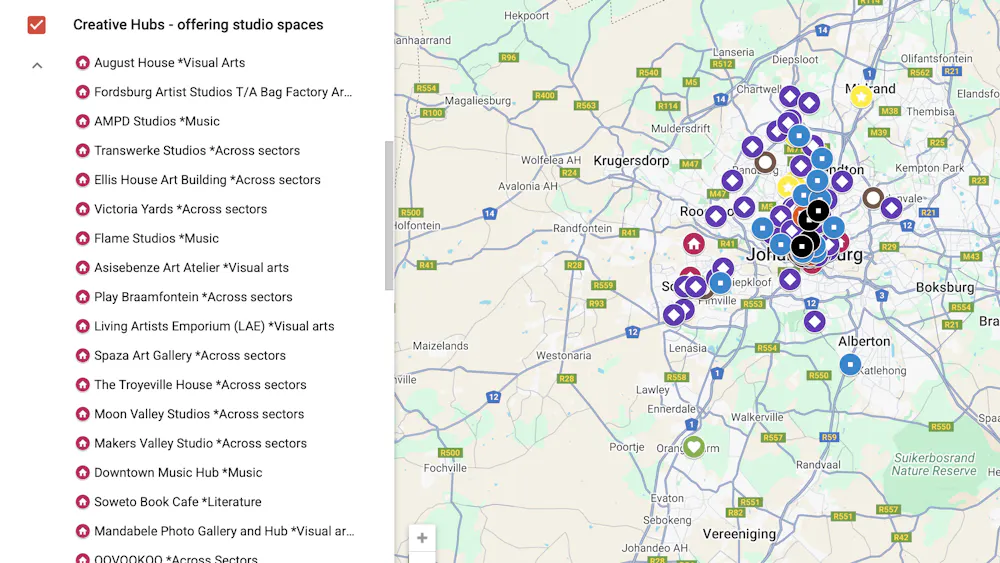
Over the last year, 21 creative hubs have been mapped in the city, the majority newly established. Notable examples include Transwerke Studios, Asisebenze Art Atelier, Victoria Yards and Oovookoo. Remarkably, 19 of the 21 hubs identified in my open-source mapping process are in the inner city. Only two are government run – Transwerke and Downtown Music Hub.

Across Johannesburg, creative hubs buzz with independent activity, yet share a common commitment to cultivating talent, business support and community impact. They are evidence of innovative partnerships between creatives and property developers.

Mapping Johannesburg’s creative hubs. Google Maps/Mariapaola McGurk

Inside these spaces, artists and creatives get opportunities through gallerist and investor visits (access to markets). They build practical and entrepreneurial skills through tailored workshops. And they collaborate on projects that place social upliftment at their heart.

Some hubs focus on offering studio spaces, while others extend their reach beyond their walls, blending artistic expression with community development and public engagement.

By actively building community and opportunity, creative hubs are becoming

lighthouses for the new urban economy.

They are small business incubators, urban beautification engines and potential cultural tourism hotspots. An event like Contra Fair opens the doors of art studio hubs once a year. Entrepreneur and social activist Tebogo Moalusi has now taken the lead in the establishment of Creative20. This will become a platform for revitalising Johannesburg’s creative cities campaign.

Neglected by the city

And yet the cultural and creative industries remain almost entirely absent from the city’s strategic planning. The Johannesburg 2040: Growth and Development Strategy fails even to mention the sector.

Bag Factory Artists Studios hosting a public event. Mark Straw

This is despite Gauteng, the province that houses Johannesburg, being the epicentre of South Africa’s creative economy. It contributes 46.3% of the industry’s gross domestic product and generates the highest employment impact. Johannesburg hosts the majority of creative businesses in the province.


Read more: The real Johannesburg: 6 powerful photos from a gritty new book on the city


The Gauteng 2030 Strategy highlights three high-growth sectors: agro-processing, cultural and creative industries, and high-tech/knowledge sectors, including digital and gaming. Two of these directly involve the creative economy. Yet there’s been little effort to integrate them into Johannesburg’s urban development agenda.

If Johannesburg is serious about inclusive economic development and sustainable urban growth, it must recognise and invest in the cultural and creative industries which are already thriving within its borders.

– Johannesburg’s creative hubs are booming: how artists are rejuvenating a failing inner city
– https://theconversation.com/johannesburgs-creative-hubs-are-booming-how-artists-are-rejuvenating-a-failing-inner-city-260224

Call for urgent overhaul of disease control framework amid ongoing FMD challenges

Source: Government of South Africa

Agriculture Minister John Steenhuisen, has called for urgent and proper regionalisation of South Africa’s disease control framework, amid ongoing challenges posed by widespread Foot-and-Mouth Disease (FMD) outbreaks.

“Every credible trading nation in the world understands the principle of regionalisation, that an outbreak in one part of a country should not result in blanket trade restrictions for the entire nation,” Steenhuisen said.

The Minister made the call during the Foot-and-Mouth Disease (FMD) Indaba, currently underway at the ARC-VIMP Campus in Roodeplaat, northeast of Pretoria.

The Minister’s call comes as the country is currently experiencing significant and ongoing challenges with widespread outbreaks of Foot and Mouth disease, affecting several provinces, including KwaZulu-Natal, Mpumalanga, Gauteng and, most recently, the Free State.

The resurgence of the disease has resulted in livestock movement restrictions and has also significantly impacted the country’s red meat trade on international markets.

In response to this escalating crisis, the Department of Agriculture, in partnership with the Agricultural Research Council (ARC), the University of Pretoria, and Onderstepoort Biological Products (OBP), is hosting a national Foot and Mouth Disease Indaba.

The two-day event, starting Monday, 21 July 2025, aims to bring together top veterinary scientists, agricultural experts, and key industry stakeholders, to deliberate on and develop long-term solutions to combat FMD.

In his opening address, Steenhuisen said South Africa is falling behind in establishing, certifying, and maintaining internationally recognised disease control zones.

He said the failure to regionalise is not due to a lack of veterinary science, but institutional coordination, legal clarity, and capacity.

“It is unacceptable that South Africa takes years to respond to import health questionnaires, delays that have cost us market access and weakened our negotiating position. This is not a regulatory issue; it is a capacity issue, and we are taking steps to fix it,” the Minister said.

To address this, the Minister announced the appointment of two senior veterinarians, Dr Emily Mogajane and Dr Nomsa Mnisi, to lead the development of a comprehensive national regionalisation framework.

Mnisi and Mogajane bring extensive experience in veterinary science, government, and international trade.

Their work will focus on:
•    Defining and operationalising regional disease zones for all major livestock sectors, in consultation with industry;
•    Supporting provinces to assume their responsibilities as prescribed in the Animal Health Act, 2002 (Act No.7 of 2002), aligning disease control with our Constitutional division of powers; and
•    Strengthening interdepartmental capacity to process export and import applications swiftly and credibly.

Public-private partnerships to improve vaccine security

Steenhuisen also called for stronger public-private partnerships to improve vaccine security, particularly for controlled animal diseases.

He urged the livestock industry, especially red meat, dairy, and game sectors to co-finance vaccine procurement.

“This does not mean you will manage the vaccines or the cold chains. But it does mean that, like in other agro-industries, we establish structured partnerships that ensure we are not caught unprepared again,” Steenhuisen said.

The Minister pointed to a recent breakdown in vaccine availability during the FMD outbreak, and that the national vaccine bank was depleted and the production cycle was misaligned with outbreak realities.

“Most notably, Onderstepoort Biological Products (OBP) currently lacks the infrastructure to produce FMD vaccines at the scale and speed required to respond to outbreaks.

“As a result, we were compelled to import vaccines from Botswana, to mount even a partial response. This situation is unsustainable for a country with South Africa’s livestock footprint and export ambitions,” the Minister said.

In response to this, Steenhuisen said government is establishing OBP, but warned that this will take time.

In the interim, he said efforts are underway to secure vaccine imports and establish forward-looking supply contracts to ensure minimum stock levels of FMD and other priority vaccines, “before the next outbreak, not after.”

He however warned that the State cannot do this alone and urged the industry to invest.

“If you want predictability, you must also invest. The time has come to build a nationally managed but jointly funded vaccine bank, not only for FMD, but for lumpy skin disease, brucellosis, Rift Valley Fever, and all other controlled diseases affecting trade and production,” SAnews.gov.za

Prolific week for entrepreneurs

Source: Government of South Africa

Small Business Development Minister Stella Ndabeni has declared this a “historic week” for entrepreneurs and Micro, Small, and Medium Enterprises (MSMEs).

She was addressing the Startup20 Midterm Engagement Group Meeting held in Gauteng on Monday.

The meeting kicks off a busy week, with Global Trade Promotion Organisations holding a parallel meeting hosted by the Department of Small Business Development (DSBD), together with the Department of Trade, Industry and Competition.

“They will consider how the global trade system is being reconfigured, and how MSMEs can build resilience and pivot towards new markets,” Ndabeni said.

Later this week, the department will host the Global SME ministerial meeting with the International Trade Centre.

“This meeting will see Ministers, Deputy Ministers and officials from more than 60 countries, as well as various multilateral organisations, converge to discuss entrepreneurship and MSME policy, and look at ways to scale global support for MSMEs, especially in underserved countries,” Ndabeni explained.

The Global SME ministerial meeting will take aim at:

  • How to bridge the digital divide to empower MSMEs and startups with the infrastructure, skills, and tools needed to compete globally;
  • How to unlock capital access, especially for women- and youth-led businesses, through inclusive financial ecosystems;
  • How to position MSMEs as key actors in the green economy, supporting sustainable practices and circular innovation, and
  • How to foster inclusive trade policies that ensure MSMEs have a seat at the global economic table.

“The outcome will be a Call to Action, endorsed by the 60 plus countries, which will contain practical policy measures and reforms that will be championed in the UN system and which we can integrate with our G20 MSME agenda.

“Building on the work started in Brazil, as South Africa we want a dedicated G20 MSME and Startup Working Group, and this week’s deliberations will greatly assist us craft clear terms of reference and agenda for this working group,” Ndabeni said.

The ministerial meeting will also allow opportunities for inputs from the Startup20 Midterm engagement.

“Some of you… will be given space to share your thinking with the delegates at the ministerial meeting.

“Together, we will build a more equal and sustainable future led by MSMEs and startups,” Ndabeni said. – SAnews.gov.za