Police have shot and killed an alleged wanted Mozambican kidnapping kingpin during an Anti-kidnapping Task Team operation in Fourways.
In a statement on Saturday, the South African Police Service (SAPS) said the Anti-kidnapping Task Team traced Mauro Mucambe Junior to a block of apartments in Fourways, Johannesburg this week. This came as the team was tracing a kidnapped Pakistani businessman from Pretoria West who is still in captivity.
“The team [is] still searching for the Pakistani national. A ransom demand has been made to the businessman’s family. The team’s tracing operation began at a residential complex in Carlswald, Midrand where they seized a Mercedes Benz, a silver Pajero and arrested two kidnappers.
“They proceeded to Fourways where the task team announced their arrival and a shootout ensued. One suspect was fatally wounded and upon further investigation, it was discovered that 40-year-old Mauro Mucambe Junior is a wanted kidnapping kingpin in Mozambique where he has been linked to several kidnappings. His warrant of arrest was issued by Maputo Police in August 2024,” said the SAPS.
One unlicensed firearm used by Junior was seized including 10 rounds of ammunition as well as four cellphones and four bank cards.
“The SAPS has full faith and confidence in the work of the Anti-kidnapping Task Team to rescue the kidnapped businessman. Since January 2024 to date, the team has arrested more than 170 criminals involved in kidnappings for ransom.
“More than R1.2 million has been recovered. More than 100 victims [have been] rescued mainly in Gauteng and more than 40 vehicles used in kidnapping crimes were also seized by the team. The team recently registered a breakthrough in the Olorato Mongale murder case where they led the tracing operation of Philangenkosi Makhanya. The search is still on for Bongani Mthimkhulu,” said police. SAnews.gov.za
Les 32es Assemblées annuelles (AAM2025) de la Banque Africaine d’Import-Export (Afreximbank) (www.Afreximbank.com) réuniront une coalition influente de dirigeants mondiaux, africains et de la CARICOM à Abuja (Nigeria), du 25 au 27 juin 2025. Ce forum de haut niveau sera axé sur la promotion du commerce, de l’investissement et de l’innovation à travers le continent. Des chefs d’État, des Premiers ministres, des dirigeants d’entreprise, des universitaires et des experts de renom ont confirmé leur participation à l’évènement.
S.E. Bola Ahmed Tinubu, Président de la République fédérale du Nigeria, l’ancien Président nigérian S.E. Olusegun Obasanjo et S.E. l’Ambassadeur Albert Muchanga, Commissaire de l’Union africaine au développement économique, au tourisme, au commerce, à l’industrie et aux mines, fait partie des dignitaires dont la présence est confirmée.
Ces personnalités seront rejointes par des ministres, des gouverneurs de banque centrale, des investisseurs et des chefs d’entreprise d’Afrique, des Caraïbes et d’ailleurs.
Organisée sous le thème « Bâtir l’avenir sur des décennies de résilience », les AAM2025 mettront l’accent sur l’accélération des opportunités commerciales, la stimulation de l’investissement et la promotion de l’innovation.
Le Professeur Benedict Oramah, Président d’Afreximbank et du Conseil d’administration de la Banque, a fait observer :
« Les AAM2025 arrivent à un moment charnière pour l’Afrique. Alors que le continent est confronté aux incertitudes mondiales, il fait face avec une détermination renouvelée. Après le succès de la 31e édition des AAM qui s’étaient tenues aux Bahamas l’année dernière, nous sommes de retour sur le continent africain pour les réunions de cette année qui visent à catalyser l’action pratique – construire des institutions plus fortes pour renforcer l’intégration commerciale et libérer le plein potentiel de l’innovation africaine. Nous exprimons notre gratitude à Bola Ahmed Tinubu, Président de la République fédérale du Nigeria pour son soutien ».
Les intervenants comprennent des économistes et des chefs d’entreprise renommés, dont le Professeur Jeffrey Sachs, Directeur du Centre pour le développement durable de l’Université Columbia et le Dr Kishore Mahbubani, membre éminent de l’Institut asiatique de recherche (Université nationale de Singapour).
Les principaux leaders africains en matière d’innovation commerciale, tels que M. Aliko Dangote, Président-directeur général de Dangote Group et M. Tony Elumelu, Président de Heirs Holdings, participeront également à la réunion. Parmi les autres intervenants, figurent le Professeur Ghulam Mufti du King’s College de Londres, l’ancien Premier ministre jamaïcain P.J. Patterson, et d’autres éminentes personnalités.
Les 32e assemblées annuelles d’Afreximbank (AAM2025) à Abuja devraient déboucher sur de solides avantages économiques, à court et à long terme. Les principaux impacts attendus sont la mobilisation du commerce et des investissements, les progrès politiques et institutionnels et le renforcement de la coopération Sud-Sud et des flux commerciaux.
Les AAM2025 devraient faciliter d’importants accords commerciaux et d’investissement, y compris des protocoles d’accord et des partenariats public-privé. Ces réunions devraient permettre de mobiliser des milliards de dollars de financement au cours des 5 à 10 prochaines années pour des secteurs stratégiques clés.
En réunissant des chefs d’État, des ministres, des dirigeants d’institutions commerciales, des décideurs politiques et le secteur privé, les réunions feront progresser le dialogue régional sur plusieurs priorités : la mise en œuvre de la Zone de libre-échange continentale africaine (ZLECAf), l’amélioration des systèmes de paiement transfrontalier pour accélérer les transactions régionales, le renforcement des liens économiques Afrique–Caraïbes (CARICOM) par l’expansion du commerce, du tourisme et des coentreprises, et la participation du secteur privé aux réformes politiques. Ces discussions visent à réduire les coûts commerciaux, à améliorer les infrastructures commerciales et à approfondir l’intégration économique régionale.
Les AAM2025, auxquelles participeront des économistes, des universitaires et des entrepreneurs de renommée mondiale,façonneront le leadership éclairé sur la voie du développement de l’Afrique.
Des plateformes comme celle-ci influencent les politiques, changent les discours et inspirent des réformes qui encouragent l’innovation, l’inclusion et la compétitivité. Les réunions de cette année marqueront également le lancement de plusieurs nouvelles initiatives.
Les AAM2025 devraient accueillir des milliers de participants et des journalistes de plus de 80 pays.
Le programme complet des événements et des intervenants est disponible sur www.AAM2025.com
Distribué par APO Group pour Afreximbank.
Contact Presse :
Vincent Musumba
Responsable, Communication et évènements (Relations média)
Courriel : press@afreximbank.com
Suivez-nous sur :
Twitter
Facebook
LinkedIn
Instagram
À propos d’Afreximbank :
La Banque Africaine d’Import-Export (Afreximbank) est une institution financière multilatérale panafricaine dédiée au financement et à la promotion du commerce intra et extra-africain. Depuis 30 ans, Afreximbank déploie des structures innovantes pour fournir des solutions de financement qui facilitent la transformation de la structure du commerce africain et accélèrent l’industrialisation et le commerce intrarégional, soutenant ainsi l’expansion économique en Afrique. Fervente défenseur de l’Accord sur la Zone de Libre-Échange Continentale Africaine (ZLECAf), Afreximbank a lancé les le Système panafricain de paiement et de règlement (PAPSS) qui a été adopté par l’Union africaine (UA) comme la plateforme de paiement et de règlement devant appuyer la mise en œuvre de la ZLECAf. En collaboration avec le Secrétariat de la ZLECAf et l’UA, la Banque a mis en place un Fonds d’ajustement de 10 milliards de dollars US pour aider les pays à participer de manière effective à la ZLECAf. À la fin de décembre 2024, le total des actifs et des garanties de la Banque s’élevait à environ 40,1 milliards de dollars US et les fonds de ses actionnaires s’établissaient à 7,2 milliards de dollars US. Afreximbank est notée A par GCR International Scale, Baa1 par Moody’s, AAA par China Chengxin International Credit Rating Co., Ltd (CCXI), A- par Japan Credit Rating Agency (JCR) et BBB par Fitch. Au fil des ans, Afreximbank est devenue un groupe constitué de la Banque, de sa filiale de financement à impact appelée Fonds de développement des exportations en Afrique (FEDA), et de sa filiale de gestion d’assurance, AfrexInsure, (les trois entités forment « le Groupe »). La Banque a son siège social au Caire, en Égypte.
KwaZulu-Natal Premier Thamsanqa Ntuli has issued a stern warning to employers who flout labour laws.
Ntuli sent the warning during an inspection at a truck depot near Durban Station, as part of a targeted provincial intervention aimed at enforcing labour laws.
Ntuli led an unannounced inspection following mounting complaints from local truck drivers alleging that some employers are hiring undocumented foreign nationals and paying them exploitative wages, undermining fair labour standards and sidelining local workers in a sector already under economic strain.
The operation coordinated in partnership with the Department of Home Affairs, South African Police Service and local law enforcement, forms part of the Premier’s broader commitment to confronting illegal employment practices.
The Premier also highlighted that over the past two days, more than 135 undocumented individuals were arrested during police enforcement blitzes in Hammarsdale and Chatsworth.
He reiterated that the provincial government is intensifying its crackdown on lawless employers while ensuring that legitimate businesses are supported.
“KwaZulu-Natal must become a province where the rule of law is respected, where fairness governs our labour practices, and where no employer gets away with exploiting desperation,” the Premier said.
The province is also expanding training, support, and placement programmes to ensure that local workers, especially young people, are equipped for sustainable employment. – SAnews.gov.za
The Sibaya Coastal Precinct is set to be a game-changer for investment and job creation in KwaZulu-Natal.
The landmark R6 billion development is situated on the North Coast of the province.
The precinct is expected to serve as a blueprint for future coastal developments, embodying a bold vision of progress, sustainability, and socio-economic transformation in KwaZulu-Natal.
“This development is not just a construction project—it is a statement that KwaZulu-Natal is open for business. It demonstrates what can be achieved when the public and private sectors come together with a shared purpose of creating opportunity and prosperity for our people,” KwaZulu-Natal Premier Thamsanqa Ntuli said at a ceremony to unveil the development on Friday.
The project is expected to generate over 70 000 jobs within the next five years.
Strategically located between Umhlanga and Umdloti along the North Coast, the Sibaya Coastal Precinct is set to become one of South Africa’s premier mixed-use developments.
The project includes residential, commercial, hospitality, and green space components, designed to integrate luxury living with sustainable urban planning.
Once completed, the development is expected to attract significant domestic and international investment, boost tourism, and support local economic development.
Ntuli commended the developers for their long-term vision and commitment to the province’s growth, noting that the investment marks a significant vote of confidence in the province’s economic resilience and potential.
The Premier emphasised that the provincial government is actively working to create an enabling environment for investment through intensified efforts to combat crime, improve infrastructure, and streamline development approvals.
“We are strengthening our partnerships with law enforcement and community safety structures to ensure this is a province where investors feel secure, and communities thrive. Fighting crime and lawlessness is not just a safety issue—it’s an economic priority,” the Premier said.
In addition to job creation, the precinct is expected to provide a substantial boost to the construction, property, retail, and tourism sectors.
The project will also support emerging businesses and contractors with dedicated efforts to include local small, medium and micro enterprises (SMMEs), and empower historically disadvantaged communities through enterprise development programmes.
The unveiling forms part of the province’s broader vision to reposition KwaZulu-Natal as South Africa’s leading coastal investment destination, driven by smart infrastructure, inclusive economic growth, and strategic partnerships.
Ntuli also used the occasion to thank all partners involved in the development, including the eThekwini Municipality, investors, contractors, and community stakeholders.
He reaffirmed the government’s commitment to working closely with the private sector to fast-track high-impact investments across the province. – SAnews.gov.za
Western Cape police have arrested 67 suspects wanted for murder and attempted murder as part of continued efforts to fight crime.
In a statement on Sunday, the South African Police Service (SAPS) in the Western Cape said crime prevention operations led to the confiscation of 24 firearms with a total of 371 rounds of ammunition which included an AK47 assault rifle and a shotgun.
“SAPS detectives arrested 67 suspects wanted for murder and attempted murder during tracing operations. Crime prevention initiatives will continue as police are clamping down on suspects who are threatening the safety and security of our communities. The recovery of these firearms is a result of proactive efforts which includes patrols, targeted operations and searches,” said the police.
The Provincial Commissioner of the Western Cape police Lieutenant General (Advocate) Thembisile Patekile appreciated the efforts of the members on the ground and appealed to the public to work together with the police to fight crime in their communities. – SAnews.gov.za
The State of Qatar regrets the deterioration of the situation with the strikes on Iranian nuclear facilities. Qatar is following with grave concern the developments following the recent attacks on the sisterly Islamic Republic of Iran, which targeted its nuclear infrastructure. In this context, Qatar underscores the urgent need to halt all military operations and to immediately return to dialogue and diplomatic channels to resolve outstanding issues.
The Ministry of Foreign Affairs warns that the current dangerous tension in the region could lead to catastrophic consequences at both the regional and international levels. Qatar hopes all parties will exercise wisdom, restraint, and to avoid further escalation, which the peoples of the region—already burdened by conflict and its tragic humanitarian toll—cannot endure.
The Ministry also reaffirms Qatar’s full support for all regional and international efforts aimed at resolving disputes and defusing crises through peaceful means, in order to consolidate peace and stability in the region.
Source: The Conversation – Africa – By Kamau Wairuri, Lecturer in criminology, Edinburgh Napier University
Weeks ahead of the first anniversary in Kenya of the Gen Z-led anti-government protests that resulted in at least 60 deaths and displays of police brutality, news broke that Albert Ojwang, a young Kenyan blogger, had died in police detention. Kamau Wairuri who has studied the politics of policing in Kenya, sets out why these events aren’t outliers, what efforts have been made to reform Kenya’s security forces, and what still needs to be done.
When did this all begin?
Recent events are part of a long history of police brutality in Kenya that can be traced back to colonial times.
Historians (colonial and post-colonial Kenya) such as David Anderson and Caroline Elkins present gruesome details of how state authorities brutalised indigenous Africans during colonial times.
The colonial origins of the police – largely modelled along the approaches of the Royal Ulster Constabulary known for its brutality in Ireland – partly explains why Kenya’s policing is the way it is. The police force was never designed for service. It was designed to safeguard the interests of the white minority ruling elite.
While there have been important changes in the architecture of policing since independence, subsequent post-colonial Kenyan regimes have adopted the same brutal approaches to stay in power. My previous work demonstrates this use of state security apparatuses to enhance the capacity of incumbents to crack down on opposition protests.
The brutal policing experienced under the current Kenya Kwanza regime falls within this broader historical trajectory.
The ruling elite see and use the police as their last line of defence against challenges to their misrule.
But police brutality goes beyond the policing of politics to everyday crime control. Police violence is a common occurrence, especially against poor young men.
What’s changed
Kenya’s history has been marked by strong agitation for justice and reform. Again, this goes back to colonial times.
There have been important legal and institutional changes since independence. The most important was the disbandment of the Special Branch in 1998, an intelligence unit of the police responsible for political repression. It was replaced by the National Security Intelligence Service. This then became the National Intelligence Service.
The most important changes came about through the constitutional reform of 2010. This saw a change in the architecture of the police, including:
Internal Affairs, a unit within the police service, is supposed to investigate police misconduct. The policing oversight agency is a civilian-led institutions with a similar mandate. Ideally, the two institutions should work together in executing crucial investigations. Internal affairs should provide access to information from within the police service that would be difficult for outsiders to access.
The National Police Service Commission was set up to handle the management of personnel. It’s mandated to address the challenges of corruption, nepotism and negative ethnicity that have characterised recruitment into the police service.
But it’s clear from the continued police brutality that these institutions aren’t achieving the intended effect. This means that police officers can expect to continue acting with relative impunity despite the control measures in place.
What still needs to be done
Policing is often imagined as the investigation of crimes, arresting suspects, and presenting them to court for prosecution and punishment if guilty. In Kenya, the actions of the police often appear to substitute for the entire criminal justice system.
In many cases, officers go beyond the metaphor of judge, jury and executioner to also become the complainant, mortician and undertaker. For instance, Mbaraka Karanja died in police custody in 1987 and officers proceeded to incinerate his body.
In my view, the brutality won’t end until the following steps have been taken.
First, the National Police Service Commission needs to reclaim its mandate. It seems to have completely abdicated duty, transferring crucial responsibilities back to the inspector general of the police service. As the human resource unit of the police, the commission has an important role of professionalising the service and maintaining discipline. It’s presently not doing so.
Second, the Internal Affairs Unit needs to be strengthened and given more autonomy. So far, it has been difficult to assess the effectiveness the unit given the secrecy that characterises the police service. A better-resourced unit will enhance investigations of police misconduct. It would unearth obscure squads within the police service and reveal evidence to help identify perpetrators.
Third, the Independent Policing Oversight Authority needs to defend its independence and develop popular legitimacy. With its limited success in prosecuting police officers – despite the prevalence of police abuse – many Kenyans have lost confidence in it. Crucially, the authority has failed in it’s deterrence role.
Fourth, the independence of the National Police Service needs to be safeguarded. The police service leadership continues to serve at the pleasure of the prevailing regime. This in turn shapes the priorities of the service. Inspectors-general have been forced to resign. President William Ruto confessed to having fired the director of criminal investigations when he took power. Ruto had initially claimed that the director had resigned.
Crucially, and in fifth place, there needs to be a change in policing culture alongside broader governance culture in Kenya. Impunity is rampant across the public service. Kenya won’t have a highly accountable police force while other agencies and senior officials are operating with significant impunity.
Identifying the levers of cultural change isn’t easy. There are many proposals to alter policing culture. These include a complete redesign of Kenya’s Penal Code to dislodge its colonial roots, transforming the training of police officers, and strengthening the policing oversight authority’s capacity to investigate cases.
But, in my mind, a crucial starting point is citizen agitation and demand for accountability. The light that Gen Z protesters, the media and civil society organisations are shining on police abuses should be encouraged. A clear signal that Kenyans will no longer tolerate police abuse is crucial for culture change within the service and among the political elite.
However, this needs to be understood within the reality that many Kenyans support police violence, believing it to be the most effective way of dealing with crime as my earlier research demonstrates. In another study, I note how police abuse is endorsed by politicians and religious leaders as a way of responding to crime and punishing groups of people they don’t like.
Combined with ineffective accountability mechanisms, this popular support for police violence, both tacit and explicit, gives the police the belief that they are the thin blue line between order and chaos. That they have the popular mandate to use any means they consider necessary – often brutal violence – to keep society safe.
In other words, the conversation on police reform requires a fundamental reframing to kick start the journey towards democratic policing. At present, we’re not only way off the mark, we seem to be heading in the wrong direction.
– Kenya’s police still kill with impunity – what needs to be done to stop them – https://theconversation.com/kenyas-police-still-kill-with-impunity-what-needs-to-be-done-to-stop-them-259326
For the first time since the end of apartheid in 1994, the ruling African National Congress lost its parliamentary majority in 2024. After 30 years in power, it had to form a coalition with 10 other political parties to govern the country. The creation of the “government of national unity” marked a turning point in the country’s democracy.
This development appears to have rekindled hope and positive sentiment among South Africans about the country’s future and its democratic processes.
The period leading up to the 2024 elections was characterised by widespread pessimism. Years of economic stagnation, high unemployment, severe electricity shortages, and high-level corruption cases had taken their toll on public trust and satisfaction with the ANC’s governance. Previous analyses by Afrobarometer (a research network that conducts public attitude surveys) had consistently shown declining satisfaction with the country’s direction and the functioning of democracy.
We are political scientists who have worked with public opinion data in South Africa for almost a decade. We analysed data from a special Afrobarometer survey just before and after the country’s 2024 election. The results show a sharp turnaround in attitudes on three issues: the direction of the country, government performance, and views on democracy.
One of the most significant findings is the shift in citizens’ perceptions about the general direction of the country. Before the election, a mere 14% of South Africans believed the country was heading in the right direction. Post-election, this figure surged to 39%.
South Africans’ renewed optimism after the formation of the unity government underscores the importance of electoral processes in shaping citizen perceptions of democracy and governance. Whether these sentiments are sustained will depend on a few things, including the coalition government’s ability to meet citizen expectations and address their most pressing concerns.
The post-election optimism boost
Afrobarometer interviewed the same group of adult South Africans before (April/May 2024) and after (August/September 2024) the election. This allowed us to track which respondents changed their views and in which direction. Here, we focus on citizens’ views of the overall direction of the country (optimism), government performance, and views on democracy.
A surge in optimism: The data show that 35% of the population became more positive in their outlook after the election. This was consistent across gender, age, and education levels. At the same time, 4% of the population maintained their positive outlook on the country’s trajectory.
About half (48%) continued to say that South Africa was going in the wrong direction after the election. A further 10% moved towards a negative outlook.
Renewed faith in democratic processes: Beyond general optimism, there was a resurgence in pro-democratic attitudes. The proportion of South Africans who believe democracy is preferable to any other form of government increased from 45% before the election to 55% after. Satisfaction with the way democracy works in South Africa jumped from 36% to 59%. These levels of support for and satisfaction with democracy were the highest recorded by Afrobarometer in South Africa since 2018 and 2011, respectively.
We found that three in 10 (29%) respondents were newly in favour of democracy after the elections. About four in 10 (39%) shifted from dissatisfaction or a neutral opinion before the election to stating they were “fairly” or “very” satisfied with the country’s democracy afterwards.
Where are the sore losers?: In both the case of support for and satisfaction with democracy, we found that a greater proportion of poorer citizens shifted their opinions, compared to their wealthier counterparts. In contrast, there were no clear patterns of opinion change by respondents’ gender, age, level of education, or race.
When examining the same question by party affiliation, the outcome was interesting. The share of partisans who preferred democracy increased among supporters of the ANC, the Economic Freedom Fighters and the MK Party after the election. A majority of supporters from the four major parties were satisfied with how democracy worked in the country.
Even ANC supporters remained largely satisfied with democracy despite the party’s electoral losses. Collectively, these findings suggest a post-electoral vote of confidence in multiparty competition.
Expectations of the new government: Citizens also appeared more hopeful about the new coalition government’s ability to tackle some of the nation’s most pressing issues. Pre-election evaluations of government performance on key services were overwhelmingly negative. The post-election wave showed some modest increases in optimism.
Two-thirds (67%) of South Africans felt the government of national unity would be more effective in the critical area of electricity provision. There was also hope for progress in other areas; 42% expected the new government to be more effective in creating jobs. Another 41% believed it would be more successful in fighting corruption.
Over the past year, the government seems to have met citizens’ expectations. South Africa has not experienced prolonged periods of power cuts over the past 12 months. However, the unemployment rate has remained unchanged, at 32.9%.
Looking ahead
The 2024 elections in South Africa seem to have served as an inflection point. It is contributing to a revival of optimism and pro-democratic sentiment. The shift from pre-election pessimism to post-election hope was palpable. Maintaining renewed public confidence, however, relies on a government’s ability to meet citizens’ expectations and deliver tangible improvements on their concerns.
The ongoing skirmishes between the ANC and the Democratic Alliance illustrate the coalition government’s difficulty in translating agreement on a broad agenda into specific outcomes.
The coming months and years will tell whether the unity government’s infighting ultimately squanders citizens’ goodwill.
– One year on: South Africa’s coalition government boosted optimism, but will it last? – https://theconversation.com/one-year-on-south-africas-coalition-government-boosted-optimism-but-will-it-last-258497
Source: The Conversation – Africa – By Rachel Ama Asaa Engmann, Associate Professor and Director of Christiansborg Archaeological Heritage Project, Associate Graduate Faculty, Rutgers University
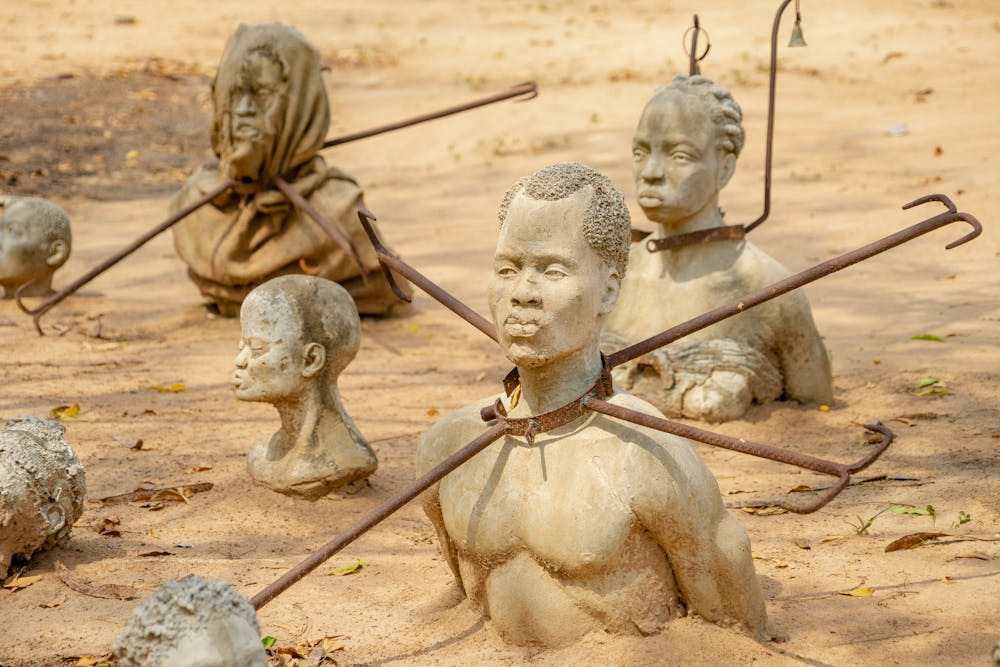
Thousands of sculpted heads – captive African men, women, and children – meticulously created by the artist Kwame Akoto-Bamfo, emerge from the soil at the Nkyinkyim Museum, as a sacred gathering of ancestors. Together, they form a powerful monument to the horror, violence, and resistance to enslavement, as well as the ongoing work of remembrance and healing.
Kwame Akoto-Bamfo.
Kwame Akoto-Bamfo is a Ghanaian multidisciplinary artist who engages with the histories and legacies of the transatlantic slave trade and colonialism at home and, increasingly, internationally, on both sides of the Atlantic.
As an archaeologist who works in the field of critical heritage studies, Akoto-Bamfo’s work is important for its powerful engagement with memory, material culture and restorative justice. I feature it in a chapter of a new book that I co-edited called Architectures of Slavery: Ruins and Reconstructions.
Who is Kwame Akoto-Bamfo?
Akoto-Bamfo studied at the Kwame Nkrumah University of Science and Technology in Kumasi. He obtained his bachelor’s and master of fine arts degrees, both in sculpture. After graduating, the artist worked as a school teacher and a university lecturer.
In 2015, Akoto-Bamfo rose to international fame through a series of large-scale installations. He called it ‘Nkyinkyim’ (“twisting” in the Ghanaian Twi language, as in the proverb, “Life’s journey is twisted”).
Four years later, he established the ‘Nkyinkyim Museum’, a non-profit organisation known as the ‘Ancestor Project’. This open-air museum is located in Nuhalenya-Ada, a two-hour drive from Accra. It has become a space for people of African descent to engage in restorative healing through art and education.
Nkyinkyim Museum
At the site’s entrance, three twenty-five-foot monuments are displayed. They are made of stone, concrete and wood. The first is inspired by North and Eastern Africa, and the second by Sudano-Sahelian architecture. The third is inspired by the Forest regions in Central and West Africa.
Sculptures at the museum entrance.Kwame Akoto-Bamfo
The collection includes multiple installations in collaboration with the local community. They illustrate “the diversity in our narratives surrounding history, philosophy, and religious beliefs”. The artist himself, demonstrates a mastery of multimedia art forms, working in cement, terracotta, brass, copper, and wood, noting “one can reach different heights with different technologies.”
Today, the museum features a sacred healing space with a compelling display of thousands of unique concrete life size heads and 7,000 terracotta miniature sculpted heads. They include captive Africans abducted, sold and forcibly trafficked during the transatlantic slave trade.
An installation of the heads of enslaved people.Kwame Akoto-Bamfo
His sculptures capture captives’ shock, horror, anger, distress and fear—emotions. This is communicated through their facial expressions in an installation that is disturbingly evocative and profoundly haunting. It is inspired by ‘nsodie’, an Akan funerary sculpture tradition, that dates back to approximately the twelfth century. Akoto-Bamfo explains during our conversations relating to the research for book:
I wanted to draw upon Akan belief in commemoration and remembrance after death in order to honour the young, old, men and women, who originated from various ethnic groups and who died in the Atlantic Ocean during the Middle Passage and did not get that chance.
Each year, the annual ‘Ancestor Veneration’ ceremony takes place under the guidance of chiefs, priests, and priestess from various ethnic groups.
The museum displays 7,000 terracotta sculpted heads.Kwame Akoto-Bamfo
Visitors are invited to participate in certain Akan rites and ceremonies – free from photography and selfies that undermine or commercialise sacred funerary art practices. Says Akoto-Bamfo:
I am Akan, so initially I began with Akan traditional rites, but now our ceremonies welcome other African ethnic groups including the Ga-Dangme, Ewe, and Yoruba, from Ghana and Nigeria, as well as African descendant people in the African diaspora.
In contrast, the ‘Freedom Parade Festival’ allows participants to creatively express and contribute to an evolving heritage tradition, without the specified observances. For example, painted bodily adornment applied directly onto the skin, yet without the necessary spiritual rites.
A protest monument
Akoto-Bamfo’s sculptures have also gained recognition beyond Ghana’s borders. For instance, the permanent installation at the Legacy Museum and National Museum for Peace and Justice in Montgomery, Alabama in the US.
More recently, in 2021, his Blank Slate Project Monument toured throughout the United States. This included stops at Times Square in New York and the King Center in Atlanta. It depicts an enslaved ancestor, bent forward with his hands behind his back, head turned sideways, face on the ground, with a booted foot on his head.
The Blank Slate Monument in New York.Roshi Sariaslan
Akoto-Bamfo describes this work as “a noisy one — a protest piece that speaks against racist Civil War monuments.” The work was completed prior to the police killing of George Floyd that led to widespread protests in the US in 2020. It was first unveiled in a private viewing in Ghana, prior to its shipment to the United States.
He says:
We had a lot of discussions among those involved in the project: some feared it might incite violence, others said that it was a prediction.
The work is interactive. It holds a removable placard that invites viewers to inscribe their reactions to the statue, which are then exhibited. Akoto-Bamfo emphasises:
I wanted ordinary people, both individuals and communities, to relate, and to contribute to, not only towards my artwork but also to the wider ongoing discussions. As an artist, I believe that I do not have the sole right to speak. I wanted ordinary Americans to add their voices because I am already contributing.
In Europe too, his work is featured at the 169 Museum in Germany.
The effects of enslavement are still felt today.Kwame Akoto-Bamfo
In Ghana, Akoto-Bamfo’s work was initially seen as too controversial. The artist shares:
At first, I had to be extremely resilient because my work was concerned with the slave trade, slavery, colonialism, racism, and human rights. I embraced uncomfortable dialogue. Yet these were difficult topics for galleries and the art world at that time in Ghana.
He adds:
Today, however, some even view me as a spiritual leader… but I have always had an innate antipathy towards injustice. My work is not only about the past but what is unfolding now.
Akoto-Bamfo offers a closing reflection on why this kind of memory work matters:
I just want to use the little knowledge that I have to contribute towards the work of restorative and transformative justice.
– Kwame Akoto-Bamfo: the Ghanaian artist using work about slavery to find justice and healing – https://theconversation.com/kwame-akoto-bamfo-the-ghanaian-artist-using-work-about-slavery-to-find-justice-and-healing-259184
The 9th Nigerian Company (NIGCOY 9) of the ECOWAS Mission in The Gambia was deployed as part of the mission on the 26th of June 2024. After completing the required period of service in the area of operation, its members were awarded the ECOWAS Peace Medal at a ceremony held on the 9th of May 2025.
This distinction honours their invaluable contribution, their sacrifices, their unwavering dedication and their constant commitment to peace, stability and security in the west coast region of The Gambia.
The ceremony took place in the presence of Her Excellency Mrs Miatta Lilly French, ECOWAS Special Representative and Head of Mission in The Gambia, the Gambian Minister of Defence, the Honourable Sering Modou and many high-ranking civilian and military figures.
In their speeches, the speakers unanimously praised the exemplary commitment of the NIGCOY, as well as its decisive contribution to the maintenance of peace and order in the country. The Special Representative particularly congratulated the company commander on the perfect organisation of the parade, while highlighting the unit’s humanitarian actions and constant support for the Gambian people.
The presence of the representative of the Chief of Staff of the Armed Forces, Lieutenant-General MO Cham, the Chief of Staff of the Gambian Army, commanders of the defence and security forces, and representatives of the local communities, underlined the strength of the ties between the Gambian Armed Forces and the Nigerian-Iranian contingent.
Finally, Mission Headquarters presented NIGCOY with an official citation in recognition of its essential role in preserving peace and stability in the West African sub-region.
Distributed by APO Group on behalf of Economic Community of West African States (ECOWAS).