Le risque de génocide reste « très élevé » au Soudan, prévient Nations Unies (ONU)


Le risque de génocide, de crimes de guerre et de crimes contre l’humanité reste « très élevé » au Soudan, a averti lundi une responsable des Nations Unies, s’alarmant également de la situation à Gaza et du sort de la communauté Peule au Sahel.

Devant le Conseil des droits de l’homme de l’ONU, la Conseillère spéciale par intérim du Secrétaire général pour la prévention du génocide a indiqué que le conflit au Soudan entre les forces armées soudanaises et les paramilitaires des Forces de soutien rapide (FSR) continue d’avoir un effet dévastateur sur la population civile.

Alors que la guerre entre dans sa troisième année, des milliers de civils ont été tués et plus de 10,5 millions de personnes ont été déplacées. Les deux parties ont commis de graves violations des droits de l’homme.

« Les attaques continues et ciblées contre certains groupes ethniques, en particulier dans les régions du Darfour et du Kordofan, constituent une préoccupation particulière pour mon mandat », a déploré Virginia Gamba, relevant que les FSR et leurs alliés des milices arabes armées continuent de mener « des attaques à motivation ethnique contre les groupes Zaghawa, Masalit et Fur ».

Horreur à Gaza

La responsable onusienne s’est également inquiétée de « l’horreur à Gaza », qui continue d’avoir « un impact sur notre conscience collective ». Mme Gamba a ainsi fustigé la campagne militaire soutenue d’Israël, qui a dévasté Gaza, tuant « des dizaines de milliers de civils et a détruisant des infrastructures essentielles ».

L’ampleur des souffrances des civils est « stupéfiante et inacceptable », a pointé la Conseillère spéciale d’Antonio Guterres. Le ciblage délibéré des infrastructures civiles, la destruction généralisée et le refus de l’aide humanitaire sont extrêmement préoccupants, a-t-elle insisté.

« Les terribles événements du 7 octobre 2023 ne seront jamais oubliés, et la souffrance continue des familles des otages doit être accueillie avec toute la sympathie et le soutien possibles ».

« On ne peut pas répondre à la violence par la violence », a-t-elle affirmé.

Cette détérioration de la situation dans l’enclave palestinienne intervient dans un contexte « très inquiétant de l’augmentation de l’antisémitisme et de l’islamophobie dans le monde entier, exacerbées par ce conflit ». 

Mme Gamba appelle donc à un cessez-le-feu immédiat, à la libération inconditionnelle des otages et au rétablissement immédiat de l’accès humanitaire.

Le conflit à Gaza aggrave la situation au Moyen-Orient, rendant la région dans un climat « extrêmement instable, où les plus vulnérables continuent de subir les conséquences les plus graves du conflit ». 

« À l’heure où les hostilités entre Israël et l’Iran s’intensifient, il est impératif de prendre toutes les mesures possibles pour ouvrir des espaces de dialogue », a fait valoir la Conseillère.

Les Peuls ciblés au Sahel

Sur le continent africain, les tensions croissantes entre la coalition au pouvoir du président Salvar Kiir et son premier vice-président Riek Machar, à la suite de violents affrontements entre les Forces de défense du peuple du Sud-Soudan et la milice d’opposition connue sous le nom d’Armée blanche, menacent de plonger ce pays d’Afrique de l’Est dans un nouveau cycle de guerre civile. Des centaines de civils ont été tués, notamment lors d’attaques à caractère ethnique. 

« Le fait de qualifier les membres de l’ethnie Nuer d’« ennemis » est dangereux et peut inciter à la violence contre ce groupe », a regretté Mme Gamba.

Dans la région du Sahel, les allégations de graves violations des droits de l’homme qui auraient été commises par les forces nationales du Burkina Faso, du Niger et du Mali restent extrêmement préoccupantes.

« Des rapports faisant état de meurtres de membres de l’ethnie Fulani par l’armée du Burkina Faso et les milices alliées près de la ville de Solenzo, dans l’ouest du pays, en mars 2025, sont emblématiques des graves inquiétudes qui règnent dans la région du Sahel », a affirmé la responsable de l’ONU, relevant que la situation dans cette partie de l’Afrique de l’Ouest « exige une attention et une action urgentes ».

Discours de haine dans l’Est de la RDC

En République démocratique du Congo, la situation reste « précaire », avec des affrontements intercommunautaires persistants dans tout le pays, des attaques de civils par des groupes armés, en particulier dans l’est du pays, où, ces derniers mois, l’escalade des combats entre les forces armées congolaises et le groupe armé M23 a entraîné de nombreuses souffrances pour les civils.

Selon la Conseillère spéciale par intérim pour la prévention du génocide, « les violences sont également perpétrées selon des critères ethniques ». 

« Au milieu des combats en cours, les discours de haine et de discrimination se sont multipliés », a fait observer Mme Gamba.

Distribué par APO Group pour UN News.

Empowering solutions for South Africa’s energy future


Download logo

Electricity Expo Africa 2025 (www.ElectricityExpoAfrica.com) is set to convene South Africa’s leading minds and innovators in the energy sector, offering a critical platform for tangible solutions to the nation’s power crisis. Taking place from 19 to 21 August 2025 at the Johannesburg Expo Centre, this inaugural event arrives at a pivotal moment as the country grapples with persistent energy instability. 

Themed ‘Empowering Solutions for South Africa’s Energy Future’, the Expo will address national grid constraints, accelerate the adoption of renewable energy, promote off-grid innovation, mitigate load shedding, and modernise infrastructure and regulation. 

Organised by the Electrical Contractors Association (SA) and the South African Electrical Workers Association (SAEWA) and proudly endorsed by the National Bargaining Council for the Electrical Industry, Electricity Expo Africa 2025 (https://apo-opa.co/4egPsr8) is a focused space for stakeholders committed to real-world impact. 

“Electricity is the engine of development. This Expo is more than just an industry gathering – it’s a national imperative, a call to action for every stakeholder invested in South Africa’s future,” said Jimmy Turner, Chairperson of Electricity Expo Africa. “We are uniting solution-providers, policymakers, and communities to collectively transform South Africa’s energy landscape from one of scarcity to one of reliability and abundance.” 

Three Pillars of Focus 

1. Confronting the National Grid Crisis 

South Africa’s ageing grid requires urgent intervention. At the heart of the Expo is a drive to modernise infrastructure through automation, smart diagnostics, and maintenance innovations. By gathering grid experts and transmission specialists, the event will foster knowledge exchange on how to prevent failures and accelerate national upgrade projects. 

This effort supports the National Energy Action Plan, which aims to restore Eskom’s reliability and accelerate the development of new power capacity. 

“Ending load shedding requires more than just talk; it demands real tools, smart systems, and urgent implementation of practical solutions,” emphasised Turner. “This Expo will present actionable answers – from cutting-edge grid technologies that bolster resilience to policy reforms that streamline infrastructure development. It’s about turning challenges into opportunities for growth.” 

2. Accelerating Renewable and Off-Grid Solutions 

South Africa’s energy future depends on a diversified generation mix. With the rapid rise of solar adoption – from 2,300 MW in 2022 to over 5,400 MW by early 2024 – the Expo will highlight solar PV, wind, and battery storage technologies that enable homes, businesses, and municipalities to generate electricity independently and reduce their reliance on the national grid. 

Over 130 IPP projects, totalling roughly 22,500 MW, are also in the pipeline. At the Expo, both large-scale and decentralised innovations will be on display, including off-grid and mini-grid solutions for rural and high-risk areas. 

Attendees will engage directly with tech developers and solution providers, demonstrating the tools needed to power communities and commercial hubs even in the absence of national supply. 

3. Innovation in Policy, Infrastructure, and Regulation 

The recent Electricity Regulation Amendment Act marks a new era for South Africa’s electricity sector, introducing reforms such as an independent transmission system operator and a competitive power market. But policy must match pace with technology. 

Electricity Expo Africa 2025 (https://apo-opa.co/4kYvdAY) will feature high-level discussions with government, regulators, and industry leaders. Topics include streamlining licences for renewables, energy storage incentives, updated grid codes, and infrastructure financing – crucial considering the estimated R390 billion needed for national grid expansion. 

“We are not just showcasing innovation; we are driving a national movement towards a resilient, inclusive electricity system,” added Turner. “Electricity Expo Africa 2025 is where solutions become action, fostering the collaboration between government, industry, and civil society that is essential for a truly sustainable energy future.” 

Who Needs to Be There 

Electricity Expo Africa 2025 will host over 150 exhibitors and more than 60 expert speakers, creating a platform for high-impact visibility and engagement. Key participants will include: 

  • Policymakers and Energy Officials – Sharing reforms and strategic plans. 
  • Municipal Utility Leaders – Highlighting local innovation and micro-grids. 
  • Renewable Energy Innovators – Showcasing new generation technologies. 
  • Grid Technology and Storage Providers – Presenting advanced smart-grid systems. 
  • Financing and Infrastructure Partners – Exploring capital mobilisation and PPPs. 
  • Community Energy Access Organisations – Championing equitable power access. 

This expansive programme creates a rare opportunity for businesses to place their innovations at the centre of national dialogue and development. 

Turner underscores the dual opportunity for exhibitors: “Exhibiting at Electricity Expo Africa 2025 is more than a marketing opportunity – it’s a chance to fuel your company’s growth and help power South Africa’s energy transformation. We encourage businesses large and small to showcase their innovations at the Expo, where they can build valuable relationships and play a role in securing the nation’s energy future.” 

Event details: 

Distributed by APO Group on behalf of Electricity Expo Africa (EEA).

Issued By: The Lime Envelope 
On Behalf Of: Electricity Expo Africa 

For Media Information: 
Kerry Oliver 
Telephone: 082 927 9470 
E-mail: kerry@thelime.co.za  

African Energy Week (AEW) 2025 Promotes Africa-Centric Energy Transition with Dedicated Program Track

The African Energy Week (AEW): Invest in African Energies conference – taking place on September 29 to October 3 in Cape Town – is organized under a mandate to make energy poverty history by 2030. As such, the event connects financiers with African projects, promoting energy development across the entire energy sector and its value chain. A dedicated Energy Transition Track at this year’s event offers attendees insight into the continent’s energy transition strategy, with panel discussions covering a series of topics, from natural gas as a clean cooking fuel to carbon capture and storage solutions to green hydrogen and renewable energy rollout.

AEW: Invest in African Energies is the platform of choice for project operators, financiers, technology providers and government, and has emerged as the official place to sign deals in African energy. Visit www.AECWeek.com for more information about this exciting event.

With over 900 million people living without access to clean cooking solutions in Africa, many countries are adopting bold strategies to advance the adoption of natural gas products such as LPG. Kenya, for example is rolling out LPG expansion, electric cooking and bioethanol alternatives with support from private sector investment, Tanzania is integrating clean cooking solutions into its national electrification plan and broader energy transition strategy while Ghana has adopted a multi-pronged approach, enhancing LPG affordability and scalability. The AEW: Invest in African Energies 2025 Energy Transition Track will feature panel discussions focused on Africa’s burgeoning LPG market. Sessions include From Firewood to Freedom: Promoting Clean Cooking in Africa; Monetizing LPG to Enhance the Value of the Barrel in Africa’s Inland Markets; and Gas-to-Liquids Market Opportunities in Africa.

Given the pressing energy access challenges faced across the continent, Africa has long-advocated for an energy transition strategy that takes into account the continent’s energy and climate needs. In this regard, many countries are pursuing a just transition, which utilizes a variety of solutions from low-carbon oil to non-associated gas to renewable energy and integrated power systems. According to the International Energy Agency, meeting Africa’s energy demand will require annual investments to more than double by 2030, reaching $240 billion annually. The Energy Transition Track at AEW: Invest in African Energies 2025 not only offers a platform to discuss Africa’s just transition strategy, but lays out strategic investment prospects across the entire energy value chain. Sessions include Just Energy Transition Dialogue: Harnessing Africa’s Resource Wealth to Establish Energy Sovereignty; Forging the Path for a Green Hydrogen Economy: Shifting from Planning to Meeting Global Market Demands; and Overcoming Infrastructure Gaps: Innovations in Road, Rail and Transport Connectivity Across Africa.

The AEW: Invest in African Energies 2025 Energy Transition Track goes beyond promoting investments in energy projects to include strategic sessions on local content, inclusive participation and collaborative leadership. With a rapidly growing population, increased urbanization and soon-to-be the world’s largest workforce, Africa requires strategic commitments by governments and companies to accelerate capacity building, skills development and inclusive work practices. By 2050, Africa’s population is projected to increase to 2.5 billion people. As such, local content will serve as a catalyst for sustainable and equitable development. During the event, sessions will address these topics, including Energy Security in Africa: Why Women’s Participation in Africa’s Resource Governance Matters; From Start-Ups to Scale-Ups: Why SMEs are Africa’s Game Changers; and Collaborative Leadership: Operator Strategies for Local Content Development.

The Energy Transition Track will also feature an Invest in Uganda session, which offers exclusive insight into the country’s $10 billion energy portfolio, comprising a mix of hydrocarbon, infrastructure and renewable energy projects. The discussion will unpack how supportive policies, a stable regulatory environment and untapped resources have made the country an attractive market to invest in. Beyond panel discussions, the track will also feature a series of Fireside Chats. These sessions aim to provide insight into the respective investment strategies of various companies, with discussions paving the way for collaborations and deals. 

“AEW: Invest in African Energies 2025 takes place under a mandate to make energy poverty history, and as such, advocates for a just energy transition which encompasses the development of a variety of energy sources. The Energy Transition Track serves as a catalyst for this goal by uniting players from the renewable energy, natural gas, regulatory and infrastructure sectors to discuss strategies for securing investment and advancing projects in Africa,” states Verner Ayukegba, Senior Vice President, African Energy Chamber.

Distributed by APO Group on behalf of African Energy Chamber.

Media files

Download logo

President Ruto, Samaila Zubairu and Africa’s Top Chief Executive Officer’s (CEO) to Headline The Africa Debate in London

Invest Africa (www.InvestAfrica.com) is pleased to announce Africa Finance Corporation (AFC) as Headline Partner for the 11th edition of The Africa Debate, taking place on Wednesday, 2 July 2025 at the Guildhall, in the heart of the City of London.

This year’s theme — “Harnessing Natural Capital for Growth” — seeks to interrogate how Africa can transform the scale and structure of investment around its most enduring assets: from its critical minerals and fertile land to its human ingenuity and demographic dynamism.

Now firmly established as the UK’s premier forum for Africa-focused investment dialogue, The Africa Debate will convene over 700 senior decision-makers from across government, finance, and industry for a full day of high-level exchanges. Through keynote addresses, ministerial dialogues, and curated sector debates, the programme will explore how to turn extractive advantage into structural transformation — mobilising green industrialisation, digital infrastructure, intra-African trade, and new financial instruments to drive inclusive, climate-smart growth.

This year’s speaker line-up reflects the extraordinary breadth of voices shaping Africa’s next chapter, from heads of state to the stewards of global capital. Highlights include: H.E. William Ruto, President of the Republic of Kenya; H.E. Hailemariam Desalegn Boshe, Former Prime Minister of Ethiopia; Board Chair, TradeMark Africa; H.E. Wamkele Mene, Secretary-General, African Continental Free Trade Area Secretariat; Benedict Oramah, President, Afreximbank; Samaila Zubairu, President & CEO, Africa Finance Corporation; Abebe Aemro Selassie, Director, African Department, International Monetary Fund; Solomon Quaynor, Vice President for Private Sector, Infrastructure & Industrialisation, African Development Bank; Strive Masiyiwa, Founder & Chair, Econet Wireless; Duncan Wanblad, CEO, Anglo American; Wale Tinubu, CEO, Oando Plc; Monique Gieskes, CEO, PHC; Marie-Chantal Kaninda, President, Glencore DRC; and more. The full programme is now available to view here (http://apo-opa.co/4ljJqbx), with detailed sessions on value chain transformation, blended finance, regional infrastructure, and Africa’s positioning in a multipolar global economy.

Samaila Zubairu, President and CEO of Africa Finance Corporation, commented: “Natural capital is only as valuable as the systems that refine, protect, and elevate it. At AFC, we believe that infrastructure is the bridge between Africa’s resource richness and the continent’s ability to rapidly industrialise and take its rightful place on the global stage. Our partnership with Invest Africa and The Africa Debate underscores the need for thoughtful, long-term capital — deployed strategically — to unlock the continent’s full economic potential. We are proud to support a platform that challenges assumptions and catalyses bold, bankable solutions.”

Chantelé Carrington, CEO of Invest Africa, added: “Africa’s path to prosperity must be built not on extraction, but on transformation. This year’s theme compels us to ask harder questions about how we steward the continent’s assets — human, natural, and institutional — in a world shaped by climate change, technological disruption, and shifting geopolitical priorities. With AFC’s visionary leadership, we are honoured to convene a dialogue that is ambitious in scope, rigorous in thought, and focused on meaningful outcomes.”

Confirmed Sponsors of The Africa Debate Include: Africa Finance Corporation (Headline Partner), Absa Group, Afreximbank, FirstBank UK Limited, Invest KZN, Standard Chartered, Standard Bank Group, Plantations et Huileries du Congo, Lagos Free Zone (Tolaram), Octopus Energy, ServiceNow, Stellar Developments, Spiro, Safaricom, Premier Invest, Remittances Hub, S-RM, DLA Piper, and London Stock Exchange Group.

To register as a delegate for The Africa Debate, please visit: https://apo-opa.co/4efWGM0. Places are limited and advance registration is essential.

Distributed by APO Group on behalf of Invest Africa.

For more information or media enquiries, please contact:
Pippa van Breda

Marketing & Communications Manager
Invest Africa
T: +44 2037 305 035
E: pippa.vanbreda@investafrica.com

About The Africa Debate:
The Africa Debate is London’s premier investment forum dedicated to shaping the future of African trade, investment, and economic transformation. Now in its 11th year, the event serves as a critical platform for global businesses, investors, policymakers, and thought leaders to engage in high-level discussions on Africa’s evolving role in the global economy.

About Invest Africa:
Invest Africa is a leading pan-African business platform that promotes trade and investment across the continent. With a 60-year heritage and a network of over 400 global members, Invest Africa provides trusted intelligence, strategic connections, and high-level convenings to support business success across African markets.

About Africa Finance Corporation:
Africa Finance Corporation is Africa’s leading multilateral finance institution, focused on bridging the continent’s infrastructure gap through innovative, commercially viable, and sustainable investments.

Media files

Download logo

President Ramaphosa conducts oversight visit to Steve Biko Hospital

Source: President of South Africa –

President Cyril Ramaphosa will on Tuesday, 24 June 2025, conduct an oversight visit to Nuclear Medicine Research Infrastructure (NuMeRI) Facility, a one-stop-shop medical imaging facility dedicated to Cancer and TB drug development and imaging-based clinical research, housed at the Steve Biko Academic Hospital in Pretoria. 

This is a world class facility that showcases a successful partnership between Department of Health, Department of Science and Innovation, and the University of Pretoria with significant support from the private sector.

President Ramaphosa will also visit cardias cathetherisation laboratory, which is part of the radiology department. The visit will highlight South Africa’s commitment to scientific innovation, equitable access to healthcare, and integrated infrastructure investment.

President will be accompanied by Ministers and Deputy Ministers including Minister of Health, Dr Aaron Motsoaledi; Gauteng Premier, Panyaza Lesufi; and Gauteng Health and Wellness MEC, Nomantu Nkomo-Ralehoko. 

Details of the visit are as follows:

Date: Tuesday, 24 June 2025 
Time: 10h00
Venue: Steve Biko Academic Hospital, Corner Steve Biko Road and Malan Street, Pretoria

Due to space limitations, the visit will be restricted to the Government Communications and Information System (GCIS), which will disseminate the materials to all media post the visit.

Media enquiries: Vincent Magwenya, Spokesperson to the President – media@presidency.gov.za

Issued by: The Presidency
Pretoria

Which African countries are flourishing? Scientists have a new way of measuring well-being

Source: The Conversation – Africa – By Victor Counted, Associate Professor of Psychology, Regent University

What does it mean to live a good life? Psychologists and social scientists have been focusing on a new idea called flourishing – a sense of well-being that goes beyond just happiness or success. It’s about your whole life being good, including how you interact with other people and your community. So then, how do Africans fare when it comes to flourishing?

Victor Counted is a psychological scientist whose research across 40 African countries offers a data-rich rethinking of flourishing on the continent. His findings challenge the dominant narrative that Africa is “lagging behind” in development by showing a more nuanced picture of what it means to live a good life. We asked him more.


What is flourishing?

Flourishing is more than economic growth or individual happiness. It’s a multidimensional state of being that reflects how people feel about their lives and how well their lives are actually going. So it also measures people’s values within their community.

The idea of well-being often carries a Eurocentric emphasis on the individual – personal satisfaction, autonomy, achievement. Flourishing accounts for how whole a person is in relation to their environment.

It includes the social, spiritual and ecological contexts in which one lives. So, it’s not just about how one feels, but how one lives – fully, meaningfully and in a satisfying relationship with the world around us.

What’s the Global Flourishing Study?

The Global Flourishing Study tries to measure global patterns of human flourishing. It’s an ongoing five-year longitudinal study in over 200,000 participants across 22 countries.

I was one of the team of global scholars brought together to examine the trends on what it means to live well across cultures and life circumstances.


Read more: What makes people flourish? A new survey of more than 200,000 people across 22 countries looks for global patterns and local differences


The study identifies six key dimensions of flourishing:

  • Happiness and life satisfaction
  • Mental and physical health
  • Meaning and purpose
  • Character and virtue
  • Close social relationships
  • Financial and material stability

Participants rate how they’re doing in each of these areas on a scale from 0 to 10. Further questions capture experiences related to trust, loneliness, hope, resilience, and other related well-being variables.


CC BY-ND

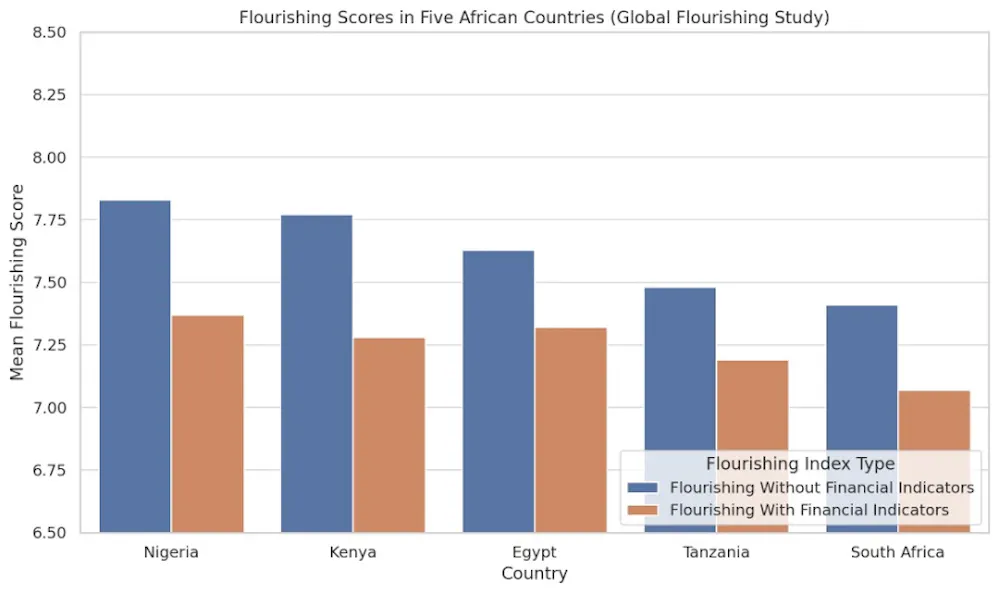
Of the 22 nations, five were African: Nigeria, Kenya, South Africa, Tanzania and Egypt.

While these countries didn’t top the global rankings (Indonesia and Mexico did), Nigeria, Kenya and Egypt all reported relatively high flourishing scores, especially when well-being was considered apart from financial status.


Courtesy Victor Counted

Nigeria, for example, ranked 5th globally in flourishing scores that excluded financial indicators – ahead of many wealthier nations. Nigerians indicated strengths in social relationships, character and virtues (like forgiveness or helping others). But potential areas of growth included financial well-being, housing, ethnic discrimination and education.

Overall, this suggests that while material resources matter, they’re not the only thing that determines well-being. Kenya ranked 7th, Egypt 10th, Tanzania 11th and South Africa 13th. Each showed unique strengths in areas like meaning, social connection or mental health.

You did a separate study on flourishing in Africa. What did you find?

In a 2024 study we analysed data from the Gallup World Poll (2020–2022) to explore 38 indicators of well-being across 40 African countries.

This study offered a more detailed and culture-sensitive picture of how Africans experience and prioritise flourishing. The dimensions explored were derived from both local and universal sources, allowing for regionally relevant insights.

We found that African populations often score high in meaning, character and social relationships – despite economic hardship. This offers an important corrective to western assumptions about well-being.

Some of our key findings were:

● There is significant diversity between and within African countries. Mauritius consistently ranked highest in life evaluations (overall satisfaction with their lives), while countries like Sierra Leone and Zimbabwe scored lowest.

● East African countries such as Rwanda and Ethiopia showed strong performance in social well-being indicators (like feeling respected or learning new things daily) even when economic indicators were low.

● Countries in West Africa, such as Senegal and Ghana, scored high in emotional well-being, with many people reporting positive daily emotions like enjoyment and laughter.

● Southern African nations, despite challenges like income inequality, displayed resilience through strong community ties and cultural practices rooted in the philosophy of ubuntu.

The results reinforced that flourishing in Africa cannot only be reduced to gross domestic product (GDP) per capita (a measure of the average economic output per person in a country) – nor to western norms of success.

What can African countries focus on to flourish?

In my view, the path to greater flourishing lies in embracing local knowledge and investing in culturally relevant development priorities. Instead of following western pathways – centred on individual advancement – Africa can model alternative flourishing pathways that reflect what matters most to African people.

1. Prioritise local knowledge systems

African ideas about a connected society – like ubuntu (southern Africa), ujamaa (east Africa), teranga or wazobia (west Africa), and al-musawat wal tarahum (north Africa) teach people to care for each other and live in peace. These values help people live meaningful lives and can inform leadership and legislation.

2. Redefine development metrics

Western development models focus on individual achievement, economic output and material consumption. GDP per capita fails to capture the everyday realities and aspirations of African communities. We should also measure things like how happy people are, how hopeful they feel about the future, how strong and resilient their communities are, and how clean, safe and dignifying their living environments are.

This is not a new idea – for years development scholars have called for a shift away from narrow economic indicators toward a focus on human dignity, agency, and the real opportunities people have to pursue the lives they value. What’s new is the growing availability of data and the momentum to take these alternative metrics seriously in shaping national policies and priorities.

3. Invest in education for character development

Quality education is essential to unlocking the continent’s potential to flourish. But Africa needs more than just academic skills and workforce readiness – it needs a strategy for intentional development of values and habits that shape how a person thinks, feels, and acts with integrity.

Part of the problem lies in how the humanities – fields like history, literature, philosophy, and religious studies – are often undervalued or underfunded in education systems. But it is precisely these disciplines that nurture moral imagination, critical reflection, and civic responsibility. We need educational models that form not just workers, but whole persons – people who can think ethically, act responsibly, and lead with character in their communities.


Read more: What makes a person seem wise? Global study finds that cultures do differ – but not as much as you’d think


What does Africa offer the world in terms of flourishing?

Africa is not waiting to be saved. Across the continent, people are building communities of care, cultivating joy amid hardship, and passing on values of unity, faith, and compassion. This is what development looks like when rooted in human dignity.

Africa flourishing goals offer an alternative vision for development – one that starts with what Africa already has, not what it lacks. These are locally emic aspirations for well-being. They are shaped by Africa’s indigenous knowledge systems, cultural values, and religious/spiritual traditions. Pursuing these goals means prioritising wholeness over wealth, community over consumption, and resilience over rescue.

The continent has so much to offer the world: wisdom, strong community values, and ways of staying resilient and living fully even in hard times. But many of these local insights are missing in the global science of well-being.

– Which African countries are flourishing? Scientists have a new way of measuring well-being
– https://theconversation.com/which-african-countries-are-flourishing-scientists-have-a-new-way-of-measuring-well-being-257458

SIU strikes on former Lotteries Commission official

Source: South Africa News Agency

Monday, June 23, 2025

The Special Investigating Unit (SIU) has obtained a court order preventing former National Lotteries Commission (NLC) senior manager, Sanele Dlamini, from accessing his pension benefits until the finalisation of a civil case against him.

The civil case relates to the alleged illegal disbursement of some R6 million in NLC funds signed off by Dlamini to the Motheo Sports and Entertainment Foundation.

“The SIU’s investigation revealed that an NLC-funded project – a sports complex – was never initiated, and supporting documents, including progress reports and financial statements, were falsified. 

“Mr Dlamini, who facilitated the irregular disbursement of R3 million to the Motheo Sports and Entertainment Foundation, co-signed the fraudulent progress report without verifying the site or documentation, enabling the unlawful payout,” the SIU said in a statement.

The corruption busting unit explained that it turned to the courts for a freezing order to “limit the risk of a hollow judgment if funds were released, noting concerns that Mr. Dlamini may lack sufficient assets to satisfy future claims”.

“The interdict bars Mr. Dlamini from accessing his pension benefits until the SIU’s main case, a civil recovery action tied to the misallocation of R6 million in NLC grant funds, is concluded. 

“The fourth respondent, Liberty’s Corporate Selection Umbrella Retirement Fund, has been directed to assess and disclose the value of Dlamini’s pension within 60 days. This preservation is intended to ensure that funds remain available for potential recovery should the SIU succeed in its claim,” the statement read. – SAnews.gov.za

Correctional Services cracks down on contraband at Tshwane facility

Source: South Africa News Agency

Monday, June 23, 2025

An unannounced raid at the Odi Correctional Centre has led to the discovery of a myriad of contraband material, including cellphones, drugs and WiFi routers.

This is according to Correctional Services National Commissioner Makgothi Thobakgale who spoke to the media following the late-night raid.

“We are here to restore order. We are here to restore the security protocols that are supposed to prevail here. So far, we have found 30 cellphones, cellphone accessories [and] three routers. 

“We found…slopes that are loaded with nyaope, mandrax tablets, crystal meth, dagga and we found offenders that are…buying from the kiosk and reselling to offenders.

“Others actually barter their items for food. It’s a problem for us because…if an offender doesn’t have enough food because they are exchanging their food for substances, it disturbs their ability to attend rehabilitation programs,” he said.

The Commissioner explained that the correctional centre was targeted following a tipoff.

“The second reason is that it is a small centre that is in a township and most instances, those centres are hubs of [the] selling of illegal substances. 

“The third reason is that we also wanted to identify offenders that, given their classification, we might have to change their classification from low and medium to high risk given the contraband that we found in their possession,” Thobakgale added.
At least two offenders have been identified for relocation in this regard.

“There are officials that are [also] going through disciplinary processes. Even here, there are two officials that have been suspended.  That is the work that management has been doing but we have identified that we need to come in and strengthen their hand in dealing with contraband and in ensuring that the centre is free from illegal substances and objects,” Thobakgale explained. – SAnews.gov.za

Call to treat municipalities like businesses to attract skilled staff

Source: South Africa News Agency

Minister of Cooperative Governance and Traditional Affairs, Velenkosini Hlabisa, has called for a differentiated approach to tackling the challenges facing municipalities. 

This includes improving funding, providing better remuneration for councillors, and attracting skilled staff to rural areas.

“We need to adopt a style where our municipalities will be run like businesses. But to do so, we need to take a bold and new approach on structuring funding and remuneration of councillors, because if our councillors are paid peanuts, they will spend most of their time on other jobs and only pay lip service as councillors,” Hlabisa said on Monday. 

The Minister was speaking at a high-level dialogue with political parties in South Africa as part of the ongoing review of the 1998 White Paper on Local Government. 

Hlabisa said the remuneration of councillors, municipal managers, and Section 56 employees should be a topic for discussion.

“If you want to attract them to deep rural municipalities, there should be a discussion that, to attract competent engineers, competent accountants and competent municipal managers from big cities to deep rural municipalities, the remuneration must compensate those people so that they can go and serve our rural municipalities.” 

Government officials and relevant stakeholders should engage with honesty while reviewing the White Paper and come up with recommendations on these important issues.

In April, Hlabisa officially published a discussion document on the Review of the 1998 White Paper on Local Government. 

This document, published under Notice No. 6118 (Gazette: 52498), initiated a national discussion aimed at producing a revised White Paper on Local Government by March 2026.

The launch of the review process involved over 300 delegates from various sectors, with political parties having until 30 June 2025 to submit their contributions.

The review process aims to inspire fresh thinking, facilitate honest reflection, and promote decisive action toward establishing a local government system that effectively serves the people of South Africa.

The gathering stressed the need for political parties to engage in shaping the future of municipalities. 

The Minister took the time to highlight the poor performance of many municipalities, citing audit outcomes, financial mismanagement, and distressed municipalities. 

“We also know that the public holds the opinion that the majority of municipalities are not doing well. There are indeed municipalities that are doing well, even if it may not be said, excellent. 

“Unfortunately, these few well-performing municipalities are overshadowed by the majority that are not doing well. Year after year, the audit outcomes show that few municipalities get a clean bill.”

The Minister acknowledged the essential role of political parties and expressed eagerness for their contributions and involvement.

“We can improve the White Paper on Local Government. Local government is where policies become services, promises become infrastructure, and governance becomes tangible. 

“Local government is at the coalface of service delivery and the closest to the people; it is the sphere that must be strengthened in terms of human resources, capacitated in terms of capabilities, and be made financially resourced to focus on maximum service delivery.”

In addition, he stated that the involvement of traditional and Khoi-San leaders in local government must be engaged to ensure their maximum participation and contribution in advancing democracy and service delivery. – SAnews.gov.za

Intense cold front to hit SA midweek 

Source: South Africa News Agency

The South African Weather Service (SAWS) has warned that an intense cold front is expected to make landfall on Wednesday over the south-western parts of South Africa, bringing a significant shift in weather conditions across the region.

“The cold front is expected to be accompanied by heavy rainfall with a risk of localised flooding over the western parts of the Western Cape, especially in low-lying and poorly drained areas on Wednesday into Thursday [25-26 June 2025],” Head of Disaster Risk Reduction at the SAWS, Rudzani Malala, said on Monday.

The public has been cautioned that wet and slippery roads may result in dangerous driving conditions. 

“Motorists should exercise caution and adhere to safety measures. Strong and gusty winds over the interior may cause localised damage to structures and uproot trees. Cold to very cold conditions can be expected, along with possible snowfall over the western mountain ranges of the Western Cape, spreading into the south-western interior of the Northern Cape.

“Strong and gusty winds over the interior may cause localised damage to structures and uproot trees. Cold to very cold conditions can be expected, along with possible snowfall over the western mountain ranges of the Western Cape, spreading into the south-western interior of the Northern Cape,” Malala explained.

READ | Western Cape prepares for severe cold, wet weather

The maritime forecast includes gale-force winds and very rough seas, with wave heights between 5.5 metres to 7.5 metres, along the coastlines of the Northern Cape and Western Cape.

These conditions will lead to disruptions to fishing and port operations, an increased risk of vessels capsizing, accidents at sea, and hazardous shoreline conditions. 

Coastal residents and beachgoers are urged to exercise caution.

“As the system progresses eastwards, it will affect the Eastern Cape, which is already vulnerable to weather-related impacts. The key concern here is strong, damaging winds that are expected across most parts of the province on Thursday, 26 June 2025.

“Furthermore, interior winds are expected to pick up and spread over the remainder of eastern provinces on Thursday and Friday, 26 and 27 June 2025, with daytime temperatures dropping to the cold category,” he said.

READ | Cold front in the Eastern Cape brings strong winds

Call to heed weather reports

The weather service called on communities to follow daily weather reports and heed severe weather warnings.

“This means following weather reports on radio, television, newspapers, social media, websites and staying attuned to what disaster management authorities have to say. This needs to be in each person’s daily routine. It is that important – a matter of life and death,” Malala said.

Additionally, the South African Weather Service will continue to monitor any further developments relating to the weather systems and will issue subsequent updates as required. 

Furthermore, intermediate updates may be followed on X (@SAWeatherServic), Facebook (South African Weather Service) or other SAWS supported social media platforms.

“Impact Based Weather Warnings, if any, will continue to be issued via the system I have just elaborated on. As I have said, we need to work more closely with stakeholders to ensure to it that we save lives and property.

“Dissemination efforts aside, the South African Weather Service will continue with its elaborate public education and awareness programme, which includes own initiative mass events and piggybacking on other governmental events to equip vulnerable communities with information that could save lives and property.

“We will also carry on with our quarterly community radio programme targeted at vulnerable communities, partnering with disaster management authorities, municipal emergency services, and humanitarian bodies such as Red Cross International for an impactful collaboration,” he said. –SAnews.gov.za