
Government-Business Partnership commits to "inclusive growth, jobs and confidence" as central framework for Phase Three

Source: President of South Africa –

President Cyril Ramaphosa today met with Ministers and senior business leaders under the Government Business Partnership, formally commencing Phase Three of the partnership with a shared commitment to placing economic growth at the centre of the partnership’s work in 2026.

The meeting reviewed progress achieved during Phase Two, during which important gains were made in stabilising the energy and logistics systems. These advances, together with a number of other achievements, contributed to improved sentiment towards the end of 2025. Investors are increasingly responding positively to South Africa’s economic trajectory and recognising policy credibility.

Significant developments include South Africa’s removal from the FATF grey list, a steady reduction in inflation towards the 3 per cent target, a successful and oversubscribed sovereign Eurobond issuance, a firmer Rand and an upgrade to South Africa’s sovereign credit rating by S&P — the first in more than two decades.

During Phase Two, coordinated interventions and policy reform improved operational performance, particularly at Eskom. The recent commencement of the Durban Pier 2 terminal concession and the opening of the rail network to private operators further demonstrate the momentum that has been achieved. The Partnership agreed that the focus in these two areas must now shift decisively from crisis management to the urgent implementation of government’s structural reform agenda. Establishing commercially viable, competitive markets in these network industries is essential to mobilising the additional investment required for growth.

Against this backdrop, Government and business agreed that the central framework for Phase Three of the Partnership will be anchored in “Inclusive Growth, Jobs and Confidence”. In a rapidly changing global environment characterised by economic realignment, heightened competition for capital and increased uncertainty, the Partnership agreed that a disciplined focus on competitiveness and inclusive growth is essential. All actions under the Partnership will be assessed against their ability to grow the economy, support job creation and strengthen confidence.

Government and business further agreed that crime and corruption remain among the most significant deterrents to confidence, investment and economic growth. While progress has been made in strengthening institutional capability — including through FATF-related reforms and improved coordination — there is agreement that a more ambitious crime and corruption focus is necessary to support Government’s efforts to reform the criminal justice system. Tackling organised crime, corruption and weaknesses in the criminal justice system will therefore become a more central focus of the Partnership’s work in 2026, recognising the direct link between the rule of law, societal and investor confidence, and growth.

Priority activities for Phase Three include support for Government’s energy market reform, including the launch of a competitive South African wholesale electricity market, grid expansion and the publication of a clear roadmap for Eskom’s unbundling which clarifies the approach to establishing an independent Transmission System Operator in line with the Electricity Regulation Act. Another priority for this year is to accelerate reforms in the transport and logistics sector, including greater private sector participation, to increase investment and improve competitiveness and efficiency.

Youth employment interventions in other sectors will build on the model of close coordination between Government and business, which resulted in the successful introduction of the Electronic Travel Authorisation (ETA), which removes a key bottleneck to increasing international tourist arrivals and supports job creation.

Across all priority areas, the emphasis will be on execution and delivery in support of growth. Government and business agreed that this year should represent a decisive turning point for South Africa’s economic trajectory, and an opportunity to achieve lasting progress and shared prosperity.

President Cyril Ramaphosa said: “After two years of hard work, we can definitively say this partnership has been a success. While we have achieved much, there is much that we need to do. As this partnership evolves and as the focus of our work shifts, we remain firmly committed to acting together and with purpose to serve the needs of our country.”

Adrian Gore, Group CEO of Discovery and co-convener of the business delegation, said: “South Africa is turning the corner. We must act decisively to convert this momentum into investment and jobs. “Growth, Jobs, Confidence” sits at the heart of our approach and needs to be the filter for every decision in 2026. If an action does not advance these objectives, it should not proceed. If it does, we should move quickly and back it fully. Business is fully committed to supporting this.”

Media enquiries: Vincent Magwenya, Spokesperson to the President – media@presidency.gov.za

For Business: Dani Cohen on 082 897 0443 / dani@prologconsulting.co.za OR Sandra Sowray on 079 167 6863 / sandra@prologconsulting.co.za

Issued by: The Presidency
Pretoria
L’initiative «Tchad Connexion 2030» : La Banque islamique de développement (BID) renforce son partenariat pour soutenir les priorités nationales de développement du Tchad

Source: Africa Press Organisation – French

Le Groupe de la Banque islamique de développement (BID) (www.IsDB.org) a organisé la Journée de la BID au Tchad, marquant une nouvelle étape dans le renforcement de la coopération avec le pays. Cet événement intervient après le lancement réussi de l’initiative «Tchad Connexion 2030» à Abou Dhabi il y a quelques mois, ce qui confirme l’engagement de la BID à soutenir des projets de développement alignés sur les priorités du Plan national de développement du Tchad.

L’événement, tenue le 26 janvier à N’Djamena, s’est déroulée en présence du Premier ministre de la République du Tchad, Son Excellence M. Allamaye Halina, et a été organisée en partenariat avec le Ministère des Finances, du Budget, de l’Économie, de la Planification et de la Coopération internationale. La délégation du Groupe de la BID était présidée par Dr. Issa Faye, représentant S.E. Dr. Muhammad Al Jasser, Président du Groupe de la BID. En outre, l’événement a connu la participation des ministres, des hauts responsables, ainsi que des représentants d’institutions financières régionales et d’entreprises privées.

S’exprimant à cette occasion, M.  Allamaye Halina a déclaré: «Le Tchad entre dans une phase où la traduction de la vision en projets concrets est essentielle. Le Groupe de la Banque islamique de développement est un partenaire de confiance dans cet effort, notamment pour le renforcement des capacités de mise en œuvre financière, le développement des compétences et la mobilisation d’investissements à fort impact pour nos populations.»

De son côté, M. Tahir Hamid Nguilin, Ministre des Finances, du Budget, de l’Économie, de la Planification et de la Coopération internationale, a souligné: «Notre priorité est de stimuler le commerce par une meilleure cohérence entre les politiques publiques, des mécanismes de financement efficaces et la mobilisation du secteur privé. La BID joue un rôle clé dans l’appui à cette approche, notamment à travers la structuration de projets, les instruments d’atténuation des risques et les solutions de financement mixte.»

Pour sa part, Dr. Issa Faye, Directeur général des pratiques mondiales et des partenariats du Groupe de la BID et chef de délégation, a déclaré: «L’engagement du groupe BID envers le Tchad est axé sur la fourniture de solutions intégrées combinant financement et assistance technique. Au cours du dialogue sur l’engagement du pays, l’équipe de la BID, en collaboration avec les autorités compétentes, explorera toutes les solutions disponibles provenant des secteurs public et privé afin de garantir que les solutions de développement co-créées soient holistiques. Grâce à une coordination plus étroite avec les autorités nationales et les parties prenantes locales, nous visons à accélérer la mise en œuvre des projets, à renforcer la résilience et à soutenir les initiatives à fort impact alignées sur le plan « Tchad Connection 2030 », en particulier dans les domaines de l’agriculture, de la technologie et des infrastructures. »

L’un des temps forts du programme a été un panel de discussion consacré aux priorités de développement du Tchad et au rôle du Groupe de la BID, visant à identifier des opportunités concrètes de coopération et à nouer des partenariats stratégiques pour accompagner le pays vers un développement durable et inclusif.

Une série de rencontres bilatérales (B2B et B2G) a également été organisée entre les représentants du Groupe de la BID, des chefs d’entreprise, des investisseurs et des institutions financières, afin d’explorer des opportunités de coopération et de partenariat. Des exemples de projets réussis mis en œuvre au Tchad en partenariat avec des entrepreneurs locaux ainsi que des institutions nationales et internationales ont été présentés.

L’événement a par ailleurs mis en lumière les activités, services et initiatives des différentes institutions du Groupe de la BID, notamment la Société islamique d’assurance des investissements et des crédits à l’exportation (SIACE), la Société islamique pour le développement du secteur privé (SID), la Société internationale islamique de financement du commerce (SIFC), l’Institut de la Banque islamique de développement (IBID) et le Forum des affaires du Groupe de la BID (THIQAH).

La journée s’est conclue par la réaffirmation de l’engagement du Groupe de la BID à poursuivre sa collaboration avec le gouvernement tchadien et le secteur privé national, afin de renforcer les partenariats stratégiques, d’élargir les opportunités d’investissement et d’améliorer l’environnement des affaires, contribuant ainsi à la réalisation du développement durable au Tchad.

Distribué par APO Group pour Islamic Development Bank Group (IsDB Group).

A propos de la Banque islamique de développement :
La Banque islamique de développement est une banque de développement multilatérale qui œuvre à promouvoir le développement social et économique de ses pays membres visant à améliorer la vie des communautés bénéficiaires. Par le biais de partenariats collaboratifs entre les communautés des 57 pays membres, la Banque cherche à permettre à ces communautés d’atteindre le progrès économique et social et de construire l’infrastructure nécessaire pour libérer leur potentiel. Le nouveau modèle commercial de la banque «faire en sorte que les marchés œuvrent pour le développement» contribue à renforcer la compétitivité des pays membres dans des secteurs stratégiques, améliorant leur intégration dans les chaînes de valeur mondiales, en particulier dans les domaines des industries alimentaire et agricole, du textile, de la pétrochimie, construction, et la finance islamique. La Banque promeut également des solutions innovantes et durables aux défis du développement mondial, met à profit le potentiel scientifique de la technologie et de l’innovation en tant que moteurs clés de la croissance économique et contribue à la réalisation des objectifs de développement durable des Nations Unies.

A propos du Plan national de développement, Tchad Connexion 2030 :
Structuré autour de quatre grands axes d’intervention, déclinés en 17 programmes comprenant 268 projets et réformes, l’initiative «Tchad Connexion 2030» vise à réaliser une transformation profonde et systémique de l’économie et de la société tchadiennes à travers :

  • L’accélération du développement des infrastructures stratégiques critiques, notamment l’extension de l’accès à l’électricité et à l’eau sur l’ensemble du territoire, la digitalisation de l’économie, le renforcement des réseaux de transport et des corridors internationaux, ainsi que l’amélioration de la navigabilité des lacs et des grands fleuves, accompagnée du renforcement des institutions afin d’assurer une gestion efficace et durable des services publics ;
  • Le renforcement des politiques sociales, en particulier dans les domaines de l’éducation, de la jeunesse, de la santé, de la formation professionnelle et de l’emploi, afin de promouvoir le développement du capital humain et l’inclusion sociale ;
  • L’intensification de la diversification économique et la promotion du «Made in Chad», notamment à travers le développement de filières industrielles orientées vers l’exportation, l’agriculture, l’élevage, la pêche, les hydrocarbures, les mines et le tourisme ;
  • L’amélioration continue du climat des affaires, le déploiement de la diplomatie économique et le renforcement de l’attractivité du pays auprès des investisseurs.

L’ambition du plan est de générer un taux de croissance annuel moyen du PIB réel de 8 % entre 2025 et 2030. Cette dynamique permettra au Tchad d’accéder au statut d’économie à revenu intermédiaire en créant davantage de richesses et d’emplois dans le secteur privé, en portant l’accès à l’électricité en milieu urbain à 90 % et l’accès national à 60 %, en fournissant de l’eau potable à 11 millions de personnes supplémentaires, en augmentant l’espérance de vie d’au moins 8 ans, en élargissant significativement le réseau routier, en doublant la production agricole, en faisant passer le taux de pénétration de la téléphonie mobile de 65 % à 80 %, en réduisant de 50 % la mortalité maternelle et néonatale, et en augmentant le taux de scolarisation au primaire de 43 % à 80 %.

Pour atteindre ces objectifs, «Tchad Connexion 2030 » prévoit de mobiliser 30 milliards USD (18.000 milliards de FCFA) d’investissements publics et privés, nationaux et internationaux, et entend positionner le Tchad comme une destination de choix pour les investisseurs. En novembre 2025, le Tchad a annoncé à Abou Dhabi la mobilisation réussie de 20,5 milliards USD, grâce à une mobilisation exceptionnelle des secteurs public et privé.

Pour en savoir plus : https://TchadConnexion2030.td

Media files

Portfolio Committee on Higher Education Satisfied with University of Venda’s State of Readiness

Source: APO


.

The Portfolio Committee on Higher Education and Training concluded a successful oversight visit to the University of Venda yesterday, where it expressed satisfaction with the institution’s level of preparedness for the 2026 academic year.

The visit marked the start of the committee’s week-long oversight programme, aimed at assessing higher education public institutions’ state of readiness ahead of the 2026 academic year. The committee found no major areas of concern or operational challenges during its engagement with the university.

The Chairperson of the committee, Mr Tebogo Letsie, commended the university’s leadership for demonstrating strong governance, effective planning and visible progress in infrastructure development. “We are satisfied with what we have observed at the University of Venda. The institution has shown clear commitment and capable leadership, particularly in ensuring that previously stalled infrastructure projects are revived and completed without loss of public funds,” said Mr Letsie.

The committee was particularly impressed by progress at the Health Sciences precinct, where construction challenges have been addressed and the building is now fully operational. The facility includes state-of-the-art nursing and clinical simulation laboratories, as well as modern hospital simulation rooms that enhance teaching and learning.

“The quality of facilities we saw, especially in the Health Sciences building, reflects serious investment in academic excellence. The leadership of the Vice-Chancellor, executive management, Council Chairperson and the entire Council is commendable,” Mr Letsie added.

The university reported to the committee that approximately 70 per cent of students have already been registered, and it is confident that enrolment targets will be fully met by the end of this week. “Based on the information presented and what we observed on the ground, the University of Venda is ready for the 2026 academic year,” emphasised Mr Letsie.

ISSUED BY THE PARLIAMENTARY COMMUNICATION SERVICES ON BEHALF OF THE CHAIRPERSON OF THE PORTFOLIO COMMITTEE ON HIGHER EDUCATION, MR TEBOGO LETSIE.

For media enquiries please contact the committee’s Media Officer:
Name: Jabulani Majozi (Mr)
Parliamentary Communication Services
Cell: 083 358 5224
E-mail: jamajozi@parliament.gov.za

Distributed by APO Group on behalf of Republic of South Africa: The Parliament.

Chad Connection 2030: Islamic Development Bank (IsDB) Deepens Partnership to Boost Chad’s National Development Priorities

Source: APO

The Islamic Development Bank Group (www.IsDB.org) hosted IsDB Day in Chad on Monday, deepening cooperation with the Central African nation.

The event follows the successful launch of “Chad Connection 2030” in Abu Dhabi a few months ago, which signaled IsDB’s commitment to support development projects aligned with Chad’s National Development Plan.

Chad’s Prime Minister Allamaye Halina attended the January 26 event in N’Djamena, organized in partnership with the Ministry of Finance, Budget, Economy, Planning and International Cooperation.

Dr. Issa Faye led the IsDB Group delegation, representing IsDB President Dr. Muhammad Al Jasser. Cabinet ministers, senior officials and representatives from regional financial institutions and private companies also participated.

The event aimed to deepen cooperation and align IsDB Group support with Chad’s National Development Plan.

H.E. Allamaye Halina, Prime Minister of the Republic of Chad, stated: “Chad is entering a phase where translating vision into concrete projects is essential. The Islamic Development Bank Group is a trusted partner in this effort, particularly in strengthening financial implementation, capacity building and mobilising investment that deliver tangible impact for our population.”

H.E. Tahir Hamid Nguilin, Minister of Finance, Budget, Economy, Planning and International Cooperation of the Republic of Chad, stressed the following: “Our priority is to boot trade through coherence between public policy, effective financing mechanisms and private sector mobilisation. The IsDB plays a key role in supporting this approach, notably through project structuring, risk mitigation instruments and blended financing solutions”.

Dr. Issa Faye, IsDB Director General for Global Practices and Partnerships, and Group Head of Delegation, stated: “The IsDB Group’s commitment to Chad is focused on delivering integrated solutions that combine financing and technical assistance. During the country engagement dialogue, IsDB team, in conjunction with relevant authorities will explore all available solutions from both public and private sector sources  to ensure that the co-created  development solutions are holistic. Through closer coordination with national authorities and local stakeholders, we aim to accelerate project delivery, building resilience and support high-impact initiatives aligned with  Chad Connection 2030. particularly in agriculture, technology and infrastructure.”

One of the main features of the program was a panel discussion on Chad’s development priorities and the role of IsDB Group, aimed at formulating practical avenues of cooperation and forging strategic partnerships to support Chad’s path towards sustainable and inclusive development.

A series of bilateral (B2B and B2G) meetings were held amongst representatives of the IsDB Group, business leaders, investors, and financial institutions to explore opportunities for cooperation and partnerships with the Islamic Development Bank Group. Inspiring success stories implemented in Chad in partnership with local entrepreneurs as well as local and international institutions were presented

The event also highlighted the activities, services, and initiatives of IsDB Group institutions, including the Islamic Corporation for the Insurance of Investment and Export Credit (ICIEC), the Islamic Corporation for the Development of the Private Sector (ICD), the International Islamic Trade Finance Corporation (ITFC), the Islamic Development Bank Institute (IsDBI), and the Islamic Development Bank Group Business Forum (THIQAH).

The day concluded with a reaffirmation of the Islamic Development Bank Group’s commitment to continue working with the Chadian government and the country’s private sector to further build strategic partnerships, expand investment opportunities, and enhance the business environment, thereby contributing to the achievement of sustainable development in Chad.

Distributed by APO Group on behalf of Islamic Development Bank Group (IsDB Group).

About Islamic Development Bank (IsDB):
The Islamic Development Bank is a multilateral development bank that works to improve the lives of those it serves by promoting social and economic development in Muslim countries and communities around the world and making a difference at scale. Through collaborative partnerships between communities in its 57 member countries, the Bank seeks to equip communities to drive their own economic and social progress at scale and put the infrastructure in place to enable them to realize their potential. The Bank’s new business model of “making markets work for development” contributes to enhancing the competitiveness of our member countries in strategic industries in order to improve participation and upgrading in global value chains. This is in the field of food and agricultural industries, textiles, clothing, leather, shoes, petrochemicals and petroleum, construction, and Islamic finance. The Bank also promotes innovative and sustainable solutions to the biggest development challenges in the world and takes advantage of the scientific potential in technology and innovation as strategic drivers of economic growth, and we also work to achieve the United Nations sustainable development goals.

About the National Development Plan, Chad Connection 2030: 
Structured around four main areas of intervention, implemented through 17 programs comprising 268 projects and reforms, Chad Connexion 2030 aims to bring about a deep and systemic transformation of Chad’s economy and society through:

  • The acceleration of the development of critical strategic infrastructures (expansion of electricity and water access across the country, digitalisation of the economy, enhancement of transport networks and international corridors, as well as improved navigability of lakes and major rivers), and the strengthening of institutions to ensure efficient and sustainable management of public services; 
  • The reinforcement of social policies, particularly in education, youth, health, vocational training, and employment, to promote human capital development and social inclusion;
  • The amplification of economic diversification and the promotion of Made in Chad, especially through the development of export-oriented industrial sectors, agriculture, livestock, fisheries, hydrocarbons, mining, and tourism;
  • The continued improvement of the business climate, deployment of economic diplomacy, and enhancement of the country’s attractiveness to investors.

The plan’s ambition is to generate an average annual real GDP growth rate of 8% between 2025 and 2030. This will enable Chad to join the ranks of middle-income economies by creating more wealth and private-sector jobs, increasing urban electricity access to 90% and national access to 60%, providing safe drinking water to an additional 11 million people, raising life expectancy by at least 8 years, significantly expanding the road network, doubling agricultural production, increasing mobile phone penetration from 65% to 80%, reducing maternal and neonatal mortality by 50%, and raising primary school enrolment from 43% to 80%. 

To fulfil these ambitions, Chad Connexion 2030 plans to mobilise USD 30 billion (CFAF 18,000 billion) in investments from both public and private sources, domestic and international and aims to make Chad a destination of choice for investors. In November 2025, Chad announced in Abu Dhabi the successful securing of USD 20,5 billions dollars thanks to an exceptional private-public mobilisation. 

Find out more on : https://TchadConnexion2030.td

Media files

.

Msunduzi Public Transport Project Could Collapse Without Proper Plans, Says Committee Chair

Source: APO


.

The Portfolio Committee on Transport has expressed concern over the stagnation of the Integrated Public Transport Network System programme in Pietermaritzburg’s Msunduzi Local Municipality.

The committee Chairperson, Mr Donald Selamolela, said the successful implementation of the programme had the potential to be a catalyst for economic growth and job creation. “The programme, otherwise known as the BRT [bus rapid transport] system, need not to have failed, as it seems in Pietermaritzburg, especially after so much money had already been spent. This programme ought not only to have benefited commuters but should have provided employment opportunities for our people,” he said.

Mr Selamolela continued: “We need not be lamenting what could have been. We are disappointed and we are concerned with what we found in Pietermaritzburg [Msunduzi Local Municipality]. The programme is going to become a white elephant if nothing is done.”

Meanwhile on Tuesday, the National Department of Transport informed the committee that the project is being wound down and will be discontinued. Mr Selamolela said the plan should be around innovative uses of the infrastructure that has been already laid out.

The committee began its visit with a meeting and a walkabout of the troubled programme’s transport system. Mr Selamolela said it is further concerning that the national Department of Transport’s understanding and expectations of the project differs to that of the municipality’s. “This speak to the silo mentality and the lack of alignment of thought around project implementation. It is not enough to cite the taxi industry as the reason for non-implementation of projects when the municipality has failed,” he said.

He added: “Now we are sitting with a situation where the national department says stop, and the municipality says it has continuation plans. That does not work; the municipality should use the available funding, developing comprehensive work plans to repurpose the already laid-out infrastructure.”

ISSUED BY THE PARLIAMENTARY COMMUNICATION SERVICES ON BEHALF OF THE CHAIRPERSON OF THE PORTFOLIO COMMITTEE ON TRANSPORT, MR DONALD SELAMOLELA.

For media inquiries or interviews with the Chairperson, please contact:
Mr Sibongile Maputi
Cell: 081 052 6060
Email: smaputi@parliament.gov.za

Distributed by APO Group on behalf of Republic of South Africa: The Parliament.

Communications Committee to Visit the Universal Services and Access Agency of South Africa (USAASA) and the Universal Services and Access Fund (USAF) as Part of Its Oversight Visit to Gauteng

Source: APO


.

The Portfolio Committee on Communications and Digital Technologies will tomorrow, 28 January 2026, visit the Universal Services and Access Agency of South Africa (USAASA) and the Universal Services and Access Fund (USAF) as part its three-day oversight visit to Gauteng.

During its visit, the committee will focus on governance and institutional stability, financial management and audit outcomes, USAF’s operations and programme delivery, operational realities, as well as slippery project timelines, often leading into unspent allocation for universal connectivity.

Details of the meeting: 
Date: Wednesday, 28 January 2026
Venue: USAASA head office (Building 1, Thornhill Office Park, 94 Bekker Road, Vorna Valley, Midrand)
Time: 08:30

The three-day oversight visit is focusing on the Media Development and Diversity Agency, USAASA and USAF, as well as Broadband Infraco as part of the committee’s ongoing efforts to ensure accountability, effective governance and the efficient use of public resources within the sector.

ISSUED BY PARLIAMENTARY COMMUNICATION SERVICES ON BEHALF OF THE CHAIRPERSON OF THE PORTFOLIO COMMITTEE ON COMMUNICATIONS AND DIGITAL TECHNOLOGIES, MS KHUSELA SANGONI-DIKO

For media enquiries or to request an interview with the Chairperson, please contact Media Officer:
Justice Molafo (Mr)
Cell: 081 424 7481
Email: jmolafo@parliament.gov.za

Distributed by APO Group on behalf of Republic of South Africa: The Parliament.

Communities in eastern Zimbabwe plant trees and turn invasive species into climate-smart solutions with Food and Agriculture Organization of the United Nations (FAO) support

Source: APO


.

Communities in Muwango Village, Chipinge District, are strengthening forest-based livelihoods and climate resilience through community-led tree planting and innovative biochar production, with technical support from the Food and Agriculture Organization of the United Nations (FAO),  the Forestry Commisison and partners, and financial support from the Government of Italy under the Miombo Transboundary Initiative (MTI).

Restoring forests while meeting local energy needs

The initiative was showcased during Zimbabwe’s National Tree Planting Day, when community members, government officials and development partners came together to establish a 2.5-hectare community woodlot. The woodlot will provide a sustainable source of firewood and construction poles, reducing pressure on nearby indigenous forests, including Chirinda Forest and surrounding miombo woodlands.

The Provincial Forestry Extension Manager commended the community for taking a proactive approach to forest restoration and sustainable resource use, noting that the woodlot would not help meet future household energy needs while strengthening the community’s beekeeping activities.

“Muwango village is demonstrating how local leadership and partnerships can deliver practical solutions that protect forests while supporting livelihoods,” said the Provincial Forestry Extension Manager, Philip Tom, “The community woodlot will ease future energy needs and directly support ongoing beekeeping activities by enhancing bee forage.”

A total of 71 participants, 68 percent of them women, attended the event, during which 300 seedlings were planted, with a further 1 000 seedlings scheduled for planting. The community plans to plant at least 1600 Eucalyptus seedlings per year over the next three years.

Located along the boundary with Chirinda Forest, the woodlot is expected to serve as a buffer zone, reducing pressure on protected areas and contributing to improved forest conservation.

Linking conservation, livelihoods and FAO support

Muwango Village is implementing diversified livelihood initiatives, including horticulture, aquaculture and apiculture, with long-standing support from the Green Institute, a local community-based organization.  FAO is building on this existing foundation to strengthen and scaleup community initiatives.

In October 2025, the community harvested around 100 kg of honey, sold it to the Forestry Commission and earning about USD 300, demonstrating growing capacity to participate in sustainable forest-based value chains.

The community currently has 30 hives 12 of which are colonized. The project will support the group with 10 more Kenyan Top Bar hives and timber for local hive construction, which is expected to double the number of hives by end of the year. If all 60 hives are colonized, honey production could reach around 900 kg per harvest, generating an estimated income of USD 1 800 at a wholesale price of USD 2 per kilogram..

Speaking at the event, the FAO National Project Coordinator, Maxwell Phiri, outlined FAO’s mandate to support food security, agricultural production and sustainable natural resources management. He introduced the Miombo Transboundary Initiative, implemented by FAO in Zimbabwe and Mozambique, and highlighted planned 2026 activities, including beekeeping, capacity building, equipment provision, fire management training, and support for community-based forest monitoring.

“Through the Miombo Transboundary Initiative, FAO is working with communities and government partners to strengthen livelihoods while conserving critical forest ecosystems,” said the FAO National Project Coordinator.

Turning an invasive species into a climate-smart solution

The programme also featured a practical demonstration on producing biochar from the invasive species Vernonanthura polyanthes. Forestry Commission specialists showed how the biochar can be mixed with manure or fertilizer to improve soil fertility and nutrient retention, while simultaneously helping to control the spread of the invasive plant. Community members were encouraged to avoid charcoal production from indigenous trees to protect natural forests.

To ensure environmental safeguards in the production of biochar, the Forestry Commission has a resident officer who will be supporting the group and there will be strict adherence to the FAO and Forestry Commission’s standard operating procedures and guidelines on creating biochar.

“Community members will also be trained to avoid risks associated with, carbon monoxide fumes and fire hazards,” added Maxwell Phiri.

The Village Head of Muwango thanked FAO, government institutions and partners for their continued support and called for sustained capacity development to ensure the long-term success of community initiatives.

Distributed by APO Group on behalf of Food and Agriculture Organization of the United Nations (FAO): Regional Office for Africa.

South Africa’s new immigration policy takes a digital direction – will it succeed?

Source: The Conversation – Africa – By Alan Hirsch, Senior Research Fellow New South Institute, Emeritus Professor at The Nelson Mandela School of Public Governance, University of Cape Town

South Africa has a new draft white paper on immigration, citizenship and refugees. This, the fourth in three decades, represents a step change from the previous efforts. It is a genuine attempt to develop an efficient but humane set of policies.

Based on my work on migration over two decades, I am convinced that the policies in this new paper are far more ambitious than previous reforms. They represent a genuine attempt to address a complex and sensitive set of challenges in a comprehensive way, using state-of-the-art technological tools. The key question is: are the reforms practically and politically feasible?

The first post-apartheid immigration white paper, published in 1997, led to the new Immigration Act of 2002. This was the second significant reform to immigration policy in the post-apartheid era. The first was the Refugee Act of 1998. The Refugee Act represented a bold realignment. In it South Africa acceded to global and African refugee treaties. It also placed human rights at the centre of the policy.

The 2002 Immigration Act was reformist rather than revolutionary. It was rightly criticised for not getting to grips with the legacy of migration patterns in southern Africa.

The white paper represents a far more coherent and systematic rethink than previous South African piecemeal reforms or similar attempts elsewhere in Africa.

The changes are being driven by Home Affairs minister Leon Schreiber. Schreiber is unusual among politicians. He is a real political scientist with real expertise in public policy. He is ambitious and seems determined to accomplish as much as he can in the current term of government. The impression I get is that his senior officials buy into the reforms – indeed, they devised many of them.

The generational change is essentially digitisation. All civil records about citizens, migrants, prospective migrants, visitors, asylum seekers and refugees will be digitised and integrated. If it works, it could result in a watertight management system for immigration, citizenship and refugee protection. This would be a huge step up from the current jumble of paper-based and incomplete datasets.

If completely successful it would eliminate both the massive inefficiency of the Department of Home Affairs, and the fraud and general confusion which still plague the governance of migrants and refugees in South Africa.

Fit for the 21st century

Digitisation and integration of information systems was recommended by the Lubisi enquiry into documentation fraud commissioned by the previous minister.

In my own work on South Africa’s migration policies, I made similar recommendations, with the benefit of the evidence in the Lubisi report and other sources.

At the heart of the system being proposed in the new white paper is an Intelligent Population Register. This is a modern, digitised system to manage and use comprehensive population data. Countries like Estonia and Denmark have pioneered such systems, and India has shown how a digital ID system can be extended to its massive population. Botswana already has an integrated civil registration system similar to the one South Africa is planning.

As the minister of Home Affairs put it, an intelligent population register

uses advanced technologies, such as artificial intelligence, machine learning, biometrics, interoperability and real-time data integration, to improve governance, integrated service delivery, and national planning.

The new system will require mandatory birth and death registration, and biometric data not only for citizens but also for foreigners, regular and irregular, who reside in the country. This would provide data that enables far more effective social and economic policies than the current incomplete population register.

Irregular foreigners, including asylum seekers and others whose status is yet to be determined, will be:

  • counted

  • allowed to use the banking system irrespective of their status

  • expected to pay tax.

Other improvements are that it will be:

  • more difficult for unethical visa applicants to game the system

  • easier to keep track of refugees and asylum seekers

  • more difficult to carry out identity theft.

The other major change is that the new system will introduce a “merit-based path” to naturalisation, in contrast to the existing “mechanical and compliance-based” pathway.

Merit is preferred to years served. After five years of permanent residence, naturalisation will be acquired according to a set of accomplishments that are yet to be detailed. This will be available to immigrants who have come in through a points-based system as well as to current citizens of Zimbabwe, Lesotho and Angola holding exemption permits. The yet to be finalised points system will include assessments of educational qualifications, acquired skills, and some measure of social impact.

The points-based system for skilled immigrants will replace or, for now, complement the critical skills list.

Other immigration reforms include a new start-up visa for tech firms, a subset of an investment visa which replaces the business visa, and new age and income requirements for retiree immigrants. The recently introduced Trusted Employer Scheme, Trusted Tour Operator Scheme and the remote work visa are endorsed in the white paper.

Reforms are proposed to speed up the asylum applications process, including a dedicated immigration court. Even those who obtain refugee status may be returned to the “first safe country” that they passed through when exiting their perilous country.

Countries which are safe for returnees would be designated by government – those which do not have raging civil wars or extreme repression or similar hazards for their citizens. South Africa would have to get agreement from the designated safe countries that they would accept returnees without prejudice.

Caveats and concerns

None of these reforms will be easy. Some, like the various points-based systems for entry, permanent residence and citizenship, and the establishment of dedicated refugee courts, are complex proposals not yet fully explained.

Other concerns include the privacy implications of the intelligent population register and the willingness of other countries to agree to being designated first safe country. Both issues are vulnerable to court challenges. Prospective first safe countries may require some incentive to cooperate, and South Africa might have to offer to accept a considerable share of the refugees.

There are also some issues covered in previous white papers not addressed here. Whether and how to draw on the financial and networking resources of the South African diaspora is not discussed. Nor is the issue of proactive policies to promote the social integration of foreigners.

Also not covered is the issue of lower-skilled migrants. However, migrant labour, mostly low-skilled, is the focus of the White Paper on National Labour Migration Policy republished by the Department of Employment and Labour last year.

The ambition signalled in the new policy paper is impressive. Whether it is doable, and whether the project will be completed, depends on many things, political, technical and judicial.

– South Africa’s new immigration policy takes a digital direction – will it succeed?
– https://theconversation.com/south-africas-new-immigration-policy-takes-a-digital-direction-will-it-succeed-274038

Attacks on Nigeria’s energy systems weaken the country – research unpacks costs, risks and ways forward

Source: The Conversation – Africa – By Haruna Inuwa, DPhil Candidate, Energy Systems, University of Oxford

Energy systems are coming under attack globally because disrupting power or fuel supplies offers strategic, economic or political leverage. This can be in local conflicts or large-scale geopolitical confrontations.

Nigeria illustrates this clearly: militants in the Niger Delta sabotage pipelines to assert control and tap into oil revenues, while the extremist group Boko Haram and armed bandits in the north hit power lines to weaken state presence.

These incidents reveal how conflict actors weaponise energy systems.

We recently published a study assessing how militancy, insurgency and armed banditry undermine Nigeria’s energy systems by disrupting oil, gas and power infrastructure. We compiled novel datasets of energy related incidents, mapping their timing, location and cost from 2009 to 2025.

Our findings show that more than 2,300 separate attacks were recorded. We see a widening pattern of energy insecurity that drains national revenue, drives away investment, and worsens environmental injustice.

This explains why Nigeria’s energy insecurity has become one of its most serious development and security challenges.

We recommend investment in decentralised systems, community engagement in oil regions, and policies supporting industrial decarbonisation to strengthen resilience and advance climate goals.

The price

According to our estimates, between 2009 and 2024, approximately US$20 billion was lost as a result of attacks. During the 2013-2016 surge in militancy, losses peaked at roughly US$17 billion.

We found that the South-South (Niger Delta) region remains the epicentre of oil sabotage, with peak revenue losses of US$8.62 trillion (2009-2012) and sustained environmental damage.

Attacks and oil theft along the Trans-Niger Pipeline were particularly devastating. This pipeline moves 450,000 barrels of crude oil daily from oil-producing fields in Niger Delta region to export terminals. Each disruption not only shuts down production but also deprives the government of huge revenues.

Since 2021, tactics have shifted. Over 40 attacks have targeted transmission lines in the North-East and North-Central, largely linked to Boko Haram and armed bandits.

Case studies of the 2016 Shell Forcados terminal bombing and the 2024 Shiroro transmission line attack show reliance on backup generators increased electricity costs by 3.2-6.0 times.

Beyond the financial toll, communities suffer respiratory illnesses, unsafe drinking water and food insecurity.

Disruptions have made Nigeria’s grid more unstable and pose risks to critical infrastructure projects nearing completion, including gas pipelines.

Attacks threaten regional energy trade and integration projects, such as the West African Power Pool, West African Gas Pipeline, Nigeria-Morocco Gas Pipeline, and the proposed Nigeria-Algeria-Gas-Pipeline, which rely on secure cross-border energy infrastructure.

Foreign investors view these risks as prohibitive. Due to attacks on energy infrastructure, in 2020, Nigeria lost around US$40 billion in foreign direct investment.

Oil theft and sabotage have also left a toxic legacy in the Niger Delta. Each pipeline rupture spills crude into rivers and farmland, wiping out livelihoods.

We find that clean-up costs from oil spills on the Trans-Niger Pipeline alone ranged from US$150 million to US$290 million per period (2009-2012, 2013-2016, 2017-2020, 2021-2024), highlighting continuous environmental degradation in the Niger Delta area.

In line with this, the United Nations Environment Programme estimated that a US$1 billion 30-year clean-up is needed in Ogoniland, while Reuters reported that addressing oil pollution in Bayelsa State alone might require US$12 billion over 12 years. When compared to Nigeria’s GDP of US$375 billion in 2024, these figures underscore the substantial financial strain that this attack-induced environmental crisis places on national resources.

Our analysis indicates that insurgents and bandits have shifted tactics since 2021. We see increased disruption and attacks on power infrastructure in the northern part of the country.

More than 40 incidents targeting high-voltage transmission lines have been recorded in just four years, a 20-fold increase from the previous decade. Two major examples show the consequences: the 2016 Forcados terminal bombing cut national power generation by 3,132MW, while the 2024 Shiroro transmission-line attack left the north-western part of the country in darkness for two weeks.

During attack-induced outages, businesses and households switch to diesel or petrol generators. We find that this backup electricity costs three to six times more than grid power, with the North-East and North-West experiencing the highest cost increase.

Each attack also carries an invisible environmental cost. Backup generators release far more carbon dioxide than grid electricity. During the 2016 and 2024 outages, we estimated sharp spikes in CO₂ across the South-West and South-South, Nigeria’s most energy-hungry regions.

This trend undermines Nigeria’s commitments under the National Climate Change Policy 2021-2030, which aims to cut emissions and expand energy access using renewable energy. Insecurity, therefore, is not just an economic or social problem – it is an obstacle to climate progress.

How Nigeria can respond

Our research points to several steps that could make the energy systems more resilient:

  1. Invest in decentralised and modular power systems: Smaller, locally managed plants – such as the 52-megawatt Maiduguri Emergency Power Plant – are harder to sabotage and quicker to repair.

  2. Rebuild trust with host communities: Environmental remediation and transparent benefit-sharing can reduce grievances that drive sabotage. Local participation in energy projects must move beyond tokenism.

  3. Adopt technology for early warning and monitoring: Pressure sensors, drones and predictive analytics can detect tampering and leaks in real-time. Government contracts with former militants to guard pipelines must be coupled with strict accountability.

  4. Accelerate innovative clean-energy deployment: In the light of Nigeria’s commitment to achieve climate goals, it is important to explore emerging decarbonisation pathways, including clean hydrogen.

Nigeria’s energy wealth has long promised prosperity, but persistent insecurity has made it a liability. The financial losses, pollution and emissions caused by repeated attacks erode resilience and deter investment. This challenge is not unique to Nigeria; it reflects a broader global reality in which energy transitions depend on secure infrastructure.

Achieving a stable, decentralised and low-carbon system will require protecting the assets that make it possible.

– Attacks on Nigeria’s energy systems weaken the country – research unpacks costs, risks and ways forward
– https://theconversation.com/attacks-on-nigerias-energy-systems-weaken-the-country-research-unpacks-costs-risks-and-ways-forward-271366

Donkeys are a common sight in northern Namibia – what colonial history has to do with it

Source: The Conversation – Africa – By Giorgio Miescher, Associate Researcher University of Basel and University of Namibia, University of Basel

Donkeys are an unassuming yet ubiquitous presence in northern Namibia. They traverse sandy village roads, pull carts stacked with firewood, and graze freely along the northern edge of the Etosha National Park.

The story of how they came to occupy such a central role in rural life – and in such large numbers – is a fascinating one that’s linked to the country’s colonial history, the management of wildlife versus domestic animals, and the role of migrant workers.

We are historians who specialise in Namibia and Southern Africa. Our research focuses on colonial legacies in nature conservation and land. In a research paper we retraced the routes of the domesticated donkey through a conservation landscape.

We found that donkeys occupy a contradictory status in communities in northern Namibia. They are indispensable, yet undervalued. For example, they remain central to tasks such as ploughing, hauling water and transporting logs. Yet their social status remains curiously low. They are rarely used in ceremonies, have little monetary value, and are strongly associated with those who cannot afford tractors or cars.

We conclude that this ambiguity has arisen from the long histories of colonial rule, labour migration, conservation and veterinary control that shaped northern Namibia.

The great trek north

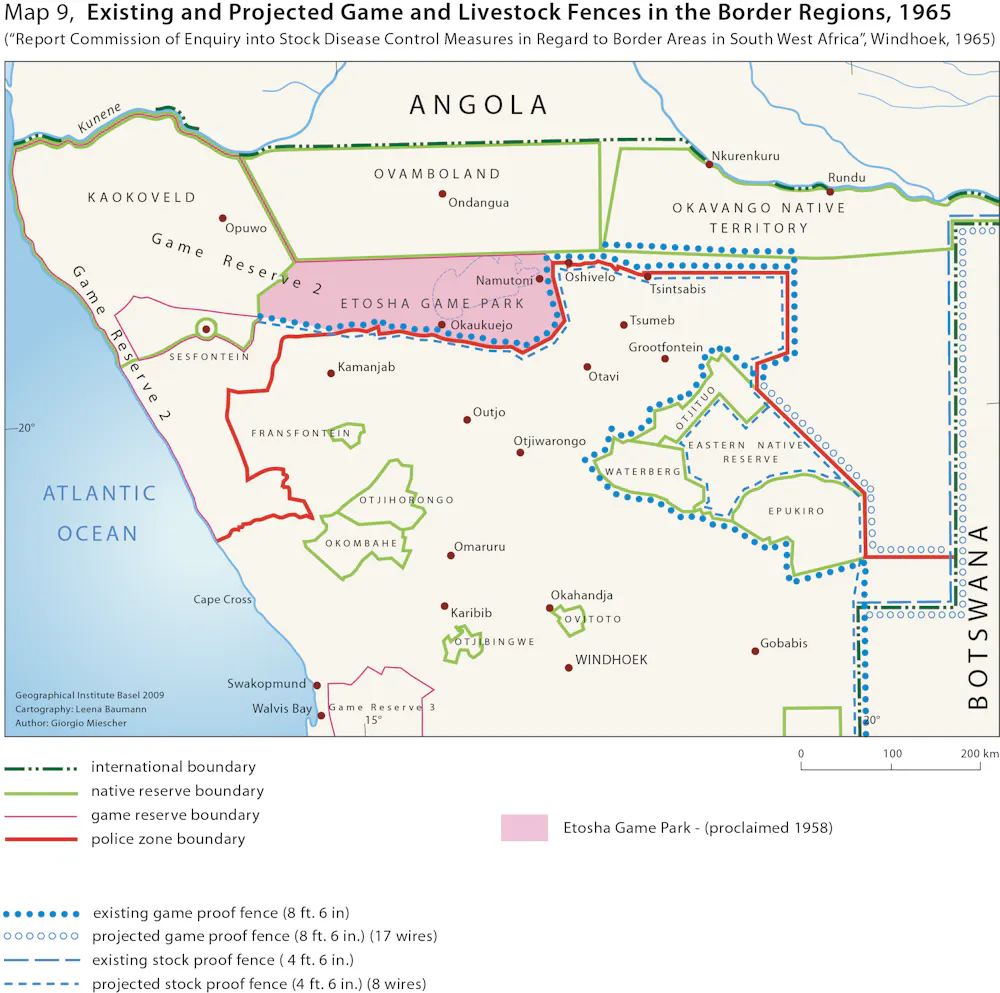
We traced donkeys’ ability to move across one of the country’s most significant borders: the veterinary cordon fence known as the Red Line. The Red Line is an inner-Namibian border, over 1,000 kilometres long, running from west to east and separating the country into two distinct parts. It originated under German colonial rule (1884-1915) and was fully implemented under South African rule (1915-1990).

It still exists today.

The Red Line separated the more densely populated northern parts of the country from the settler-colonial heartland, the so-called Police Zone in central and southern Namibia. The Etosha Game Reserve served as a buffer zone between the Police Zone and the Owambo region in the central north, conceptualised as a migrant labour reservoir.

Map of existing and projected game and livestock fences in Namibia, 1965. Author provided (no reuse)

Donkeys entered Namibia’s central north relatively late, and only became common in the 1920s and 1930s. Their presence across the region was driven largely by migrant labourers working on contract. As thousands of men travelled between the Police Zone and Owambo, many returned home with equines – especially donkeys – purchased in the south.

Luggage transport with a team of donkeys, early 1940s. Scherz Collection, Basler Afrika Bibliographien, S05_0001, Author provided (no reuse)

Cheap, hardy, and resistant to many diseases, donkeys became essential companions on the workers’ long journeys. Donkeys carried heavy loads of clothes, tools and other goods, including gramophones and radios, earned through contract labour.

Since they were associated with commodities, donkeys also became a symbol of modernity expanding from the thriving settler economy in the south.

Today, people still recount how returning labour migrants used donkeys to haul luggage through predator-rich landscapes within Etosha, or how villagers took their carts to meet these men halfway. Donkeys also served as ambulances during emergencies in the Namibian Liberation War (1966-1989).

Their presence has also been entangled with colonial border regimes and conservation policies.

Ploughing with donkeys, Owambo, 1953. Dammann Collection, Basler Afrika Bibliographien, D01_0897, Author provided (no reuse)

The tensions

During the rinderpest epidemic of 1896-97, in a failed attempt to stop the disease from entering the colony, German colonial authorities established a cordon of military outposts along the southern edge of the Etosha Pan. Although intended to control the movement of cattle, this cordon would later become the Red Line.

The devastation of rinderpest prompted German forces to import donkeys and mules as disease-resistant alternatives to oxen. These animals gradually filtered into civilian hands in the Police Zone, the heartland of settler colonialism in central and southern Namibia, and became increasingly common by the 1910s.

The establishment of Game Reserve 2, comprising today’s Etosha National Park and the areas north-west of the Etosha Pan, was part of a policy to seal off Owambo from the Police Zone. Hunting and human movement in the reserve became highly regulated.

In 1915 South Africa defeated the German forces and took over Namibia. The new colonial power maintained the inner border and formalised it as the Red Line in the 1920s and 1930s. They banned cattle movement across the Red Line but allowed equines, provided they carried veterinary certificates.

Red Line fence between Owambo and Etosha, 2002. Private collection, Giorgio Miescher and Lorena Rizzo, Author provided (no reuse)

Donkeys thus became one of the few domestic animals permitted to cross the border legally.

As migrant labour expanded, so too did the flow of donkeys northward. By the late 1920s and 1930s, hundreds of donkeys passed through Etosha each year. In Owambo, they were quickly adopted for local agriculture and transport. Even as motorised lorries and buses began to dominate long-distance travel from the 1930s onward, many migrant workers still preferred to buy donkeys as durable companions.

By the 1940s, however, administrators in Owambo began to worry about the donkeys’ impact on grazing. Restrictions were introduced, but donkeys continued to slip into the north through unofficial routes.

From the 1950s onward, the situation changed dramatically as the Etosha National Park was transformed into a fenced conservation area. Residents and livestock were expelled, and by 1961 the southern boundary was fully fenced. Donkey traffic through Etosha came to an end.

Meanwhile, the northern boundary of Etosha became a flashpoint. The government of the pseudo-independent new Ovamboland homeland resisted efforts to fence this border and insisted on continued movement of wildlife out of Etosha – especially zebra, an important local food source. Conservation officials accused communities of using donkeys to disguise poaching tracks and allowing their animals to stray into the park.

New rules

With Namibia’s independence in 1990, new animal-movement regulations emerged, but donkeys retained their special status. Unlike cattle, they were still permitted to cross the Red Line.

Their symbolic and practical importance has changed. Migrant workers no longer return with donkeys from the south, and motorised transport dominates even in rural areas.

But donkeys remain deeply woven into the fabric of northern Namibian life. They continue to support poorer households, endure harsh environments, and live in proximity to wildlife. Their presence evokes conflicting memories – of difficult journeys and colonial border regimes, but also of development and modernity.

– Donkeys are a common sight in northern Namibia – what colonial history has to do with it
– https://theconversation.com/donkeys-are-a-common-sight-in-northern-namibia-what-colonial-history-has-to-do-with-it-273058