
Attacks on Nigeria’s energy systems weaken the country – research unpacks costs, risks and ways forward

Source: The Conversation – Africa – By Haruna Inuwa, DPhil Candidate, Energy Systems, University of Oxford

Energy systems are coming under attack globally because disrupting power or fuel supplies offers strategic, economic or political leverage. This can be in local conflicts or large-scale geopolitical confrontations.

Nigeria illustrates this clearly: militants in the Niger Delta sabotage pipelines to assert control and tap into oil revenues, while the extremist group Boko Haram and armed bandits in the north hit power lines to weaken state presence.

These incidents reveal how conflict actors weaponise energy systems.

We recently published a study assessing how militancy, insurgency and armed banditry undermine Nigeria’s energy systems by disrupting oil, gas and power infrastructure. We compiled novel datasets of energy related incidents, mapping their timing, location and cost from 2009 to 2025.

Our findings show that more than 2,300 separate attacks were recorded. We see a widening pattern of energy insecurity that drains national revenue, drives away investment, and worsens environmental injustice.

This explains why Nigeria’s energy insecurity has become one of its most serious development and security challenges.

We recommend investment in decentralised systems, community engagement in oil regions, and policies supporting industrial decarbonisation to strengthen resilience and advance climate goals.

The price

According to our estimates, between 2009 and 2024, approximately US$20 billion was lost as a result of attacks. During the 2013-2016 surge in militancy, losses peaked at roughly US$17 billion.

We found that the South-South (Niger Delta) region remains the epicentre of oil sabotage, with peak revenue losses of US$8.62 trillion (2009-2012) and sustained environmental damage.

Attacks and oil theft along the Trans-Niger Pipeline were particularly devastating. This pipeline moves 450,000 barrels of crude oil daily from oil-producing fields in Niger Delta region to export terminals. Each disruption not only shuts down production but also deprives the government of huge revenues.

Since 2021, tactics have shifted. Over 40 attacks have targeted transmission lines in the North-East and North-Central, largely linked to Boko Haram and armed bandits.

Case studies of the 2016 Shell Forcados terminal bombing and the 2024 Shiroro transmission line attack show reliance on backup generators increased electricity costs by 3.2-6.0 times.

Beyond the financial toll, communities suffer respiratory illnesses, unsafe drinking water and food insecurity.

Disruptions have made Nigeria’s grid more unstable and pose risks to critical infrastructure projects nearing completion, including gas pipelines.

Attacks threaten regional energy trade and integration projects, such as the West African Power Pool, West African Gas Pipeline, Nigeria-Morocco Gas Pipeline, and the proposed Nigeria-Algeria-Gas-Pipeline, which rely on secure cross-border energy infrastructure.

Foreign investors view these risks as prohibitive. Due to attacks on energy infrastructure, in 2020, Nigeria lost around US$40 billion in foreign direct investment.

Oil theft and sabotage have also left a toxic legacy in the Niger Delta. Each pipeline rupture spills crude into rivers and farmland, wiping out livelihoods.

We find that clean-up costs from oil spills on the Trans-Niger Pipeline alone ranged from US$150 million to US$290 million per period (2009-2012, 2013-2016, 2017-2020, 2021-2024), highlighting continuous environmental degradation in the Niger Delta area.

In line with this, the United Nations Environment Programme estimated that a US$1 billion 30-year clean-up is needed in Ogoniland, while Reuters reported that addressing oil pollution in Bayelsa State alone might require US$12 billion over 12 years. When compared to Nigeria’s GDP of US$375 billion in 2024, these figures underscore the substantial financial strain that this attack-induced environmental crisis places on national resources.

Our analysis indicates that insurgents and bandits have shifted tactics since 2021. We see increased disruption and attacks on power infrastructure in the northern part of the country.

More than 40 incidents targeting high-voltage transmission lines have been recorded in just four years, a 20-fold increase from the previous decade. Two major examples show the consequences: the 2016 Forcados terminal bombing cut national power generation by 3,132MW, while the 2024 Shiroro transmission-line attack left the north-western part of the country in darkness for two weeks.

During attack-induced outages, businesses and households switch to diesel or petrol generators. We find that this backup electricity costs three to six times more than grid power, with the North-East and North-West experiencing the highest cost increase.

Each attack also carries an invisible environmental cost. Backup generators release far more carbon dioxide than grid electricity. During the 2016 and 2024 outages, we estimated sharp spikes in CO₂ across the South-West and South-South, Nigeria’s most energy-hungry regions.

This trend undermines Nigeria’s commitments under the National Climate Change Policy 2021-2030, which aims to cut emissions and expand energy access using renewable energy. Insecurity, therefore, is not just an economic or social problem – it is an obstacle to climate progress.

How Nigeria can respond

Our research points to several steps that could make the energy systems more resilient:

  1. Invest in decentralised and modular power systems: Smaller, locally managed plants – such as the 52-megawatt Maiduguri Emergency Power Plant – are harder to sabotage and quicker to repair.

  2. Rebuild trust with host communities: Environmental remediation and transparent benefit-sharing can reduce grievances that drive sabotage. Local participation in energy projects must move beyond tokenism.

  3. Adopt technology for early warning and monitoring: Pressure sensors, drones and predictive analytics can detect tampering and leaks in real-time. Government contracts with former militants to guard pipelines must be coupled with strict accountability.

  4. Accelerate innovative clean-energy deployment: In the light of Nigeria’s commitment to achieve climate goals, it is important to explore emerging decarbonisation pathways, including clean hydrogen.

Nigeria’s energy wealth has long promised prosperity, but persistent insecurity has made it a liability. The financial losses, pollution and emissions caused by repeated attacks erode resilience and deter investment. This challenge is not unique to Nigeria; it reflects a broader global reality in which energy transitions depend on secure infrastructure.

Achieving a stable, decentralised and low-carbon system will require protecting the assets that make it possible.

– Attacks on Nigeria’s energy systems weaken the country – research unpacks costs, risks and ways forward
– https://theconversation.com/attacks-on-nigerias-energy-systems-weaken-the-country-research-unpacks-costs-risks-and-ways-forward-271366
Donkeys are a common sight in northern Namibia – what colonial history has to do with it

Source: The Conversation – Africa – By Giorgio Miescher, Associate Researcher University of Basel and University of Namibia, University of Basel

Donkeys are an unassuming yet ubiquitous presence in northern Namibia. They traverse sandy village roads, pull carts stacked with firewood, and graze freely along the northern edge of the Etosha National Park.

The story of how they came to occupy such a central role in rural life – and in such large numbers – is a fascinating one that’s linked to the country’s colonial history, the management of wildlife versus domestic animals, and the role of migrant workers.

We are historians who specialise in Namibia and Southern Africa. Our research focuses on colonial legacies in nature conservation and land. In a research paper we retraced the routes of the domesticated donkey through a conservation landscape.

We found that donkeys occupy a contradictory status in communities in northern Namibia. They are indispensable, yet undervalued. For example, they remain central to tasks such as ploughing, hauling water and transporting logs. Yet their social status remains curiously low. They are rarely used in ceremonies, have little monetary value, and are strongly associated with those who cannot afford tractors or cars.

We conclude that this ambiguity has arisen from the long histories of colonial rule, labour migration, conservation and veterinary control that shaped northern Namibia.

The great trek north

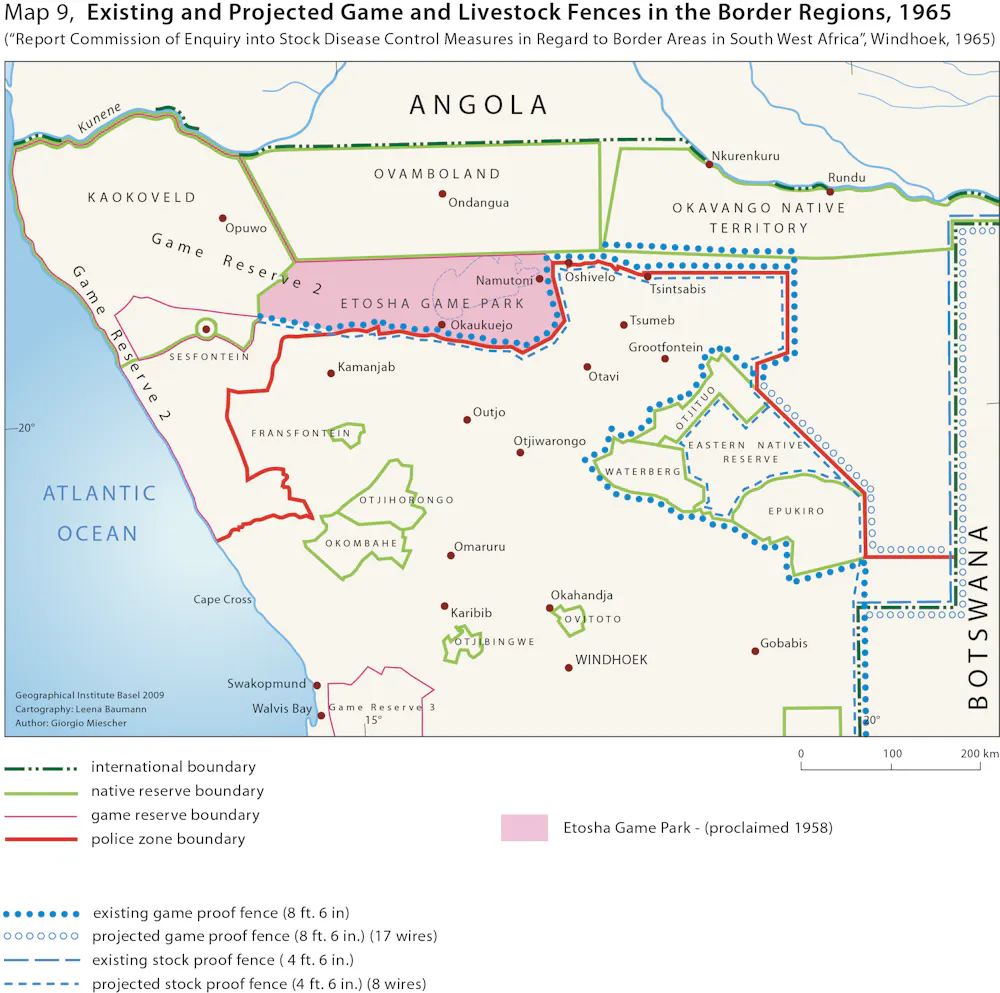
We traced donkeys’ ability to move across one of the country’s most significant borders: the veterinary cordon fence known as the Red Line. The Red Line is an inner-Namibian border, over 1,000 kilometres long, running from west to east and separating the country into two distinct parts. It originated under German colonial rule (1884-1915) and was fully implemented under South African rule (1915-1990).

It still exists today.

The Red Line separated the more densely populated northern parts of the country from the settler-colonial heartland, the so-called Police Zone in central and southern Namibia. The Etosha Game Reserve served as a buffer zone between the Police Zone and the Owambo region in the central north, conceptualised as a migrant labour reservoir.

Map of existing and projected game and livestock fences in Namibia, 1965. Author provided (no reuse)

Donkeys entered Namibia’s central north relatively late, and only became common in the 1920s and 1930s. Their presence across the region was driven largely by migrant labourers working on contract. As thousands of men travelled between the Police Zone and Owambo, many returned home with equines – especially donkeys – purchased in the south.

Luggage transport with a team of donkeys, early 1940s. Scherz Collection, Basler Afrika Bibliographien, S05_0001, Author provided (no reuse)

Cheap, hardy, and resistant to many diseases, donkeys became essential companions on the workers’ long journeys. Donkeys carried heavy loads of clothes, tools and other goods, including gramophones and radios, earned through contract labour.

Since they were associated with commodities, donkeys also became a symbol of modernity expanding from the thriving settler economy in the south.

Today, people still recount how returning labour migrants used donkeys to haul luggage through predator-rich landscapes within Etosha, or how villagers took their carts to meet these men halfway. Donkeys also served as ambulances during emergencies in the Namibian Liberation War (1966-1989).

Their presence has also been entangled with colonial border regimes and conservation policies.

Ploughing with donkeys, Owambo, 1953. Dammann Collection, Basler Afrika Bibliographien, D01_0897, Author provided (no reuse)

The tensions

During the rinderpest epidemic of 1896-97, in a failed attempt to stop the disease from entering the colony, German colonial authorities established a cordon of military outposts along the southern edge of the Etosha Pan. Although intended to control the movement of cattle, this cordon would later become the Red Line.

The devastation of rinderpest prompted German forces to import donkeys and mules as disease-resistant alternatives to oxen. These animals gradually filtered into civilian hands in the Police Zone, the heartland of settler colonialism in central and southern Namibia, and became increasingly common by the 1910s.

The establishment of Game Reserve 2, comprising today’s Etosha National Park and the areas north-west of the Etosha Pan, was part of a policy to seal off Owambo from the Police Zone. Hunting and human movement in the reserve became highly regulated.

In 1915 South Africa defeated the German forces and took over Namibia. The new colonial power maintained the inner border and formalised it as the Red Line in the 1920s and 1930s. They banned cattle movement across the Red Line but allowed equines, provided they carried veterinary certificates.

Red Line fence between Owambo and Etosha, 2002. Private collection, Giorgio Miescher and Lorena Rizzo, Author provided (no reuse)

Donkeys thus became one of the few domestic animals permitted to cross the border legally.

As migrant labour expanded, so too did the flow of donkeys northward. By the late 1920s and 1930s, hundreds of donkeys passed through Etosha each year. In Owambo, they were quickly adopted for local agriculture and transport. Even as motorised lorries and buses began to dominate long-distance travel from the 1930s onward, many migrant workers still preferred to buy donkeys as durable companions.

By the 1940s, however, administrators in Owambo began to worry about the donkeys’ impact on grazing. Restrictions were introduced, but donkeys continued to slip into the north through unofficial routes.

From the 1950s onward, the situation changed dramatically as the Etosha National Park was transformed into a fenced conservation area. Residents and livestock were expelled, and by 1961 the southern boundary was fully fenced. Donkey traffic through Etosha came to an end.

Meanwhile, the northern boundary of Etosha became a flashpoint. The government of the pseudo-independent new Ovamboland homeland resisted efforts to fence this border and insisted on continued movement of wildlife out of Etosha – especially zebra, an important local food source. Conservation officials accused communities of using donkeys to disguise poaching tracks and allowing their animals to stray into the park.

New rules

With Namibia’s independence in 1990, new animal-movement regulations emerged, but donkeys retained their special status. Unlike cattle, they were still permitted to cross the Red Line.

Their symbolic and practical importance has changed. Migrant workers no longer return with donkeys from the south, and motorised transport dominates even in rural areas.

But donkeys remain deeply woven into the fabric of northern Namibian life. They continue to support poorer households, endure harsh environments, and live in proximity to wildlife. Their presence evokes conflicting memories – of difficult journeys and colonial border regimes, but also of development and modernity.

– Donkeys are a common sight in northern Namibia – what colonial history has to do with it
– https://theconversation.com/donkeys-are-a-common-sight-in-northern-namibia-what-colonial-history-has-to-do-with-it-273058

Afcon drama: what went wrong and what went right at the continent’s biggest football cup in Morocco

Source: The Conversation – Africa – By Chuka Onwumechili, Professor of Communications, Howard University

The 35th edition of the Africa Cup of Nations, hosted by Morocco, produced thrills and several story lines, some good and others not so good. It ended in a victory for Senegal – their second Afcon championship. While the 1-0 victory over Morocco was deserved, the championship game ended on a sour note as fans invaded the field and the winning country abandoned the game for 16 minutes.

I’m a sports communications scholar and an author of multiple books on football as it relates to Africa.

The top four positives of the tournament were:

  • quality matches played on impeccable surfaces

  • expanded media coverage

  • increased global interest

  • higher attendance figures.

On the downside, however, we had the Senegalese team walkout during the final, bad refereeing decisions, especially in games involving Morocco, and ticketing challenges.

This 2026 Afcon provided examples of quality pitches and marketing that future hosts should learn from. However, providing better security around the field and better trained match officials are lessons that CAF (the Confederation of African Football) must learn from this tournament.

What went well

The infrastructure at Afcon showed Morocco’s readiness to host the World Cup later in the year. On six stadiums alone, the country spent US$1.4 billion. As much as US$10 billion was spent on allied public infrastructure for transport. The matches were of high quality on excellent surfaces.

The fans who watched the spectacular football on the field were transported by a high-speed rail system and seamless other transportation means.

The quality of the surfaces may have contributed to the fact that there were fewer surprises or upsets. All four teams that reached the semi-final stage – Egypt, Morocco, Nigeria and Senegal – were top ranked in their groups.

Eventually, the championship game was contested by the two top ranked African teams. The game was outstanding as the well-known names produced memorable football throughout the tournament.


Read more: African football won the 34th Afcon, with Côte d’Ivoire a close second


Expanded media coverage

The decision to expand to additional markets led to expanded media coverage in China, Brazil and key European markets. With several well-known players from European clubs participating, a global audience was assured. Teams like Real Madrid, PSG, Bayern Munich, Manchester United and Liverpool had players participating.

Beyond those were recent world renowned players such as Sadio Mane, Riyad Mahrez and Pierre-Emerick Aubameyang. Those names were certain to attract media audiences across the world.

Viewership rose overall, with remarkable increases in Europe. France recorded 3.4 million viewers and the UK had 1.7 million viewers.

Increased global interest

CAF announced a 90% increase in revenue. This year’s revenue was US$192.6 million (US$114 million profit) compared to US$105.6 million and US$72 million profit in the previous Afcon. This shows the steady rise from just nine partners in the 2021 tournament to 17 in the 2023 tournament and 23 in this one. Greater media reach resulted in commercial interest.

Attendance figures have also risen remarkably. Figures announced at the end of the competition showed 1.34 million attended the games. The number of attendees in 2023 in Côte d’Ivoire was 1.1 million.

This clearly shows increased interest in the tournament. Morocco’s proximity to Europe was also a critical factor. More attendees travelled from the continent and elsewhere.

The prizes awarded to teams at the tournament also set records, with Senegal taking home US$11.6 million. Teams eliminated at the group stage received US$1.3 million each.


Read more: Nigeria wins its 10th Wafcon title – but women’s football has never been more competitive


Errors

Angry scenes: The championship game was marred by a Senegalese walkout following protest over a penalty kick awarded to Morocco during the extra time. The game was delayed for 16 minutes. Senegal was angered by the cancellation of its goal late in regulation time. Its protest over the penalty awarded to Morocco lasted until one of its famous faces, Sadio Mane, asked his teammates to continue the game.

By then angry Senegalese fans had torn seats in the stands and multiple fights broke out. In the end, Morocco could not convert the penalty award and Senegal scored a memorable goal to emerge winner.

Umpiring questions: Throughout the tournament, Morocco appeared to be favoured by several refereeing decisions and non-decisions. CAF should consider match official exchange programmes with other confederations as a way of improving officiating. This would not only help Afcon but expose officials to other continental events.

Also of concern, Moroccan ball boys were seen seizing the goalkeepers’ towels for opposing teams in both Nigeria v Morocco and Senegal v Morocco.

Ticketing challenges: There were ticketing challenges also. While tickets were sold out, several stadiums during the group games were deserted. This may be attributed to hiccups where secondary sellers may have bought more tickets than they could re-sell. Nonetheless, an average 21,167 attended each game. Media attendance also rose during the tournament. Reports indicated over 3,800 journalists covered the event from Morocco.

Looking ahead

The competition demonstrated Morocco’s readiness to host World Cup games in 2030. Morocco, along with Spain and Portugal, will host the games, featuring 48 teams. All six cities used for the 2025 Afcon will host the world in 2030. Portugal will have only two host cities and Spain will provide nine venues.

It will be difficult for the host nations for the 2027 Afcon to match Morocco’s accomplishment.

The three hosts for 2027 – Kenya, Tanzania and Uganda – should at least measure up to what Côte d’Ivoire accomplished hosting the 2023 event.

They can look to improve the ticketing system, at the least. Further improving security around stadiums and educating the ball boys would help in protecting visiting teams.

But the on-field disturbances should not take away from this tournament’s numerous accomplishments off the field and the available facilities.

– Afcon drama: what went wrong and what went right at the continent’s biggest football cup in Morocco
– https://theconversation.com/afcon-drama-what-went-wrong-and-what-went-right-at-the-continents-biggest-football-cup-in-morocco-273819

Tourism is key driver of economic growth and job creation in SA

Source: Government of South Africa

Tourism is key driver of economic growth and job creation in SA

Tourism Minister Patricia de Lille has reaffirmed that tourism is a key driver of economic growth, investment and job creation in South Africa. 

Between January and December 2025, South Africa welcomed 10.48 million international arrivals, a 17.6% increase compared to 2024 and the highest number of arrivals on record.

This confirms tourism’s growing contribution to the economy, said the Minister who was addressing the media in Pretoria earlier today.

“This is not coincidence. It is the result of deliberate policy choices, focused implementation and strong collaboration between government and the private sector,” De Lille said.

Last year, Cabinet endorsed the Tourism Growth Partnership Plan, a product of deep collaboration between government and industry being led by the South African Tourism Business Council.

“Home Affairs plans to roll out the Electronic Travel Authorisation system, beginning with key source markets, including India, China, Mexico and Indonesia, following its successful pilot during the G20 Summit. 

“With the full rollout of the Electronic Travel Authorisation system, we project the creation of between 80 000 and 100 000 additional jobs. That is transformative,” the Minister said.

She welcomed new direct flights to and from the country, including Qantas’ direct flight from Perth to Johannesburg, the return of Air France’s daily seasonal service to Cape Town, SAA’s new Cape Town – Mauritius route and expanded domestic connectivity including FlySafair’s Hoedspruit – Cape Town service.

“These routes are unlocking demand and dispersing tourism across the country,” the Minister said.  

She congratulated the KwaZulu-Natal province for turning the corner, as Durban welcomed a record-breaking 1.2 million visitors during the past festive season.

“The Free State’s Kgodumodumo Dinosaur Interpretive Centre, developed through a R120 million partnership between the Department of Tourism, the European Union and SANParks, has welcomed over 80 000 visitors and generated more than R1 million in revenue since opening.

“The private sector has established a crime call centre linked to the Secura App, enabling rapid emergency response. During the festive season, 1500 tourism monitors were deployed nationally, including more than 400 supporting the Border Management Authority,” the Minister said.

South Africa’s global competitiveness was further recognised when the country was named Best Destination: Africa 2025, by the Travel Weekly Reader’s Choice Awards. – SAnews.gov.za


Edwin

77 views

AfricAI et Micropolis Robotics: accord d’exclusivité pour la robotique en Afrique

Source: Africa Press Organisation – French

AfricAI (www.AfricAI.ai) a signé un accord pluriannuel de distribution et de déploiement exclusif avec Micropolis Robotics, octroyant à AfricAI les droits exclusifs de commercialisation, de déploiement et d’expansion des plateformes robotiques avancées de Micropolis sur l’ensemble de l’Afrique. Il s’agit de l’une des entrées les plus significatives du marché de la robotique sur le continent à ce jour.

Aux termes de cet accord, Micropolis Robotics désigne AfricAI comme son partenaire continental exclusif, interdisant toute vente directe, tout autre distributeur ou agent tiers opérant sur le territoire. L’accord positionne AfricAI comme la plateforme principale d’exécution, de localisation et de commercialisation de la robotique intelligente dans les secteurs industriels, de la sécurité, de la logistique et des infrastructures africains.

Ce mandat exclusif fait d’AfricAI la porte d’entrée des systèmes autonomes avancés sur les marchés africains, garantissant la conformité réglementaire, le développement des capacités locales et le contrôle souverain des cadres de déploiement. Ce partenariat dépasse le cadre de l’intelligence artificielle logicielle pour s’inscrire dans celui de l’IA physique, des machines intelligentes capables d’opérer dans des environnements africains complexes et réels.

« Il ne s’agit pas d’une simple collaboration, mais d’un mandat qui transforme le marché », a déclaré Fareed Aljawhari, directeur général de Micropolis Robotics. « AfricAI représente désormais la porte d’entrée exclusive par laquelle les technologies Micropolis pénètrent en Afrique. Leur vision d’une IA souveraine, leur portée opérationnelle et leur maîtrise réglementaire font d’eux le seul partenaire capable d’exécuter à l’échelle continentale. »

L’accord permet à AfricAI d’intégrer les systèmes robotiques autonomes de Micropolis avec sa propre infrastructure d’IA souveraine, rendant possibles des plateformes de sécurité et de surveillance pilotées par l’IA, des opérations logistiques et portuaires assistées par la robotique, l’automatisation industrielle, les infrastructures intelligentes et la robotique municipale adaptée aux conditions opérationnelles africaines.

L’accord intègre des droits d’expansion à long terme liés aux performances, des renouvellements automatiques et un cadre structuré de localisation conçu pour ancrer le déploiement robotique, la formation de la main-d’œuvre et le transfert de compétences en Afrique.

Son Altesse Royale le Prince Malik Ado-Ibrahim, président exécutif d’AfricAI, a déclaré : « L’Afrique n’a pas besoin d’automatisation importée, elle a besoin de systèmes intelligents souverains et adaptés à son contexte. Ce mandat exclusif permet à AfricAI d’industrialiser le déploiement robotique à grande échelle tout en conservant le contrôle, la conformité et la création de valeur sur le continent. »

Les premiers déploiements débuteront dans les secteurs de la sécurité, des infrastructures intelligentes et de la logistique, avec une expansion progressive dans plusieurs États africains dans le cadre de la stratégie continentale plus large d’AfricAI en matière d’IA, de données et d’infrastructures intelligentes.

Les analystes du secteur soulignent que cet accord positionne AfricAI comme l’un des premiers gardiens exclusifs de la robotique sur le continent, permettant à l’Afrique de contourner les voies d’industrialisation traditionnelles grâce au déploiement d’infrastructures physiques autonomes pilotées par l’IA.

Les deux entreprises ont réaffirmé leur engagement en faveur de l’innovation responsable, de la conformité ESG et du développement d’écosystèmes robotiques durables qui renforcent la productivité, la sécurité et la résilience économique en Afrique.

Distribué par APO Group pour AfricAI.

Contact :
Rebecca King
Directrice de la communication
Next Digital Communications
rebecca@africai.ai

À propos de Micropolis Robotics :
Micropolis Robotics conçoit et fabrique des systèmes robotiques autonomes avancés pour des applications de sécurité, industrielles et commerciales, alliant ingénierie de précision et systèmes d’autonomie et de contrôle de nouvelle génération.

www.Micropolis.ai

À propos d’AfricAI :
AfricAI est une plateforme panafricaine d’intelligence artificielle et de technologies émergentes axée sur l’infrastructure d’IA souveraine, l’automatisation intelligente et le déploiement de technologies avancées à l’échelle du continent dans les secteurs public et privé.

www.AfricAI.ai

Media files

Canon Achieves EcoVadis Platinum Status: Top 1% Global Recognition for Second Consecutive Year

Source: APO

Today, Canon (www.Canon-CNA.com) has earned EcoVadis Platinum status for the second consecutive year, placing the company in the top 1% of businesses rated worldwide for sustainability performance.

EcoVadis evaluates over 150,000 companies spanning 185 countries and 250 industries across four categories: Environment, Labour & Human Rights, Ethics, and Sustainable Procurement. Canon’s overall score improved to 89/100, up from 85/100 in 2025, maintaining the company’s Platinum rating for a second consecutive year.

The Canon Group’s strong performance highlights its comprehensive dedication to sustainability, leading to high scores in all four categories. Canon received particularly high marks in the categories of Environment and Labour & Human Rights.

Driving Impact: Ongoing Sustainability Commitments

Canon is committed to strengthening initiatives related to environmental and social issues.

In the environmental field, Canon aims to achieve net-zero greenhouse gas (GHG) emissions throughout entire product life cycles (scope 1, 2, and 3) by 2050. [1] Canon has also set science-based GHG emissions reduction targets in line with SBTi standards: by 2030, a 42% reduction in Scope 1 and 2 emissions and a 25% reduction in Scope 3 emissions (categories 1 and 11) compared to 2022 levels. [2]

Furthermore, Canon has formulated the Canon Group Human Rights Policy as a declaration of its stance on human rights and implements human rights due diligence throughout the entire Group.

“We are so proud of achieving the EcoVadis Platinum rating for the second consecutive year” said Peter Bragg, EMEA Sustainability & Government Affairs Director at Canon EMEA. “This ongoing recognition, alongside our improved overall score, serves as powerful validation of our commitment to sustainable business practices and our continuous drive to positively influence our environmental and social footprint. Retaining our Platinum status and remaining among the top 1% of rated organisations motivates us to continue raising the bar for sustainability in our industry.”


[1] Scope 1: Direct emissions (city gas, LPG, diesel, kerosene, non-energy-related greenhouse gases, etc.); Scope 2: Indirect emissions (electricity, steam, etc.); Scope 3: Emissions in the supply chains. category 1: Purchased goods and services; category 11: Use of products sold.

[2] The Science Based Targets initiative (SBTi) is a global initiative that encourages companies to set GHG reduction targets based on climate science. It is jointly operated by the UN Global Compact (UNGC), World Resources Institute (WRI), World Wide Fund for Nature (WWF), and the CDP.

Distributed by APO Group on behalf of Canon Central and North Africa (CCNA).

Media enquiries, please contact:
Canon Central and North Africa
Mai Youssef
e. Mai.youssef@canon-me.com

APO Group – PR Agency
Rania ElRafie
e. Rania.ElRafie@apo-opa.com

About EcoVadis:
EcoVadis is a global leader in sustainability ratings, specifically designed for businesses to assess their performance in critical areas regarding environmental, social, and governance (ESG) criteria. The company provides reliable, globally recognised sustainability ratings and insights, enabling companies to reduce risk, drive improvement, and accelerate positive impact on the planet and society.

About Canon Central and North Africa:
Canon Central and North Africa (CCNA) (www.Canon-CNA.com) is a division within Canon Middle East FZ LLC (CME), a subsidiary of Canon Europe. The formation of CCNA in 2016 was a strategic step that aimed to enhance Canon’s business within the Africa region – by strengthening Canon’s in-country presence and focus. CCNA also demonstrates Canon’s commitment to operating closer to its customers and meeting their demands in the rapidly evolving African market.

Canon has been represented in the African continent for more than 15 years through distributors and partners that have successfully built a solid customer base in the region. CCNA ensures the provision of high quality, technologically advanced products that meet the requirements of Africa’s rapidly evolving marketplace. With over 100 employees, CCNA manages sales and marketing activities across 44 countries in Africa.

Canon’s corporate philosophy is Kyosei (https://apo-opa.co/4bkKH0j) – ‘living and working together for the common good’. CCNA pursues sustainable business growth, focusing on reducing its own environmental impact and supporting customers to reduce theirs using Canon’s products, solutions and services. At Canon, we are pioneers, constantly redefining the world of imaging for the greater good. Through our technology and our spirit of innovation, we push the bounds of what is possible – helping us to see our world in ways we never have before. We help bring creativity to life, one image at a time. Because when we can see our world, we can transform it for the better.

For more information: www.Canon-CNA.com

Media files

.

AfricAI Secures Exclusive Continental Rights to Deploy Advanced Robotics Platforms Across Africa in Landmark Deal with Micropolis Robotics

Source: APO

AfricAI (www.AfricAI.ai) has signed a multi-year exclusive distribution and deployment agreement with Micropolis Robotics, granting AfricAI sole and exclusive rights to commercialise, deploy, and scale Micropolis’s advanced robotics platforms across Africa, marking one of the most consequential robotics market entries on the continent to date.

Under the agreement, Micropolis Robotics appoints AfricAI as its exclusive continental partner, prohibiting direct sales, alternative distributors, or third-party agents operating within the territory. The agreement establishes AfricAI as the primary execution, localisation, and go-to-market platform for intelligent robotics across African industrial, security, logistics, and infrastructure sectors.

This exclusive mandate positions AfricAI as the gateway for advanced autonomous systems entering African markets, ensuring regulatory compliance, local capacity building, and sovereign control over deployment frameworks. The partnership moves beyond software- based artificial intelligence into the realm of physical AI — intelligent machines capable of operating in complex, real-world African environments.

“This is not a collaboration — it is a market-shaping mandate,” said Fareed Aljawhari, CEO of Micropolis Robotics. “AfricAI now represents the exclusive gateway through which Micropolis technologies enter Africa. Their sovereign AI vision, operational reach, and regulatory fluency make them the only partner capable of executing at a continental scale.

The agreement enables AfricAI to integrate Micropolis’s autonomous robotics systems with AfricAI’s sovereign AI stack, enabling AI-driven security and surveillance platforms, robotics-enabled logistics and port operations, industrial automation, smart infrastructure, and municipal robotics tailored to African operating conditions.

Embedded within the agreement are long-term performance-linked expansion rights, automatic renewals, and a structured localisation framework designed to anchor robotics deployment, workforce training, and skills transfer within Africa.

HRH Prince Malik Ado-Ibrahim, Executive Chairman of AfricAI, stated: “Africa does not need imported automation — it needs sovereign, context-aware intelligent systems. This exclusive mandate allows AfricAI to industrialise robotics deployment at scale while retaining control, compliance, and value creation on the continent.”

Initial deployments will commence in security, smart infrastructure, and logistics, with phased expansion across multiple African states as part of AfricAI’s broader continental AI, data, and intelligent infrastructure strategy.

Industry analysts note that the agreement positions AfricAI as one of the first exclusive robotics gatekeepers on the continent, enabling Africa to leapfrog legacy industrialisation pathways through the deployment of autonomous, AI-driven physical infrastructure.

Both companies reaffirmed their commitment to responsible innovation, ESG compliance, and the development of sustainable robotics ecosystems that enhance productivity, security, and economic resilience across Africa.

Distributed by APO Group on behalf of AfricAI.

Contact:
Rebecca King
Next Digital Communications Director
rebecca@africai.ai

About Micropolis Robotics:
Micropolis Robotics designs and manufactures advanced autonomous robotic systems for security, industrial, and commercial applications, combining precision engineering with next-generation autonomy and control systems.

www.Micropolis.ai

About AfricAI:
AfricAI is a pan-African artificial intelligence and emerging-technology platform focused on sovereign AI infrastructure, intelligent automation, and continent-scale deployment of advanced technologies across public and private sectors.

www.AfricAI.ai

Media files

.

SASSA beneficiaries can complete biometric verifications at local offices

Source: Government of South Africa

SASSA beneficiaries can complete biometric verifications at local offices

The South African Social Security Agency (SASSA) in Mpumalanga is encouraging all R370 Social Relief of Distress (SRD) grant beneficiaries who do not have data or a smartphone or laptop to visit their nearest SASSA local offices for assistance. 

In a statement on Tuesday, the agency said that all its offices are equipped to support beneficiaries with biometric identity verification with kiosks, official laptops and guest Wi-Fi.

“The agency is doing this to ensure that all qualifying beneficiaries receive their grant at the right time, to avoid unnecessary delays and eliminate frustrations,” Acting Regional Executive Manager, Xolela Mpambani, said. 

Mpambani further explained that SRD grant applications may be declined where the system detects a source of income through external databases, including financial institutions. 

Beneficiaries whose applications are declined have the right to appeal the decision if they are not satisfied with the reasons provided on the system.

SASSA has also warned beneficiaries to safeguard their personal information, cautioning that scammers often target vulnerable grant recipients. Beneficiaries are advised not to share sensitive details and to always verify the identity of anyone requesting their information. – SAnews.gov.za 


DikelediM

39 views

APO Group annonce la promotion de Malika Bouayad au poste de Directrice des Comptes Groupe

Source: Africa Press Organisation – French

APO Group (www.APO-opa.com),  le leader panafricain du conseil en communication et de la distribution de communiqués de presse e, est heureux d’annoncer la promotion de Malika Bouayad au poste de Directrice des Comptes Groupe s, au sein de la division Relations publiques et Communications stratégiques de la société. Cette nomination, qui a pris effet le 1er décembre 2025, reflète l’engagement d’APO Group à développer de solides talents africains et à optimiser son soutien communicationnel pour ses clients sur le continent et au-delà.

Originaire du Maroc, Malika apporte près d’une décennie d’expérience en communication, marketing et engagement des parties prenantes dans divers secteurs. Parlant couramment l’anglais, l’arabe et le français, elle est titulaire d’un Bachelor et d’un MBA de l’université Al Akhawayn d’Ifrane.

Depuis son arrivée au sein d’APO Group en 2022, Malika a joué un rôle central dans le déploiement de campagnes primées. Elle a été le fer de lance de grands programmes médiatiques pour des événements mondiaux, dont trois éditions consécutives de GITEX Global et GITEX Africa, gérant les médias africains et internationaux avec précision et excellence. Elle a également dirigé l’engagement des médias locaux au Maroc pour des clients de premier plan tels que la Ligue africaine de basketball (BAL) et Canon, et a contribué au travail de communication stratégique pour des organisations telles qu’APIX et le Comité international olympique (CIO).

À ses nouvelles fonctions, Malika sera responsable à la fois du pilotage stratégique des clients et de l’excellence opérationnelle dans la mise en œuvre. Elle dirigera des engagements client de haut niveau, supervisera l’assurance qualité et l’alignement commercial, et veillera à ce que tous les programmes clients soient alignés stratégiquement, éprouvés sur le plan opérationnel, optimisés en termes de ressources et exécutés selon les normes les plus rigoureuses. Elle jouera également un rôle clé dans la rationalisation des opérations d’exécution au sein de l’équipe.

Commentant la promotion, Bas Wijne, PDG d’APO Group, déclare : « Malika incarne le professionnalisme, la créativité et la vision stratégique qui définissent le travail d’APO Group dans toute l’Afrique. Elle a toujours généré des résultats exceptionnels pour nos clients et est devenue un partenaire de confiance pour les hauts dirigeants à travers le continent. Sa promotion est une évolution naturelle et témoigne de son dévouement, de son leadership et de sa passion pour le développement de l’Afrique. Nous sommes fiers de la voir assumer ce rôle élargi et attendons avec impatience de voir tout ce qu’elle accomplira ».

« Après avoir intégré APO Group il y a près de quatre ans, devenir aujourd’hui directrice des comptes groupe m’a montré que notre force réside dans nos équipes, notre mission et notre quête incessante de l’excellence. Cette promotion n’est pas juste la mienne : elle reflète chaque mentor, collègue et client qui nous inspirent à aller plus loin. Je suis déterminée à diriger avec intégrité, à renforcer notre équipe et à faire avancer les récits africains avec crédibilité, créativité et un impact transformateur sur l’ensemble du continent », déclare Malika.

En cultivant des talents africains dans les domaines des relations publiques et des communications stratégiques, APO Group accomplit sa vision de façonner l’avenir de la communication et de servir d’amplificateur pour les voix de toute l’Afrique.

Distribué par APO Group pour APO Group.

Contact avec les médias : 
marie@apo-opa.com 

À propos d’APO Group :
Fondé en 2007, APO Group (www.APO-opa.com) est le leader panafricain du conseil en communication et de la distribution de communiqués de presse. Réputés pour notre expertise africaine profondément enracinée et notre perspective globale, nous sommes spécialisés dans l’optimisation de la réputation et de la valeur de la marque des organisations privées et publiques à travers l’Afrique. En tant que partenaire de confiance, notre mission est d’exploiter le pouvoir des médias, en élaborant des stratégies sur mesure qui ont un impact tangible et mesurable en Afrique et au-delà.

Notre engagement en faveur de l’excellence et de l’innovation a été récompensé par des prix prestigieux, notamment un PRovoke Media Global SABRE Award et plusieurs PRovoke Media Africa SABRE Awards. Nous avons été nommés Leading Public Relations Firm Africa et Leading Pan-African Communications Consultancy Africa en 2023, et Best Public Relations and Media Consultancy of the Year South Africa en 2024 lors des World Business Outlook Awards. En 2025, Brands Review Magazine nous a reconnus en tant que Leading Communications Consultancy in Africa pour la seconde année consécutive. Le magazine nous a également nommé Best PR Agency et Leading Press Release Distribution Platform in Africa en 2024. En 2025, nous avons reçu la médaille d’or de la meilleure campagne RP et la médaille de bronze des événements hors catégorie aux Davos Communications Awards.   

La clientèle estimée d’APO Group, qui comprend des géants mondiaux tels que Canon, Nestlé, Western Union, le PNUD, Network International, African Energy Chamber, Mercy Ships, Marriott, Africa’s Business Heroes et Liquid Intelligent Technologies, reflète notre capacité inégalée à évoluer dans l’écosystème médiatique africain complexe. Avec une équipe multiculturelle à travers l’Afrique, nous offrons des perspectives et une portée inégalées à travers le continent. APO Group se consacre à la refonte de la narration sur l’Afrique, à la remise en question des stéréotypes et à la présentation de récits africains inspirants à un public mondial. Notre expertise dans l’élaboration et l’accompagnement de campagnes de relations publiques dans le monde entier nous permet d’amplifier les messages des marques, de renforcer les réputations et d’établir un lien pertinent avec les publics cibles.

Media files

APO Group Announces Promotion of Malika Bouayad to Group Account Director

Source: APO

APO Group (www.APO-opa.com), the leading multi-award-winning pan-African communications consultancy and press release distribution service, is pleased to announce the promotion of Malika Bouayad to Group Account Director, in the company’s Public Relations & Strategic Communications division. This appointment, effective 1 December 2025, reflects APO Group’s commitment to developing strong African talent and enhancing its delivery of world-class communications support to clients across the continent and beyond.

Born and raised in Morocco, Malika brings close to a decade of experience in communications, marketing, and stakeholder engagement across diverse sectors. Fluent in English, Arabic, and French, she holds both a bachelor’s degree and an MBA from Al Akhawayn University in Ifrane.

Since joining APO Group in 2022, Malika has played a pivotal role in delivering award-winning campaigns. She has spearheaded major media programmes for global events, including three consecutive editions of GITEX Global and GITEX Africa, managing African and international media with precision and excellence. She has also led local media engagement in Morocco for high-profile clients such as Basketball Africa League (BAL) and Canon and contributed to strategic communications work for organisations including APIX and the International Olympic Committee (IOC).

In her new role, Malika will be responsible for both strategic client leadership and operational delivery excellence. She will lead high-level client engagements, oversee quality assurance and commercial alignment, and ensure that all client programmes are strategically aligned, operationally sound, resource-optimised, and delivered to the highest standard. She will also play a key role in streamlining delivery operations across the team.

Commenting on the promotion, APO Group CEO, Bas Wijne, said: “Malika embodies the professionalism, creativity, and strategic insight that define APO Group’s work across Africa. She has consistently delivered exceptional results for our clients and has become a trusted partner to senior leaders across the continent. Her promotion is a natural next step and a testament to her dedication, leadership, and passion for Africa’s development. We are proud to see her take on this expanded role and look forward to all she will achieve.”

“Joining APO Group almost four years ago and growing into the role of Group Account Director has shown me that our strength lies in our people, our purpose, and a relentless pursuit of excellence. This promotion is not mine alone – it reflects every mentor, colleague, and client who inspires us to push further. I’m energised to lead with integrity, empower our team, and to advance African stories with credibility, creativity, and transformative impact across the continent,” said Malika.

By nurturing outstanding African PR and strategic communications talent, APO Group is delivering on its vision to pioneer the future of communication and serve as the channel for Africa’s voices.

Distributed by APO Group on behalf of APO Group.

Media contact: 
marie@apo-opa.com 

About APO Group: 
Founded in 2007, APO Group (www.APO-opa.com) is the leading award-winning pan-African communications consultancy and press release distribution service. Renowned for our deep-rooted African expertise and expansive global perspective, we specialise in elevating the reputation and brand equity of private and public organisations across Africa. As a trusted partner, our mission is to harness the power of media, crafting bespoke strategies that drive tangible, measurable impact both on the continent and globally.   

Our commitment to excellence and innovation has been recognised with multiple prestigious awards, including a PRovoke Media Global SABRE Award and multiple PRovoke Media Africa SABRE Awards. In 2023, we were named the Leading Public Relations Firm Africa and the Leading Pan-African Communications Consultancy Africa in the World Business Outlook Awards, and the Best Public Relations and Media Consultancy of the Year South Africa in 2024 in the same awards. In 2025, Brands Review Magazine acknowledged us as the Leading Communications Consultancy in Africa for the second consecutive year. They also named us the Best PR Agency and the Leading Press Release Distribution Platform in Africa in 2024. Additionally, in 2025, we were honoured with the Gold distinction for Best PR Campaign and Bronze in the Special Event category at the Davos Communications Awards. 

APO Group’s esteemed clientele, which includes global giants such as Canon, Nestlé, Western Union, the UNDP, Network International, African Energy Chamber, Mercy Ships, Marriott, Africa’s Business Heroes, and Liquid Intelligent Technologies, reflects our unparalleled ability to navigate the complex African media landscape. With a multicultural team across Africa, we offer unmatched, truly pan-African insights, expertise, and reach across the continent. APO Group is dedicated to reshaping narratives about Africa, challenging stereotypes, and bringing inspiring African stories to global audiences, with our expertise in developing and supporting public relations campaigns worldwide uniquely positioning us to amplify brand messaging, enhance reputations, and connect effectively with target audiences.  

Media files

.