Nigeria’s economy has improved but ordinary people still feel the pinch: economist offers some solutions

Source: The Conversation – Africa – By Stephen Onyeiwu, Professor of Economics & Business, Allegheny College

Nigerians have been waiting anxiously for the economy to “turn a corner”, following economic reform initiatives undertaken by President Bola Tinubu in 2023. These included removing the country’s fuel subsidy and freeing up its foreign exchange market.

There have been signs of improvement. Key among these are stronger economic growth, and a rise in capital inflows and diaspora remittances. Foreign reserves have risen to the highest level in seven years. Core inflation has declined and the foreign exchange market is less volatile.

But ordinary Nigerians aren’t feeling the benefits. There’s anger and resentment, as evident in the nationwide protest in June 2025 against hunger and insecurity.

How might one explain this mismatch?

The answer lies in living conditions, which have not improved and may well have deteriorated since the economic reforms.

Many Nigerians are still without jobs – the unemployment rate has been estimated at about 30%. But this is an underestimate, considering that millions of under-employed Nigerians in the informal sector are counted as employed.

Because of the lack of jobs, about 93% are engaged in low-income informal sector activities. Public spaces and highways in the country have been taken over by roadside hawkers and other informal sector workers.

Nigerians are also chronically poor and food insecure. According to the World Bank, the number of poor people in Nigeria rose from 81 million in 2019 to 139 million in October 2025. Most have no safety net or means of protection from unforeseen events like illness, natural disasters or loss of jobs.

As an economist who has studied the Nigerian economy for over four decades, I argue that Nigeria needs a radical shift in its economic policy approach. Macroeconomic stability can’t be expected to automatically create jobs and alleviate poverty. Time and again, trickle-down economics has been shown to be a flawed economic philosophy.

It is time for the Tinubu administration to take decisive and unprecedented steps to translate macroeconomic improvements into better living conditions for Nigerians.

Why reforms aren’t feeding through

Most Nigerians have not felt the impact of improvements in macroeconomic performance because of the following:

Economic growth is not robust enough: Growth needs to be 6%-8% a year for at least five years, for most Nigerians to feel the impact of an improved economy. Much of that growth must come from labour-intensive sectors of the economy, particularly manufacturing and agro-processing.

Jobless growth: Employment-intensive sectors of the economy haven’t been affected by the reforms. The manufacturing sector, for instance, remains weak due to the high cost of imported raw materials, poor infrastructure, competition from cheap imported goods, and the high cost of borrowing.

Income stagnation and declines in real purchasing power: The few Nigerians with jobs have found that their income lags behind the rate of inflation. The fact that Nigeria’s inflation rate has fallen does not mean that prices have decreased. It simply means that prices are rising more slowly than they did before. And the minimum wage in Nigeria is one of the lowest in the world.

Non-inclusivity of growth: The gains from macroeconomic stability in Nigeria have not been broadly shared. There are two reasons. First, the main drivers of growth are sectors that are not labour-intensive: oil and gas, financial services, digital services, hospitality, music, art and design. Second, many Nigerians don’t have the skills and competencies to be employed in these sectors.

Perverse sectoral distribution of capital inflows: Although foreign capital has increased, much of it is portfolio investment in bonds, government treasury bills, and the stocks of financial institutions. The opportunities for employment generation are therefore very limited.

Economic challenges that need to be addressed

To translate recent policy reforms into better living standards, more needs to be done.

Job creation: The government should work with the private sector to resuscitate the manufacturing sector and agro-processing. Incentives should be given to foreign and domestic investors to invest in manufacturing and agro-processing. A rejuvenated manufacturing sector will integrate the Nigerian economy into global value chains.

Only about 2% of capital inflows this year is foreign direct investment. The rest is portfolio investment in government bonds and securities, as well as corporate stocks – especially in banking. Portfolio investment does not create jobs. Equity investment in manufacturing, agro-processing and even agriculture is preferable for job creation.

Cash transfers: Reduce the huge cost of running the country and use the savings for cash transfers for vulnerable Nigerians. Only about 8.4 million households (out of a population of 238 million) have received cash transfers of between N25,000 and N75,000. This is grossly inadequate. Giving more people cash would represent a big change for many Nigerians, no matter how small the transfer. Cash transfers that are paid for by a reduction in governance cost will not create inflation but enable Nigerians to invest in economic activities and be productive.

Public works: The government should accelerate the rate of job creation by using direct labour for targeted public works projects. Nigeria has many bad roads and dilapidated public buildings.

Streamline the foreign exchange market: There is still a gap between the official and parallel rates of exchange. There are many black-market foreign currency traders. In a well-functioning foreign exchange market, a sprawling black market should not exist.

Reduce the size of the informal sector: This can be done through the development of the manufacturing sector, which will draw surplus labour from the informal sector.

Economic development should be about people, their well-being and their economic dignity. While stabilising the economy, the government should intentionally put in place mechanisms to ensure that macroeconomic improvements result in better living conditions.

– Nigeria’s economy has improved but ordinary people still feel the pinch: economist offers some solutions
– https://theconversation.com/nigerias-economy-has-improved-but-ordinary-people-still-feel-the-pinch-economist-offers-some-solutions-271496

Early shoppers: how African consumers set global trade trends in the 1800s

Source: The Conversation – Africa – By Alessandro De Cola, Univertsity Assistant (Postdoc), Universität Wien; Università di Bologna

A dynamic new “consumer class” emerging from Africa is attracting international attention. With the prospect of rising incomes and a young population, international consulting firms see the continent as the next frontier for consumer goods. Global entrepreneurs even warn of the increasing savviness of African buyers.

But the influence of African consumers on global markets is far from a new thing. In the 1800s, the continent’s consumer demand called the tune for European factories.

We’re a team of economic and social historians, anthropologists, and African studies specialists. Our research project investigates the roots of these dynamics.


Read more: Africa is the world’s largest market for Guinness beer – how its ad campaigns exploit men


Focusing on the African demand for goods like arms, beads and cloth, our research calls into question the Eurocentric idea that Africa was just a supplier of cheap labour and raw materials before the “Scramble for Africa” by colonial powers.

Instead, in the 1800s, the continent was a key driver of industrial production, compelling manufacturers to tailor their goods to African preferences.

This challenges the conventional view of globalisation as a flow of goods and ideas from dominant economies to so-called peripheral regions. In fact globalisation has always been a connected process – one in which African consumers, though often overlooked, played a decisive role in shaping global markets.

Arms

Analysis of the arms trade takes us to the Congo River estuary in the late precolonial era. Before the late 1800s and colonialism, this region was free of direct European political control.

The illegal slave trade lasted at least until the mid-1850s, when the export of legitimate goods finally began to gather momentum. From roughly the 1850s, one of the products most consistently favoured by consumers in the Congo estuary was the so-called “trade gun”.

These rugged, muzzle-loading muskets were deemed outdated by European manufacturers and traders. In the Congo estuary these firearms remained in high demand.

Nineteenth-century percussion-lock musket. Private collection/Arms Beads & Cloth

Trade guns could be flintlocks (using a flint to ignite gunpowder) or percussion guns (using a small, explosive cap to ignite it). Flintlocks were more popular because flintstones were more readily available in Africa.

Moreover, smoothbore muzzle-loaders, commonly made from “soft” wrought iron rather than “hard” steel, were not only cheaper but also a more accessible technology than rifles for African consumers. Although flintlocks were sometimes not effective for big-game hunting, they had substantial military value.

Understanding the role of these weapons in African history, however, requires looking beyond just their function. Imported firearms were also commonly given symbolic meanings shaped by local norms and power structures.


Read more: The incredible journey of two princes from Mozambique whose lives were upended by the slave trade


For example, among Kikongo speakers in the lower Congo, gunfire was used as a sign of rejoicing during celebrations and funerals. Noise was believed to drive away bad spirits and aid passage into the spirit world.

Although the gun trade in the lower Congo is not always easy to quantify, it is documented, for example, that the Nieuwe Afrikaansche Handels Vennootschap imported an annual average of about 24,000 guns between 1884 and 1888. The majority of these were discarded French percussion guns that had been modified into flintlocks in Liège.

The development of the arms trade in the lower Congo also mirrors broader changes within the European firearms industry. African consumer demand was not just driven by European industrial output, but was rather an active force that shaped and sustained global economic integration throughout the 1800s.

Beads

Venetian glass bead producers were well aware that their specialised industry depended on demand from Africa and Asia. It is almost impossible to find out exactly how many glass beads were poured into the African continent in the 19th century. Glass beads went through many different hands (in many different ports) before they reached the shores of Africa, and the available information on Venetian production is not consistent.

Historians have shown that, during the 1800s, beads produced in Venice were a key commodity exchanged for ivory along the east African caravan routes connecting the Swahili coast to the Great Lakes. These routes were established by Arab traders and Nyamwezi traders (from today’s Tanzania) on expeditions financed by Gujarati merchants from India.

As demand for ivory grew in European and American markets, these traders began penetrating deeper into the continent to discover new sources of elephant tusks and rhino horns. They established new market centres in the process.

A Venetian bead book displayed available products. © British Museum, CC BY-NC-SA

Glass beads were portable and relatively cheap. This made them especially suitable as a form of money in everyday transactions. Beads had a major importance in securing food for caravan porters. Bringing the wrong type of beads could spell disaster for an expedition. This required an updated knowledge of the kinds of beads that were more in demand along specific routes.

Through the caravan leaders, information was gathered by European agents in major commercial hubs such as Zanzibar. This was mailed or telegraphed to their companies’ headquarters, allowing producers to respond to demand as promptly as possible.

Today, sample cards displaying the most requested kinds of glass beads, preserved in European and American museums, are the most tangible product of this information chain.

Cloth

African demand also influenced technological innovation. On the coast of east Africa and in Sudan, people eagerly imported millions of yards of American unbleached cotton cloth. This helped build the fortunes of US industries – so much so that “merikani” (from “American”) became a general term for this product – and, later, of Indian manufacturers.

Its spread, however, was limited by transport costs. Ethiopian markets were supplied mainly by local production, with a robust tradition of cotton spinning and weaving. The cloth was distinctively white and soft – praised by travellers as comparable to the finest European textiles. In Ethiopia, the only clear technological advantage enjoyed by western producers was dyes, especially after the introduction of synthetic colours in the 1870s.

A shamma, a typical Ethiopian shawl, of local white cotton cloth with dyes obtained from abroad. © British Museum, CC BY-NC-SA

Ethiopian weavers eagerly sought coloured yarn from Europe and India to pair with their own white cloth. This demand stimulated the spread of new dying technology abroad. The situation changed significantly after the unification of Ethiopia under Menelik II, whose reign brought stability and infrastructure development.

Coarse, unbleached cotton became widely available even in the interior, offering a cheap and easily washable option for ordinary people: 12 million square yards from the US were imported in 1905-1906 alone. Meanwhile, Ethiopian elites continued to favour local cotton but complemented it with imported accessories like felt hats and umbrellas. Coloured cloth, once a luxury, became a popular consumer good.

The big picture

The story of how arms, glass beads and cloth were commercialised in Africa and how production and distribution had to adapt to the continent’s needs provides a more nuanced picture of how global trade as we know it took shape.

Our research emphasises that globalisation was not ignited in the global north, but depended on consumers located far from the centres of production.


We discussed these topics in an online seminar series now available on YouTube.

– Early shoppers: how African consumers set global trade trends in the 1800s
– https://theconversation.com/early-shoppers-how-african-consumers-set-global-trade-trends-in-the-1800s-266794

The history of the Zambezi River is a tale of culture, conquest and commerce

Source: The Conversation – Africa – By Malyn Newitt, Emeritus Professor in History, King’s College London

The Zambezi is Africa’s fourth longest river, flowing through six countries: Angola, Zambia, Namibia, Botswana, Zimbabwe and Mozambique, where it becomes the largest river to flow into the Indian Ocean.

Hurst Publishers

The entire length of the river is referred to as the Zambezi Valley region and it carries with it a rich history of movement, conquest and commerce.

Great Britain colonised Zambia, Botswana and Zimbabwe; Germany colonised Namibia. The beginning and the end of the Zambezi, in Angola and Mozambique, were Portuguese colonies.

Malyn Newitt is a historian of Portuguese colonialism in Africa and has written numerous books on the subject, and one on the Zambezi in particular. We asked him about this history.


When and how did the Portuguese encounter the Zambezi?

The Portuguese were the first Europeans to establish permanent relations with the peoples of sub-Saharan Africa. After the explorer Vasco da Gama’s successful return voyage from Europe to India (1497-1499) the Portuguese heard about the gold trade being carried on in the ports of the Zambezi River. By the middle of the 1500s they were trading there, from their bases on the coast of modern Mozambique. From Sofala and Mozambique Island, they sent agents to the gold trading fairs inland.

The Zambezi is the dark blue line. MellonDor, CC BY-SA

Between 1569 and 1575 a Portuguese military expedition tried to conquer the gold producing regions of what became known as Mashonaland (today part of Zimbabwe). This failed, but permanent settlements were made in the Zambezi valley from which Portuguese control was gradually extended over the river up to the Cahora Bassa gorge in modern Mozambique.

Portuguese adventurers, with their locally recruited private armies, began to control large semi-feudal land holdings known as prazos. These reached their greatest extent in the mid-1600s.

Africa’s river basins. GRID-Arendal, CC BY-NC-SA

During the 1700s and early 1800s the area of Portuguese control was limited to the Zambezi valley. Here the elite of Afro-Portuguese prazo holders traded gold and slaves.

The first half of the 1800s saw drought, the migrations of the Nguni (spurred by Zulu-led wars in southern Africa) and the continuing slave trade. During these disturbed conditions, Afro-Portuguese warlords raised private armies and extended their control up the river. They went as far as Kariba (on the border between modern Zambia and Zimbabwe) and through much of the escarpment country north and south of the river.

This eventually brought them into conflict with Britain, whose agents were expanding their activities from South Africa. It resulted in an 1891 agreement which drew the frontiers in and around the Zambezi valley which still exist today.

Who are the people who live along the river?

The people who have inhabited the length of the Zambezi valley have often been generically referred to as Tonga. For the most part they’ve organised their lives in small, lineage-based settlements. Their economy is based on crop growing and occupations relating to trade and navigation on the river.

Because of the lack of any centralised political organisation, the valley communities were often dominated by the powerful kingdoms on the north and south of the river. This might involve raiding and enslavement or simply paying tribute to the kings. On the upper reaches of the river in Zambia, populations became subject to the large Barotse kingdom in the 1800s.

The Zambezi where Zambia and Zimbabwe meet. Diego Delso, CC BY-SA

On the lower river many of the people came under the overlordship of prazos. They worked as carriers, artisans, boatmen and soldiers. Because of the extensive gold and ivory trade, a fine tradition of goldsmith work developed and men became skilled elephant hunters.

Throughout history, valley communities have often been loosely organised around spirit shrines with mediums. These are very influential in providing stability and direction for people’s lives.

How did the Portuguese understand these cultures?

For 400 years the Portuguese controlled the lower reaches of the Zambezi, in Mozambique. They wrote many accounts of the people of the region which show a complex interaction. Portugal’s administration and system of land law controlled matters at the apex of society, but could not control African culture.

An old Portuguese map of the region. Discott, CC BY-NC-SA

The Portuguese were few in number and intermarried to some extent with the local population. This produced a hybrid Afro-Portuguese society in which everyday life was carried on according to African traditional practice. Agriculture, transport, artisan crafts, mining and warfare reflected local traditions.

Although the Portuguese tried to introduce Christianity, it failed to attract many people away from the spirit cults. It became diluted with local religious ideas.

The Portuguese built square, European-style houses in the river ports and on the estates along the river. But most of the population retained the traditional African hut design. Afro-Portuguese were often literate but literacy did not penetrate far and the Portuguese language never replaced the local languages.

How did silver play a role in all this?

Late in the 1500s the Portuguese became obsessed with the idea that there were silver mines in Africa comparable to those discovered by the Spanish in the New World. Considerable effort was made to locate these mines in Angola and in the Zambezi valley.


Read more: The incredible journey of two princes from Mozambique whose lives were upended by the slave trade


Military expeditions were dispatched and skilled miners were sent from Europe to test the ores that had allegedly been discovered. Attempts to find the mines throughout the 1600s helped to sustain Portuguese interest in the Zambezi settlements. No silver was ever discovered – not surprisingly, as there is no silver in southern Africa.

Can you bring us up to today? What impact has development had on the river?

Until the 1900s the Zambezi defied most attempts at development. The river was difficult to navigate – too shallow in the dry season, too dangerous during the floods. These fluctuations determine the pattern of migrations and agricultural production.

Moreover, as the river passed through a series of gorges which blocked navigation it was only on its upper reaches, beyond the Victoria Falls, on the borders of Zimbabwe and Zambia, that it was able to act as a major highway.

Dona Ana railway bridge over the Zambezi in Mozambique. Courtesy Malyn Newitt, Author provided (no reuse)

And the river constituted a major obstacle to any contact between people north and south of it. The first bridge was only built in 1905, to carry the railway from South Africa to the copper belt. In the 1930s, British engineers built a second rail bridge across the lower Zambezi. But the first road bridge was only built in 1934, at Chirundu at the border between Zambia and Zimbabwe. This at last linked the areas north and south of the river.

Meanwhile the floods of the Zambezi came to be contained by the building of the Kariba Dam (opened in 1959) and the Cahora Bassa Dam (1974). As a result much of the Zambezi below the Victoria Falls has altered drastically and been turned into a succession of large inland seas.

The Victoria Falls. Diego Delso, CC BY-NC-SA

Large sectors of the population have been forcibly removed and the floods no longer keep sea water from invading the delta. Meanwhile water extraction for irrigation, and increasingly frequent droughts, have endangered the river’s very existence.

The Zambezi has become an example of what happens when the natural resources of a great river have been thoughtlessly over-exploited.

– The history of the Zambezi River is a tale of culture, conquest and commerce
– https://theconversation.com/the-history-of-the-zambezi-river-is-a-tale-of-culture-conquest-and-commerce-269217

Coups in Africa: how democratic failings help shape military takeovers – study

Source: The Conversation – Africa – By Ernest Harsch, Researcher, Institute of African Studies, Columbia University

Mali, Burkina Faso, Niger, Guinea and Gabon have all suffered regime change in the last five years, led by men in military uniform.

Madagascar and Guinea-Bissau experienced the same fate in 2025. Benin looked to join the list in early December, but the civilian government held onto power – just.

The academic literature on coups in Africa has highlighted a wide range of influences and triggers. These include:

  • personal and institutional rifts within the armed forces

  • susceptibility to both elite manipulation and popular pressure

  • instigation by foreign powers against governments deemed hostile to their interests.

In a recent paper I added a further question: to what extent were democratic failings an element in the coups of the past six years?

I am a journalist and academic who has focused on African political and development issues since the 1970s. Among my most recently published books is Burkina Faso: A History of Power, Protest and Revolution.

In the paper I explored underlying shortcomings of Africa’s democracies as one major factor leading to military seizures. I focused on the recent coups in Mali, Guinea, Burkina Faso, Niger and Gabon.

I selected those cases because each of their takeovers was mounted against an elected civilian government. In some instances, I found, factors other than poor elections were also at play. The juntas in both Burkina Faso and Niger cited political defects of their elected, if somewhat ineffective, governments. But they mainly blamed their predecessors’ failure to put down growing jihadist insurgencies.

Insecurity was also a factor in Mali. But Mali, Guinea and Gabon all had elections commonly perceived to have been rigged or in violation of constitutional term limits. They provoked popular opposition which prompted officers to step in.

My main finding was thus that popular disappointment in elected governments was a prominent element. It established a more favourable context enabling officers to seize power with a measure of popular support.

That finding suggests that in order to better protect democracy in Africa, it is not sufficient to simply condemn military coups (as Africa’s regional institutions, such as the African Union and Economic Community of West African States, are quick to do). African activists, and some policymakers, have urged a step further: denouncing elected leaders who violate democratic rights or rig their systems to hang onto power.

If elected leaders were better held to account, then potential coup makers would lose one of their central justifications.

Problems are bigger than rigged polls

The problems, however, go beyond rigged polls, errant elected leaders, and violated constitutions. Many African governments, whether they are democratic or not, have great difficulty meeting citizens’ expectations, especially for improvements in their daily lives.

The deeper structural weaknesses of African states further contribute to hampering effective governance. As Ugandan anthropologist Mahmood Mamdani, Kenyan political scholar Ken Ochieng’ Opalo, and other African scholars have pointed out, those shortcomings include the externally oriented and fragmentary nature of the states inherited from colonial rule. These exclude many citizens from active political engagement and ensure government by unaccountable elites.

In particular, a neoliberal model of democracy has been widely adopted in Africa since the 1990s. That model insists that democracy be tethered to pro-market economic policies and greatly limit the size and activities of African states. That in turn hinders the ability of even well-elected governments to provide their citizens with security and services.


Read more: South African protesters echo a global cry: democracy isn’t making people’s lives better


Conducting elections while continuing to subject African economies to the economic policy direction of the International Monetary Fund and World Bank has left them with a “choiceless democracy,” as Malawian economist Thandika Mkandawire termed it. That is, while voters may sometimes be able to change top leaders, they cannot alter basic economic policies. Such policies generally favour austerity and cutbacks over delivering jobs, education and healthcare.

So in addition to improving the quality of democratic systems on the continent, “coup proofing” African states will also require giving greater scope to popular input into real decision making, in both the political and economic spheres.

That will depend primarily on Africans themselves fighting for the democracies they want. Clearing the way for them means ending the all-too-common repression of street mobilisations and alternative views that displease the ruling elites.

Support for democracy

There may be general unhappiness with the flaws of Africa’s electoral systems. Surveys nevertheless demonstrate continued strong support for the ideals of democracy. Many ordinary Africans, moreover, are mobilising in various ways to advance their own conceptions of democratic practice.

For example, when the Macky Sall government in Senegal used repression and unconstitutional manoeuvres to try to prolong his tenure, tens of thousands mobilised in the streets in 2023-24 to block him and force an election that brought radical young oppositionists to power.

In Sudan, the community resistance committees that mobilised massively against the country’s military elites outlined an alternative vision of a people’s democracy encompassing national elections, decentralised local assemblies, and participatory citizen engagement.


Read more: Africans want consensual democracy – why is that reality so hard to accept?


Findings by the Afrobarometer research network, which has repeatedly polled tens of thousands of African citizens, provide solid grounds for hope. Surveys in 39 countries between 2021 and 2023 show that 66% of respondents still strongly preferred democracy to any alternative form of government.

For anyone committed to a democratic future for Africa, that is something to build on.

– Coups in Africa: how democratic failings help shape military takeovers – study
– https://theconversation.com/coups-in-africa-how-democratic-failings-help-shape-military-takeovers-study-271565

Thiaroye massacre: report on the French killing of Senegalese troops in 1944 exposes a painful history

Source: The Conversation – Africa – By Martin Mourre, Historien et anthropologue spécialisé dans les armées coloniales et postcoloniales en Afrique de l’Ouest, École des Hautes Études en Sciences Sociales (EHESS)

The Thiaroye camp near Dakar was a Senegalese army barracks housing African soldiers called “tirailleurs sénégalais” (Senegalese riflemen). It welcomed men returning from the European front of the second world war, where the riflemen had been held as German prisoners of war while serving on the side of France. They were waiting for their long-overdue back pay and bonuses.

But at dawn on 1 December 1944, they were shot by their own French officers. What should have been a time of celebration became a bloodbath. France sought to downplay or deny the massacre for many years.

In 2024, ahead of the 80th anniversary commemorations of the massacre, Senegal’s Prime Minister Ousmane Sonko appointed a commission to establish the truth of what happened, to ensure proper recognition and reparations for the victims, and to assert Senegal’s sovereignty to write its own history.

Chaired by Professor Mamadou Diouf of Columbia University, one of its tasks was to draft a new report (a white paper) on Thiaroye. This was presented to President Bassirou Diomaye Faye on 17 October 2025.

Martin Mourre, a historian and anthropologist specialising in colonial armies, has studied this issue and explains what the new report brings to light and why Thiaroye remains so sensitive.


What happened at Thiaroye?

On 21 November 1944, the first group of former prisoners of war arrived at the Thiaroye camp to be demobilised. They were owed substantial sums, mainly the back pay accumulated during their captivity.

The French army refused to give them what they were owed, even though the funds were reportedly available in Dakar.

On 27 November, tensions escalated, prompting the intervention of a senior officer. He planned a repression operation that, on 1 December, turned into a massacre.


Read more: The time has come for France to own up to the massacre of its own troops in Senegal


Even though a number of questions remain unanswered, the event is fairly well documented. The main debate revived by the new report and echoed in the media focuses on two issues: the death toll and the burial site of the victims.

Regarding the death toll, one may rely on a literal reading of the archives, which consistently report 35 deaths (or 70 in one officer’s report, phrased in a particularly obscure way).

On this point, the white paper does not appear to go further than previous research, which supports a higher estimate of 300 to 400 deaths.

How has France responded to the Thiaroye issue over the years?

France actively sought to erase the events at Thiaroye. In the weeks following the tragedy, French officials declared, according to archival records, that adequate measures must be taken to hide these hours of madness. The language reveals a deliberate effort to downplay and conceal the atrocity.

This continued long after independence in 1960. One of the most infamous examples is the censorship of the acclaimed film The Camp at Thiaroye by Senegalese filmmakers Ousmane Sembène and Thierno Faty Sow, which failed to find distributors in France when it was released.

However, things began to change in the 2000s, particularly when President Abdoulaye Wade organised official commemorations of the massacre. For the first time, a special French ambassador attending the commemoration acknowledged the colonial army’s responsibility for the tragedy.


Read more: Ousmane Sembène at 100: a tribute to Senegal’s ‘father of African cinema’


A more prominent gesture came in 2014 when President François Hollande visited the military cemetery. He delivered a speech and handed over a batch of archives to Senegalese President Macky Sall. He claimed – falsely, as it later turned out – that these represented all the documents France possessed on the massacre.

These archives were not available for analysis in Senegal until an executive order was issued by President Bassirou Diomaye Faye in 2024. The reason for the decade-long blockade was never adequately explained.

In 2024, President Emmanuel Macron went further than his predecessor by officially recognising events at Thiaroye as “a massacre”. A word his predecessor had avoided. Macron made this statement in a letter to Faye.

What new information does the report provide?

The main new element presented in the white paper is the initial outcome of archaeological excavations of the burial site, carried out by a team from Dakar’s Cheikh Anta Diop University. They have so far uncovered the remains of seven individuals.

All indications are that these men were victims of the massacre. Investigators highlighted the rushed and irregular nature of the graves and the burials, with bodies still dressed in military uniforms.

Senegalese Tirailleurs, 1940. RaBoe/Wikimedia Commons, CC BY-SA

French administrative records had offered no answers about where or how the victims were laid to rest. This left the question of potential mass graves unresolved and shrouded in uncertainty.

These new findings from the report verify that victims were buried at this site. They also challenge official French narratives. The investigation continues. The archaeological team plans to expand their search, believing that more remains may lie hidden across the site.

What momentum led to the search at the grave site?

The issue of excavations of this site has a longer history. In 2017, several pan-African organisations urged Senegalese authorities to carry out such searches at Thiaroye. Among them was the party of Ousmane Sonko, today prime minister of Senegal but then a member of parliament.

Ten years earlier, during the construction of a highway crossing part of the military camp, historian Cheikh Faty Faye had already raised the issue publicly. Faye, who died in 2021, had worked on Thiaroye since the 1970s. He was part of a tradition of activist-scholars connected to pan-Africanist movements.

Through decades of commemoration and organising, these groups transformed the cemetery into a site of collective memory.


Read more: David Diop: his haunting account of a Senegalese soldier that won the Booker prize


The cemetery holds 202 graves, roughly 30 of which stand apart from the others. To my knowledge, no scientific work has traced its origins, but it likely dates back to the first world war, when the Thiaroye camp was built.

It’s located about 1km from the camp’s main entrance. It served as the burial ground for west African riflemen from Senegal and numerous other French colonial territories who died during training. Their remains were never repatriated.

If future research confirms that the recently discovered bodies belong to the men killed on 1 December, it would be an important step towards clarifying the death toll.

What else is important in this report?

While the white paper dedicates considerable attention to the death toll, it also signals an interest in recovering the individual life stories of the Thiaroye riflemen.

Yet in my view, a crucial question remains unaddressed: the distinctly colonial character of the violence itself.

This is a form of violence inherent to the colonial context, marked by racialisation, a sense of impunity, and the distance between the colony and mainland France.

The challenge today is no longer just to document what happened at Thiaroye. It is ensure that this history is passed on to future generations. Integrating it into school curricula – anchored in rigorous scholarly work – shows how understanding the past illuminates the present and helps build a collective memory on solid foundations.

– Thiaroye massacre: report on the French killing of Senegalese troops in 1944 exposes a painful history
– https://theconversation.com/thiaroye-massacre-report-on-the-french-killing-of-senegalese-troops-in-1944-exposes-a-painful-history-271035

Roger Lumbala is accused of horrific war crimes in DRC: can his trial in France bring justice?

Source: The Conversation – Africa – By Kerstin Bree Carlson, Associate Professor International Law, Roskilde University

The Democratic Republic of Congo (DRC) has been called “the worst place on earth to be a woman” and “the rape capital of the world”. A 2014 survey estimated that 22% of women and 10% of men had experienced sexual violence during the conflict in the country’s east. After years of impunity, Roger Lumbala, a 67-year-old former member of parliament who once led a rebel group in eastern DRC, is facing trial for these crimes. He is charged in a French court with complicity in crimes against humanity, including summary executions, torture, rape, pillage and enslavement. Kerstin Bree Carlson, a scholar of international criminal law and transitional justice, explains the significance of this trial and the controversies it has sparked.

What is the special war crimes chamber in Paris? And what is ‘universal jurisdiction’?

Lumbala is being tried before a special war crimes tribunal in Paris because France exercises “universal jurisdiction” over international atrocity crimes like genocide, crimes against humanity and war crimes. These are the crimes that are the remit of the International Criminal Court (ICC). Because the ICC is designed to be a court of last resort, hearing international atrocity crimes only when states cannot or will not, all ICC member states must criminalise international atrocity crimes in their domestic criminal codes.

Although courts usually only try cases against their own citizens or which occur on their own territory, France’s “universal jurisdiction” law allows it to hear cases regarding atrocity crimes committed outside France by non-French nationals. The law restricts the application of universal jurisdiction to individuals residing in France who are citizens of countries that are ICC members. Prosecutors in France’s special war crimes unit (“OCLCH”) furthermore enjoy discretion over which cases they pursue.

Prosecutions unfold as they do for any criminal case in France: a claim made by the prosecutor is sent to an investigative judge. The judge examines the claim neutrally, weighing evidence of guilt and innocence, to determine whether to issue an indictment. These findings can be appealed. When the appeals are finalised, if the indictment stands, the indicted individuals are put on trial before a panel of judges and a jury who will determine guilt (and an eventual sentence).

In addition to prosecution and defence, victims can participate in the proceedings as “civil parties”. Civil parties are full participants; they may call witnesses, address the court through argumentation, and question witnesses brought by prosecution and defence.

Lumbala’s path to the Paris court

Lumbala’s trial opened on 12 November 2025. The indictment alleges that Lumbala conspired to and was complicit in the commission of crimes against humanity in relation to Operation “Effacer le tableau” (Wipe the Slate Clean). This was a military campaign that terrorised eastern Congo in 2002-3.

The civil parties in Lumbala’s case played a central role in bringing Lumbala before the court. These include international NGOs such as TRIAL International, the Clooney Foundation for Justice, the Minority Rights Group, Amnesty International, We are not Weapons of War and others. These groups have recorded atrocity crimes in the DRC for decades, and some assisted in the 2010 Mapping report by the UN, a seminal document which detailed the extent of the violence between 1993 and 2003.

Lumbala has resided in France on and off since 2013. It was his application for asylum that put him on French authorities’ radar, and they opened an investigation into his alleged crimes in connection with his role as leader of a rebel group turned political party, Rally of Congolese Democrats and Nationalists (RCD-N). In late 2020, French authorities arrested him. Investigative judges issued an indictment against him in November 2023; that indictment was upheld by the appeals court in March 2024, leading to the opening of the trial. If convicted, Lumbala could face life imprisonment.

What is at stake in this trial?

Although a few low-level soldiers in the DRC have been tried, no high-ranking leader has been convicted for the pervasive practice of using rape as a weapon of war. A decade ago, one of Lumbala’s allies, Jean-Pierre Bemba, was prosecuted by the ICC for war crimes, including sexual violence committed in Central African Republic. Bemba’s 2016 conviction was widely celebrated as a victory for victims. His 2018 acquittal on appeal for procedural reasons was a bitter pill.

Victims wanting to address Lumbala directly have been served their own bitter pill. At the end of the first day of the trial, Lumbala announced that he did not recognise the court’s jurisdiction and would not participate in the trial. He told the court:

This is reminiscent of past centuries. The jury is French; the prosecutor is French. This court does not even know where DRC is.

Lumbala left the court and has not attended the trial since then. Every morning he is brought from jail, and sits in the basement of the court house instead of in the courtroom. He also fired his lawyers, who in turn refused to assist the court in providing a defence in absentia.

Technically, there is no problem; the trial may continue.

Symbolically, Lumbala’s absence deprives civil parties of the chance to address the defendant personally. For a victim, being able to face the alleged perpetrator as a rebalance of power is one of the purposes of trial, and contributes to justice; Lumbala’s absence may make the trial less fair for victims.

Without the participation of the defence, will the trial seem fair to others? For Lumbala and his team, who have been fighting France’s jurisdiction over this case for years, the move is in keeping with their general defence strategy of sowing doubt.

What this means for the court, and for the prosecution of universal jurisdiction cases more generally, is the larger question. If defendants can endanger judicial legitimacy by refusing to participate, it will not be the last time we see this strategy. Universal jurisdiction has been challenged in other countries: Belgium’s wide-reaching 1993 universal jurisdiction law was repealed in 2003 after a decade of practice. France’s more limited practice, akin to extraterritorial jurisdiction, is a test case for how individual countries can help support the work of the ICC. Although the ICC can investigate any case in or involving its member states, the unfulfilled arrest warrants against Russia’s Vladimir Putin and Israel’s Benjamin Netanyahu are a reminder of how difficult it can be for the ICC to take custody over defendants.

The greater significance of the Lumbala case is therefore what it may mean for France, or any country or institution, to prosecute atrocity crimes outside its borders, which will in turn have an impact on impunity for international atrocity crimes.

– Roger Lumbala is accused of horrific war crimes in DRC: can his trial in France bring justice?
– https://theconversation.com/roger-lumbala-is-accused-of-horrific-war-crimes-in-drc-can-his-trial-in-france-bring-justice-270482

Fossil science owes a debt to indigenous knowledge: Lesotho missionary’s notes tell the story

Source: The Conversation – Africa – By Julien Benoit, Associate professor in Vertebrate Palaeontology, University of the Witwatersrand

For over a century, the scientific literature has credited western missionaries with “discovering” fossils in Lesotho, the small, mountainous country surrounded by South Africa.

The narrative typically begins with figures like the French missionary Hermann Dieterlen, who, in 1885, reported unusual “petrified bird tracks” near the settlement of Morija. This account implies that earth sciences like the study of rocks and fossils arrived in Lesotho from Europe.

In contrast, our research supports the notion that the local people recognised, interpreted and explained these fossils before missionaries arrived. Our research focus is on the dinosaur bones and tracks of Lesotho, its geomythology (cultural explanations of geological phenomena), and indigenous palaeontology.

Our recent study revisits the private archives of French missionary and self-taught palaeontologist Paul Ellenberger (1919–2016). He lived in Lesotho from 1953 to 1970 as part of a three-generation missionary family. During this period, he documented various fossils and published his findings in scientific literature. After returning to France, he earned a PhD in palaeontology in the mid-1970s. His contributions laid the foundation for the study of animal fossil tracks and traces in southern Africa.

His notes reveal that the Basotho and San people in Lesotho not only noticed fossils but also integrated them into their culture as geomyths.

This matters beyond Lesotho. Scientific history has often portrayed African indigenous communities as passive background figures. Fossils were deemed “discovered” only when Europeans documented them, despite what local people already knew.

Revisiting Ellenberger’s archives corrects this imbalance. His notes support that indigenous knowledge informed scientific discovery. As some sciences grapple with their colonial legacies, narratives like this offer a path forward.

Fossils in Lesotho

Lesotho is part of the southern African main Karoo Basin, one of the world’s richest continental fossil archives. It is a record of several major evolutionary and environmental transitions. This includes the rise of dinosaurs after the end-Permian mass extinction some 252 million years ago.

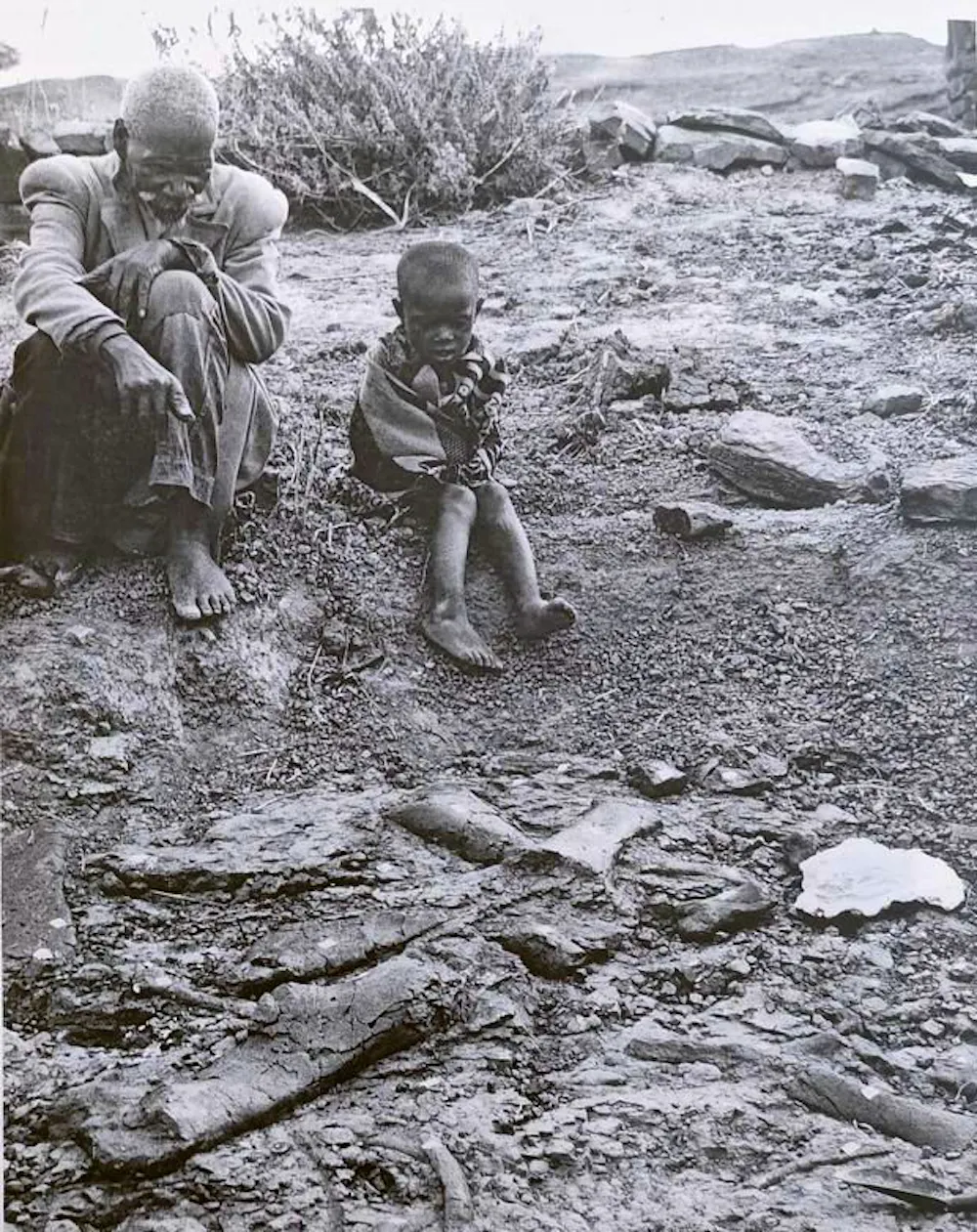
Unidentified Basotho person pointing at the Maphutseng dinosaur bones, circa 1955. Author unknown. With authorisation of the Morija Museum Archives, Author provided (no reuse)

Both body fossils and trace fossils have been found in Lesotho and its surroundings. Erosion of fossil-rich rocks exposes numerous dinosaur, amphibian and reptile trackways, fish trails and burrows, alongside full or partial skeletons and plant remains. Thus, fossils are part of Lesotho’s rugged landscape.

For the Basotho, giant bones eroding from the hills are not mere curiosities; they are referred to the Kholumolumo. This was an enormous, all-devouring mythical creature whose thunderous footsteps echoed across the landscape, leaving footprints behind.

This folktale aligns closely with the fossil record: skeletons and trackways, mostly of dinosaurs, which are prevalent in the sky-high exposures of the Maloti (or the Drakensberg, as the mountain range is known in South Africa).


Read more: Dinosaur tracksite in Lesotho: how a wrong turn led to an exciting find


The Kholumolumo myth serves as a cultural framework that preserves real observations of Lesotho’s fossil heritage over time. It’s an example of early citizen science – local people identifying recurring patterns in their environment and explaining them within their own cultural framework.

Ellenberger’s original archival materials reveal that this local knowledge was highly practical. When French palaeontologists arrived in 1955, they were guided to Maphutseng – now known for one of southern Africa’s richest dinosaur bone beds – by Samuel Motsoane. He was a local schoolteacher who had known the “stone bones” since childhood, in the 1930s.

Basotho chiefs visiting the Maphutseng excavation site in the 1970s. Ellenberger archive, with authorisation of the ISEM, University of Montpellier, Author provided (no reuse)

The San and the fossil footprints

The Basotho and San were among the first in southern Africa to examine giant footprints preserved in stone and ponder: what walked here?

The indigenous San people, who followed a hunter-gatherer way of life before their culture disappeared from Lesotho, were masters in the interpretation of tracks. They could identify the size, behaviour and movement of living animals from a single footprint. Ellenberger believed they applied these skills to fossil tracks as well.


Read more: Mysterious South African cave painting may have been inspired by fossils


His manuscripts describe rock art at Mokhali Cave that appears to depict a dinosaur footprint alongside bipedal creatures reminiscent of the three-toed dinosaur fossils preserved in nearby outcrops.

Ellenberger also noted that some San myths seemed to differentiate between the tracks of four-legged animals in the lowlands and those of two-legged animals higher in the mountains.

In southern Africa, fossil tracks of bipedal dinosaurs are found in higher rock layers only, where the rocks are younger. Lower rocks contain only quadrupedal trackways made by more primitive animals.

So the myths appear to demonstrate some level of understanding of the evolution of species.

Although this seems more speculative, his core observation remains valid: the San recognised patterns in the fossil record and integrated them into their worldview. They observed their land with precision long before formal palaeontology developed in the area.

Rethinking the narrative of ‘discoveries’

The diaries show that locals guided researchers to fossil sites. They recognised fossil bones and tracks as evidence of ancient animals, and preserved this understanding through stories that served as explanations.

Ellenberger himself valued this intellectual tradition: he spoke Sesotho fluently, collaborated with locals, and documented their insights respectfully. His notes credit half a dozen Basotho who discovered fossils of important scientific value.

The Mokhali rock shelter is the site near Leribe where the San painted a possible dinosaur footprint and some of the oldest known dinosaur reconstructions. Julien Benoit, Author provided (no reuse)

His notes show that the roots of awareness and interpretation of fossils in southern Africa predate European expeditions and reach into the deep sense of place held by the people living among these fossils since generations. Their interpretations were not “quaint myths” but sophisticated observations shaped by centuries of engagement with the land.

Acknowledging this enriches the scientific record, broadens our understanding of early palaeontology, and honours the contributions of communities whose insights led to important discoveries. Ellenberger has left us an empowering and inspiring legacy for the new generation of southern African palaeontologists.

– Fossil science owes a debt to indigenous knowledge: Lesotho missionary’s notes tell the story
– https://theconversation.com/fossil-science-owes-a-debt-to-indigenous-knowledge-lesotho-missionarys-notes-tell-the-story-270431

Guinea-Bissau coup: election uncertainty has triggered military takeovers before

Source: The Conversation – Africa – By Salah Ben Hammou, Postdoctoral Research Associate, Rice University

Guinea-Bissau has had nine attempted coups and five successful ones since its independence in September 1973. Salah Ben Hammou, a researcher with a focus on the politics of military coups, explains that the coup on 26 November 2025 appears to have followed earlier patterns of military intervention. It undermines Guinea-Bissau’s already fragile efforts to stabilise democratic governance.


How does the latest coup fit into Guinea-Bissau’s history of military takeovers?

This latest episode fits into a pattern of electoral coups that the country has experienced in the last two decades. In 2003 and 2012 the armed forces intervened at moments of electoral uncertainty.

The 26 November coup followed the same logic. It came just one day before the electoral commission was due to release the results of the 23 November presidential election, a contest already mired in controversy. Major opposition parties had been barred from running and President Umaro Sissoco Embaló faced accusations of overstaying his mandate. Both candidates claimed victory before any official results were announced.

Given this backdrop, the coup’s timing strongly suggests that the intervention was intended to preempt or nullify one potential outcome: the victory of opposition candidate Fernando Dias da Costa.

Many observers suspect that Embaló may have helped instigate or tacitly approved the military’s move to prevent an opposition victory.

There is still no definitive evidence of Embaló’s role. But incumbents have, in some cases, instigated coups against their own governments to void unfavourable election outcomes or preempt mass unrest. Sudan’s 1958 coup and Bolivia’s 1951 episode are classic examples.

What are the implications of the coup?

The coup undermines Guinea-Bissau’s already fragile efforts to stabilise democratic governance in two key ways.

First, it entrenches the military as the ultimate arbiter of political power, privileging the barracks over the ballot box. Once the armed forces are viewed – by incumbents, opposition forces, or the public – as a legitimate referee in political disputes, incentives shift. Instead of resolving conflicts through elections or courts, political competitors are more likely to seek military intervention when outcomes appear uncertain or unfavourable. This dynamic has long plagued Guinea-Bissau, and the latest coup reinforces it.

Second, and closely related, by effectively vetoing a core democratic process, the coup deepens the institutional backsliding already underway. In the months leading up to the vote, Guinea-Bissau had seen the exclusion of major opposition parties, disputes over term limits, and allegations of presidential overreach. The military’s intervention now entrenches these anti-democratic practices.

Whether or not Embaló played a direct role, the signal is clear: electoral rules and constitutional procedures can be overridden by force when they are inconvenient. The new junta’s reliance on Embaló’s allies to staff the new government further suggests continuity, not rupture, from the previous administration.

Economically, the coup is unlikely to benefit the general population. Nearly 70% live below the poverty line, making it one of the poorest countries in the world. Instability deters foreign investment, disrupts trade and stalls development projects. Even recent gains in the cashew industry, around 5.1% this year, risk being undermined.

What are the regional implications of the coup?

For anyone following developments in west Africa, and the continent more broadly, over the last five years, Guinea-Bissau’s latest coup will come as no great surprise. It joins a growing roster of countries under military rule. Each successful takeover in this so-called coup wave sends a clear signal: such interventions are possible and, in some contexts, tolerated.

Yet the broader impact will hinge on the junta’s next moves. It is not just the initial seizure of power that matters. Jonathan Powell and I have highlighted a pattern in which military rulers now remain in power for long periods compared with coups in the early 2000s. Transitional timelines, like the one-year promise announced by Guinea-Bissau’s junta, are increasingly symbolic rather than binding.

As I noted earlier this year in Foreign Policy, efforts to consolidate power, from delaying elections to manipulating them, also embolden other junta leaders across the region.

Guinea-Bissau’s military leaders are likely to study the strategies of their counterparts in west Africa and adopt them. In turn, the tactics they employ will provide a template for others. This type of learning is what will continue to solidify the return to military rule.

What should Ecowas and the African Union do?

Coups are rarely isolated events; they are usually symptoms of deeper political challenges. In Guinea-Bissau, the environment leading up to the coup, marked by Embaló’s efforts to undermine the electoral process, largely went unchecked. That created conditions that made military intervention more likely.

Regional organisations like Ecowas also face real constraints in addressing these challenges. Embaló threatened to expel Ecowas mediators attempting to negotiate a resolution to the electoral timeline. The same constraints are usually present after coups take hold.

That said, Ecowas and the African Union cannot afford to look away from post-coup developments. Every step the junta takes, whether shaping electoral timelines or managing opposition activity, must be scrutinised.

Both organisations should coordinate a unified diplomatic approach alongside other regional actors to secure clear, credible commitments to free and fair elections. Any attempts to delay the transition, manipulate political competition, or suppress dissent must be met with swift and meaningful consequences.

A key component of this strategy should be a ban on electoral participation for anyone involved in the coup. Existing mechanisms already allow for such measures, but their effectiveness depends on consistent application. Regional organisations have yet to do that.

Without such consistency, coups carry minimal consequences. And those who orchestrate them continue to profit from their actions.

– Guinea-Bissau coup: election uncertainty has triggered military takeovers before
– https://theconversation.com/guinea-bissau-coup-election-uncertainty-has-triggered-military-takeovers-before-271368

Benin’s failed coup: three factors behind the takeover attempt

Source: The Conversation – Africa – By John Joseph Chin, Assistant Teaching Professor of Strategy and Technology, Carnegie Mellon University

Military elements attempted to topple Benin’s government in early December 2025. However, unlike other coups across the Sahel and west Africa since 2020, this bid triggered a military response from Benin’s neighbours.

Benin is a west African state of 14.8 million people bordered by Togo, Burkina Faso, Niger and Nigeria.

Responding to two requests for assistance from the government of President Patrice Talon, Nigeria deployed fighter jets and the Economic Community of West African States (Ecowas) deployed elements of its standby force to target and dislodge the pro-coup forces.

Ecowas intervention likely played an important role in undermining the coup’s momentum and restoring order. The dozen or so putschists scored early tactical successes. They captured and broadcast from the national television station, occupied a military camp, and even took the two senior-most army officers hostage. But once Ecowas intervened militarily, any fence-sitters concluded that loyalists would prevail. Rather than a broad-based uprising, only 14 were arrested with a few plotters still at large.

I’m a scholar who maintains the Colpus dataset of coups and I have documented the history of post-second world war coups. As part of this work, I have sought to document the complex causes and effects of Africa’s post-2020 “epidemic of coups”, now entering its fifth year.

Though details remain scant on the motives of the coup plotters led by Lt. Col. Pascal Tigri, three structural factors likely contributed to the latest coup attempt:

From democratic backsliding to democratic u-turn?

Benin does not have a history of recent coups. It had not suffered a bona fide coup attempt since January 1975.

In the first 15 years after independence from France in 1960, Dahomey (as the country was then called) experienced nine coup attempts, making it one of the most coup-prone countries in sub-Saharan Africa during the early Cold War period.

However, political instability through the early 1970s gave way to the stable and durable personalist regime of Mathieu Kérékou (1972-1990). This was followed by electoral democracy after the Cold War.

Until recently, Benin had been heralded as one of Africa’s “democratic outliers” and success cases of democratic survival despite challenging conditions. Though poor, Benin has seen decades of improving average living standards. Economic growth in 2025 was 7.5%; the latest unrest cannot be blamed on poverty or an economic crisis.

However, data on three key dimensions of democracy shows that although electoral contestation and participation have endured, constraints on the executive (and thus liberal democracy overall) have declined in Benin since Talon’s election as president in 2016.

Above: Dimensions of democracy in Benin, 1960-2024. Author replication of Boese et al. (2022) and V-Dem 2025, v. 15.

According to autocratic regime data from US political scientists Barbara Geddes, Joe Wright and Erica Frantz as well as the Varieties of Democracy (V-Dem) project (which surveys experts about democracy worldwide), Benin slipped back into an electoral autocracy in 2019. That is when opposition candidates were prevented from competing in parliamentary elections. The polls were marred by repression of mass protests and an internet shutdown.

In 2021, an electoral boycott led to Talon’s easy re-election.

V-Dem data show a very partial and incomplete democratic rebound since 2022. The opposition was allowed to compete in the January 2023 parliamentary elections. And earlier this year Talon confirmed that he would not seek an unconstitutional third term.

The potential for a coup, however, was foreshadowed last fall when the regime alleged that it had uncovered a coup plot involving a presidential hopeful in 2026. Last month, parliament’s vote to create a Senate was condemned by the opposition as allowing Talon a means to influence affairs after he steps down.

With the main opposition party barred from running in next year’s presidential election, Talon is expected to hand off power to his ally and finance minister, Romuald Wadagni.

Though the political leanings of Tigri and coup plotters remain unclear, Tigri claimed to seek to “free the people from dictatorship”.

The coupmakers also presumably sought to block the upcoming 2026 parliamentary and presidential elections.

A growing jihadist threat

Among the coup leaders’ key complaints was Talon’s mismanagement of the country. In particular, they cited “continuing deterioration of the security situation in northern Benin and “the ignorance and neglect of the situation of our brothers in arms who have fallen at the front” due to worsening jihadist violence.

A number of coups in nearby countries since 2020 have been preceded by rising levels of political violence and deepening insecurity born of jihadist insurgencies. That was certainly the case in Mali, Burkina Faso and to a lesser extent Niger.

Since last year, it has been clear that the jihadist violence was spilling over from Sahel neighbours such as Burkina Faso and Niger into the borderlands of west Africa. This included Benin’s north. ACLED data show a major increase in political violence events since 2022. And a spike in political fatalities in 2024:

Political Violence and Fatalities in Benin, 1997-Nov. 2025. Armed Conflict and Location & Event (ACLED) Data.

Much of this increased violence is attributable to the advance of operations by the al-Qaida affiliated group Jama’at Nusrat al-Islam wal-Muslimin (JNIM). The group also managed to launch its first fatal attack in Nigeria at the end of October.


Read more: Nigeria’s new terror threat: JNIM is spreading but it’s not too late to act


Russia has become the primary security partner for the Sahel Alliance. The defence pact was signed in 2023 by post-coup juntas of Burkina Faso, Mali and Niger to defeat jihadists and maintain power.

Nevertheless, Benin has continued to rely on western security partners to aid its counter-insurgency efforts and bolster border security. Notably, Benin continues to welcome military cooperation with France. Since 2022 Paris has pledged greater military aid to combat terrorism.

In September, US Africa Command commander General Dagvin Anderson visited Benin to underscore cooperation to oppose terrorism.

During the coup attempt, Tigri reportedly warned against French intervention and railed against “imperialism”. The speech reportedly ended with the phrase “The Republic or Death”, which echoes the new motto of Burkina Faso’s junta.

This suggests that the coup makers may have been inspired by others in the Sahel.

Risk of the coup belt expanding

The Benin events mark the third coup attempt and first failed coup this year in the Sahel region. There have been 17 coup attempts in Africa since 2020, including 11 successful coups. This makes the African coup belt stretching across the Sahel and west Africa the global epicentre of coups.


Read more: Africa’s power grabs are rising – the AU’s mixed response is making things worse


West Africa’s latest “copycat” coup attempt was condemned by the African Union, European Union and Ecowas. Yet it was praised by pro-Russian social media accounts, reflecting a growing cleavage between the Russia-aligned juntas of the Sahel Alliance and the remaining Ecowas-aligned civilian regimes of west Africa.


Read more: Coups in west Africa have five things in common: knowing what they are is key to defending democracy


Although Nigeria-led Ecowas threatened military intervention after the coup in Niger in July 2023, the regional body only actually militarily intervened to defeat the coup attempt in Benin. Nigeria, it appears, has drawn a line in the sand to retain a buffer from further instability – including JNIM operations. On the same day of the coup attempt in Benin, it was reported that Nigeria was seeking greater aid from France to combat insecurity.

– Benin’s failed coup: three factors behind the takeover attempt
– https://theconversation.com/benins-failed-coup-three-factors-behind-the-takeover-attempt-271540

Africa’s power grabs are rising – the AU’s mixed response is making things worse

Source: The Conversation – Africa – By Richard Fosu, Lecturer in International Relations, Monash University

Hardly a month goes by without news of another unconstitutional change of government on the African continent.

These can take one of three forms.

The first is a military coup d’état or violent change of (democratically) elected government. The second is the refusal of an incumbent government to relinquish power after losing an election. And finally, manipulating constitutions to win or extend term limits of an incumbent government.

We study peace and conflict in Africa, as well as African Union law. We set out these three categories in a paper we published in 2023. In it we analysed unconstitutional changes of government in Africa between 2001 and 2022.

We found that there had been 20 coup d’états, six instances of constitutional manipulation and four attempts by incumbents to hang onto power after losing elections.

These patterns have persisted since the publication of our study. The most recent was the military takeover in Guinea-Bissau in late November 2025.

With the persistence of unconstitutional changes of government, particularly what has been described as a coup resurgence in Africa, we analysed the African Union’s stance on these three forms of regime change.

The African Charter on Democracy, Elections and Good Governance of 2007 prohibits unconstitutional changes of government. It prescribes sanctions to restore constitutional order when they occur.

We found that for the majority of coup d’états (17 out of 20 in our dataset), the AU was strict in enforcing the sanctions prescribed by the charter to restore constitutional order. However, its response to incumbents’ attempts to hang onto power after losing elections and constitutional manipulations to extend term limits has been mixed at best.


Read more: Presidential term limits help protect democracy – long ones can be dangerous


These findings led us to look at how the AU can strengthen continental democratic mechanisms to prevent the so-called African coup belt from widening further.

We conclude from our findings that the AU needs to do two things.

Firstly, avoid unconstitutional changes of government. The way to do it is to:

  • foster a true democratic culture in African states

  • set clear rules on matters such as constitutional changes that are often manipulated by incumbents to stay in power

  • enforce these rules without fear or favour.

Secondly, the AU, the Economic Community of West African States (Ecowas) and other regional bodies must apply firm sanctions to civilian leaders who manipulate the law to stay in power, just as they do to military coup makers.

A history of coups

The euphoria that swept across Africa following independence from European colonial rule in the late 1950s and 1960s was short-lived.

Many African countries plunged into decades of political instability, socioeconomic crises and civil wars. One of the major factors that drove this period was the lack of strong systems of democratic participation and peaceful transfers of power.

With no meaningful space for inclusive political participation and peaceful transitions, military coups and countercoups, rebel movements and other violent means of ascending power became the norm.

Between 1956 and 2001, there were 80 successful coup d’états, 108 failed coup attempts and 139 coup plots in sub-Saharan Africa.


Read more: Coups in west Africa have five things in common: knowing what they are is key to defending democracy


In 2000, African leaders decided at a summit in Togo to adopt the Lomé Declaration. This condemned coup d’états and other unconstitutional changes of government. It was the first continental instrument to lay out a framework for a collective African response to unconstitutional changes of government.

This was followed by the 2007 African charter on democracy and the Malabo Protocol on an African criminal court in 2014.

These three instruments provide for various sanctions targeted at African states and individuals complicit in breaching democratic principles.

Despite these, several African states have still recorded transitions of power that are unconstitutional. And the AU’s response has been mixed.

The AU’s mixed response

These are some of the examples we identified.

In 2010, the AU supported an international effort to remove Laurent Gbagbo after he refused to hand over power after losing elections in Côte d’Ivoire.

Yahya Jammeh’s refusal to step down from power after losing elections in 2016 in The Gambia was also met with a stern response from the AU. It said it “will not recognise” Jammeh. Ecowas considered “removing him using mililtary force” if he refused to hand over power peacefully.

But there have been some notable failures to take action.

For instance, Ali Bongo’s flawed electoral win in Gabon in 2016 did not attract concrete action from the AU. Nor was any action taken over the delayed elections in the Democratic Republic of Congo under Joseph Kabila in 2018.


Read more: Who do Africans trust most? Surveys show it’s not the state (more likely the army)


The most glaring failure in building democratic principles in Africa has been the lack of sanctions from the AU when incumbents manipulate constitutions to extend term limits.

From Burundi to Côte d’Ivoire, through Togo to Zimbabwe, we found no evidence in our dataset where the AU has directly responded to instances of constitutional manipulations.

Yet, in recent history, constitutional manipulations have been the major precipitants of military interventions. Recent coups in Gabon, Guinea, Chad and Sudan were all preceded by constitutonal manipulation to extend or abolish term limits.

We found that when the democratic space shrinks and people feel they have no way to express dissent, the risk of popular uprisings increases. The military often seizes on these moments to intervene.

What needs to happen

The continental treaties on democracy and good governance require strict adherence to democratic principles and respect for the principles of democratic changes of government.

For them to be effective, the following steps need to be taken.

Firstly, democratic principles must be clearly defined. For instance, does amending a constitution to abolish presidential term limits to benefit an incumbent violate these principles? How about engineering the disqualification of opposition candidates through machinations like politically motivated prosecutions?

Secondly, clear rules must be established on matters like term limits.

Thirdly, the AU, Ecowas and other regional bodies must stop coddling pseudo-democrats whose conduct invites coups. They must stop supervising and endorsing sham elections that keep these leaders in power.

Finally, the AU can demonstrate its commitment to democracy and good governance by refusing to reward autocrats. This could mean not appointing autocrats to important bodies, such as the AU Peace and Security Council (which is charged with monitoring democracy and good governance on the continent), or awarding them chairmanship positions.

Dr Christopher Nyinevi, who works with the Ecowas Court of Justice in Abuja, Nigeria, is a co-author of this article.

– Africa’s power grabs are rising – the AU’s mixed response is making things worse
– https://theconversation.com/africas-power-grabs-are-rising-the-aus-mixed-response-is-making-things-worse-271137