
Women trapped with abusers: South Africa’s COVID lockdowns exposed serious protection gaps

Source: The Conversation – Africa – By Marinei Herselman, Lecturer, University of Fort Hare

The unintended consequences of measures introduced to limit the spread of the COVID-19 virus from 2020 to 2022 have been studied extensively. Research in South Africa shows that some of these measures added to social ills, such as unemployment and poverty.

Another impact of “lockdown” was on gender-based violence. The government’s Gender-Based Violence Command Centre reported over 120,000 cases within the first three weeks of lockdown.

In the year 2019-20, 53,293 sexual offences were reported, an average of 146 per day. This was up from 52,420 in 2018-19. Most of these were cases of rape. The police recorded 42,289 rapes in 2019-20, up from 41,583 in 2018-19, an average of 116 rapes each day. Further, a total of 2,695 women were murdered in South Africa in 2019-20. This means a woman is murdered every three hours.

The lockdown measures required people to remain indoors. Schools and non-essential establishments like restaurants were closed. Travelling internationally and between provinces was prohibited.

Research showed that the lockdown measures trapped many women and children in abusive environments. The gender-based violence incidents highlighted gaps in support services and underscored the critical role of social workers in crisis situations.

In a recent paper, we described our study of the impact the lockdown measures had on gender-based violence in Matatiele, a small town in South Africa’s Eastern Cape, one of the poorest regions in the country.

The study highlighted the need to integrate gender-based violence support services into emergency plans to ensure continuity of care in times of crisis. In addition, the challenges faced by social workers during the pandemic showed systemic weaknesses in the support infrastructure.


Read more: South African women face exclusion from society due to gender-based violence – how they’re fighting back


We recommend prioritising gender-based violence services, expanding the social work workforce, and ensuring accessible, effective support mechanisms to safeguard survivors. By engaging local and provincial partners through cross-sector collaboration, South Africa can build a more equitable society and empower survivors during future emergencies.

Interviewing survivors of violence

Our findings were based on interviews with 30 survivors of gender-based violence and five social workers at the Thuthuzela Care Centre in Matatiele, which provides support for rape survivors. Twenty-four of the survivors (80%) were women and six (20%) were males. The participants were aged 18-35.

We found that 63.3% of survivors experienced gender-based violence differently during the pandemic, primarily because access to support services was reduced. Key findings were that:

  • survivors found it difficult to reach police stations, hospitals and support centres

  • a lack of transport and staffing made access to services even more difficult than usual

  • survivors were often imprisoned with their abusers, making it nearly impossible to escape the abusive environment

  • the closure of schools and community centres destroyed additional refuges and support networks

  • social workers reported that remote counselling methods, such as telephone calls, were less effective

  • poor internet connection and the inability to meet in person limited the quality of psychosocial support provided

  • many perpetrators faced job losses and economic hardships; this led to increased stress and violence.

Our findings highlight how public health crises can worsen existing social vulnerabilities. The COVID-19 pandemic starkly illustrated the vulnerability of survivors during crises and the role of social workers in providing support.


Read more: Spoken word poetry challenges gender-based violence in Namibia


Women’s experiences

As shown in the table, some participants said their experiences of abuse were the same before and during COVID-19. This might be because a participant was abused during the pandemic and had not been a victim before.

Supplied by author.

Most of the research participants said their experience of gender-based violence was different from how it had been before COVID-19. Asked to explain, most of them responded in similar ways.

One of the women said:

I have difficulty escaping my abuser.

Another said:

I struggled to sleep, and I was anxious for a long time. I accepted the situation and told myself that I will be fine. I was abused by a stranger, which made it difficult for me to get justice but I told myself that abuse is something that you cannot run away from.

Lack of sleep is a common challenge for many survivors of gender-based violence.

One of the male survivors in the study, a married man, spoke of the difficulty of dealing with societal norms which are rooted in patriarchy. There’s a local saying which captures the typical attitude: indoda yokwenyani ayikhali (“a real man does not cry”).

There appeared to be a general sense that gender-based violence would not change, so women and men just accepted and normalised it.


Read more: Men abused by women don’t all fight back. Some believe a strong man is non-violent – South African study


Next steps

An effective response to gender-based violence requires sufficient staffing of response facilities. There is also a need for robust communication tools and training to handle remote support scenarios as happened during COVID.

Gender-based violence is a serious problem that needs a multi-faceted response. Governments, and non-profit, non-governmental and civil society organisations must work together. This will help in achieving UN Sustainable Development Goal 5 on gender equality. Gender equality is a fundamental human right. It is a foundation for a peaceful, prosperous and sustainable world. While some progress has been made in recent decades, the world is not on track to achieve gender equality by 2030.

To lessen the impact of future crises on survivors of gender-based violence, several steps are essential:

  • the government must recognise support services as critical in emergencies; social workers must be classified as essential personnel so that they can continue their work without restrictions

  • essential services such as safe shelters, mental health support and legal aid must be in place, and healthcare services must be fully available, well-equipped and well-staffed

  • the government must expand and train the social worker workforce, and provide specialised training for any crisis situation in the future

  • there is need to develop support channels, including online platforms, helplines and mobile outreach programmes

  • investing in reliable communication technologies and transportation can help people reach support services

  • long-term strategies should focus on reducing gender inequalities and challenging patriarchal norms.

Bongeka Zawani, a master’s student at the University of Fort Hare, carried out the study this article is based on.

– Women trapped with abusers: South Africa’s COVID lockdowns exposed serious protection gaps
– https://theconversation.com/women-trapped-with-abusers-south-africas-covid-lockdowns-exposed-serious-protection-gaps-243198

Sudan: foreign interests are deepening a devastating war – only regional diplomacy can stop them

Source: The Conversation – Africa – By John Mukum Mbaku, Professor, Weber State University

The war between the Sudanese Armed Forces and the Rapid Support Forces has raged since April 2023. It’s turned Sudan into the site of one of the world’s most catastrophic humanitarian and displacement crises.

At least 150,000 people have been killed. More than 14 million have been displaced, with over 3 million fleeing to neighbouring countries like Chad, Ethiopia and South Sudan. Once a vibrant capital city, Khartoum is now a “burnt-out shell”.

This devastating war, rooted in long-standing ethnic, political and economic tensions, has been compounded by what international and regional actors have done and failed to do. As Amnesty International notes, the international response remains “woefully inadequate”.

The problem lies in the fact that external involvement has not been neutral. Instead of halting the conflict, many external players have complicated it. In some cases, international interventions have escalated it.

More than 10 countries across Africa, the Middle East and Asia have been drawn into Sudan’s war. This has turned it into a proxy conflict that reflects the interests of external actors, such as Egypt, Turkey and Saudi Arabia.

Several actors have taken sides.

Saudi Arabia, for instance, backs the Sudanese army. The United Arab Emirates (UAE) is alleged to support the paramilitary Rapid Support Forces. Egypt, citing historical ties, backs the army. For their part, Ethiopia and Eritrea reportedly support the paramilitary group. Chad has been accused of facilitating arms shipments to the Rapid Support Forces via its eastern airports. Russia, Ukraine, Turkey and Iran have also been linked to diplomatic and military support to Sudan’s army.

These geopolitical entanglements have made peace nearly impossible, deepening the conflict instead of resolving it.

I have studied Africa’s governance failures for more than 30 years, from military elites and coups to state capture and political instability. Based on this, my view is that Sudan’s conflict cannot be resolved without serious international commitment to neutrality and peace.


Read more: Sudan’s peace mediation should be led by the African Union: 3 reasons why


The involvement of foreign actors on opposing sides must be reversed. International involvement must be premised on helping the Sudanese people develop the capacity to resolve governance problems themselves.

For this to happen, regional diplomacy must be stepped up. The African Union must assert its legitimacy and take the lead in addressing this challenging crisis. It can do this by putting pressure on member states to ensure that any ceasefire agreements are enforced.

The East African Community and the Intergovernmental Authority on Development can provide assistance in securing a peace agreement and ensuring it’s enforced. Members of these continental organisations can encourage external actors to limit their intervention in Sudan to activities that promote democratic governance and sustainable development.

The African Union

The African Union should play a central role in bringing peace to Sudan. But its absence has been conspicuous.

Despite adopting the “African solutions to African problems” mantra, the African Union has neither held Sudan’s warlords accountable nor put in place adequate civilian protection measures.

First, it could have worked closely with the UN to deploy a mission to Sudan with a mandate to protect civilians, monitor human rights (especially the rights of women and girls), assist in the return of all displaced persons and prevent any further attacks on civilians.

Second, the African Union could have sent an expert group to investigate human rights violations, especially sexual violence. The results could have been submitted to the union’s Peace and Security Council for further action.

Third, the African Union could have worked closely with regional and international actors, including the Arab League. This would ensure a unified approach to the conflict, based on the interests of Sudanese people for peace and development.

Finally, the AU could have addressed the root causes of Sudan’s conflicts, which include extreme poverty, inequality, political exclusion and economic marginalisation.

The African Union could also make use of the insights and knowledge gleaned by African leaders like Kenya’s William Ruto and Egypt’s Abdel Fattah el-Sisi, who have attempted to mediate, but have failed. The AU should also use the political expertise of elder statesmen, such as Thabo Mbeki, Moussa Faki and Olusegun Obasanjo, to help address the conflict and humanitarian crisis.

The United Arab Emirates

The UAE is alleged to back the paramilitary troops in the war. In recent years, the UAE has become increasingly involved in African conflicts. It has supported various factions to conflicts in the Horn of Africa, the Sahel region and Libya.

Its increased involvement in Africa is driven by several strategic interests. These include fighting terrorism, securing maritime routes, and expanding its trade and influence.


Read more: Sudan is burning and foreign powers are benefiting – what’s in it for the UAE


In 2009, the UAE helped Sudan mediate its border conflict with Chad. The UAE supported the ouster of Omar al-Bashir in April 2019, as well as Sudan’s transitional military council.

In 2021, the UAE signed a strategic partnership with Sudan to modernise its political institutions and return the country to the international community. The UAE has stated that it has taken a neutral position in the present conflict. However, on 6 March 2025, Sudan brought a case against the UAE to the International Court of Justice. It accused the UAE of complicity in genocide, alleging that the UAE “has been arming the RSF with the aim of wiping out the non-Arab Massalit population of West Darfur.”

The United States

During his first term, US president Donald Trump spearheaded the Abraham Accords. These agreements were aimed at normalising relations between Israel and several Arab countries, including Sudan. Subsequently, Sudan was removed from the US list of state sponsors of terrorism.

The accords appeared to have brought Khartoum closer to Washington. They provided avenues for the type of engagement that could have placed it in good stead when Trump returned to the White House in 2025.

However, Sudan’s internal political and economic instability, including the present civil war, has complicated the situation.

The Abraham Accords were a significant foreign policy achievement for Trump. A peaceful, democratically governed, and economically stable and prosperous Sudan could serve as the foundation for Trump’s “circle of peace” in the Middle East.

But Trump and his administration are preoccupied with other domestic and foreign policy priorities. During his May 2025 visit to Saudi Arabia, Trump did not officially address the conflict in Sudan. Instead, he placed emphasis on securing business deals and investments.

The European Union

The European Union has strongly condemned the violence and the atrocities committed during the war in Sudan, especially against children and women. The organisation has appealed for an immediate and lasting ceasefire while noting that Sudan faces the “most catastrophic humanitarian crisis of the 21st century”.

Unfortunately, member countries will remain preoccupied with helping Ukraine, especially given the growing uncertainty in Washington’s relationship with the authorities in Kyiv.

The preoccupation and focus of the EU and the US on Gaza, Ukraine and Iran may, however, be underestimating the geopolitical risks Sudan’s war is generating.

A peaceful and democratically governed Sudan can contribute to peace not just in the region, but also in many other parts of the world.

What now?

To end Sudan’s war and prevent future ones, international and African actors must do more than issue statements. They must act coherently, collectively and with genuine commitment to the Sudanese people’s right to peace, democratic governance and sustainable development.

Democracy and the rule of law are key to peaceful coexistence and sustainable development in Sudan. However, establishing and sustaining institutions that enhance and support democracy is the job of the Sudanese people. The external community can provide the financial support that Sudan is likely to need. It can also support the strengthening of electoral systems, civic education and citizen trust in public institutions.

– Sudan: foreign interests are deepening a devastating war – only regional diplomacy can stop them
– https://theconversation.com/sudan-foreign-interests-are-deepening-a-devastating-war-only-regional-diplomacy-can-stop-them-259824

Netflix gives African film a platform – but the cultural price is high

Source: The Conversation – Africa – By Wunpini Fatimata Mohammed, Assistant Professor of Communication, Cornell University

Netflix began its Africa operations in South Africa in 2016. When the US streaming giant announced it was setting up shop in Nigeria in 2020, many west African film-makers, writers, artists and media audiences were jubilant.

Finally, west Africa’s creativity and brilliance would be formally recognised on the world stage. Netflix Naija’s purpose was to produce local content for Netflix just like Netflix South Africa and later Netflix Kenya.


Read more: Netflix Naija: creative freedom in Nigeria’s emerging digital space?


Some film-makers have been wary of US cultural imperialism happening through the market dominance of Netflix and other US streamers. Others have rushed to the streamer to sign deals that will gain their films and TV shows a global audience.

Netflix’s interest in African stories comes with a colonial power dynamic that research and scholarship has not fully explored. As a scholar of media and communication, I recently examined the effect US streamers are having on the stories being told in films in Nigeria and Ghana.

In my study, I argue that despite the growing global interest in African pop culture, African creative workers need to be careful about interest from global conglomerates. We can’t talk about African cinemas going global without paying attention to how Hollywood’s colonial relationship with Africa has shaped and influenced what African filmmakers believe will sell globally.


Read more: Black Panther, Wakanda Forever and the problem with Hollywood – an African perspective


What price is being paid to appeal to global audiences? Film-makers might focus so much on the western gaze that they lose focus on telling African stories authentically and respectfully.

In my study, I analyse various films including the Ghanaian film Azali and the Nigerian movie Lionheart to argue that that’s exactly what’s happening.

Dancing to the tune of the west

Despite the existence of thriving African film and TV industries before the advent of streaming technologies, we are seeing a replication of what I call the everydayness of colonialism in the area of media representations of the continent.

Here, African filmmakers and producers find themselves jumping through hoops to tell stories that are “fit” to be streamed to Netflix’s millions of American, European and global subscribers. Global cosmopolitan audiences are prioritised over African audiences.


Read more: Woman King is set in Benin but filmed in South Africa – in the process it erases real people’s struggles


African audiences at home and in the diaspora are the reason we have vibrant film industries such as Nollywood to begin with.

This displacement of African audiences happens both in representation and in access.

Most African movie audiences do not have access to Netflix and other streaming platforms due to the digital divide and the cost of subscribing. So the target audience shifts to the elite, both African and global, who can afford to stream.

Azali and Lionheart

Ghana and Nigeria’s film industries were developed by artists who wanted to reflect their societies to their communities. I found that with Netflix’s arrival, there is a danger of disrupting and undoing this important work.

The intervention of US streamers has led to the development of glossier versions of Africa. They are universal enough to be consumed by anyone, anywhere in the world, even if it means sacrificing the integrity of stories to achieve this global appeal.

In Azali, for example, I found that the film sacrificed authentic language and geographical accuracy to tell a story for a western audience.

Azali explores the themes of child marriage, child-trafficking and rural-urban migration in Ghana. Here, a film about the Dagbamba was set in the town of Zebilla, where Dagbanli is not the dominant language. The film cast non-Dagbanli speakers in major roles to speak a language they neither understood nor had any proficiency in. If Dagbamba had been centred as the primary audience of the movie, this cultural indignity might not have happened.

Lionheart, though star-studded, departed from traditional Nollywood narrative conventions. The film tells the story of a wealthy Nigerian family and the quest of a young woman to take control of the family business. The movie had high production values and told a story that would be considered universally relatable. However, it was disqualified in its bid for an Oscar nomination in the Best International Feature Film category because of its majority English dialogue. Despite appealing to Netflix in the area of production quality and storyline, African film-makers were still punished by the Academy.

Nigeria and Ghana’s film industries have traditionally told a wide variety of African stories. Netflix’s arrival is reducing African stories to stories about the elite and for the global cosmopolitan elite.

Stories about the majority of Africans are being erased. Africa becomes a backdrop to tell stories about the elite class.

In my study, I argue that narrative construction is an important part of identity and that when external factors begin to determine how African stories are told, it distorts the image of Africa for Africans and raises questions of cultural sovereignty.

Moving forward

It is refreshing to see African cultures appreciated on a global scale. But this shouldn’t erase narratives about the African masses and working communities.

There are film-makers that are resisting the Netflix canon. Nigerian actress and producer Funke Akindele shows that this is possible in A Tribe Called Judah. Her film set a new box office record in Nigeria by avoiding direct to Netflix/streamer distribution and staying true to African audiences. The film tells the story of how a single mother and her five sons navigate poverty in Lagos. It was later licensed to stream on Amazon Prime Video after it made history at the box office in Nigeria.

Other film-makers like Omoni Oboli, whose approach centres the Nigerian masses, has turned to YouTube. She tells Nigerian stories while resisting the exploitation that can often come with signing a Netflix deal.


Read more: The unique strategy Netflix deployed to reach 90 million worldwide subscribers


These projects offer an alternative. As Netflix expands, African creative workers and cultural policymakers must protect the narrative integrity of African stories and resist the economic exploitation of African film-makers. Productions can capture the nuances of African stories while representing African languages and cultures with respect and dignity – without selling out to western values.

– Netflix gives African film a platform – but the cultural price is high
– https://theconversation.com/netflix-gives-african-film-a-platform-but-the-cultural-price-is-high-259252

Migrants in South Africa’s economic powerhouse often go hungry: the drivers and what can be done about it

Source: The Conversation – Africa – By Adrino Mazenda, Senior Researcher, Associate Professor Economic Management Sciences, University of Pretoria

About 281 million people globally have migrated from their country of origin to another country. This movement can be temporary or permanent and can occur for various reasons, including economic opportunities, family reunification and education. Then there are also millions who are escaping conflict and seeking refuge in another country.

Countries at different stages of development also experience large volumes of internal migration. Migration within a country can be temporary or permanent too, and reflect economic reasons or insecurity.

Both types of migrants sometimes experience food insecurity: the physical and financial inability to access nutritious, safe and sufficient food to fulfil a person’s dietary requirements.

There are an estimated 2.89 million documented foreign migrants in South Africa, accounting for about 5% of the country’s population. Most immigrants in South Africa come from the Southern African Development Community countries. South Africa also experiences a high annual internal migration rate. About 850,0000 people temporarily and permanently relocate from rural to urban areas.

Gauteng, the province which contributes more than a third of South Africa’s economic output, attracts a disproportionate share of internal and international migration.

As social scientists who have been studying migration and food security, we conducted research to explore the food security status of migrant households (international and internal) and native Gauteng households, and to understand their differences, if any.

The study used data from the 2020/21 Quality of Life survey. This is one of the largest social surveys in South Africa, and respondents include both internal and international migrants. It is conducted every two years by the Gauteng City Region Observatory. Quantitative research methods and statistical analysis were then applied to identify patterns and relationships between food insecurity and migration variables.

Food insecurity remains a pressing concern in South Africa’s major cities, particularly among migrant populations. Not all migrants experience food insecurity the same way, however. Internal and international migrants differ not only from native Gauteng residents but also from one another. There are different factors influencing their vulnerability.

The differences

One differentiating factor between the internal and foreign migrants is government social support services. They seem to play a key role in determining the well-being of internal migrants. International migrants don’t qualify for such services. But they sometimes fared better than internal migrants or natives, likely due to age, education, or resourcefulness (social support networks).

Internal migrants experienced their own set of challenges. For example, poor health service provision and lack of medical aid were strong predictors of food insecurity. This suggests that addressing food access requires improvements in health services, insurance, and broader social infrastructure.

Improved access to healthcare reduces the financial burden on households dealing with medical expenses, so they can spend more on food. Access to maternal and child health services enhances nutritional knowledge and practices. That in turn improves the way households use food. Health insurance and unemployment insurance protect households from income shocks that could otherwise lead to food insecurity.

A stronger social infrastructure improves food access by enhancing education, healthcare, and social protection systems. Education boosts income and nutritional knowledge. Preventive healthcare reduces illness and medical expenses, freeing up resources for food. Social protection measures help households withstand financial shocks, ensuring consistent access to food.

Of course all this support has a cost that needs to be funded from the public purse, but its benefits may well outweigh the cost.

Gender disparities

Immigrants contribute significantly to South Africa’s economy. Migration enhances labour market flexibility, promotes economic dynamism, and supports livelihoods in both urban and rural areas, making it essential for inclusive economic growth. Internal migrants provide labour in sectors such as mining, construction and services, while also supporting rural households through remittances. They help stimulate urban informal economies.

International migrants bring valuable skills and resilience to various sectors, including agriculture, healthcare, manufacturing and construction. They contribute local income taxes. Some operate small and large formal businesses, which adds to job creation.

However, employment data reveals a pronounced gender disparity among international migrants and internal migrants.

In all population groups (native residents, internal migrants and international migrants), men are more likely to be employed than women. Among international migrants, over 1 million men were employed compared to 400,000 women. More women (281,553) than men (88,598) were classified as economically inactive – not available for work.

The primary reason for internal migration among both men and women was the search for paid employment. For men, the second most common reason was job transfers or accepting new employment.

In contrast, female migrants cited moving to live with or be closer to a spouse, family, or friends, often due to marriage, as their main motivation.

Way forward

Our study highlights the determinants of food insecurity among migrant populations. It also challenges harmful stereotypes and invites more inclusive thinking about social support and job creation.

The study’s findings can help inform the public about who needs more support and why. It shows that food aid and government support systems aren’t working as intended.

The main conclusions we reached from the study were that:

  • Rural health infrastructure is in dire need of public support.

  • Increased inequities in healthcare access are unjustified.

  • The medical and health bills of foreign citizens can be shared between home and host countries to reduce the strain on the host’s infrastructure through a combination of policy reforms, bilateral agreements and global cooperation mechanisms. Key to this is an inter-government billing system where host countries track migrants’ healthcare use and send bills to their home country governments or insurers.

  • It is desirable for migrants to hold valid health insurance as a condition of entry or residency.

  • Policies to promote agriculture and rural areas, particularly developing new rural housing schemes, appear to be a promising way to abate food insecurity.

  • Revitalising special economic zones, the designated areas offering incentives to attract investment, boost trade and create jobs, can help limit the concentration of migrants in Gauteng.

– Migrants in South Africa’s economic powerhouse often go hungry: the drivers and what can be done about it
– https://theconversation.com/migrants-in-south-africas-economic-powerhouse-often-go-hungry-the-drivers-and-what-can-be-done-about-it-256907

Turkey is stepping up its influence in west Africa – what’s behind its bid for soft power

Source: The Conversation – Africa – By Issouf Binaté, enseignant-chercheur, Université Alassane Ouattara de Bouaké

Turkey is stepping up its influence in west Africa as the geopolitical and economic landscape in the region shifts. In Senegal, the state-owned Turkish Petroleum Corporation has entered a key partnership in the oil and gas sector. Meanwhile, Karpowership, a company providing electricity via floating power plants, now supplies energy to eight African countries. But Turkey’s not stopping there. As part of its soft power strategy, it is also winning hearts and minds through education and culture while deepening trade and security ties.

Historian Issouf Binaté, who has studied Turkey’s growing presence in west Africa, breaks down how Ankara is positioning itself as an alternative to both former colonial powers and newer global players competing for influence on the continent.

What drives Turkey’s growing influence in west Africa?

Turkey’s foreign policy in west Africa leans on two main pillars.

One is institutional power, driven by state-backed agencies (embassies, the religious affairs directorate Diyanet, and the economic cooperation agency (TIKA) .

The other is more grassroots, led by non-state actors such as religious foundations and NGOs.

These groups laid the groundwork for Turkey’s African expansion long before Ankara officially stepped in.

A key player in Turkey’s earlier outreach was the Gülen movement, named after preacher Fethullah Gülen (1941–2024). The Gülen movement pioneered Turkey’s soft power approach with “Turkish schools”, starting with the Yavuz Sultan Selim and Yavuz Selim-Bosphore high schools in Dakar in 1997.

Also at the end of the 1990s a network composed of Turkish business leaders and social activists under the Turkish Confederation of Businessmen and Industrialists, which claimed over 100,000 member companies, expanded Turkey’s influence across Africa. At that time, Turkey had only three diplomatic representations for the whole of sub-Saharan Africa.

The more recent contact with Africa comes at a time when western hegemony faces growing criticism from a new generation of Africans engaged in decolonial movements. Gülen-affiliated institutions now number 113, alongside religious and secular schools run by other groups like Mahmud Hudayi Vakfi and Hayrat Vakfi. Since the 2016 political rift between Gülen and President Recep Tayyip Erdoğan, these schools were gradually transferred to Maarif Foundation, Turkey’s state-run overseas education arm.

Back in 2003, Turkey had only 12 diplomatic missions across Africa. Today, that number has grown to 44, bolstered by Turkish religious foundations (like Mahmud Hudayi Vakfi and Hayrat Vakfi), NGOs, and entrepreneurs who have filled the gap left by the Gülen movement.

Another powerful player in Turkey’s Africa strategy is Turkish Airlines, now one of the top carriers on the continent. It is now flying to 62 airports in 41 African countries.

What role do west African students trained in Turkey play?

By investing in education, Turkey didn’t just open its doors to African students. It also planted the seeds for a long-term influence strategy. These students, and more broadly young African migrants trained in Turkey, are now among the key messengers of “Turkishness” back home.

In doing so, Ankara is following a familiar path once used by colonial powers. They used student mobility as a powerful tool for their diplomacy.

This policy of openness took several forms. As early as 1960, it welcomed students from non-self-governing territories in accordance with UN General Assembly resolutions.

Then, in the 1990s, Turkey continued this effort through a scholarship programme for African students, supported by the Islamic Development Bank. During this period, Turkey launched the Büyük Öğrenci Projesi (Great Student Project), which provided scholarships to international students.

Starting in 2012, this programme was re-branded as YTB (Yurtdışı Türkler ve Akraba Topluluklar Başkanlığı, or Directorate for Turks Abroad and Related Communities). It introduced reforms, including a digital application process for scholarships via an app on the YTB website. This shift caused a dramatic spike in interest. Applications soared from 10,000 to 155,000 between 2012 and 2020.

For non-scholarship students, Turkey simplified visa processes, reduced tuition fees, and offered other incentives. These measures contributed to a significant increase in the number of applicants to study in Turkey. As the number of universities in Turkey jumped from 76 to 193 between 2003 and 2015, the country became increasingly attractive.

By 2017, Turkey had become the 13th most popular destination for students from sub-Saharan Africa, according to Campus France (a platform that supports international students studying in France). By 2019, there were an estimated 61,000 African students studying in Turkey.

Now, nearly three decades into this strategy, many of these former students are stepping into new roles. They are taking over from Turkish entrepreneurs in fostering socioeconomic ties with Africa. They also act as bridges, promoting Turkish universities and supporting visitors in areas like medical and industrial tourism.

In Istanbul, some run cargo companies – some of them informal – that ship goods to Africa. Others are working to formalise these ventures and build long-term economic bridges. Groups like Bizim Afrika, a network of African Turkish-speakers, and the Federation of African Students in Turkey (founded in 2019), are playing key roles in shaping this next chapter of Turkey–Africa relations.

How is Turkey’s strategy in west Africa different from that of China or France?

In substance, Turkey’s strategy isn’t so different from that of France or China. It also carries traces of colonial thinking, even though its approach leans more on religious soft power like building mosques across Africa. Unlike France, which used force in its colonial past, Turkey is trying to gain influence through other means. It uses familiar tools: embassies, schools, cinema, security services, and development agencies.

However, Turkey has learned from the criticism faced by western powers at a pivotal moment in Africa’s global relations.

While access to Europe, the US and Canada has become more difficult due to stricter visa rules, Turkey has opened its doors. It eased visa procedures for African business people, expanded its universities, and promoted medical tourism.

Turkey has become a hub for several sectors. It’s a major centre for nose surgery (rhinoplasty), hair transplants, and textiles. Its textile industry now supplies traders at Makola Market in Accra, Adjamé’s Forum in Côte d’Ivoire, and the Grand Marché in Bamako.

Turkey has also capitalised on the security crisis in the Sahel, where France’s military presence has become controversial. It stepped in by selling Bayraktar TB2 drones and offering private security services to some governments.

Is this Turkish presence set to last?

Turkey’s presence in Africa is now visible in several symbolic ways. You can see it in Maarif schools, murals at Abidjan airport, the “Le Istanbul” restaurant in Niamey’s government district, or the National Mosque in Accra, modelled after Istanbul’s Blue Mosque.

The. Amuzujoe

Turkey’s engagement is a work in progress. But its outreach to Africa is already yielding results. Trade volume reached US$40.7 billion in 2022. The return of the first waves of African students trained in Turkey has shifted the dynamic. Cooperation no longer relies solely on Turkish business people and social entrepreneurs.

Even though African elites often speak English, French or Arabic, new voices are emerging. Young people trained in Turkey are beginning to find their place. Many work in import-export, construction, and even Islamic religious leadership. This trend points to promising prospects for long-term ties.

For Turkey, Africa represents a continent with major economic opportunities. Becoming a trusted partner is now a key goal. On the diplomatic level, Turkey gained observer status at the African Union in 2005 and has hosted Turkey-Africa summits in Istanbul since 2008.

This growing involvement suggests that Turkey’s role in Africa is likely to last. It will depend on the continent’s market needs, especially at a time when many African countries are rethinking their relationships with traditional western powers and international institutions.

– Turkey is stepping up its influence in west Africa – what’s behind its bid for soft power
– https://theconversation.com/turkey-is-stepping-up-its-influence-in-west-africa-whats-behind-its-bid-for-soft-power-256929

Kenya police brutality – it will take more than laws and public anger to change behaviour

Source: The Conversation – Africa – By Oscar Gakuo Mwangi, Adjunct Associate Professor, Departnent of Social Sciences, Pwani University

Kenya has once again been reminded of brutality within its police force. Two events in mid-June 2025 pointed to the grave challenge that Kenya must confront to reform the service.

The first was the death in police custody of a teacher and blogger. A few days later a bystander at the scene of a protest in Nairobi was shot and severely injured by police.

The use of excessive force to disperse and arrest peaceful demonstrators has got worse since the nationwide protests by young Kenyans in June 2024. Police have also been behind disappearances and extrajudicial killings.

Excesses by the National Police Service have prompted action in the past. Repressive laws have been repealed and mechanisms are in place to identify, report and punish police excesses.

Wide-ranging policing reforms mandated by the 2010 constitution have also been carried out since 2013. As part of these reforms, the Independent Police Oversight Authority was set up to investigate police wrong-doing. The conviction and dismissal rates are low, however, because of defective prosecutions, poor investigations, witnesses fearing retribution or victimisation, lack of evidence, and lengthy court trials.

I am a political scientist with a focus on Kenya’s security sector. It is my view that the quest to change police behaviour in Kenya must go beyond the rule book, recriminations and repeated political proclamations of police reform.

In my view real change will come about only if the state, firstly, puts funds into the recurrent and development expenditures of the police. The aim should be to ensure these institutions are able to enforce compliance and accountability. Secondly, the state needs to strengthen its partnership with local-level civil society organisations affected by policy brutality. And lastly, it must set up digital channels that people can confidently use to lodge their complaints.

Funding gaps

The National Police Service is underfunded. This has constrained its ability to maintain law and order. It has:

  • inadequate and poorly maintained equipment and gear

  • insufficient monthly fuel allocations for patrols and other critical functions

  • poor training and operational physical facilities.

Added to these constraints are dehumanising working conditions and deplorable living conditions. This undermines their morale and ability to deliver quality services.

Another blow to police morale is the entrenched culture of corruption. Corrupt practices skew recruitment, transfers, deployments, promotions and procurement.

At the same time, the police service is expected to deal with a host of domestic and global security challenges. These include cybercrimes, cross-border security, violent extremism and terrorism.

Money needs to be allocated to improve facilities, equipment and gear. This should also enhance its logistical and technological capabilities, and provide affordable and decent housing and medical cover for its officers.

Providing adequate resources can also counter the culture of corruption, which is often driven by poor renumeration and working conditions.

Budget allocations should sustain police reforms. This should include:

Partnerships with communities

Community policing in Kenya makes a significant contribution to local-level security. This form of policing is citizen-centred with an emphasis on addressing crime risk factors by encouraging citizen participation.

Also known by its Kiswahili name, Nyumba Kumi, meaning “Ten Households”, the key strategy is anchoring community policing at the household level. Despite several problems associated with formulation and implementation, community policing in Kenya has improved local-level police-community relations in some areas of the country.

The community policing strategy is aimed at addressing emerging security needs such as infiltration by terrorist groups. It serves the whole of Kenya in terms of local-level security and is viewed as one of the key areas of police reform and a shift to democratic policing.

Community involvement can address the lack of trust between citizens and police officers due to police bias or brutality. But this is a gradual process that happens through daily interactions between communities and the police.

Public participation channels

Public participation is enshrined in Kenya’s constitution as one of the principles and values of good governance. By establishing a complaints and redress mechanism, public participation can become an integral component of promoting effective handling of complaints.

The constitution has created different institutions to address public complaints. These include the Commission on Administrative Justice (Office of the Ombudsman), Kenya National Commission on Human Rights, and the Independent Police Oversight Authority. Some of these have digital public complaints systems, which provide more confidentiality and better access for people.

Other channels of handling complaints include civil society actors and the media. Civil society organisations provide civic education and mobilise citizens to take part in monitoring and evaluation government’s performance.

Making these channels more effective could help absorb public anger that could turn into violence.

Conclusion

Police brutality in Kenya has arisen through historical, social, economic and political factors. Mitigating it therefore requires a long-term, combined top-down and bottom-up approach.

Genuine political support from the country’s political leaders is essential to instil positive attitudes about Kenya’s political and security institutions. It also requires genuine support from local-level or grassroots communities. This, in turn, entails communities trusting each other and building social cohesion.

– Kenya police brutality – it will take more than laws and public anger to change behaviour
– https://theconversation.com/kenya-police-brutality-it-will-take-more-than-laws-and-public-anger-to-change-behaviour-259327

Mozambique after 50 years of independence: what’s there to celebrate?

Source: The Conversation – Africa – By Luca Bussotti, Professor at the PhD Course in Peace, Democracy, Social Movements and Human Development, Universidade Técnica de Moçambique (UDM)

Mozambique’s government, led by the Frelimo party, has long been planning celebrations for 2025. It is 50 years since independence, won after an anti-colonial war against Portugal led by the same party.

Something has gone wrong, however, especially in the past two years.

Since the country’s popular rapper Azagaia died in March 2023 and peaceful processions in his memory escalated into violent clashes with the police, space has opened up for the establishment of a social movement of young people. This has since turned into a political movement, taking on the name “Povo no Poder” (“People in Power”). At its head is a brilliant politician, Venâncio Mondlane.

Povo no Poder was also the name of Azagaia’s hit song, which had been the soundtrack to 2008 protests against rising energy costs.

Azagaia’s POVO NO PODER.

The demonstrations in March 2023 marked a turning point for Mozambique. It was as if all the energy and indignation about a highly corrupt and increasingly authoritarian country that Azagaia had expressed through his songs had been passed on to previously fearful young people. Now they dared to challenge the police and army in the open and without any weapons.

In late 2024 Mozambicans took to the streets to protest against elections they claimed were rigged. Over 300 people were killed in demonstrations.

Efforts have been made to redress this serious wound. In preparation for the 50 years of independence Frelimo has been recalling key places and symbols in the liberation war, harking back to a time when they represented justice.

But attempts to evoke past glory and ideals are not resonating with ordinary Mozambicans. The mood in the country is subdued.

As a specialist in the politics of lusophone Africa, in particular Mozambique, based on years of research, I find it difficult to envision a future of peace and prosperity for the next 50 years. There are divisive elements at play across the country. The post-election crisis has its roots in widespread discontent. Mozambicans are also rising against the cost of living crisis.

Attempts to rekindle the flame

The newly elected president, Daniel Chapo, opened the 50th anniversary celebrations on 7 April in Nangade, in Cabo Delgado province. This is one of the places where the armed struggle against the Portuguese began.

National symbolism has focused on the torch of national unity, travelling the length and breadth of Mozambique to arrive in Maputo at the historic Machava Stadium on 25 June, Independence Day, for a concluding public ceremony.

Not everyone has shared this attempt to patch up a country torn both politically and socio-economically.

Too much has been lost in the intervening decades.

In the initial period of independence Frelimo adopted socialist policies and attempted to promote free and universal social services, primarily healthcare and education. Back then, the ruling class, starting with the country’s first president, Samora Machel, didn’t enjoy any particular economic privileges.

The reality today is quite different.

Journalist and social activist Tomás Vieira Mário, one of the main critics of the current regime, has traced the stages of independent Mozambique’s history. He’s pointed out the contradiction between the initial thrust by many Mozambican common people towards the liberation movement and subsequent, authoritarian developments.

He concluded in an article that all that remained to unite Mozambicans was the

mere sharing of the same territorial space. And a lot of blood.

He was referring to the long war against Renamo from 1976 to 1992 and again from 2013 to 2019, ethnic questions that have never been resolved, and finally the armed attacks in Cabo Delgado of jihadist and ethnic nature.

For his part, renowned philosopher Severino Ngoenha has also underscored the importance of a justice system that is fair and inclusive, and not at the service of one political party.

The new opposition is coming not from Renamo or Frelimo but from the streets. Popular protests have taken place this year even in areas once considered Frelimo strongholds. In Gaza province, southern Mozambique, for example, there have been outbreaks of violence, demonstrating that the bipolar system that emerged from the 1992 peace accord now seems incapable of responding to the new demands of Mozambican society.

On the political level, efforts are being made to overcome the post-electoral crisis and its wounds through the establishment of an Inclusive Dialogue Commission. This is being chaired by jurist Edson Macuacua, who is a vice-minister in the Frelimo government.

The commission is made up of representatives from all major parties as well as three members of civil society. The eventual aim is radical reform of the state.

But there are serious doubts about the success of this ambitious project which I believe are legitimate. The big question, beyond any institutional and electoral reforms, is whether the Frelimo party-state will be able to change its political culture in the next elections, accepting any negative results and, therefore, the loss of power.

Efforts are being made on all fronts to obstruct Mondlane from gaining a political foothold. Mondlane wants to start a new party called the Anamalala (meaning “It will end”, or “Stop!”).

The name has been rejected by the Ministry of Justice because a Mozambican party cannot be named using a local language – in this case Emakhuwa.

On the judicial level, several trials are underway against Mondlane and his closest associates, which could result in convictions for inciting protesters to destroy public infrastructure during the post-election demonstrations. If convicted, he would be declared ineligible to run in elections scheduled for 2029.

Inequality and disparities

Mozambique is among the six most unequal countries in the world and one of the poorest. According to World Bank data, 500,000 young people enter the labour market each year, with an average absorption capacity of about 25,000 in the formal sector, and 36% of young people unemployed in Maputo.

Meanwhile, the number of very rich is growing. Mozambique ranks 16th among African countries in terms of the number of millionaires, with 18% growth over the past 10 years.

This inequality puts national unity at risk.

The economic disparities between the capital, Maputo, and the rest of the country are increasingly evident.

Entire ethnic groups and territories are marginalised. Socio-economic and cultural divisions have been replicated in the case of discoveries of large natural resources in the north of the country. Large investments have been made in gas (Total and ENI-Exxon) and rubies in Cabo Delgado.

A new threat has arisen too: extremism. Islamist-motivated attacks have been occurring in Cabo Delgado since 2017. There was an attack recently on a military base in Macomia.

Efforts to encourage unity are coming from many quarters: from the promotion of inclusive dialogue; from a civic consciousness that has grown since 2023-2024; and from the country’s economic potential.

But social inequality remains. So do doubts about Frelimo’s willingness to make Mozambique a country where the winner governs without manipulating election results.

– Mozambique after 50 years of independence: what’s there to celebrate?
– https://theconversation.com/mozambique-after-50-years-of-independence-whats-there-to-celebrate-259528

Which African countries are flourishing? Scientists have a new way of measuring well-being

Source: The Conversation – Africa – By Victor Counted, Associate Professor of Psychology, Regent University

What does it mean to live a good life? Psychologists and social scientists have been focusing on a new idea called flourishing – a sense of well-being that goes beyond just happiness or success. It’s about your whole life being good, including how you interact with other people and your community. So then, how do Africans fare when it comes to flourishing?

Victor Counted is a psychological scientist whose research across 40 African countries offers a data-rich rethinking of flourishing on the continent. His findings challenge the dominant narrative that Africa is “lagging behind” in development by showing a more nuanced picture of what it means to live a good life. We asked him more.


What is flourishing?

Flourishing is more than economic growth or individual happiness. It’s a multidimensional state of being that reflects how people feel about their lives and how well their lives are actually going. So it also measures people’s values within their community.

The idea of well-being often carries a Eurocentric emphasis on the individual – personal satisfaction, autonomy, achievement. Flourishing accounts for how whole a person is in relation to their environment.

It includes the social, spiritual and ecological contexts in which one lives. So, it’s not just about how one feels, but how one lives – fully, meaningfully and in a satisfying relationship with the world around us.

What’s the Global Flourishing Study?

The Global Flourishing Study tries to measure global patterns of human flourishing. It’s an ongoing five-year longitudinal study in over 200,000 participants across 22 countries.

I was one of the team of global scholars brought together to examine the trends on what it means to live well across cultures and life circumstances.


Read more: What makes people flourish? A new survey of more than 200,000 people across 22 countries looks for global patterns and local differences


The study identifies six key dimensions of flourishing:

  • Happiness and life satisfaction
  • Mental and physical health
  • Meaning and purpose
  • Character and virtue
  • Close social relationships
  • Financial and material stability

Participants rate how they’re doing in each of these areas on a scale from 0 to 10. Further questions capture experiences related to trust, loneliness, hope, resilience, and other related well-being variables.


CC BY-ND

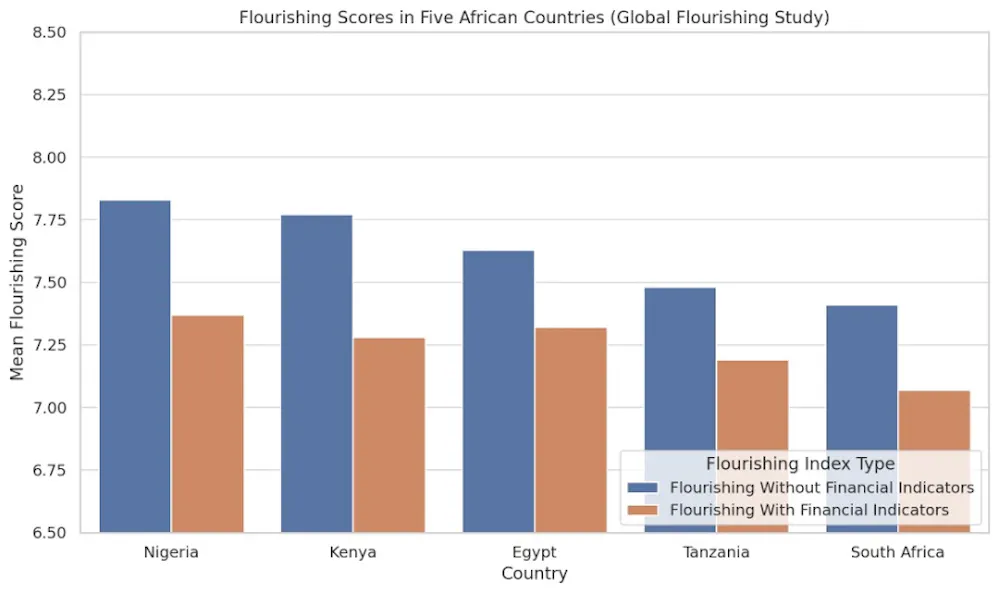
Of the 22 nations, five were African: Nigeria, Kenya, South Africa, Tanzania and Egypt.

While these countries didn’t top the global rankings (Indonesia and Mexico did), Nigeria, Kenya and Egypt all reported relatively high flourishing scores, especially when well-being was considered apart from financial status.


Courtesy Victor Counted

Nigeria, for example, ranked 5th globally in flourishing scores that excluded financial indicators – ahead of many wealthier nations. Nigerians indicated strengths in social relationships, character and virtues (like forgiveness or helping others). But potential areas of growth included financial well-being, housing, ethnic discrimination and education.

Overall, this suggests that while material resources matter, they’re not the only thing that determines well-being. Kenya ranked 7th, Egypt 10th, Tanzania 11th and South Africa 13th. Each showed unique strengths in areas like meaning, social connection or mental health.

You did a separate study on flourishing in Africa. What did you find?

In a 2024 study we analysed data from the Gallup World Poll (2020–2022) to explore 38 indicators of well-being across 40 African countries.

This study offered a more detailed and culture-sensitive picture of how Africans experience and prioritise flourishing. The dimensions explored were derived from both local and universal sources, allowing for regionally relevant insights.

We found that African populations often score high in meaning, character and social relationships – despite economic hardship. This offers an important corrective to western assumptions about well-being.

Some of our key findings were:

● There is significant diversity between and within African countries. Mauritius consistently ranked highest in life evaluations (overall satisfaction with their lives), while countries like Sierra Leone and Zimbabwe scored lowest.

● East African countries such as Rwanda and Ethiopia showed strong performance in social well-being indicators (like feeling respected or learning new things daily) even when economic indicators were low.

● Countries in West Africa, such as Senegal and Ghana, scored high in emotional well-being, with many people reporting positive daily emotions like enjoyment and laughter.

● Southern African nations, despite challenges like income inequality, displayed resilience through strong community ties and cultural practices rooted in the philosophy of ubuntu.

The results reinforced that flourishing in Africa cannot only be reduced to gross domestic product (GDP) per capita (a measure of the average economic output per person in a country) – nor to western norms of success.

What can African countries focus on to flourish?

In my view, the path to greater flourishing lies in embracing local knowledge and investing in culturally relevant development priorities. Instead of following western pathways – centred on individual advancement – Africa can model alternative flourishing pathways that reflect what matters most to African people.

1. Prioritise local knowledge systems

African ideas about a connected society – like ubuntu (southern Africa), ujamaa (east Africa), teranga or wazobia (west Africa), and al-musawat wal tarahum (north Africa) teach people to care for each other and live in peace. These values help people live meaningful lives and can inform leadership and legislation.

2. Redefine development metrics

Western development models focus on individual achievement, economic output and material consumption. GDP per capita fails to capture the everyday realities and aspirations of African communities. We should also measure things like how happy people are, how hopeful they feel about the future, how strong and resilient their communities are, and how clean, safe and dignifying their living environments are.

This is not a new idea – for years development scholars have called for a shift away from narrow economic indicators toward a focus on human dignity, agency, and the real opportunities people have to pursue the lives they value. What’s new is the growing availability of data and the momentum to take these alternative metrics seriously in shaping national policies and priorities.

3. Invest in education for character development

Quality education is essential to unlocking the continent’s potential to flourish. But Africa needs more than just academic skills and workforce readiness – it needs a strategy for intentional development of values and habits that shape how a person thinks, feels, and acts with integrity.

Part of the problem lies in how the humanities – fields like history, literature, philosophy, and religious studies – are often undervalued or underfunded in education systems. But it is precisely these disciplines that nurture moral imagination, critical reflection, and civic responsibility. We need educational models that form not just workers, but whole persons – people who can think ethically, act responsibly, and lead with character in their communities.


Read more: What makes a person seem wise? Global study finds that cultures do differ – but not as much as you’d think


What does Africa offer the world in terms of flourishing?

Africa is not waiting to be saved. Across the continent, people are building communities of care, cultivating joy amid hardship, and passing on values of unity, faith, and compassion. This is what development looks like when rooted in human dignity.

Africa flourishing goals offer an alternative vision for development – one that starts with what Africa already has, not what it lacks. These are locally emic aspirations for well-being. They are shaped by Africa’s indigenous knowledge systems, cultural values, and religious/spiritual traditions. Pursuing these goals means prioritising wholeness over wealth, community over consumption, and resilience over rescue.

The continent has so much to offer the world: wisdom, strong community values, and ways of staying resilient and living fully even in hard times. But many of these local insights are missing in the global science of well-being.

– Which African countries are flourishing? Scientists have a new way of measuring well-being
– https://theconversation.com/which-african-countries-are-flourishing-scientists-have-a-new-way-of-measuring-well-being-257458

African finance ministers shouldn’t be making bond deals: how to hand over the job to experts

Source: The Conversation – Africa – By Misheck Mutize, Post Doctoral Researcher, Graduate School of Business (GSB), University of Cape Town

Eurobonds, debts owed in a foreign currency, have become a quick and attractive way for African countries to borrow money. They are behind a sharp rise in commercial borrowing as a percentage of total external debt: it has nearly doubled from 27% in 2011 to 52% in 2020. This has increased the debt vulnerability of most African countries.

Recent developments, however, show that most of the bonds have not been structured properly. As a result, African countries are paying way over the odds relative to their sovereign risks.

Based on my bond price modelling expertise, it is my view that there are two major drivers of the mispricing of African government bonds. They are interlinked.

Firstly, a lack of expertise in debt management offices, whose job it is to negotiate the terms of any debt deals and to oversee their execution. This is a topic I explored in a recent article.


Read more: African countries are bad at issuing bonds, so debt costs more than it should: what needs to change


The second factor, which I address here, is that in many African countries, finance ministers have assumed primary responsibility for Eurobond issuance. They engage directly with investment bankers, legal advisors and credit rating agencies.

In my view they shouldn’t.

Finance ministers should stay away from debt negotiations because they are political appointees. They operate under incentives tied to electoral cycles, not fiscal sustainability. Their short tenures and desire to fund visible projects often conflict with the long-term nature of sovereign debt obligations.

They don’t have the necessary expertise to handle the technical complexity required to get the best possible deal, either.

Simply calling for ministers to step aside would ignore the institutional realities in most African countries. In particular, debt management offices have severe capacity constraints.

Nevertheless, as global financial conditions tighten and African countries seek to refinance maturing Eurobonds or issue new instruments, the risks of politicised borrowing must be minimised. Ministers should spend their energies on ensuring their debt management offices are well staffed with top quality teams. They should then leave it up to these technical staff to prepare and arrange the financing.

This would leave room for ministers to manage any disagreements between technical staff and the banks when necessary. And to close the final deal.

Ministers versus the experts

Eurobond issuance involves advanced financial engineering – pricing models, investor engagement, covenant structuring and legal compliance across jurisdictions. It takes a deep understanding of capital markets.

When debt management offices are operating at their best, they are filled with people who have this knowledge. They have a combination of financial market and public policy skills, including debt portfolio management, risk analysis and debt transaction processing.

In discussions with debt managers at the African Sovereign Debt Conference it’s become clear to me that debt managers are sidelined in the international bond issuance negotiations. They are also sidelined in the execution process, except for administrative support.

What happens instead is that finance ministers are usually key contacts of the investment bankers. By approaching a minister directly, investment bankers get to close their mandates faster.

But this minimises due diligence and bypasses internal safeguards. Ministers may not pay attention to complex legal clauses under foreign jurisdictions, details of investor negotiations and fee structures. They may accept unfavourable terms, ignore sustainability assessments and obscure fiscal vulnerabilities in pursuit of political wins and quick disbursements.

For example, in 2018, Ghana’s then finance minister was internationally lauded for financial stewardship. Ghana was the first African issuer of a longest tenure and a zero-coupon bond. A year later, the country defaulted, suggesting the bond terms weren’t great for the country. The minister nevertheless received several awards as the best and most prudent in Africa.

There is also the issue of conflicts of interest. When the same actor – in this case the finance minister – proposes, negotiates and approves a debt instrument, the system lacks accountability.

In many African countries, parliaments, audit institutions and civil society have limited understanding about the technical details of bond agreements. Ministers can easily sideline procurement rules and transparency mechanisms, resulting in non-competitive contracts and opaque fees paid to underwriters and advisors.

Investment bankers prefer this arrangement as it works in their favour.

Reforms that are needed

Before finance ministers can hand over control, debt management offices must be equipped. This requires targeted reforms, including:

  • Capacity building through strategic partnerships: African debt management offices should work with international issuing syndicates and development partners to gain first-hand exposure to structuring, pricing and marketing global bonds.

  • Human capital reforms: Governments must attract and retain highly skilled debt managers by offering competitive pay, professional development opportunities and protection from political interference.

  • Debt management offices must be staffed by dedicated quantitative analysts. They must also be equipped to use real-time market intelligence systems and formal investor relations programmes.

  • Gradual delegation: Authority can be shifted, starting with less complex debt instruments.

The role of the finance minister must evolve. Ministers should provide strategic leadership: approving borrowing strategies, ensuring alignment with macroeconomic goals, and engaging parliament and the public.

Their function should shift from operational to institutional oversight and accountability.

Structural reforms must embed the capacity, autonomy and transparency required for debt management offices to lead effectively.

In South Africa, for example, the assets and liabilities management division of the National Treasury department manages government’s annual funding programme.

Professionalising the debt issuance process is not just about avoiding technical mistakes. It’s also about creating resilient institutions that can withstand political turnover. That fosters credibility and long-term access to capital.

Ministers should remain accountable to the public, and debt management offices must do their work based on technical merit.

– African finance ministers shouldn’t be making bond deals: how to hand over the job to experts
– https://theconversation.com/african-finance-ministers-shouldnt-be-making-bond-deals-how-to-hand-over-the-job-to-experts-259017

Kenya’s police still kill with impunity – what needs to be done to stop them

Source: The Conversation – Africa – By Kamau Wairuri, Lecturer in criminology, Edinburgh Napier University

Weeks ahead of the first anniversary in Kenya of the Gen Z-led anti-government protests that resulted in at least 60 deaths and displays of police brutality, news broke that Albert Ojwang, a young Kenyan blogger, had died in police detention. Kamau Wairuri who has studied the politics of policing in Kenya, sets out why these events aren’t outliers, what efforts have been made to reform Kenya’s security forces, and what still needs to be done.

When did this all begin?

Recent events are part of a long history of police brutality in Kenya that can be traced back to colonial times.

Historians (colonial and post-colonial Kenya) such as David Anderson and Caroline Elkins present gruesome details of how state authorities brutalised indigenous Africans during colonial times.

The colonial origins of the police – largely modelled along the approaches of the Royal Ulster Constabulary known for its brutality in Ireland – partly explains why Kenya’s policing is the way it is. The police force was never designed for service. It was designed to safeguard the interests of the white minority ruling elite.

While there have been important changes in the architecture of policing since independence, subsequent post-colonial Kenyan regimes have adopted the same brutal approaches to stay in power. My previous work demonstrates this use of state security apparatuses to enhance the capacity of incumbents to crack down on opposition protests.

The brutal policing experienced under the current Kenya Kwanza regime falls within this broader historical trajectory.

The ruling elite see and use the police as their last line of defence against challenges to their misrule.

But police brutality goes beyond the policing of politics to everyday crime control. Police violence is a common occurrence, especially against poor young men.

What’s changed

Kenya’s history has been marked by strong agitation for justice and reform. Again, this goes back to colonial times.

There have been important legal and institutional changes since independence. The most important was the disbandment of the Special Branch in 1998, an intelligence unit of the police responsible for political repression. It was replaced by the National Security Intelligence Service. This then became the National Intelligence Service.

The most important changes came about through the constitutional reform of 2010. This saw a change in the architecture of the police, including:

Internal Affairs, a unit within the police service, is supposed to investigate police misconduct. The policing oversight agency is a civilian-led institutions with a similar mandate. Ideally, the two institutions should work together in executing crucial investigations. Internal affairs should provide access to information from within the police service that would be difficult for outsiders to access.

The National Police Service Commission was set up to handle the management of personnel. It’s mandated to address the challenges of corruption, nepotism and negative ethnicity that have characterised recruitment into the police service.

But it’s clear from the continued police brutality that these institutions aren’t achieving the intended effect. This means that police officers can expect to continue acting with relative impunity despite the control measures in place.

What still needs to be done

Policing is often imagined as the investigation of crimes, arresting suspects, and presenting them to court for prosecution and punishment if guilty. In Kenya, the actions of the police often appear to substitute for the entire criminal justice system.

In many cases, officers go beyond the metaphor of judge, jury and executioner to also become the complainant, mortician and undertaker. For instance, Mbaraka Karanja died in police custody in 1987 and officers proceeded to incinerate his body.

In my view, the brutality won’t end until the following steps have been taken.

First, the National Police Service Commission needs to reclaim its mandate. It seems to have completely abdicated duty, transferring crucial responsibilities back to the inspector general of the police service. As the human resource unit of the police, the commission has an important role of professionalising the service and maintaining discipline. It’s presently not doing so.

Second, the Internal Affairs Unit needs to be strengthened and given more autonomy. So far, it has been difficult to assess the effectiveness the unit given the secrecy that characterises the police service. A better-resourced unit will enhance investigations of police misconduct. It would unearth obscure squads within the police service and reveal evidence to help identify perpetrators.

Third, the Independent Policing Oversight Authority needs to defend its independence and develop popular legitimacy. With its limited success in prosecuting police officers – despite the prevalence of police abuse – many Kenyans have lost confidence in it. Crucially, the authority has failed in it’s deterrence role.

Fourth, the independence of the National Police Service needs to be safeguarded. The police service leadership continues to serve at the pleasure of the prevailing regime. This in turn shapes the priorities of the service. Inspectors-general have been forced to resign. President William Ruto confessed to having fired the director of criminal investigations when he took power. Ruto had initially claimed that the director had resigned.

Crucially, and in fifth place, there needs to be a change in policing culture alongside broader governance culture in Kenya. Impunity is rampant across the public service. Kenya won’t have a highly accountable police force while other agencies and senior officials are operating with significant impunity.

Identifying the levers of cultural change isn’t easy. There are many proposals to alter policing culture. These include a complete redesign of Kenya’s Penal Code to dislodge its colonial roots, transforming the training of police officers, and strengthening the policing oversight authority’s capacity to investigate cases.

But, in my mind, a crucial starting point is citizen agitation and demand for accountability. The light that Gen Z protesters, the media and civil society organisations are shining on police abuses should be encouraged. A clear signal that Kenyans will no longer tolerate police abuse is crucial for culture change within the service and among the political elite.

However, this needs to be understood within the reality that many Kenyans support police violence, believing it to be the most effective way of dealing with crime as my earlier research demonstrates. In another study, I note how police abuse is endorsed by politicians and religious leaders as a way of responding to crime and punishing groups of people they don’t like.

Combined with ineffective accountability mechanisms, this popular support for police violence, both tacit and explicit, gives the police the belief that they are the thin blue line between order and chaos. That they have the popular mandate to use any means they consider necessary – often brutal violence – to keep society safe.

In other words, the conversation on police reform requires a fundamental reframing to kick start the journey towards democratic policing. At present, we’re not only way off the mark, we seem to be heading in the wrong direction.

– Kenya’s police still kill with impunity – what needs to be done to stop them
– https://theconversation.com/kenyas-police-still-kill-with-impunity-what-needs-to-be-done-to-stop-them-259326