Action humanitaire en République Centrafricaine (RCA) : entre progrès sécuritaires et manque de ressources

Source: Africa Press Organisation – French


Bangui a abrité, le 19 août 2025, une conférence-débat marquant la Journée mondiale de l’aide humanitaire, sur le thème « Action humanitaire en RCA au défi des ressources ». L’objectif était de sensibiliser l’opinion publique et de mobiliser un soutien accru à l’action humanitaire. L’événement a réuni des médias, des représentants de la société civile, des étudiants, des acteurs humanitaires locaux et internationaux, ainsi que des partenaires, dont la MINUSCA.

La Journée mondiale de l’aide humanitaire vise à dénoncer la banalisation des attaques contre les civils et les humanitaires, et à rappeler l’obligation de protection inscrite dans le droit international. Les participants ont appelé le gouvernement et les parties au conflit à garantir la sécurité des populations, du personnel humanitaire et des infrastructures essentielles.

Une situation en amélioration, mais encore fragile

D’après la Coordination humanitaire en République centrafricaine, 2,4 millions de personnes, soit 37,5 % de la population, demeurent extrêmement vulnérables en 2025. Ce chiffre, en baisse par rapport à 2024, reflète une amélioration progressive de la sécurité dans certaines localités.

« La situation humanitaire s’est améliorée grâce aux efforts conjoints du gouvernement et de ses partenaires, notamment la MINUSCA, qui œuvre à restaurer l’autorité de l’État », a indiqué Georgine Ouaby, chargée de mission au ministère de l’Action humanitaire. Elle a toutefois rappelé que les besoins restent criants dans plusieurs régions, en raison des attaques armées et des chocs climatiques.

Hommage aux humanitaires

Les humanitaires continuent d’opérer dans un contexte difficile marqué par des attaques contre les centres de santé et d’autres infrastructures vitales, limitant l’accès des populations aux services essentiels. Malgré cela, 548 000 personnes vulnérables ont reçu une assistance humanitaire au premier semestre 2025.

« Je tiens à rendre hommage à ces hommes et femmes qui se dévouent pour venir en aide aux plus vulnérables, dans la neutralité et l’impartialité », a déclaré Marie Roseline Bélizaire, coordonnatrice humanitaire par intérim pour la RCA. Elle a salué leur engagement dans un pays où les risques demeurent élevés pour les travailleurs humanitaires.

Le défi des ressources

L’un des sujets majeurs de la conférence a été la réduction des financements humanitaires. Le retrait de l’aide américaine, qui représentait près de 50 % de la réponse en 2024, a fortement impacté les capacités d’intervention.

Pour 2025, la communauté humanitaire estime avoir besoin de 326,1 millions de dollars pour venir en aide à 1,8 million de Centrafricains vulnérables, avec des priorités dans les secteurs de l’eau, de l’hygiène, de l’assainissement, de la sécurité alimentaire et de la santé.

La MINUSCA, conformément à son mandat, apporte un soutien à l’acheminement immédiat, complet, en toute sécurité et sans entrave de l’aide humanitaire.

Distribué par APO Group pour United Nations Multidimensional Integrated Stabilization Mission in the Central African Republic (MINUSCA).

Angola launches strategic initiative to strengthen public health communication

Source: APO – Report:

.

The Ministry of Health (MOH), the World Health Organization (WHO), and the United Nations Children’s Fund (UNICEF), with the support of the European Union, will hold a national training session on August 20 at the Journalist Training Center (CEFOJOR) dedicated to the role of the media in managing public health crises. 

The initiative will bring together journalists, institutional communicators, and strategic partners to reflect on the challenges of public health in Angola and reinforce the fundamental role of communication in saving lives, promoting healthy behaviors, and combating misinformation. 

This meeting marks the beginning of a joint effort to create the Health Communication Network in Angola, a collaborative platform that aims to strengthen the link between the media, health authorities, and international partners, promoting a more effective and coordinated response to health emergencies. 

In a context where Angola faces persistent challenges such as maternal and infant mortality, epidemic outbreaks, and the impacts of climate change, clear, accessible, and fact-based communication becomes a fundamental pillar of public health. The right information at the right time can make the difference between risk and protection, between doubt and confidence. 

The training will have around 60 participants, including professionals from public and private organizations, international correspondents, and institutional communicators. The program will include practical sessions, debates, and the sharing of tools to improve the quality and accountability of journalistic coverage of health issues. 

Through this initiative, the partners reaffirm their commitment to a more informed, healthier Angola that is better prepared to face current and future health challenges. 

– on behalf of World Health Organization (WHO) – Angola.

Once Rescued, Now a Rescuer

Source: APO – Report:

Found as a newborn by a vet in Kenya and adopted by a family from the UK, 31-year-old occupational therapist Becky Chaplin has come full circle. Today, she leads rehabilitation service on board the Global Mercy™, the world’s largest purpose-built civilian hospital ship operated by international charity Mercy Ships (MercyShips.org).

Becky’s story is one of resilience, identity, and service. Found abandoned and still attached to her umbilical cord, she was saved by a passing veterinarian and adopted at 7 weeks old by a British missionary couple.

“Mum said when she picked me up, she felt God was saying ‘this is your daughter,’” Becky said with a proud smile. “I’m Kenyan by birth but British by adoption.”

Raised between Kenya and the UK, she embraces her dual heritage and uses her unique perspective to bridge cultures in her work.

“Living in Kenya, I saw both sides,” she shared. “I was exposed to extreme poverty and the opportunities you can have with education. I was fortunate to be adopted into a family that gave me that opportunity.”

She received her early education in both countries, experiencing two school systems. At 10 years old, her family moved to the UK, where she continued her studies.

“I think I’ve got both cultures in me. I can relate to more than one group of people from different cultures.”

That awareness fueled her decision to become an occupational therapist. After working in UK hospitals, including in burn and hand therapy, Becky felt called to volunteer her skills abroad. In 2023, she joined Mercy Ships for a three-month sabbatical in Senegal.

“I absolutely loved it. I loved being back in an African country with people that look like me,” she said.

Today, as Rehabilitation Team Leader aboard the Global Mercy, Becky is part of a multinational volunteer crew providing free surgeries and medical training to help strengthen local healthcare systems. She leads post-operational rehabilitation for patients recovering from life-changing procedures; many of whom are children with server burns or congenital conditions.

Many patients have left a lasting impression on Becky. One of them is a 10-year-old girl from Senegal who had a contracture. “She made me work hard to disguise all the exercises within games,” said Becky. “So, we painted, drew, and stuck things up on the wall. That was impactful because it wasn’t easy. But there was a joy and satisfaction when we were able to get the movements that we wanted.”

As the Global Mercy embarks on its next chapter in Sierra Leone, Becky’s story embodies the mission of Mercy Ships, to bring hope and healing where it’s needed most.

To anyone contemplating service with Mercy Ships, Becky’s advice is simple: “If you want something that’s enriching, pushes you, and grows you, then it’s for you. You’re not just giving, you also learn a lot and receive a lot. I’d say, just step out in faith and you won’t be disappointed.”

– on behalf of Mercy Ships.

For more information about Mercy Ships, contact:
Email: International.media@mercyships.org   

ABOUT MERCY SHIPS:    

Mercy Ships operates hospital ships that deliver free surgeries and other healthcare services to those with little access to safe medical care. An international faith-based organization, Mercy Ships has focused entirely on partnering with nations in Africa for the past three decades. Working with in-country partners, Mercy Ships also provides training to local healthcare professionals and supports the construction of in-country medical infrastructure to leave a lasting impact. Each year, more than 2,500 volunteer professionals from over 60 countries serve on board the world’s two largest non-governmental hospital ships, the Africa Mercy® and the Global Mercy. Professionals such as surgeons, dentists, nurses, health trainers, cooks, and engineers dedicate their time and skills to accelerate access to safe surgical and anesthetic care. Mercy Ships was founded in 1978 and has offices in 16 countries as well as an Africa Service Center in Dakar, Senegal. For more information, visit MercyShips.org and follow @MercyShips on social media.  
 

Media files

.

Sauvée et sauveuse à la fois

Source: Africa Press Organisation – French

Trouvée à sa naissance, au Kenya, par un vétérinaire et adoptée par une famille britannique, Becky Chaplin, ergothérapeute de 31 ans, a bouclé la boucle. Aujourd’hui, elle dirige le service de rééducation à bord du Global Mercy, le plus grand navire-hôpital civil au monde, exploité par l’organisation humanitaire internationale Mercy Ships (MercyShips.org). 

L’histoire de Becky est celle de la résilience, de l’identité et de l’amour de son prochain. Abandonnée alors qu’elle était encore attachée à son cordon ombilical, elle a été sauvée par un vétérinaire de passage puis adoptée à l’âge de 7 semaines par un couple de missionnaires britanniques.

« Maman m’a dit que lorsqu’elle m’a prise dans ses bras, elle a senti que Dieu lui disait ‘C’est ta fille’, raconte Becky avec un sourire fier. « Je suis kenyane de naissance, mais britannique d’adoption. »

Élevée entre le Kenya et le Royaume-Uni, elle assume pleinement sa double identité qu’elle met à profit dans son travail en rapprochant les deux cultures.

« En vivant au Kenya, j’ai vu les deux facettes », confie-t-elle. « J’ai été confrontée à l’extrême pauvreté d’une part, et aux opportunités que peut offrir l’éducation d’autre part. Ma famille d’adoption m’a donné cette chance. »

À l’âge de 10 ans, sa famille a déménagé au Royaume-Uni, où elle a poursuivi ses études. 

« Je pense que j’ai les deux cultures en moi. Je peux m’identifier à des groupes de personnes de cultures différentes. »

Son parcours insolite a poussé Becky  à travailler dans le secteur médical, où elle a exercé dans des hôpitaux britanniques, notamment dans le domaine des brûlures et de la thérapie de la main.  Elle a ressenti le besoin de mettre ses compétences au service d’une cause à l’étranger. En 2023, elle a rejoint Mercy Ships pour un congé sabbatique de trois mois au Sénégal. 

« J’ai adoré cette expérience et j’ai adoré retourner dans un pays africain avec des gens qui me ressemblent », témoigne-t-elle. 

Aujourd’hui, en tant que responsable de l’équipe de rééducation à bord du Global Mercy, Becky fait partie d’un équipage multinational de bénévoles qui fournit des opérations chirurgicales gratuites et des formations médicales pour renforcer les systèmes de santé locaux. Elle dirige la rééducation postopératoire des patients qui se remettent d’interventions, dont beaucoup sont des enfants souffrant de brûlures graves ou de malformations congénitales. 

De nombreux patients ont laissé une impression forte à Becky. L’un d’eux est une fillette sénégalaise de 10 ans qui souffrait d’une contracture. « Elle m’a donné beaucoup de fil à retordre pour dissimuler tous les exercices dans des jeux », raconte Becky. « Nous avons donc peint, dessiné et collé des choses sur le mur. Ce n’était pas facile, mais la satisfaction est immense lorsque nous avons réussi à obtenir les mouvements souhaités. »

Alors que le Global Mercy entame sa troisième visite consécutive en Sierra Leone, l’histoire de Becky incarne la mission de Mercy Ships, apporter espoir et guérison aux plus démunis.

À tous ceux qui envisagent de s’engager auprès de Mercy Ships, Becky donne un conseil simple : « Si vous voulez vivre une expérience enrichissante, qui vous pousse à vous dépasser et vous fait grandir, alors venez nous rejoindre. Vous ne faites pas que donner, vous apprenez aussi beaucoup et recevez énormément en retour. Je vous dirais simplement : lancez-vous avec confiance, vous ne regretterez pas. »

Distribué par APO Group pour Mercy Ships.

Pour plus d’informations sur Mercy Ships, veuillez contacter :
Email: International.media@mercyships.org   

À PROPOS DE MERCY SHIPS :
Mercy Ships est une organisation humanitaire internationale qui déploie les deux plus grands navires-hôpitaux civils au monde, l’Africa Mercy et le Global Mercy, pour fournir des soins de santé gratuits et de première qualité aux plus démunis. L’ONG internationale soutient également le développement des systèmes de santé des pays hôtes par la formation des professionnels de la santé et la rénovation d’infrastructures. Fondé en Suisse en 1978 par Don et Deyon Stephens, Mercy Ships est intervenu dans 55 pays. A bord de ses navires, une moyenne de 2 500 bénévoles par an, issus de 60 pays, contribuent à l’œuvre de Mercy Ships. Des professionnels tels que chirurgiens, dentistes, personnel infirmier, formateurs dans le domaine de la santé, cuisiniers, marins, ingénieurs et agriculteurs dédient leur temps et leurs compétences à cette cause. Avec des bureaux dans 16 pays et un Centre opérationnel pour l’Afrique basé à Dakar, au Sénégal, Mercy Ships se met au service des nations en restaurant santé et dignité.
Rendez-vous sur MercyShips.org et suivez @MercyShips sur les réseaux sociaux. 

Media files

Hype and western values are shaping AI reporting in Africa: what needs to change

Source: The Conversation – Africa – By Sisanda Nkoala, Associate professor, University of the Western Cape

News media shape public understanding of artificial intelligence (AI) and influence how society interacts with these technologies. For many people, especially those who have not sought more knowledge about AI elsewhere, media platforms are a primary source of information.

This is particularly significant in Africa, where historical and socioeconomic contexts like colonial legacies and uneven technology transfer shape how AI is understood and adopted.

Consequently, the way African news media represent and frame AI carries weight in shaping broader public discourse.

To explore how African media report on AI, we, as media researchers, analysed 724 news articles about AI from 26 English-speaking African countries. These were published between 1 June 2022 and 31 December 2023. We looked at how these publications contributed to the hype about AI – exaggerated excitement, inflated expectations, and often sensationalised claims about what artificial intelligence can do.

Hype is often contrasted with the notion of something called an AI winter. This is a period of diminished interest and investment in AI technologies. It’s a cyclical trend that has been seen since AI’s inception in the 1950s. It manifests in exaggerated language, overly optimistic or pessimistic views and significant investments in AI.

Our study examined how AI was portrayed in African news media – whether it was exaggerated or overly optimistic. Media portrayal can influence policy, investment and public acceptance of new technologies. For example, in Germany it was found that positive media coverage of different fuels changed public perception in a positive way.

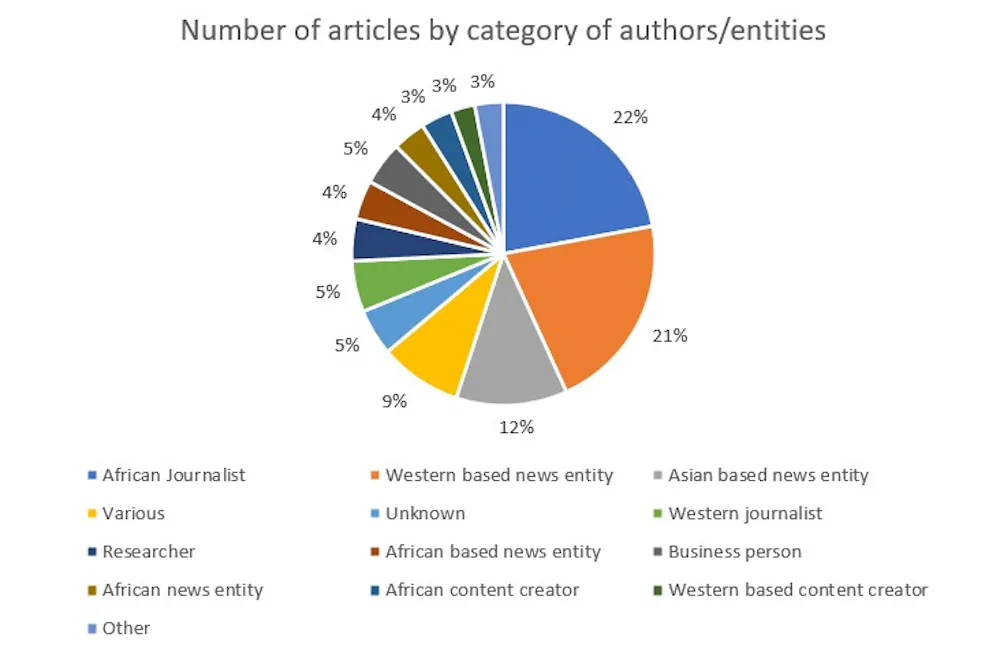
Our findings show a clear pattern in placement and authorship of articles. The most common placement of AI articles (36%) was in the technology section of publications, followed by general news (24%) and then the business section (19%). This shows that these publications mostly talk about AI as a practical tool that can solve problems and create economic opportunities. They highlight its usefulness and potential benefits, rather than exploring its social or ethical implications. Discussion of issues like employment, inequality and cultural values was largely missing.

African journalists, news entities and content creators contributed some 29% of the articles. But western-based news entities (21%) and journalists (5%) had a considerable influence. Global news agencies like AFP (15%) and Reuters (6%), along with tech news providers like Research Snipers (13%), frequently wrote these pieces.

Only a small proportion of articles (4%) were written by researchers. This suggests that the voices of those directly engaged in AI research and development in Africa were muted. But they are crucial for a locally informed understanding.

To sum up the patterns:

  • practical benefits of AI are emphasised at the expense of social and ethical conversations

  • African perspectives on how AI should be developed and used are often overlooked in favour of a western, business-focused viewpoint.

Supplied

What words are used to describe AI?

We also analysed the words used most frequently. The frequent mention of Google, Microsoft and ChatGPT reflects the dominance of western tech giants in the AI landscape. Words like “he” and “his” appeared disturbingly frequently, while feminine pronouns weren’t among the top words. This indicates a bias towards male perspectives.

The scarcity of terms like Africa, African and African countries suggests that the coverage seldom regards specific African needs and challenges. This overlooks Africa’s growing AI ecosystem.

Supplied

We found three main themes around AI in African news:

  • AI’s transformative potential, for example for agriculture, administration, healthcare and economic growth

  • concerns about AI’s potential negative effects, the unknown and disruptive nature of AI

  • articles that offered a more balanced view and useful information, aiming to demystify AI tools and explain developments.

What this means for Africa

The dominance of technical and economic framing, often by western voices, might steer policy decisions towards uptake without adequate local consultation or ethical oversight. This might lead to policies that mirror global hype rather than community-specific needs.

The overemphasis on “tools” and “solutions” risks overlooking the broader effects of AI on employment, inequality and cultural values.

The lack of Afrocentric terms in the reporting contributes to a symbolic exclusion, where Africa’s specific needs and opportunities are marginalised.

Towards a more inclusive AI narrative

To encourage a more responsible and locally relevant AI journalism in Africa, African journalists and researchers should be empowered to report on and analyse this technology.

The range of voices should expand to include local researchers, policymakers and communities experiencing AI’s effects firsthand. This means balancing coverage of AI’s economic potential with sustained attention to its social, cultural and ethical implications. African media can resist one-dimensional hype and create a more inclusive and socially responsible conversation around AI.

– Hype and western values are shaping AI reporting in Africa: what needs to change
– https://theconversation.com/hype-and-western-values-are-shaping-ai-reporting-in-africa-what-needs-to-change-262551

Cameroon’s conflict is part of a bigger trend: negotiations are losing ground to military solutions

Source: The Conversation – Africa – By Jacqui Cho, PhD Fellow, swisspeace Mediation Program, University of Basel

In central Africa, a violent conflict has been unfolding for nearly eight years. What began in 2016 as peaceful protests by lawyers and teachers against the increasing “francophonisation” of the legal and education systems in Cameroon’s anglophone regions quickly escalated into an armed conflict between separatist groups and government forces.

It has come at a devastating human cost. With both sides of the civil war using education as a weapon, over 700,000 children have been forced out of school since 2017. By October 2024, the conflict had resulted in more than 6,500 deaths and displaced over 584,000 people internally. More than 73,000 have been forced to seek refuge in neighbouring Nigeria.

Yet Cameroon’s government has refused meaningful negotiations. Though a key party to a conflict that remains unquestionably unresolved, Yaoundé insists that the situation is under control. In practice, it has pursued a dual strategy of military repression paired with a façade of dialogue. Behind the scenes, it has quietly stalled and derailed authentic efforts for peace.

Why has Yaoundé been able to avoid a peace settlement with so little international backlash? I sought answers as part of my PhD research in mediation, focused on the conflict in Cameroon.

In an era of revived rivalry between great powers, Cameroon has learned to navigate and exploit the interests of competing global actors. Western governments, eager to keep Cameroon within their sphere of influence and fearful of growing Russian and Chinese engagement, have not applied pressure for peace. Pushing hard for negotiations would risk jeopardising relations with Yaoundé – an outcome western capitals are keen to avoid.

Cameroon’s case reveals a broader trend. Across Africa and beyond, the post-cold war norm of resolving political conflicts through negotiation is losing ground. In its place, a militarised approach is becoming increasingly common. Global powers are tolerating, even encouraging, forceful approaches. This is particularly true when the regimes in question serve, or help protect, their respective strategic interests. This shift is quietly reshaping the rules of conflict resolution, with serious implications for peace and democracy.

Calculated defiance of dialogue

Between 2019 and 2022, Switzerland attempted to facilitate peace talks between the Cameroonian state and various separatist groups. The process failed, largely due to the Cameroonian government’s aloofness and lack of commitment. When the Swiss initiative was quietly shelved, there was little international backlash.

Cameroon’s ability to walk away from the facilitation effort, while escalating military operations, was a result of its diplomatic manoeuvring within the Franco-Russian rivalry. By signing a military deal with Russia in April 2022, Cameroon signalled to France and others that it had diplomatic options. This move reportedly shifted France’s stance to one of allowing Yaoundé to do as it pleased, as long as it remained within the French sphere of influence. The French president’s visit to Cameroon just months afterwards reinforced the idea that strategic relationships would take precedence over conflict resolution or democratic norms.

Cameroon has also cultivated a circle of “quiet enablers” over decades. Its strong relations with states as diverse as the US, China, Israel and Japan have similarly provided tacit support as Yaoundé took a more militarised approach and have shielded it diplomatically.

Global drift towards force

The anglophone crisis in Cameroon illustrates a troubling global development. While negotiated settlements were the dominant, or preferred, model for resolving conflicts in the post-cold war era, today that model is under threat.

This challenge to the norm of negotiated settlements stems from various sources. On the one hand, changes within so-called liberal western states, particularly since the “global war on terror”, have led to a renewed emphasis on security, sometimes at the expense of liberal democratic principles. This has generated greater tolerance for authoritarian regimes and tacit acceptance of the use of force.

On the other hand, rising powers like Russia and China are promoting alternative models of conflict management. They favour approaches that empower strong states to maintain peace, even through the use of force. Russia, for example, views its military engagements in Syria as a form of “peacemaking”. It prioritises order over justice. China’s model for peace similarly focuses on building a strong central state.

African states are far from passive observers in this evolving landscape. Drawing on experiences from the eras of empire and the cold war, African states are looking to further their own interests both domestically and internationally.

It’s not just global powers objectifying Africa. It is also about African actors strategically playing the game because they benefit.

Elections and the stakes for democracy and governance

With a presidential election looming in October 2025, the stakes for Cameroon’s democracy, governance and peace could not be clearer. At the age of 92, President Paul Biya has formally announced his candidacy for an eighth term.

Opposition parties describe a system already rigged against them, with reported incidents of harassment and intimidation. The ongoing conflict in the anglophone areas is expected to make voting harder, if not impossible. This is a situation that will likely favour Biya.

The regime’s ability to defy calls for dialogue is emboldened by geopolitical cover and a fragmented opposition. It raises the risk of a militarised status quo being mistaken for stability. Everyday violence, kidnappings, and killings – especially in rural areas – have become normalised, with little international outcry. The regime continues to pursue its strong-arm tactics without concerns about international repercussions.

Dangerous precedent

The case of Cameroon’s anglophone crisis is emblematic of a broader, worldwide struggle between a negotiations-oriented model and a militarised approach to ending violent political conflicts. The erosion of the norm of negotiated settlement, coupled with the increased agency of African states to withstand external pressure, brings an additional challenge to an already difficult process of encouraging conflict parties to come to the table.

Cameroon shows how global silence and strategic use of the geopolitical environment can give rise to and legitimise conflict resolution through brute force. Without a renewed commitment to inclusive dialogue and political settlements, the precedent being set today may shape the conflict management of tomorrow across Africa and beyond.

– Cameroon’s conflict is part of a bigger trend: negotiations are losing ground to military solutions
– https://theconversation.com/cameroons-conflict-is-part-of-a-bigger-trend-negotiations-are-losing-ground-to-military-solutions-261697

Young South Africans don’t bother with elections: would lowering the voting age make a difference?

Source: The Conversation – Africa – By Dirk Kotze, Professor in Political Science, University of South Africa

South Africa is due to hold local government elections in 2026. In the last election in 2021, only 15% of the eligible voters aged 18 to 21 registered for the election. In view of this, it’s worth considering whether the minimum voting age of 18 years should be reduced to increase participation.

What are the main driving forces for such a consideration? Based on international comparisons, how advisable would it be? What would be some of the implications of such a change for elections in South Africa?

The South African constitution does not state explicitly that the voting age is 18 years, but it is implied. Section 1(d) entrenches the constitutional principle of universal adult suffrage. Section 19(3) says “every adult citizen has the right (a) to vote in elections of any legislative body and (b) to stand for public office”.

The legal description of an adult is found in South African common law. At the age of 18 years, a person becomes legally an adult or reaches the age of majority.

The South African Electoral Act, as amended in 2003, provides that a person can register as a voter at the age of 16 years but the name can be placed on the voters’ roll only once the applicant becomes 18 years old.

South Africa’s current dispensation is currently the same as those of most countries in the world.

The United Arab Emirates is the state with the oldest minimum voting age: 25 years. In the following states it is 21 years: Singapore, Lebanon, Oman, Kuwait, Samoa and Tonga. Three of them (plus the UAE) are in the Middle East. All seven of these are very small states and the majority of them are not democratic.

By far the majority of state entities (202 in total) use 18 years as the minimum voting age. Indonesia, North Korea and Greece, on the other hand, decided on 17 years as the voting age, while in Brazil, Argentina and Ecuador it is 16 years.

Lowering of the voting age is not an uncontested idea. A number of considerations can be presented as its pros and cons. The general contention is that if a larger proportion of the population elects their public representatives, it would enhance public trust in elections. But, in South Africa at least, that is offset by young people’s lack of enthusiasm in elections.

For the moment, a change in the voting age would most possibly not add major advantages to South Africa’s electoral dynamics, because it would not necessarily increase the number of voters or change the outcome of elections.

Main considerations

Voting for a political candidate is one of the most important decisions a citizen of a state can make. What determines sound decision-making?

A person should understand what the decision is about: what the issues are and what the options and their implications are. The question therefore is: at what age would a person make rational voting decisions?

In the era of populism, fake news and manipulation, a voter should be a person who can think independently, who can distinguish between reliable and misleading information and be strong enough not to be manipulated.

A voter should also have a vested interest in the future of their country and therefore participate in voting to determine what is in the best interest of that country. An illustration of this point is the 26th amendment of the American constitution in 1971 when the voting age was reduced from 21 to 18 years. The decision was influenced by the apparent contradiction that 18-year-old American citizens were drafted to fight in the Vietnam war while they were still excluded from voting.

But how well a person is informed about politics or the issues in a country isn’t determined by age. Especially in the era of easily accessible internet information and the different forms of social media. This implies that knowledge of the issues or politics in general is not a sufficient motivation for lowering the voting age.

The critical factor is how that information is used to take an informed and rational decision.

The rationale of why minors need guardians who must assist them in decision-making is that they do not have yet the life experience and judgement abilities to take the responsibility for a decision on their own. Voting is an individual and independent action and therefore no assistance in the decision-making process can be allowed.

Implications

Do 16- or 17-year-old people have a different attitude towards elections or politics in general than 18-year-olds?

In the absence of survey data, an informed guess is: no.

Adding them would not necessarily change the outcomes of elections. The minority Economic Freedom Fighters party in South Africa is the only one that has a strong appeal to young voters. But it has been losing support.

How many new registered voters could be added by 16- and 17-year-old newcomers? Statistics SA provides figures only for the age bracket 15-19, which is slightly more than 9% of the total population. The age group 16-17 years therefore might be around 3%-4% of the population. Given the trends of low voter registration among the young eligible voters, the percentage it would add to the total might therefore be quite small.

If the 16-17-year bracket were to be added to the electorate, the total number of eligible voters would increase but because the rate of registration as voters is in decline, the total percentage of registered voters would most possibly decrease. Young eligible voters are proportionally less likely to register than their older counterparts.

With a decline in the voting age, voter turnout based on the number of registered voters might not decrease dramatically. The main difference would be seen in the voter turnout as a percentage of the eligible voters, because of the low level of young eligible voters who are willing to register as voters.

Probably an unintended consequence of a 16-year voting age is that school pupils would be eligible voters during the last two or three years of their school studies. This has the potential to politicise schools, especially during election times. Political parties might insist on campaigning at schools.

At the same time, it would be an opportunity for more concentrated civic and voter education of a captured audience. Following this argument, a registered voter who complies with the constitution’s section 47 could stand as a candidate and be elected as a public representative in a legislature.

For now, the chances are slim that the voting age will change at a time when several other electoral reform processes are in the pipeline affecting the electoral system, party funding and even electronic voting.

– Young South Africans don’t bother with elections: would lowering the voting age make a difference?
– https://theconversation.com/young-south-africans-dont-bother-with-elections-would-lowering-the-voting-age-make-a-difference-262818

South Africa: Minister Dion George welcomes arrest of international rhino horn syndicate

Source: APO – Report:

.

  • After a seven-year investigation, the Wildlife Trafficking Section of the Serious Organised Crime Investigation Unit has dismantled a major transnational rhino horn trafficking network.
  • The syndicate is linked to a fraudulent scheme involving 964 rhino horns, worth millions of rands, destined for illegal markets in Southeast Asia.
  • Six suspects, between the ages of 49 and 84, face charges of fraud, theft, and contravention of the National Environmental Management: Biodiversity Act (NEMBA) of 2004, with additional charges of racketeering and money laundering under consideration.

The Minister of Forestry, Fisheries and the Environment, Dr Dion George, has hailed the arrests as a decisive victory in South Africa’s fight against international wildlife crime.

“This complex investigation, which was also supported by the Enforcement unit of the Department (the Green Scorpions) and the National Prosecuting Authority, is a powerful demonstration of South Africa’s resolve to protect its natural heritage,” said Minister George. “The Hawks’ work shows that our enforcement agencies will not hesitate to pursue those who plunder our wildlife for criminal profit. The illegal trade in rhino horn not only destroys biodiversity but also undermines the rule of law and the foundations of environmental governance.”

Investigations reveal that the suspects allegedly defrauded the Department of Forestry, Fisheries and the Environment by securing permits under false pretences to buy and sell rhino horns domestically, while funnelling them into illegal international markets. Under South African law, domestic trade is permitted with valid DFFE-issued permits in terms of NEMBA. International commercial trade in rhino horn is banned under the Convention on International Trade in Endangered Species of Wild Fauna and Flora (CITES).

The six suspects, five men and one woman, surrendered to the Hawks at Sunnyside Police Station and appeared before the Pretoria Magistrates’ Court on 19 August 2025.

Dr George added: “Let there be no doubt: South Africa will bring the full force of its laws against those who plunder our wildlife. This arrest proves that syndicates cannot escape justice, no matter how complex their schemes.”

– on behalf of Republic Of South Africa: Department of Forestry, Fisheries and the Environment.

World Humanitarian Day: African Union (AU) Commission Chairperson Pays Tribute to Humanitarian Workers

Source: APO – Report:

.

On World Humanitarian Day, the Chairperson of the African Union Commission, H.E. Mahmoud Ali Youssouf, honoured the courage and sacrifice of humanitarian workers in Africa and across the world.

“Every day, in the most dangerous conditions, humanitarian workers save lives, ease suffering, and protect human dignity. They represent the very best of our shared humanity,” said the Chairperson.

The Chairperson noted that Africa and the wider world face overlapping crises – protracted conflicts, the accelerating climate emergency, food insecurity, shrinking humanitarian resources, and mounting pressure on the multilateral system. “These converging challenges are compounding vulnerabilities and testing the limits of our collective response,” he stressed.

He called for renewed global solidarity, stronger multilateral partnerships, and predictable, sustainable investment in resilience, prevention, and peace. “Humanitarian action must be backed by political will, grounded in international humanitarian law, and complemented by efforts to tackle the root causes of crises,” he added.

On this day of reflection and recommitment, the African Union stands shoulder to shoulder with humanitarian actors worldwide. “Protecting life and dignity is not just a collective responsibility—it is the moral imperative of our time,” the Chairperson conclude.

– on behalf of African Union (AU).

South Africa: President Ramaphosa arrives in Japan to participate at the 9th Tokyo International Conference on African Development Summit

Source: APO – Report:

.

President Cyril Ramaphosa has today, 19 August 2025, arrived in Japan to lead South Africa’s High Level Delegation participation to the 9th Tokyo International Conference on African Development Summit (TICAD9).

TICAD9 Summit will convene in Yokohama from 20 – 22 August 2025 under the theme “Co-creating Innovative Solutions With Africa”. The Summit is underpinned by (3) Plenary Sessions, which illustrate established areas of cooperation between the African Union and Japan, namely: 

i) Society: Realising a Sustainable Future; 
ii) Economy: Promoting Trade and Investment; 
iii) Peace and stability: Ensuring Human Dignity and Human Security.

The 9th TICAD Summit takes place at a time of unprecedented threats to global peace and security, ongoing conflicts in some regions of the world, distortions and disruption to global trade and a concerning revision by some states to unilateral action at a time when multilateralism and collective solutions to common challenges is crucial.

Rising fuel, food and energy prices have severely impacted developing countries, entrenching poverty and fuelling higher levels of inequality in the face of constrained employment and job opportunities. The debt and liquidity crisis on the African continent is worsening the challenging socio-economic environment and constraining the fiscal space for governments to cast a safety net over its citizens. The AU discussions with the government of Japan under the auspices of TICAD presents an opportunity for the two sides to engage in discussions that seek to foster collective solutions to these challenges.

South Africa, as a Member State of the AU, will prioritise support from the government of Japan for the Second Ten-Year Implementation Plan (STYIP) of Agenda 2063: The Africa We Want, especially in the priority areas of infrastructure development, peace and security, and health.

President Ramaphosa will advance South Africa’s Presidency of the G20 and pursue bilateral economic engagements with the government of Japan with a view to strengthening trade and investment ties between South Africa and Japan.

The 2025 year marks 115 years of relations between South Africa and Japan. The two countries enjoy well-established bilateral relations within the framework of the Partnership Forum held at a Ministerial level, and maintain strong cooperation in the fields of trade and investment; science and technology; education; skills transfer and capacity building through development cooperation. Bilateral trade between Japan and South Africa had been expanding since the establishment of full diplomatic relations in 1992.

Japan is one of the major investors (over R90 billion) in the South African economy, with 260 Japanese companies, sustaining over 150,000 local jobs. Japan is the 4th largest economy in the world, and total bilateral trade between the two countries in 2024 was R132 billion, with South Africa recording a trade surplus of R52 billion.

President Ramaphosa will engage with leading captains of Japanese industry and business. Japan is one of South Africa’s major economic partners with sizeable investments in the South African economy, and the potential for further investments exists. A South African high level business delegation is also participating at the TICAD9.

Also at the margins of TICAD9, In his capacity as the chair of the Global Leader’s Network for Women’s, Children’s and Adolescents’ Health, President Ramaphosa will deliver a keynote address to parliamentarians, business and developmental agencies on the importance of increasing investments into women’s, children’s and adolescents health as an imperative for peace and security.

President Ramaphosa is accompanied by Minister of International Relations and Cooperation, Ronald Lamola; Minister of Science, Innovation and Technology, Dr Bonginkosi Nzimande; Minister of Trade, Industry and Competition, Parks Tau; Minister of Electricity and Energy, Dr Kgosientsho Ramokgopa; Deputy Minister of Health, Dr Joe Phaahla; and senior Government officials. 

– on behalf of The Presidency of the Republic of South Africa.