Minister of State at Ministry of Foreign Affairs, Malian Foreign Minister Discuss Ties, Sahel Region Developments

Source: Government of Qatar

Doha| April 30, 2026

HE Minister of State at the Ministry of Foreign Affairs Dr. Mohammed bin Abdulaziz bin Saleh Al Khulaifi held Thursday a telephone conversation with HE Minister of Foreign Affairs and International Cooperation of the Republic of Mali Abdoulaye Diop.

Discussion during the call focused on Qatar-Mali cooperation relations and means to bolster them, in addition to developments in the Sahel region.

HE the Minister of State at the Ministry of Foreign Affairs reiterated Qatar’s condemnation of the attacks on several military and civil sites in the republic of Mali. He also voiced the State of Qatar’s full solidarity with the Republic of Mali, and its support for all measures taken by Bamako to preserve its security, stability and the safety of its citizens.

Closing remarks by President Cyril Ramaphosa to the first session of the Extended President's Coordinating Council Meeting, Birchwood Hotel, Ekurhuleni

Source: President of South Africa –

Honourable Ministers, Mayors, colleagues,

Thank you for the frank, serious and constructive spirit that has characterised this engagement.

Our discussions today have reinforced the central point that our water and sanitation crisis is not confined to one municipality, one province or one institution.

It is rooted in long-standing weaknesses in governance, infrastructure maintenance, technical capability and financial discipline.

That is why our response must be integrated, sustained and measurable. 

As we conclude this part of the programme, we can agree on three key points: 

First, the commitments discussed here must now move into implementation. 

Plans must be sharpened and roles clarified. We must honour timelines and be rigorous in reporting.

Second, the principle of cooperative governance must become fully operational. 

The three spheres of government must act in concert, guided by the National Water Action Plan, and supported by the mechanisms that are now in place through the National Water Crisis Committee and related structures.

Third, the public must begin to see results. 

They must see improved maintenance, stronger operational performance, better wastewater compliance, more credible implementation and clear accountability. 

The work ahead is substantial. 

But this engagement has demonstrated that there is both clarity on the challenge and a shared recognition that the time for incremental responses has passed. 

Let us leave this session with a renewed determination to ensure that every municipality works, that every sphere of government plays its part and that the people of South Africa experience the state through delivery.

The Constitution enjoins us to hold elections every five years. The current term of office of the municipal councils elected on 1 November 2021 expires on 1 November 2026.

Accordingly, the elections for the next term of local government must be held between 2 November 2026 and 30 January 2027.

I have, therefore, in terms of section 159 of the Constitution of the Republic of South Africa, 1996, read together with section 24(1) of the Local Government; Municipal Structures Act, 1998 (“the Municipal Structures Act”), and in consultation with the Minister of Cooperative Governance and Traditional Affairs (COGTA), and the Independent Electoral Commission (IEC), have set the date of Wednesday, 04 November 2026 as the date for the 2026 Local Government Elections.

I thank you.

Invest Africa and United Kingdom (UK) Government announce strategic partnership for The Africa Debate – London

Source: APO

Invest Africa (www.InvestAfrica.com), the leading platform for trade and investment across the African continent, is proud to announce a strategic partnership with the UK Government for the 12th edition of The Africa Debate, taking place on Wednesday, 3 June 2026 at the historic Guildhall in the City of London.

As the UK’s leading forum for high-level dialogue on Africa’s economic trajectory, The Africa Debate 2026 will convene over 800 senior leaders from government, finance and industry to explore this year’s theme: “Redefining Partnership: Navigating a World in Transition”.

As the global order evolves and new economic and geopolitical realities emerge, the forum will examine what these shifts mean for African economies and their international partners. Against a backdrop of continued global uncertainty, discussions will focus on how to accelerate investment, unlock growth and strengthen development outcomes through a new era of collaboration.

The event comes at a pivotal moment, following the UK Government’s renewed Approach to Africa, which sets out a clear focus on trade, investment and long-term strategic partnership across the continent.

The Rt. Hon. Baroness Chapman of Darlington, Minister for International Development and Africa, commented:

“Across Africa, countries are building opportunities through a period of intense change and challenges. The UK is stepping up as partners to build modern, long-term relationships based on mutual benefit and shared ambitions.

Through the UK’s new Approach to Africa, we are committed to working alongside African nations as partners, and investors, supporting innovation and unlocking sustainable growth.

That’s why we’re proud to support The Africa Debate. It provides a powerful platform to deepen trade and investment, bringing together leaders from across the continent and the UK to build solutions and advance the wealth and prosperity of our countries.”

Chantelé Carrington, Chief Executive Officer of Invest Africa, added:

“Our collaboration with the UK Government reflects the growing importance of The Africa Debate as a leading platform, now in its 12th year, for shaping the future of UK–Africa engagement. Following the launch of the UK’s Approach to Africa, this is a timely opportunity to build a modern partnership centred on mutual benefit. As African economies advance industrialisation, value addition and sustainable investment, we are proud to connect the UK’s financial expertise and private sector strength with Africa’s vast economic potential.”

The Africa Debate 2026 will feature H.E. John Dramani Mahama, President of the Republic of Ghana and ministerial keynotes, alongside high-level plenaries and curated side events bringing together leaders from across Africa and the global investment community. This year’s agenda will explore how strategic partnerships can be redefined across trade, finance, energy transition, critical minerals and digital innovation, shaping the next phase of investment, industrialisation and sustainable growth.

Distributed by APO Group on behalf of Invest Africa.

Media Contact:
Invest Africa
Email: fiona.hannig@investafrica.com
T: +442037305035

About The Africa Debate:
The Africa Debate is London’s premier investment forum dedicated to shaping the future of African trade, investment, and economic transformation. Now in its 12th year, the event serves as a critical platform for global businesses, investors, policymakers, and thought leaders to engage in high-level discussions on Africa’s evolving role in the global economy. 

www.InvestAfrica.com

About Invest Africa:
Invest Africa is a leading pan-African business and investment platform, that drives trade and investment across the continent. With over seventy years’ experience in Africa, we provide our network with trusted market insights, tailored business support, and platforms for meaningful engagement. Our network includes more than 400 multinational corporations, investors, policy makers, and entrepreneurs, united by a shared commitment to building sustainable opportunity across Africa.

https://TheAfricaDebate.com

Media files

.

Organization of the Petroleum Exporting Countries (OPEC) Secretary General to Address African Energy Week 2026 as Energy Markets Enter New Geopolitical Phase

Source: APO

OPEC Secretary General Haitham Al Ghais will address African Energy Week (AEW) 2026 in Cape Town, bringing one of the most influential voices in global oil governance into direct engagement with Africa’s leading producers, investors and policymakers.

His participation comes as global oil markets continue to adjust to evolving geopolitical dynamics, OPEC+ supply management decisions and shifting demand patterns across emerging economies. With spare capacity closely managed and production discipline remaining a central feature of market coordination, OPEC continues to play a stabilizing role in global energy markets.

OPEC+ – which accounts for roughly 45% of global crude oil supply – has maintained a cautious production approach into 2026, prioritizing market stability alongside broader considerations of global demand trends and economic growth trajectories. At the same time, energy security has returned to the forefront of policy discussions across both producing and consuming countries, reinforcing the importance of predictable and well-coordinated supply frameworks.

Within this environment, Africa remains structurally important to OPEC’s evolving outlook. The continent is home to key member states including Nigeria, the Republic of Congo, Equatorial Guinea, Algeria, Gabon and Libya, each playing a distinct role in the organization’s broader production and investment framework.

Nigeria, OPEC’s largest African producer, continues to pursue upstream reforms under the Petroleum Industry Act, alongside efforts to revitalize key assets such as the Niger Delta Joint Venture portfolio and deepwater developments like Bonga North, aimed at stabilizing output and improving investment conditions after years of volatility.

The Republic of Congo is steadily expanding offshore production through developments in the Moho Nord extension and Marine XII projects in partnership with international operators, while Equatorial Guinea is advancing LNG and gas monetization anchored by the Punta Europa LNG complex and the Gas Mega Hub strategy.

In Libya, production recovery efforts continue around key fields in the Sirte Basin as operators work to restore output stability, while Algeria is maintaining investment momentum through gas developments led by Sonatrach, particularly around its Hassi R’Mel expansion and LNG export infrastructure. Gabon, meanwhile, is focusing on sustaining offshore production through redevelopment of mature fields and broader partnerships aimed at improving recovery rates and extending asset life.

“Africa is not operating at the margins of global energy markets – it is central to their stability, resilience and future balance,” said NJ Ayuk, Executive Chairman of the African Energy Chamber. “Having Secretary General Haitham Al Ghais at African Energy Week reflects the reality that today’s energy challenges cannot be solved without Africa at the table, shaping the conversation on supply, investment and long-term security.”

OPEC’s medium-term outlook into 2026–2027 continues to emphasize the need for sustained upstream investment to offset natural field decline and ensure long-term supply adequacy. While oil demand growth is increasingly concentrated in Asia and emerging markets, Africa’s role as both a producing region and a demand growth frontier is becoming more pronounced in global energy forecasts.

The organization is also placing greater emphasis on the role of gas and integrated energy systems in supporting long-term energy security. This aligns with Africa’s own LNG expansion trajectory, with major developments underway in Mozambique, Mauritania-Senegal and across West and North Africa, where new projects are gradually reshaping the continent’s export capacity.

At AEW 2026, Al Ghais is expected to engage in high-level discussions around market stability, investment requirements and Africa’s long-term production outlook, as global producers seek to balance security of supply with capital discipline in a more complex geopolitical environment.

Distributed by APO Group on behalf of African Energy Chamber.

Media files

.

Le secrétaire général de Organisation des Pays Exportateurs de Pétrole (OPEP) prendra la parole lors de l’African Energy Week 2026 alors que les marchés de l’énergie entrent dans une nouvelle phase géopolitique

Source: Africa Press Organisation – French

Le secrétaire général de l’OPEP, Haitham Al Ghais, prendra la parole lors de l’African Energy Week (AEW) 2026 au Cap, permettant ainsi à l’une des voix les plus influentes de la gouvernance mondiale du pétrole de dialoguer directement avec les principaux producteurs, investisseurs et décideurs politiques africains.

Sa participation intervient alors que les marchés mondiaux du pétrole continuent de s’adapter à l’évolution de la dynamique géopolitique, aux décisions de gestion de l’offre de l’OPEP+ et aux changements dans les schémas de demande des économies émergentes. Avec des capacités de réserve étroitement gérées et une discipline de production restant au cœur de la coordination du marché, l’OPEP continue de jouer un rôle stabilisateur sur les marchés mondiaux de l’énergie.

L’OPEP+, qui représente environ 45 % de l’offre mondiale de pétrole brut, a maintenu une approche prudente en matière de production jusqu’en 2026, donnant la priorité à la stabilité du marché tout en tenant compte de considérations plus larges concernant les tendances de la demande mondiale et les trajectoires de croissance économique. Dans le même temps, la sécurité énergétique est revenue au premier plan des discussions politiques tant dans les pays producteurs que dans les pays consommateurs, renforçant l’importance de cadres d’approvisionnement prévisibles et bien coordonnés.

Dans ce contexte, l’Afrique reste structurellement importante pour les perspectives évolutives de l’OPEP. Le continent abrite des États membres clés, notamment le Nigeria, la République du Congo, la Guinée équatoriale, l’Algérie, le Gabon et la Libye, chacun jouant un rôle distinct dans le cadre plus large de production et d’investissement de l’organisation.

Le Nigeria, premier producteur africain de l’OPEP, poursuit ses réformes en amont dans le cadre de la loi sur l’industrie pétrolière, parallèlement à des efforts visant à revitaliser des actifs clés tels que le portefeuille de la coentreprise du delta du Niger et les développements en eaux profondes comme Bonga Nord, dans le but de stabiliser la production et d’améliorer les conditions d’investissement après des années de volatilité.

La République du Congo développe progressivement sa production offshore grâce aux projets d’extension de Moho Nord et Marine XII, menés en partenariat avec des opérateurs internationaux, tandis que la Guinée équatoriale poursuit la monétisation du GNL et du gaz, en s’appuyant sur le complexe GNL de Punta Europa et la stratégie du « Gas Mega Hub ».

En Libye, les efforts de relance de la production se poursuivent autour des champs clés du bassin de Syrte, les opérateurs s’efforçant de rétablir la stabilité de la production, tandis que l’Algérie maintient la dynamique d’investissement grâce aux développements gaziers menés par Sonatrach, notamment autour de l’extension de Hassi R’Mel et des infrastructures d’exportation de GNL. Le Gabon, quant à lui, se concentre sur le maintien de la production offshore par le réaménagement de champs matures et des partenariats élargis visant à améliorer les taux de récupération et à prolonger la durée de vie des actifs.

« L’Afrique n’opère pas en marge des marchés énergétiques mondiaux : elle est au cœur de leur stabilité, de leur résilience et de leur équilibre futur », a déclaré NJ Ayuk, président exécutif de la Chambre africaine de l’énergie. « La présence du secrétaire général Haitham Al Ghais à l’African Energy Week reflète la réalité selon laquelle les défis énergétiques d’aujourd’hui ne peuvent être résolus sans l’Afrique à la table des négociations, pour façonner le débat sur l’approvisionnement, l’investissement et la sécurité à long terme. »

Les perspectives à moyen terme de l’OPEP pour 2026–2027 continuent de souligner la nécessité d’investissements soutenus en amont afin de compenser le déclin naturel des gisements et de garantir l’adéquation de l’offre à long terme. Alors que la croissance de la demande de pétrole se concentre de plus en plus en Asie et sur les marchés émergents, le rôle de l’Afrique en tant que région productrice et frontière de croissance de la demande devient plus marqué dans les prévisions énergétiques mondiales.

L’organisation met également davantage l’accent sur le rôle du gaz et des systèmes énergétiques intégrés dans le soutien à la sécurité énergétique à long terme. Cela s’inscrit dans la trajectoire d’expansion du GNL en Afrique, avec des développements majeurs en cours au Mozambique, en Mauritanie-Sénégal et à travers l’Afrique de l’Ouest et du Nord, où de nouveaux projets redéfinissent progressivement la capacité d’exportation du continent.

Lors de l’AEW 2026, M. Al Ghais devrait participer à des discussions de haut niveau sur la stabilité du marché, les besoins en investissements et les perspectives de production à long terme de l’Afrique, alors que les producteurs mondiaux cherchent à trouver un équilibre entre la sécurité de l’approvisionnement et la discipline financière dans un environnement géopolitique plus complexe.

Distribué par APO Group pour African Energy Chamber.

Media files

Secretário-geral da Organização dos Países Exportadores de Petróleo (OPEP) discursará na Semana Africana da Energia 2026, numa altura em que os mercados energéticos entram numa nova fase geopolítica

Source: Africa Press Organisation – Portuguese –

O Secretário-Geral da OPEP, Haitham Al Ghais, irá discursar na Semana Africana da Energia (AEW) 2026, na Cidade do Cabo, colocando uma das vozes mais influentes na governação global do petróleo em contacto direto com os principais produtores, investidores e decisores políticos de África.

A sua participação surge num momento em que os mercados globais de petróleo continuam a ajustar-se à dinâmica geopolítica em evolução, às decisões de gestão da oferta da OPEP+ e às mudanças nos padrões de procura nas economias emergentes. Com a capacidade excedentária gerida de forma rigorosa e a disciplina de produção a continuar a ser uma característica central da coordenação do mercado, a OPEP continua a desempenhar um papel estabilizador nos mercados globais de energia.

A OPEP+ – que representa cerca de 45% da oferta global de petróleo bruto – tem mantido uma abordagem cautelosa em matéria de produção até 2026, dando prioridade à estabilidade do mercado a par de considerações mais amplas sobre as tendências da procura global e as trajetórias de crescimento económico. Ao mesmo tempo, a segurança energética voltou a estar na vanguarda das discussões políticas tanto nos países produtores como nos consumidores, reforçando a importância de quadros de oferta previsíveis e bem coordenados.

Neste contexto, África continua a ser estruturalmente importante para as perspetivas em evolução da OPEP. O continente acolhe Estados-Membros fundamentais, incluindo a Nigéria, a República do Congo, a Guiné Equatorial, a Argélia, o Gabão e a Líbia, cada um desempenhando um papel distinto no quadro mais alargado de produção e investimento da organização.

A Nigéria, o maior produtor africano da OPEP, continua a prosseguir com reformas no setor upstream ao abrigo da Lei da Indústria Petrolífera, a par de esforços para revitalizar ativos-chave, tais como a carteira da Joint Venture do Delta do Níger e desenvolvimentos em águas profundas como Bonga North, com o objetivo de estabilizar a produção e melhorar as condições de investimento após anos de volatilidade.

A República do Congo está a expandir de forma constante a produção offshore através de desenvolvimentos na extensão Moho Nord e nos projetos Marine XII, em parceria com operadores internacionais, enquanto a Guiné Equatorial está a avançar na monetização do GNL e do gás, ancorada no complexo de GNL de Punta Europa e na estratégia do Gas Mega Hub.

Na Líbia, os esforços de recuperação da produção continuam em torno de campos-chave na Bacia de Sirte, à medida que as operadoras trabalham para restaurar a estabilidade da produção, enquanto a Argélia mantém o ímpeto de investimento através de desenvolvimentos de gás liderados pela Sonatrach, particularmente em torno da sua expansão de Hassi R’Mel e da infraestrutura de exportação de GNL. O Gabão, entretanto, está a concentrar-se na sustentabilidade da produção offshore através da reabilitação de campos maduros e de parcerias mais amplas destinadas a melhorar as taxas de recuperação e prolongar a vida útil dos ativos.

«África não opera à margem dos mercados energéticos globais — é fundamental para a sua estabilidade, resiliência e equilíbrio futuro», afirmou NJ Ayuk, Presidente Executivo da Câmara Africana de Energia. «A presença do Secretário-Geral Haitham Al Ghais na African Energy Week reflete a realidade de que os desafios energéticos atuais não podem ser resolvidos sem a participação de África, moldando o debate sobre o abastecimento, o investimento e a segurança a longo prazo.»

As perspetivas a médio prazo da OPEP para 2026–2027 continuam a enfatizar a necessidade de investimento sustentado a montante para compensar o declínio natural dos campos e garantir a adequação do abastecimento a longo prazo. Enquanto o crescimento da procura de petróleo se concentra cada vez mais na Ásia e nos mercados emergentes, o papel de África, tanto como região produtora como fronteira de crescimento da procura, está a tornar-se mais pronunciado nas previsões energéticas globais.

A organização está também a dar maior ênfase ao papel do gás e dos sistemas energéticos integrados no apoio à segurança energética a longo prazo. Isto está em sintonia com a própria trajetória de expansão do GNL em África, com grandes desenvolvimentos em curso em Moçambique, na Mauritânia-Senegal e em toda a África Ocidental e Setentrional, onde novos projetos estão gradualmente a remodelar a capacidade de exportação do continente.

Na AEW 2026, espera-se que Al Ghais participe em debates de alto nível sobre a estabilidade do mercado, os requisitos de investimento e as perspetivas de produção a longo prazo de África, numa altura em que os produtores globais procuram equilibrar a segurança do abastecimento com a disciplina de capital num ambiente geopolítico mais complexo.

Distribuído pelo Grupo APO para African Energy Chamber.

Media files

Baixar .tipo

Reforms to South Africa’s technical colleges keep failing students and employers: why?

Source: The Conversation – Africa – By Stephanie Allais, Faculty member, Centre for Researching Education and Labour, University of the Witwatersrand

South Africa’s 50 public technical and vocational education and training (TVET) colleges are, in the main, struggling institutions.

In many, throughput rates – how many students qualify in the expected time – are low. Some lecturers are under-qualified and under-resourced. Relationships with employers, which are crucial for the type of training that these colleges offer, are uneven.

Colleges are hard pressed to provide training to young people with weak schooling behind them and no clear path to employment ahead. The youth unemployment rate is almost 44%.


Read more: Life after school for young South Africans: six insights into what lies ahead


The response to problems in the sector has been reform: rename the colleges, restructure them, give them new governance models, new qualification types, new funding arrangements. Over 30 years of democracy, South Africa has done all of these things, repeatedly. It has not worked.

And now there’s another round of changes being rolled out. There is little clearly documented explanation of what the new system is and how it will work in practice. But colleges have been instructed that most current qualification offerings will be phased out and replaced by new “occupational” qualifications.

In 2024 I wrote a paper tracing the history of the technical and vocational training sector, drawing on published literature, my research on skills development and my own involvement in South Africa’s education and training policy processes. The paper sets out why the sector is not working and what it needs to succeed.

In my view, based on the history of the sector, there is a serious risk that the latest reforms will make things worse.

Thirty years of the same mistake

South Africa’s policy vision and funding model for TVET colleges has, like that of many other countries, been to base funding on student enrolment for programmes that are linked to employer demand. It assumes colleges will respond to what employers want, and channel young people into jobs.

It has a long and largely unsuccessful track record, with problems in many countries – most extensively documented in Australia and the UK, the originators of the broad policy model.

The problem is structural. Funding institutions only through enrolments in specific programmes provides no institutional stability. It creates no incentive to invest in equipment, lecturers, or long-term relationships with employers. It treats colleges as if they were competing as private training providers.

When the programmes that attract funded enrolments change – as they do, repeatedly – colleges are left with stranded staff, obsolete equipment, and no financial buffer. And when new funding is made available, for new programmes, they don’t have lecturers who can teach them.

Private institutions tend not to offer manufacturing-related programmes – those are expensive. They focus on business-related programmes, which are cheaper.

Consider the National Technical Education Diploma (Nated) qualifications, the government-funded programmes that colleges have provided for decades. First, they were to be phased out. Then, when the National Development Plan created TVET enrolment targets, colleges were told to expand them. Colleges have built up staffing around them and enrolled students in them.

Now, the Department of Higher Education and Training has instructed colleges to phase them out. What replaces them are “occupational qualifications”.

The occupational qualifications problem

The department defines an occupation as

a set of jobs whose main tasks and duties are characterised by a high degree of similarity (skill specialisation).

The theory behind occupational qualifications is sound: link qualifications to specific occupations, make workplace experience part of the qualification, and graduates will have credentials that employers recognise and value.

The framework has thousands of occupations.

The problem – and here is where our new research (not yet published online) is indicating an uncomfortable finding – is that many of the “occupations” to which these new qualifications are linked do not really exist in workplaces and labour markets. And there is little publicly available information about them.

Some “occupations” have special skills that need special training, and others are really just jobs.

For example, in our research (not yet online) across 53 food and beverage manufacturing plants, we found that there are artisan trades like millwrighting, fitting and turning, and electrical work which fit the idea of an occupation. But machine operators don’t fit that description. Yet machine operators are among the new qualifications to be offered. The employers we visited don’t need those qualifications. They would rather hire someone they can train themselves, to use the equipment in their plant.

Training in a “knowledge module” like “personal mastery and interpersonal relationships” is not specific to the “occupation” of operating a machine.

You cannot create an occupation by developing a qualification for it. It works the other way: the occupation must exist before you create a qualification for it.


Read more: Jobs of the future: South Africa has major gaps in skills needed to shape the green economy


This is not an abstract concern. Colleges are now being instructed to gain accreditation to offer these qualifications, to hire staff to teach them, to find workplace placements for students doing them – all on the assumption that there is a real occupational destination at the end.

For artisans, this assumption holds: there are real occupations that translate to opportunities in the workplace. But for the majority of new occupational qualifications being developed, far more analysis is needed.

What institutions actually need

Colleges cannot become strong institutions through enrolment-driven funding alone, any more than a school can become strong by being paid per pupil with no base funding for teachers or classrooms. And calling qualifications “occupational” does not mean that they will lead to work where there is no meaningful occupation in labour markets or workplaces.

Institutions need a stable core – employed lecturers, maintained equipment, administrative capacity – that allows them to function as institutions rather than as collections of projects cobbled together from different funding streams.

Some of them may be better off offering second-chance matric (secondary school leaving certificate) programmes instead of narrowly focused programmes where there are few real opportunities for employment in the surrounding areas, and no way colleges can find work placements for their learners.

Pockets of genuine excellence exist in the current system: colleges with good employer relationships and real employment outcomes for graduates. What they have in common is principled management, experienced staff, and enough stability to build relationships over time. The system should be trying to replicate those conditions.

In my view, what needs to happen is this:

  • colleges should be funded with a core institutional grant, and enabled to provide a mix of training that reflects their local economic contexts

  • occupational qualifications should be rolled out only where employers need them.

Otherwise the latest reforms risk repeating the errors of the past 30 years. Colleges and young people deserve better than that.

– Reforms to South Africa’s technical colleges keep failing students and employers: why?
– https://theconversation.com/reforms-to-south-africas-technical-colleges-keep-failing-students-and-employers-why-278711

Working from home in Nigeria: study finds women don’t have much choice

Source: The Conversation – Africa – By Ikechukwu (Ike) Nwaka, Assistant Lecturer, Business Economics, University of Alberta

Nigerian women of working age are mostly (90%) self-employed. By comparison, self-employment accounts for less than 16% of employment in high-income countries such as the United States, Germany and the United Kingdom. It is far lower in middle-income countries like South Africa and Turkey too.

Official statistics show that self-employment in Nigeria is concentrated in the northern regions. And there’s a gender difference: women make up the majority of those working for themselves (Figure 1).

What these numbers do not explain is why women are far more likely than men to operate businesses from their homes, or whether those businesses generate meaningful economic returns.

Authors’ calculations from the Annual Nigerian Labour Force Survey Report (National Bureau of Statistics, 2023), accessed at nigerianstat.gov.ng.

As economists working on labour, gender, energy and development, we addressed these questions in a recent paper.

Using nationally representative household data from 2010 to 2019, the study examines why Nigerian women run enterprises from their homes. These kinds of operations include selling goods from a front room, preparing food at home, or offering haircuts, beauty services, laundry and dry cleaning, and shoe repair. They also make textiles, crafts, garments, shoes and cosmetics at home rather than in shops, kiosks or workshops.

The findings challenge the idea that home-based self-employment is mainly about personal preference or flexibility.

Childcare responsibilities, housing access, electricity and cultural norms strongly shape women’s work location. These insights reveal that supporting women in business must go beyond training or microfinance, and remove structural barriers.

Childcare limits women’s workplaces

We first identified factors associated with operating home-based businesses, using data (2010-2019) from national surveys that follow the same households over time.

We then examined how individual, household and contextual factors shape the likelihood of operating a business from home. We found that childcare was the strongest factor influencing women’s choice of work location.

The presence of young children doesn’t much affect where men work. For women, however, having young children makes it more likely they will run a business from home.

In Nigeria, women shoulder most of the unpaid domestic labour, including childcare, cooking and cleaning. Home-based businesses allow women to earn income while doing that labour.

For many women, home-based work may not be the most attractive option. Rather, the patterns we saw in the data suggest that it’s a way to reconcile income-earning with unpaid domestic responsibilities. Other research into women’s experiences has also shown that working from home may be a necessity rather than a choice.

Why home ownership doesn’t benefit women equally

Homeowners who operate home-based enterprises are better positioned to use property as collateral, access credit, expand workspace, or invest in equipment. They are able to turn housing into productive capital.

However, these advantages are not equally accessible to women.

Only 8.2% of women aged 20-49 are sole owners of land, compared with 34.2% of men, according to World Bank research into gender disparities in property ownership in sub-Saharan Africa.

The Nigerian constitution grants women equal rights to own, inherit and manage property. But many face legal, financial and social barriers that limit their actual control over assets.

Even in owner-occupied households, customary and patriarchal practices can mean that ownership doesn’t translate into decision-making power. Consequently, the same asset generates different economic returns for men and women. It confines women to lower-return home-based activities.

We found that 67% of female homeowners operate home-based enterprises compared with 33% of male owners. Most men who own homes work away from home.

Geography and social norms matter

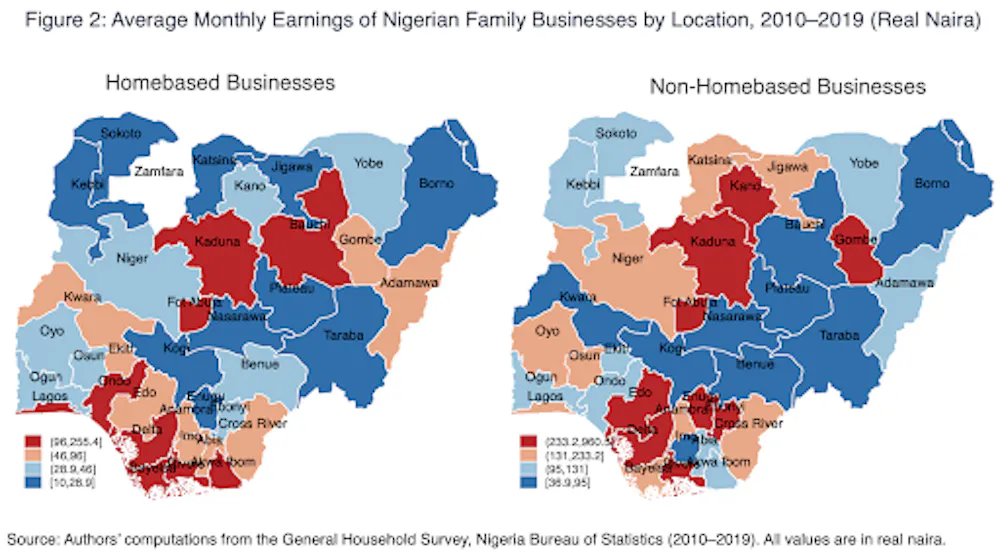
We found that home-based enterprises are concentrated in poorer regions where returns are low, particularly in northern Nigeria, as shown in figure 2.

Even after accounting for income and education, women in northern Nigeria are far more likely to run businesses from home than women in the south. Cultural and religious norms that restrict women’s mobility and public participation probably play a central role.

This complicates global policy narratives that frame home-based work as inherently empowering. In Nigeria, it often reflects the need to juggle paid work with household obligations under restrictive conditions. These businesses tend to cluster in low-entry sectors, offer limited skill development, and have little growth potential.

Education helps, but only up to a point

Education and household income do expand women’s options, but their effects are limited. Our study shows that better-educated women are less likely than equally educated men to remain in home-based businesses when alternatives are available.

As household income rises, women are also less likely to operate enterprises from home. Importantly, observable characteristics do not explain the full gender gap. The study finds that less than half of the difference in home-based self-employment can be attributed to education, household size, marital status and housing. The rest likely reflects deeper structural forces that shape outcomes differently for men and women. These are forces like social norms, unequal access to finance, gendered returns to assets, and expectations around unpaid care work.

What this means for policy

Promoting home-based self-employment as a route to women’s economic empowerment can be misleading. When women are pushed into home-based enterprises because childcare is expensive, institutions and property rights are weak, or finance is inaccessible, entrepreneurship becomes a response to constraint, not opportunity.

Policies that reduce childcare costs, strengthen women’s property and inheritance rights, and improve access to credit are likely to do more to expand women’s choices than entrepreneurship programmes alone.

Digital infrastructure can help some home-based businesses reach wider markets, but only if deeper barriers are addressed. And because constraints vary across regions, one-size-fits-all solutions are unlikely to work.

More than flexibility

Home-based self-employment in Nigeria reflects deeply gendered expectations about work and care. Many women work from home not to assert independence, but because they have limited options.

Recognising this distinction matters. Celebrating women’s “flexibility” without addressing the constraints behind it risks turning resilience into a permanent requirement. A more equal future is one in which women can choose where and how they work, rather than adjusting their livelihoods around structural barriers.

– Working from home in Nigeria: study finds women don’t have much choice
– https://theconversation.com/working-from-home-in-nigeria-study-finds-women-dont-have-much-choice-274792

South Sudan Declines to Renew Oranto’s License for Block B3

Source: APO


.

The Ministry of Petroleum of the Republic of South Sudan (https://MOP.Gov.SS) announces that it has decided not to renew the Exploration and Production Sharing Agreement (EPSA) held by Oranto Petroleum for Block B3.

This decision follows a comprehensive review of Oranto’s performance under the EPSA over the six-year contractual period. The review found that Oranto did not meet key work program obligations, including the completion of required seismic surveys and the drilling commitments stipulated in the agreement.

In addition, Oranto failed to fulfill its financial obligations to the Government of South Sudan and related project commitments, as provided for under the EPSA framework.

In line with the Government’s policy of ensuring responsible resource development and attracting credible, technically capable investors, the Ministry has therefore concluded that the non-renewal of the Block B3 license is in the best interest of the country.

Block B3 is now open for new applications, and the Ministry of Petroleum welcomes interest from serious and qualified international and regional oil and gas companies committed to timely exploration, compliance with contractual obligations, and long-term partnership with the Republic of South Sudan.

The Ministry reaffirms its commitment to transparency, accountability, and the sustainable development of South Sudan’s petroleum sector.

Distributed by APO Group on behalf of Ministry of Petroleum South Sudan.

For further information:
Ministry of Petroleum, Republic of South Sudan

O Sudão do Sul recusa-se a renovar a licença da Oranto para o Bloco B3

Source: Africa Press Organisation – Portuguese –

Baixar .tipo

O Ministério do Petróleo da República do Sudão do Sul (https://MOP.Gov.SS) anuncia que decidiu não renovar o Acordo de Partilha de Exploração e Produção (EPSA) detido pela Oranto Petroleum para o Bloco B3.

Esta decisão surge na sequência de uma análise exaustiva do desempenho da Oranto ao abrigo do EPSA ao longo do período contratual de seis anos. A análise concluiu que a Oranto não cumpriu obrigações fundamentais do programa de trabalho, incluindo a conclusão dos levantamentos sísmicos exigidos e os compromissos de perfuração estipulados no acordo.

Além disso, a Oranto não cumpriu as suas obrigações financeiras para com o Governo do Sudão do Sul e os compromissos relacionados com o projeto, tal como previsto no âmbito do EPSA.

Em consonância com a política do Governo de garantir o desenvolvimento responsável dos recursos e atrair investidores credíveis e tecnicamente capazes, o Ministério concluiu, por conseguinte, que a não renovação da licença do Bloco B3 é do melhor interesse do país.

O Bloco B3 está agora aberto a novas candidaturas, e o Ministério do Petróleo acolhe com agrado o interesse de empresas petrolíferas e de gás internacionais e regionais sérias e qualificadas, empenhadas na exploração atempada, no cumprimento das obrigações contratuais e numa parceria de longo prazo com a República do Sudão do Sul.

O Ministério reafirma o seu compromisso com a transparência, a responsabilização e o desenvolvimento sustentável do setor petrolífero do Sudão do Sul.

Distribuído pelo Grupo APO para Ministry of Petroleum South Sudan.

Para mais informações:
Ministério do Petróleo, República do Sudão do Sul