
Reforms to South Africa’s technical colleges keep failing students and employers: why?

Source: The Conversation – Africa – By Stephanie Allais, Faculty member, Centre for Researching Education and Labour, University of the Witwatersrand

South Africa’s 50 public technical and vocational education and training (TVET) colleges are, in the main, struggling institutions.

In many, throughput rates – how many students qualify in the expected time – are low. Some lecturers are under-qualified and under-resourced. Relationships with employers, which are crucial for the type of training that these colleges offer, are uneven.

Colleges are hard pressed to provide training to young people with weak schooling behind them and no clear path to employment ahead. The youth unemployment rate is almost 44%.


Read more: Life after school for young South Africans: six insights into what lies ahead


The response to problems in the sector has been reform: rename the colleges, restructure them, give them new governance models, new qualification types, new funding arrangements. Over 30 years of democracy, South Africa has done all of these things, repeatedly. It has not worked.

And now there’s another round of changes being rolled out. There is little clearly documented explanation of what the new system is and how it will work in practice. But colleges have been instructed that most current qualification offerings will be phased out and replaced by new “occupational” qualifications.

In 2024 I wrote a paper tracing the history of the technical and vocational training sector, drawing on published literature, my research on skills development and my own involvement in South Africa’s education and training policy processes. The paper sets out why the sector is not working and what it needs to succeed.

In my view, based on the history of the sector, there is a serious risk that the latest reforms will make things worse.

Thirty years of the same mistake

South Africa’s policy vision and funding model for TVET colleges has, like that of many other countries, been to base funding on student enrolment for programmes that are linked to employer demand. It assumes colleges will respond to what employers want, and channel young people into jobs.

It has a long and largely unsuccessful track record, with problems in many countries – most extensively documented in Australia and the UK, the originators of the broad policy model.

The problem is structural. Funding institutions only through enrolments in specific programmes provides no institutional stability. It creates no incentive to invest in equipment, lecturers, or long-term relationships with employers. It treats colleges as if they were competing as private training providers.

When the programmes that attract funded enrolments change – as they do, repeatedly – colleges are left with stranded staff, obsolete equipment, and no financial buffer. And when new funding is made available, for new programmes, they don’t have lecturers who can teach them.

Private institutions tend not to offer manufacturing-related programmes – those are expensive. They focus on business-related programmes, which are cheaper.

Consider the National Technical Education Diploma (Nated) qualifications, the government-funded programmes that colleges have provided for decades. First, they were to be phased out. Then, when the National Development Plan created TVET enrolment targets, colleges were told to expand them. Colleges have built up staffing around them and enrolled students in them.

Now, the Department of Higher Education and Training has instructed colleges to phase them out. What replaces them are “occupational qualifications”.

The occupational qualifications problem

The department defines an occupation as

a set of jobs whose main tasks and duties are characterised by a high degree of similarity (skill specialisation).

The theory behind occupational qualifications is sound: link qualifications to specific occupations, make workplace experience part of the qualification, and graduates will have credentials that employers recognise and value.

The framework has thousands of occupations.

The problem – and here is where our new research (not yet published online) is indicating an uncomfortable finding – is that many of the “occupations” to which these new qualifications are linked do not really exist in workplaces and labour markets. And there is little publicly available information about them.

Some “occupations” have special skills that need special training, and others are really just jobs.

For example, in our research (not yet online) across 53 food and beverage manufacturing plants, we found that there are artisan trades like millwrighting, fitting and turning, and electrical work which fit the idea of an occupation. But machine operators don’t fit that description. Yet machine operators are among the new qualifications to be offered. The employers we visited don’t need those qualifications. They would rather hire someone they can train themselves, to use the equipment in their plant.

Training in a “knowledge module” like “personal mastery and interpersonal relationships” is not specific to the “occupation” of operating a machine.

You cannot create an occupation by developing a qualification for it. It works the other way: the occupation must exist before you create a qualification for it.


Read more: Jobs of the future: South Africa has major gaps in skills needed to shape the green economy


This is not an abstract concern. Colleges are now being instructed to gain accreditation to offer these qualifications, to hire staff to teach them, to find workplace placements for students doing them – all on the assumption that there is a real occupational destination at the end.

For artisans, this assumption holds: there are real occupations that translate to opportunities in the workplace. But for the majority of new occupational qualifications being developed, far more analysis is needed.

What institutions actually need

Colleges cannot become strong institutions through enrolment-driven funding alone, any more than a school can become strong by being paid per pupil with no base funding for teachers or classrooms. And calling qualifications “occupational” does not mean that they will lead to work where there is no meaningful occupation in labour markets or workplaces.

Institutions need a stable core – employed lecturers, maintained equipment, administrative capacity – that allows them to function as institutions rather than as collections of projects cobbled together from different funding streams.

Some of them may be better off offering second-chance matric (secondary school leaving certificate) programmes instead of narrowly focused programmes where there are few real opportunities for employment in the surrounding areas, and no way colleges can find work placements for their learners.

Pockets of genuine excellence exist in the current system: colleges with good employer relationships and real employment outcomes for graduates. What they have in common is principled management, experienced staff, and enough stability to build relationships over time. The system should be trying to replicate those conditions.

In my view, what needs to happen is this:

  • colleges should be funded with a core institutional grant, and enabled to provide a mix of training that reflects their local economic contexts

  • occupational qualifications should be rolled out only where employers need them.

Otherwise the latest reforms risk repeating the errors of the past 30 years. Colleges and young people deserve better than that.

– Reforms to South Africa’s technical colleges keep failing students and employers: why?
– https://theconversation.com/reforms-to-south-africas-technical-colleges-keep-failing-students-and-employers-why-278711

Working from home in Nigeria: study finds women don’t have much choice

Source: The Conversation – Africa – By Ikechukwu (Ike) Nwaka, Assistant Lecturer, Business Economics, University of Alberta

Nigerian women of working age are mostly (90%) self-employed. By comparison, self-employment accounts for less than 16% of employment in high-income countries such as the United States, Germany and the United Kingdom. It is far lower in middle-income countries like South Africa and Turkey too.

Official statistics show that self-employment in Nigeria is concentrated in the northern regions. And there’s a gender difference: women make up the majority of those working for themselves (Figure 1).

What these numbers do not explain is why women are far more likely than men to operate businesses from their homes, or whether those businesses generate meaningful economic returns.

Authors’ calculations from the Annual Nigerian Labour Force Survey Report (National Bureau of Statistics, 2023), accessed at nigerianstat.gov.ng.

As economists working on labour, gender, energy and development, we addressed these questions in a recent paper.

Using nationally representative household data from 2010 to 2019, the study examines why Nigerian women run enterprises from their homes. These kinds of operations include selling goods from a front room, preparing food at home, or offering haircuts, beauty services, laundry and dry cleaning, and shoe repair. They also make textiles, crafts, garments, shoes and cosmetics at home rather than in shops, kiosks or workshops.

The findings challenge the idea that home-based self-employment is mainly about personal preference or flexibility.

Childcare responsibilities, housing access, electricity and cultural norms strongly shape women’s work location. These insights reveal that supporting women in business must go beyond training or microfinance, and remove structural barriers.

Childcare limits women’s workplaces

We first identified factors associated with operating home-based businesses, using data (2010-2019) from national surveys that follow the same households over time.

We then examined how individual, household and contextual factors shape the likelihood of operating a business from home. We found that childcare was the strongest factor influencing women’s choice of work location.

The presence of young children doesn’t much affect where men work. For women, however, having young children makes it more likely they will run a business from home.

In Nigeria, women shoulder most of the unpaid domestic labour, including childcare, cooking and cleaning. Home-based businesses allow women to earn income while doing that labour.

For many women, home-based work may not be the most attractive option. Rather, the patterns we saw in the data suggest that it’s a way to reconcile income-earning with unpaid domestic responsibilities. Other research into women’s experiences has also shown that working from home may be a necessity rather than a choice.

Why home ownership doesn’t benefit women equally

Homeowners who operate home-based enterprises are better positioned to use property as collateral, access credit, expand workspace, or invest in equipment. They are able to turn housing into productive capital.

However, these advantages are not equally accessible to women.

Only 8.2% of women aged 20-49 are sole owners of land, compared with 34.2% of men, according to World Bank research into gender disparities in property ownership in sub-Saharan Africa.

The Nigerian constitution grants women equal rights to own, inherit and manage property. But many face legal, financial and social barriers that limit their actual control over assets.

Even in owner-occupied households, customary and patriarchal practices can mean that ownership doesn’t translate into decision-making power. Consequently, the same asset generates different economic returns for men and women. It confines women to lower-return home-based activities.

We found that 67% of female homeowners operate home-based enterprises compared with 33% of male owners. Most men who own homes work away from home.

Geography and social norms matter

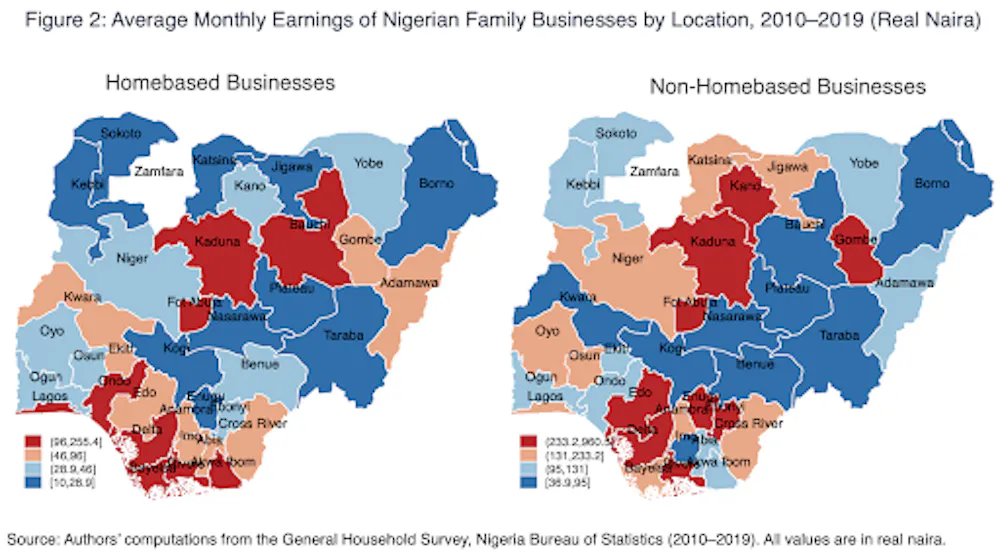
We found that home-based enterprises are concentrated in poorer regions where returns are low, particularly in northern Nigeria, as shown in figure 2.

Even after accounting for income and education, women in northern Nigeria are far more likely to run businesses from home than women in the south. Cultural and religious norms that restrict women’s mobility and public participation probably play a central role.

This complicates global policy narratives that frame home-based work as inherently empowering. In Nigeria, it often reflects the need to juggle paid work with household obligations under restrictive conditions. These businesses tend to cluster in low-entry sectors, offer limited skill development, and have little growth potential.

Education helps, but only up to a point

Education and household income do expand women’s options, but their effects are limited. Our study shows that better-educated women are less likely than equally educated men to remain in home-based businesses when alternatives are available.

As household income rises, women are also less likely to operate enterprises from home. Importantly, observable characteristics do not explain the full gender gap. The study finds that less than half of the difference in home-based self-employment can be attributed to education, household size, marital status and housing. The rest likely reflects deeper structural forces that shape outcomes differently for men and women. These are forces like social norms, unequal access to finance, gendered returns to assets, and expectations around unpaid care work.

What this means for policy

Promoting home-based self-employment as a route to women’s economic empowerment can be misleading. When women are pushed into home-based enterprises because childcare is expensive, institutions and property rights are weak, or finance is inaccessible, entrepreneurship becomes a response to constraint, not opportunity.

Policies that reduce childcare costs, strengthen women’s property and inheritance rights, and improve access to credit are likely to do more to expand women’s choices than entrepreneurship programmes alone.

Digital infrastructure can help some home-based businesses reach wider markets, but only if deeper barriers are addressed. And because constraints vary across regions, one-size-fits-all solutions are unlikely to work.

More than flexibility

Home-based self-employment in Nigeria reflects deeply gendered expectations about work and care. Many women work from home not to assert independence, but because they have limited options.

Recognising this distinction matters. Celebrating women’s “flexibility” without addressing the constraints behind it risks turning resilience into a permanent requirement. A more equal future is one in which women can choose where and how they work, rather than adjusting their livelihoods around structural barriers.

– Working from home in Nigeria: study finds women don’t have much choice
– https://theconversation.com/working-from-home-in-nigeria-study-finds-women-dont-have-much-choice-274792

South Sudan Declines to Renew Oranto’s License for Block B3

Source: APO


.

The Ministry of Petroleum of the Republic of South Sudan (https://MOP.Gov.SS) announces that it has decided not to renew the Exploration and Production Sharing Agreement (EPSA) held by Oranto Petroleum for Block B3.

This decision follows a comprehensive review of Oranto’s performance under the EPSA over the six-year contractual period. The review found that Oranto did not meet key work program obligations, including the completion of required seismic surveys and the drilling commitments stipulated in the agreement.

In addition, Oranto failed to fulfill its financial obligations to the Government of South Sudan and related project commitments, as provided for under the EPSA framework.

In line with the Government’s policy of ensuring responsible resource development and attracting credible, technically capable investors, the Ministry has therefore concluded that the non-renewal of the Block B3 license is in the best interest of the country.

Block B3 is now open for new applications, and the Ministry of Petroleum welcomes interest from serious and qualified international and regional oil and gas companies committed to timely exploration, compliance with contractual obligations, and long-term partnership with the Republic of South Sudan.

The Ministry reaffirms its commitment to transparency, accountability, and the sustainable development of South Sudan’s petroleum sector.

Distributed by APO Group on behalf of Ministry of Petroleum South Sudan.

For further information:
Ministry of Petroleum, Republic of South Sudan

O Sudão do Sul recusa-se a renovar a licença da Oranto para o Bloco B3

Source: Africa Press Organisation – Portuguese –

Baixar .tipo

O Ministério do Petróleo da República do Sudão do Sul (https://MOP.Gov.SS) anuncia que decidiu não renovar o Acordo de Partilha de Exploração e Produção (EPSA) detido pela Oranto Petroleum para o Bloco B3.

Esta decisão surge na sequência de uma análise exaustiva do desempenho da Oranto ao abrigo do EPSA ao longo do período contratual de seis anos. A análise concluiu que a Oranto não cumpriu obrigações fundamentais do programa de trabalho, incluindo a conclusão dos levantamentos sísmicos exigidos e os compromissos de perfuração estipulados no acordo.

Além disso, a Oranto não cumpriu as suas obrigações financeiras para com o Governo do Sudão do Sul e os compromissos relacionados com o projeto, tal como previsto no âmbito do EPSA.

Em consonância com a política do Governo de garantir o desenvolvimento responsável dos recursos e atrair investidores credíveis e tecnicamente capazes, o Ministério concluiu, por conseguinte, que a não renovação da licença do Bloco B3 é do melhor interesse do país.

O Bloco B3 está agora aberto a novas candidaturas, e o Ministério do Petróleo acolhe com agrado o interesse de empresas petrolíferas e de gás internacionais e regionais sérias e qualificadas, empenhadas na exploração atempada, no cumprimento das obrigações contratuais e numa parceria de longo prazo com a República do Sudão do Sul.

O Ministério reafirma o seu compromisso com a transparência, a responsabilização e o desenvolvimento sustentável do setor petrolífero do Sudão do Sul.

Distribuído pelo Grupo APO para Ministry of Petroleum South Sudan.

Para mais informações:
Ministério do Petróleo, República do Sudão do Sul

Limpopo MEC urges road safety ahead of May Day rallies

Source: Government of South Africa

Limpopo MEC urges road safety ahead of May Day rallies

Limpopo MEC for Transport and Community Safety, Violet Mathye, has called on motorists, public transport operators and workers travelling to the Congress of South African Trade Unions (Cosatu) May Day event to prioritise road safety, as traffic volumes are expected to spike over this long weekend.

The Cosatu national May Day rally will take place on Friday, 1 May, at Old Peter Mokaba Stadium from 8am to 6pm, with an estimated 15 000 people expected to attend.

Additional rallies organised by other federations will also be held across the province.

Mathye noted that the rally coincides with month-end, a period typically marked by increased travel as workers receive their salaries.

“This is another extended weekend. We want every worker to arrive at their respective rallies safely and return alive,” Mathye said on Thursday.

Traffic management plan activated

The department has activated a comprehensive traffic management plan covering major routes into Polokwane.

Law enforcement officers will be deployed from early Friday morning to monitor key corridors, including:
•    N1 South and R101 (Waterberg District)
•    R37 (Sekhukhune District)
•    R71 and R81 (Mopani District)
•    N1 North, R524 and R578 (Vhembe District)
•    D19, R521 and R567 (Capricorn District)

Hundreds of buses and minibus taxis are expected to transport commuters from across Limpopo’s five districts to the main venue.

Safety appeal to motorists and operators

Mathye issued a strong appeal for compliance with road safety regulations:

  • No overloading.
  • No drinking and driving.
  • No speeding.
  •  Rest and patience. 

The department wished all workers a safe, peaceful, and successful International Workers’ Day. – SAnews.gov.za

GabiK

0

eThekwini mayor calls for special courts to tackle land invasions

Source: Government of South Africa

eThekwini mayor calls for special courts to tackle land invasions

EThekwini Municipality Mayor Cyril Xaba has called for the establishment of special courts to address the growing problem of land invasions and property hijackings.

Xaba on Wednesday said he has approached Justice and Constitutional Development Minister, Mmamoloko Kubayi, with the proposal, citing growing concern among property owners who struggle to reclaim hijacked land or buildings through existing legal processes.

“Once they lose control of their land or buildings to criminals, it becomes extremely difficult and costly to reclaim them. This process requires court supervision, which does not come cheap,” Xaba said during a media briefing on Wednesday.

Xaba noted that in many townships and suburbs, properties are still registered in the names of the original owners, who are now deceased. The problem, he said, is compounded by the fact that many did not leave wills, which further complicates the transfer of ownership.

“Some of these properties have fallen prey to criminal syndicates, who hijack them and unlawfully collect rent from tenants. Many property owners are unable to access legal recourse due to financial constraints,” the mayor said.

Xaba believes that specialised courts can ameliorate the situation and make the administration of justice more accessible, similar to municipal courts that deal with traffic violations and commercial courts.

“I strongly believe that the establishment of special courts for hijacked properties and land invasions will protect property owners from unlawful activities and ensure that perpetrators are held accountable,” he said.

The mayor has directed City Manager Musa Mbhele to establish a task team to consolidate a formal proposal for submission to the Minister.

Xaba’s call follows the Prevention of Illegal Eviction (PIE) from and Unlawful Occupation of Land Amendment Bill, published recently, which seeks to empower municipalities, State entities and private property owners to respond more decisively to illegal occupations and evictions.

Human Settlements Minister Thembi Simelane, who announced the release of the bill for public comments, said the proposed amendments aim to strengthen the Prevention of Illegal Eviction from and Unlawful Occupation of Land Act of 1998 by making it more effective, easier to interpret and simpler to enforce.

The move comes amid a rise in unlawful land and building occupations across the country, placing a significant financial and administrative burden on both government and the private sector.

Debt relief for deceased estates

In a related intervention, Xaba announced that the eThekwini Metropolitan Municipality has introduced a Deceased Estate Debt Write-Off Programme to help address challenges linked to properties registered under deceased estates.

Xaba said the programme was due to challenges when the municipality collect rates from properties registered under deceased estates.

He said through the initiative, the municipality has written off more than R500 million in outstanding debt.

The programme applies to properties valued at under R1 million, where the estate had remained unresolved for at least 24 months, as of the policy’s approval in August 2024.

“A key condition is that family members must agree on who will take responsibility for municipal accounts to prevent the re-accumulation of debt,” Xaba explained.

Xaba said the intervention aims to ease administrative and financial burdens on affected families, while improving revenue collection and property regularisation in the city. – SAnews.gov.za

GabiK

0

Le Soudan du Sud refuse de renouveler la licence d’Oranto pour le bloc B3

Source: Africa Press Organisation – French


Le ministère du Pétrole de la République du Soudan du Sud (https://MOP.Gov.SS) annonce qu’il a décidé de ne pas renouveler le contrat de partage de production et d’exploration (EPSA) détenu par Oranto Petroleum pour le bloc B3.

Cette décision fait suite à un examen approfondi des performances d’Oranto dans le cadre de l’EPSA au cours de la période contractuelle de six ans. L’examen a révélé qu’Oranto n’avait pas respecté ses obligations clés en matière de programme de travail, notamment la réalisation des études sismiques requises et les engagements de forage stipulés dans l’accord.

En outre, Oranto n’a pas rempli ses obligations financières envers le gouvernement du Soudan du Sud ni ses engagements liés au projet, tels que prévus dans le cadre de l’EPSA.

Conformément à la politique du gouvernement visant à garantir une exploitation responsable des ressources et à attirer des investisseurs crédibles et techniquement compétents, le ministère a donc conclu que le non-renouvellement de la licence du bloc B3 était dans le meilleur intérêt du pays.

Le bloc B3 est désormais ouvert à de nouvelles candidatures, et le ministère du Pétrole encourage les sociétés pétrolières et gazières internationales et régionales sérieuses et qualifiées, engagées à mener des activités d’exploration dans les délais, à respecter leurs obligations contractuelles et à établir un partenariat à long terme avec la République du Soudan du Sud, à manifester leur intérêt.

Le ministère réaffirme son engagement en faveur de la transparence, de la responsabilité et du développement durable du secteur pétrolier du Soudan du Sud.

Distribué par APO Group pour Ministry of Petroleum South Sudan.

Pour plus d’informations :
Ministère du Pétrole, République du Soudan du Sud

Manhunt on for attackers of Crime Intelligence officers

Source: Government of South Africa

Manhunt on for attackers of Crime Intelligence officers

Acting National Commissioner Lieutenant General Puleng Dimpane says maximum resources have been mobilised to hunt down a group of criminals who attacked two Crime Intelligence officers this afternoon in Durban, KwaZulu-Natal.

The attack on the Crime Intelligence officers happened in the Mount Edgecombe area.

A member who was the driver of a State vehicle has succumbed to the gunshot wounds sustained at the scene. 

Another member, who was also shot and wounded during the attack, has been airlifted to hospital and is currently receiving urgent medical care.

A manhunt has been launched for the suspects.

South African Police Service (SAPS) specialised units, including Crime Intelligence operatives, detectives, the organised crime unit and highly trained police officers are working around the clock to track down and apprehend those involved.

Acting National Commissioner, Lieutenant General Puleng Dimpane, has condemned the attack, describing it as an assault on the authority of the State and those who risk their lives in the fight against crime.

“No stone will be left unturned in ensuring that the perpetrators are brought to justice.”

SAPS has deployed its Employee Health and Wellness experts, including psychologists and chaplains, to the family of the deceased and the SAPS Crime Intelligence unit to offer psychosocial services.

SAPS has extended its deepest condolences to the family, friends, and colleagues of the fallen officer and has wished the injured member a full and speedy recovery. – SAnews.gov.za

Edwin

0

President sets 4 November 2026 as date for Local Government Elections

Source: Government of South Africa

President sets 4 November 2026 as date for Local Government Elections

President Cyril Ramaphosa has officially announced 4 November 2026 as the date for South Africa’s upcoming Local Government Elections, setting the stage for political parties and voters to begin preparations.

The President made the announcement on Thursday during the Extended Presidential Coordinating Council (PCC) meeting at the Birchwood Hotel and OR Tambo Conference Centre in Ekurhuleni, where he is meeting with Premiers, mayors and senior government officials.

“I therefore determine that the next local Government Elections will be held on a Wednesday, on a date I now determine as the 4th of November 2026. Therefore, with the full concurrence of the Deputy President here, I now determine that the next Local Government Elections will be held on 4 November 2026,” President Ramaphosa said.

The proclamation follows consultations with Cooperative Governance and Traditional Affairs Minister Velenkosini Hlabisa. 

Speaking to the media after the announcement, the President said the elections will mark the completion of a full five-year term since the 2021 municipal polls, in keeping with constitutional timelines. 

“The 4th of November 2026 is the date that we have set for the Local Government Elections that will have completed a full five years since [the] 2021 [elections], and this is in line with our constitutional construct [to] keep to those timelines that are clearly set out in our Constitution,” he said.

President Ramaphosa said the announcement provides certainty and signals the official start of the campaign period, with political parties expected to mobilise support and prepare for the polls.

“It gives everyone clear focus on what needs to be done… The race has started, and people will do the best they can.” 

President Ramaphosa noted that while elected leaders will campaign for re-election, the administrative arm of municipalities will continue its work to ensure stability and continuity in governance.

The President also stressed the importance of increasing voter turnout, particularly among young people.

“Many parties are already ensuring that they talk to their voters, their supporters, and get voters to be registered, to come forward and vote. 

“Voter turnout is always a concern to political parties and indeed to the State or the government because the fewer people who vote, the more we get concerned about the status of our democracy. Our task is to increase voter turnout, to get as many people as possible, especially young people, to come out, register and vote,” the President said. 

The President said the remaining six months, supported by media networks, political party mobilisation and the spread of information on social media, should be sufficient. 

“The [objective] is to get everyone to be properly mobilised to go out and vote. Today gives them the starting blocks. They must now work harder to make sure that the campaigning starts and [that] voter registration also starts. I will also be doing my part,” he said.

On service delivery, President Ramaphosa said government has already begun implementing key interventions outlined in the Water Action Plan, with several workstreams underway. 

He acknowledged that poor service delivery often leads to public dissatisfaction, but said government and political leaders have a responsibility to both demonstrate clear plans and encourage citizens to participate in the democratic process.

“Obviously as services fail… people get disgruntled and they become unhappy. Our job as party leaders and government is to encourage people to come and vote — as many of them as possible — and to demonstrate that we have plans,” the President said. 

The President added that further details on implementation timelines would be communicated to ensure transparency and accountability.

The announcement marks the official start of preparations for the 2026 Municipal Elections, with political parties expected to ramp up campaigning and voter registration efforts in the months ahead, while government continues efforts to strengthen local governance and rebuild public trust. – SAnews.gov.za

DikelediM

0

Community safety structures commended for strengthening democracy

Source: Government of South Africa

Community safety structures commended for strengthening democracy

KwaZulu-Natal Premier Thamsanqa Ntuli has commended voluntary community safety structures for their role in protecting communities and strengthening democracy. 

Ntuli was speaking at Zakheni B Community Hall in the Alfred Duma Local Municipality, where he officially welcomed newly trained members of community safety structures. 

The event coincided with Freedom Day earlier in the week, which marked 32 years of South Africa’s first democratic elections. 

Delivering his keynote address, Ntuli commended the spirit of volunteerism demonstrated by community safety structure members, noting that their work contributes significantly to protecting the gains of South Africa’s democratic dispensation since 1994.

“Community-based crime prevention structures play a critical role in supporting law enforcement agencies and strengthening grassroots safety interventions,” Ntuli said. 

He highlighted the importance of civic participation, noting that community safety structures embody the spirit of active citizenship central to South Africa’s constitutional democracy. 

Addressing crime concerns 

Ntuli raised concern about the proliferation of unlicensed firearms in parts of the municipality and urged both community safety structures and residents to report illegal weapons to their nearest police stations. 

He also pointed to growing challenges related to drug dependency and increasing incidents of gender-based violence and femicide (GBVF) reported, particularly in areas such as Zakheni. 

“Law enforcement agencies have identified several high-risk areas requiring intensified intervention and collaboration. These include Pieters Industrial Estate, Qinisa, Zakheni sections A, B, D and E, Manzabilayo, St Chads and Mhlumayo,” the Premier said. 

He stressed the need for stronger collaboration between police and community safety structures to effectively combat crime in these hotspots. 

Strengthening partnerships for safer communities

The Premier further acknowledged the role played by traditional leaders, including mayors, the religious sector and the business community in supporting crime prevention efforts and promoting safer environments. 

“Addressing crime requires a coordinated, multi-sectoral approach involving all stakeholders, including government, law enforcement and communities,” he said. 

Ntuli reaffirmed the provincial government’s commitment to strengthening and supporting community safety structures, ensuring they are adequately equipped to contribute meaningfully to safer communities across KwaZulu-Natal. – SAnews.gov.za

GabiK

0