
Source: The Conversation – Africa – By Giorgio Miescher, Associate Researcher University of Basel and University of Namibia, University of Basel
Donkeys are an unassuming yet ubiquitous presence in northern Namibia. They traverse sandy village roads, pull carts stacked with firewood, and graze freely along the northern edge of the Etosha National Park.
The story of how they came to occupy such a central role in rural life – and in such large numbers – is a fascinating one that’s linked to the country’s colonial history, the management of wildlife versus domestic animals, and the role of migrant workers.
We are historians who specialise in Namibia and Southern Africa. Our research focuses on colonial legacies in nature conservation and land. In a research paper we retraced the routes of the domesticated donkey through a conservation landscape.
We found that donkeys occupy a contradictory status in communities in northern Namibia. They are indispensable, yet undervalued. For example, they remain central to tasks such as ploughing, hauling water and transporting logs. Yet their social status remains curiously low. They are rarely used in ceremonies, have little monetary value, and are strongly associated with those who cannot afford tractors or cars.
We conclude that this ambiguity has arisen from the long histories of colonial rule, labour migration, conservation and veterinary control that shaped northern Namibia.
The great trek north
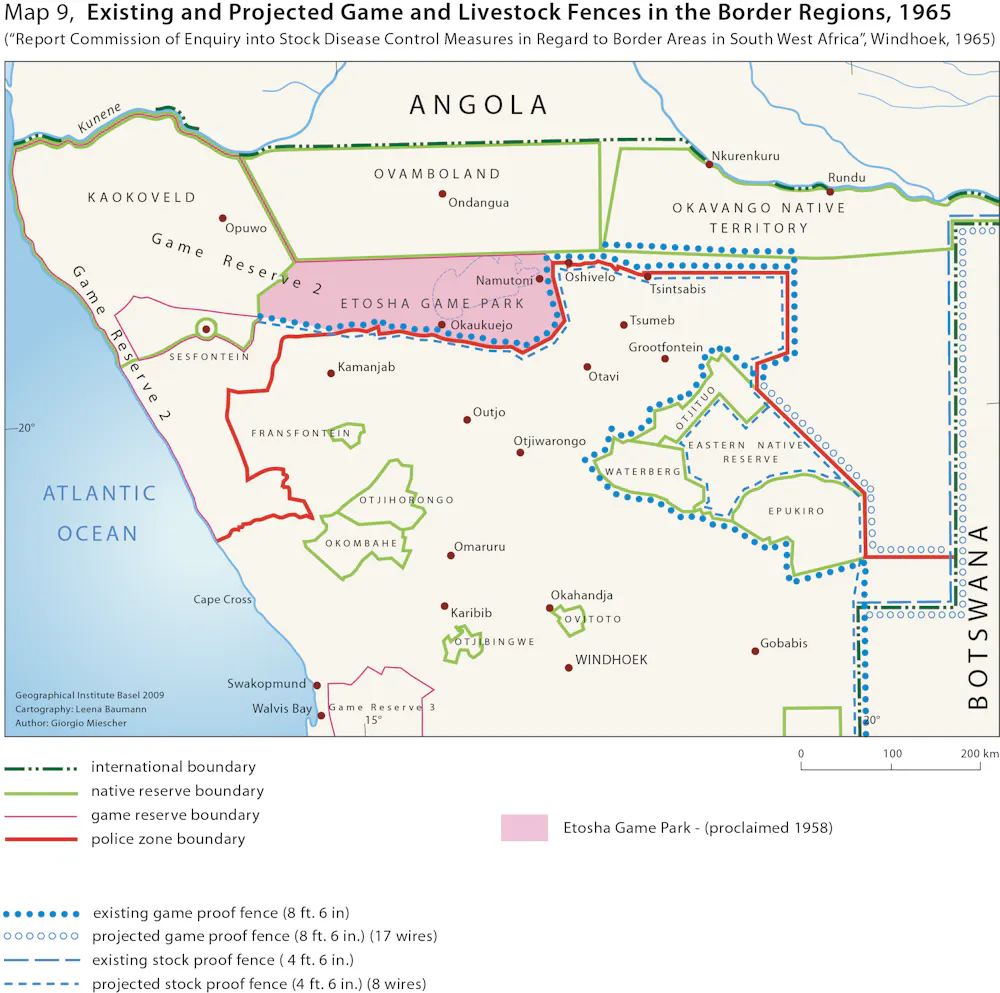
We traced donkeys’ ability to move across one of the country’s most significant borders: the veterinary cordon fence known as the Red Line. The Red Line is an inner-Namibian border, over 1,000 kilometres long, running from west to east and separating the country into two distinct parts. It originated under German colonial rule (1884-1915) and was fully implemented under South African rule (1915-1990).
It still exists today.
The Red Line separated the more densely populated northern parts of the country from the settler-colonial heartland, the so-called Police Zone in central and southern Namibia. The Etosha Game Reserve served as a buffer zone between the Police Zone and the Owambo region in the central north, conceptualised as a migrant labour reservoir.
Donkeys entered Namibia’s central north relatively late, and only became common in the 1920s and 1930s. Their presence across the region was driven largely by migrant labourers working on contract. As thousands of men travelled between the Police Zone and Owambo, many returned home with equines – especially donkeys – purchased in the south.

Cheap, hardy, and resistant to many diseases, donkeys became essential companions on the workers’ long journeys. Donkeys carried heavy loads of clothes, tools and other goods, including gramophones and radios, earned through contract labour.
Since they were associated with commodities, donkeys also became a symbol of modernity expanding from the thriving settler economy in the south.
Today, people still recount how returning labour migrants used donkeys to haul luggage through predator-rich landscapes within Etosha, or how villagers took their carts to meet these men halfway. Donkeys also served as ambulances during emergencies in the Namibian Liberation War (1966-1989).
Their presence has also been entangled with colonial border regimes and conservation policies.

The tensions
During the rinderpest epidemic of 1896-97, in a failed attempt to stop the disease from entering the colony, German colonial authorities established a cordon of military outposts along the southern edge of the Etosha Pan. Although intended to control the movement of cattle, this cordon would later become the Red Line.
The devastation of rinderpest prompted German forces to import donkeys and mules as disease-resistant alternatives to oxen. These animals gradually filtered into civilian hands in the Police Zone, the heartland of settler colonialism in central and southern Namibia, and became increasingly common by the 1910s.
The establishment of Game Reserve 2, comprising today’s Etosha National Park and the areas north-west of the Etosha Pan, was part of a policy to seal off Owambo from the Police Zone. Hunting and human movement in the reserve became highly regulated.
In 1915 South Africa defeated the German forces and took over Namibia. The new colonial power maintained the inner border and formalised it as the Red Line in the 1920s and 1930s. They banned cattle movement across the Red Line but allowed equines, provided they carried veterinary certificates.

Donkeys thus became one of the few domestic animals permitted to cross the border legally.
As migrant labour expanded, so too did the flow of donkeys northward. By the late 1920s and 1930s, hundreds of donkeys passed through Etosha each year. In Owambo, they were quickly adopted for local agriculture and transport. Even as motorised lorries and buses began to dominate long-distance travel from the 1930s onward, many migrant workers still preferred to buy donkeys as durable companions.
By the 1940s, however, administrators in Owambo began to worry about the donkeys’ impact on grazing. Restrictions were introduced, but donkeys continued to slip into the north through unofficial routes.
From the 1950s onward, the situation changed dramatically as the Etosha National Park was transformed into a fenced conservation area. Residents and livestock were expelled, and by 1961 the southern boundary was fully fenced. Donkey traffic through Etosha came to an end.
Meanwhile, the northern boundary of Etosha became a flashpoint. The government of the pseudo-independent new Ovamboland homeland resisted efforts to fence this border and insisted on continued movement of wildlife out of Etosha – especially zebra, an important local food source. Conservation officials accused communities of using donkeys to disguise poaching tracks and allowing their animals to stray into the park.
New rules
With Namibia’s independence in 1990, new animal-movement regulations emerged, but donkeys retained their special status. Unlike cattle, they were still permitted to cross the Red Line.
Their symbolic and practical importance has changed. Migrant workers no longer return with donkeys from the south, and motorised transport dominates even in rural areas.
But donkeys remain deeply woven into the fabric of northern Namibian life. They continue to support poorer households, endure harsh environments, and live in proximity to wildlife. Their presence evokes conflicting memories – of difficult journeys and colonial border regimes, but also of development and modernity.
– Donkeys are a common sight in northern Namibia – what colonial history has to do with it
– https://theconversation.com/donkeys-are-a-common-sight-in-northern-namibia-what-colonial-history-has-to-do-with-it-273058