O Governo de Cabo Verde informa que o Banco Mundial aprovou, no dia 18 de março, o financiamento adicional para o Projeto de Melhoria da Conectividade e das Infraestruturas Urbanas de Cabo Verde (P178644), no montante total de 40 milhões de dólares norte-americanos da IDA, dos quais 30 milhões provenientes da Janela de Recuperação de Crises (CRW).
O presente financiamento adicional permitirá, nomeadamente:
(i) expandir o âmbito dos investimentos prioritários, identificados na sequência da rápida mobilização do financiamento inicial;
(ii) apoiar as necessidades de recuperação pós-desastre e de reconstrução resiliente, na sequência das cheias de agosto de 2025 nas ilhas de Barlavento e das chuvas intensas de novembro de 2025 em Santiago;
(iii) acomodar custos adicionais face às estimativas iniciais, decorrentes de ajustamentos de conceção, incluindo o reforço dos padrões de resiliência climática, bem como de atrasos associados a fenómenos meteorológicos extremos e a constrangimentos logísticos, entre outros fatores.
A concretização deste importante marco foi possível graças ao empenho, profissionalismo e espírito de colaboração dos parceiros envolvidos e dos representantes do Ministério das Finanças, nomeadamente da Direção Nacional do Planeamento (DNP) e da Unidade de Gestão de Projetos Especiais (UGPE), bem como do Ministério das Infraestruturas, Ordenamento do Território e Habitação e das demais instituições participantes.
Distribuído pelo Grupo APO para Governo de Cabo Verde.
O Ministério da Educação e a Universidade Estadual de Bridgewater assinaram, nesta quarta-feira (18), um Memorando de Entendimento para criar e implementar um Programa de Desenvolvimento de Liderança e Educação para as Futuras Gerações de Líderes Africanos – Intercâmbio de Líderes Africanos (ALEX), a ser realizado em Cabo Verde.
A parceria enquadra-se na visão estratégica do Governo de Cabo Verde de posicionar o país como um polo de conhecimento regional e global.
Consolidando um percurso de mais de vinte anos de parceria e colaboração entre a Universidade Estadual de Bridgewater (BSU) e diversas instituições em Cabo Verde, o protocolo fundamenta-se na vasta experiência da instituição universitária em acolher o Programa Mandela Washington Fellowship para Jovens Líderes Africanos. Este histórico permitiu o envolvimento com milhares de ex-bolseiros que buscam continuamente oportunidades de networking, aprendizagem e desenvolvimento de recursos.
A assinatura deste Memorando com a Bridgewater State University, segundo o Ministro da Educação, Amadeu Cruz, reveste-se de um profundo simbolismo institucional, sobretudo no contexto de final deste mandato.
“O Governo de Cabo Verde atribui especial relevância a este Protocolo, que terá como motor a inovação, considerando que os nossos jovens líderes beneficiarão de níveis superiores de preparação, alinhados com as exigências internacionais. Trata-se de um instrumento estratégico essencial para aferir a qualidade e orientar a evolução das políticas e das práticas educativas, consolidando as bases de um sistema mais robusto, competitivo e orientado para o futuro”, avançou.
É neste sentido que este governante mostrou disponibilidade para participar ativamente no Programa de Desenvolvimento de Liderança e Educação para as Futuras Gerações de Líderes Africanos – Intercâmbio de Líderes Africanos (ALEX), a ser realizado em Cabo Verde, assegurando o necessário endosso institucional e o apoio político à iniciativa.
“Paralelamente, o Ministério continuará a facilitar a coordenação com os parceiros nacionais, reforçando a articulação interinstitucional para garantir o pleno êxito do programa”, acrescentou.
Não obstante, Amadeu Cruz realçou que as universidades e as instituições de investigação aplicada devem dispor de instrumentos eficazes de avaliação da qualidade das aprendizagens, permitindo-lhes aferir o seu desempenho, estabelecer comparações relevantes entre instituições e considerar os diferentes contextos socioeconómicos.
“Este processo é igualmente fundamental para acompanhar a evolução dos indicadores de uma liderança eficaz, contribuindo para a construção de modelos formativos mais robustos e ajustados às necessidades de desenvolvimento do país.”
Distribuído pelo Grupo APO para Governo de Cabo Verde.
The Chairperson of the Portfolio Committee on Communications and Digital Technologies, Khusela Sangoni-Diko, has welcomed Postbank’s milestone achievement of successfully registering as a licensed Financial Services Provider (FSP) with the Financial Sector Conduct Authority.
This means that Postbank is now authorised and regulated to provide financial services that meet the standards set by the regulator, under the Financial Advisory and Intermediary Services Act (FAIS Act).
Diko described the development as a significant milestone in the ongoing journey to transform Postbank into a fully-fledged State-owned bank, capable of advancing financial inclusion and supporting economic participation for all South Africans.
“This is a moment of great progress and affirmation. The licensing of Postbank as a financial services provider signals that the institution is steadily meeting critical regulatory requirements and strengthening its capacity to operate within South Africa’s financial sector,” said Ms Diko.
She further noted that the achievement reflects sustained efforts by the Department of Communications and Digital Technologies and Postbank to rebuild governance, enhance compliance and restore public confidence in the institution.
“As the committee, we have consistently emphasised the importance of strong governance, accountability and regulatory compliance. This milestone demonstrates that Postbank is moving in the right direction and lays a solid foundation for its evolution into a fully-fledged state-owned bank,” she added.
Diko highlighted Postbank’s strategic importance in extending affordable and accessible financial services, particularly to underserved and rural communities.
She said that a properly capacitated Postbank has the potential to play a transformative role in deepening financial inclusion, reducing the cost of banking and ensuring that no South African is left behind in accessing essential financial services.
While welcoming the progress, Diko stressed that more work remains to be done to secure a full banking licence and achieve operational readiness.
She commended all stakeholders involved in achieving this milestone and looks forward to further progress in the establishment of a state-owned bank that serves the developmental needs of the country. – SAnews.gov.za
To mark International Women’s Day 2026, UN Women East and Southern Africa Regional Office (ESARO), in partnership with UNHCR’s Regional Bureau for Eastern and Southern Africa (RBESA), convened a Media & Legal Café in Nairobi under the global theme “Rights. Justice. Action. For All Women and Girls.”
The Café brought together media professionals, legal practitioners, refugee-led and women-led organizations, civil society actors, and survivors to examine persistent barriers to justice—particularly for women and girls affected by conflict, displacement, and violence.
Opening the dialogue, Idil Absiye, Regional Policy Advisor for Women, Peace and Security at UN Women ESARO, underscored the urgency of transforming justice systems that continue to fail women and girls. She highlighted the widening global justice gap and the critical role of media and legal actors in advancing accountability, shifting harmful narratives, and ensuring survivors are believed and supported.
A powerful testimony by Jacqueline Mutere of Grace Agenda, a survivor of Kenya’s 2007–2008 post-election sexual violence, grounded the discussions in lived experience. She shared the long and painful journey survivors continue to face in their pursuit of reparations and recognition, reminding participants that justice delayed remains justice denied—especially for women and children born of conflict-related sexual violence.
Media leaders and journalists reflected on their responsibility to report ethically and amplify women’s voices without causing harm. Panelists emphasized the need for survivor-centered storytelling, protection of identities, and inclusive representation—particularly of refugee and marginalized women—both in the media and in policy spaces.
The panelists also examined gaps in existing legal frameworks, noting that while innovations such as GBV courts and digital case-tracking have improved access, patriarchal laws, documentation barriers, and systemic exclusion continue to obstruct justice for many women.
Fatima Mohammed Cole, Head of Bureau Protection and Solutions Service at UNHCR RBESA, called for justice systems that go beyond laws on paper to deliver dignity, safety, and redress in practice—especially for displaced and stateless women and girls.
The IWD 2026 Media & Legal Café reaffirmed UN Women’s commitment to survivor-centered justice, inclusive participation, and strategic partnerships that turn rights into action—and action into lasting change.
Distributed by APO Group on behalf of UN Women – Africa.
Source: The Conversation – Africa – By Henning Melber, Extraordinary Professor, Department of Political Sciences, University of Pretoria
Namibia might not be well known in many parts of the world. But the arid southern African country has an extraordinary history.
Rich in indigenous cultural diversity, Namibians lived for more than a century under German and South African rule. Their anti-colonial resistance shaped the country from 1960 to independence on 21 March 1990 and beyond.
Henning Melber is a political scientist who works with this history. In numerous books he has tried to understand Namibia. His latest effort is a history for German speaking readers. We asked him about it.
What is the German connection?
Namibian and German histories have been entangled since the mid-1800s when German missionaries interacted with local communities. German settler-colonial rule followed in 1884.
C.H. Beck
The complicated ties with Germany remain alive today. Namibia’s three million inhabitants include an estimated 15,000-20,000 White German speakers. They outnumber those during colonial times and maintain minority rights, with their own institutionalised identity. Namibia has the continent’s only German daily newspaper and a German radio programme by the public broadcaster.
Likewise, Namibia is the most prominent African country in the German public sphere. Hundreds of thousands of German speakers visit the country every year – almost half of Namibia’s overseas tourists are from German speaking countries.
Before independence, the West German parliament adopted a resolution declaring a special responsibility for Namibia. It referred to the German speakers in the country as the reason, without mentioning the colonial history.
The book includes the role Germans played and continue to play. I came to Namibia as the young son of German emigrants in 1967. When I was 24, in 1974, I joined the South West Africa People’s Organisation (Swapo), the liberation movement fighting for independence. The book is therefore also partly a personal history.
What is Namibia’s early history?
In contrast to the colonial view, Namibia’s territory has neither been uninhabited (terra nullus) nor unknown (terra incognita).
The country’s world famous rock art has World Heritage Site status. Some of the paintings date back 3,000 years, created by the Bushmen (San) groups as the country’s first peoples. Migration within Africa added to the local ethnic diversity.
As hunters and foragers with high mobility, Bushmen became marginalised when newer groups claimed land. Like other indigenous minorities, some now earn a living as tourist attractions.
What happened under Germany?
Germany’s first colony was based on fraudulent land deals in 1883 and 1884 by the merchant Adolf Lüderitz, acting under German “protection”. He tricked the local Nama chief into giving away much more land than intended.
German negotiations with the Portuguese and British established the borders of the current state in the early 1900s. The British harbour enclave of Walvis Bay was integrated in 1994.
From the early 1890s, local resistance to colonisation was met with brute force. Leaders were executed, and communities forced into “protection treaties”. In 1893 the massacre at Hornkranz was the writing on the wall. Over 80 women and children of the Witbooi Nama were murdered by German troops.
Settler colonial encroachment became an existential threat. In 1904 the Ovaherero resorted to armed resistance. They were joined by the Nama. The German military response ended in the first genocide of the 20th century.
An estimated 80% of the Ovaherero and 50% of the Nama were killed, plus an unknown number of Damara. German settlers organised hunting safaris to exterminate the Bushmen.
Nama and Ovaherero were imprisoned in concentration camps on Shark Island, in Swakopmund and elsewhere. Their land was appropriated, and strict segregation through laws and reserves was imposed.
Apartheid – institutionalised racial segregation – is usually associated with South Africa, where it was entrenched in law in 1948. But I argue it was in fact a German invention.
German colonialism left scars and open wounds, mainly among the descendants of the decimated indigenous communities. In 2015, the German government admitted to genocide. Negotiations between the governments have tried to come to terms with this crime, but reparations remain a contested issue.
How did South Africa end up running the country?
After the fist world war, the League of Nations turned all German colonies into mandates. These were administered by member states of the allied forces until their inhabitants were able to govern themselves.
The Union of South Africa got the mandate over neighbouring Namibia, then named South West Africa. This meant annexation in all but name. South Africa would later refuse to remain accountable to the United Nations (UN) Trusteeship Council, which exercised oversight over the mandates.
This motivated the UN to declare Namibia a “trust betrayed”. In 1971 South Africa’s mandate was revoked by the International Court of Justice.
After long negotiations a one-year transition under UN supervision paved the way for decolonisation. Independence was declared on 21 March 1990 and Namibia became the 160th UN member state.
How did organised resistance emerge?
The genocide had decimated the people needed as labour for the settler economy, so the German administration established a system of contract labour. Workers from the northern region under indirect rule, the so-called Ovamboland, were recruited.
The first coordinated resistance emerged within the ranks of the contract labour movement. It was a nucleus for the formation of Swapo.
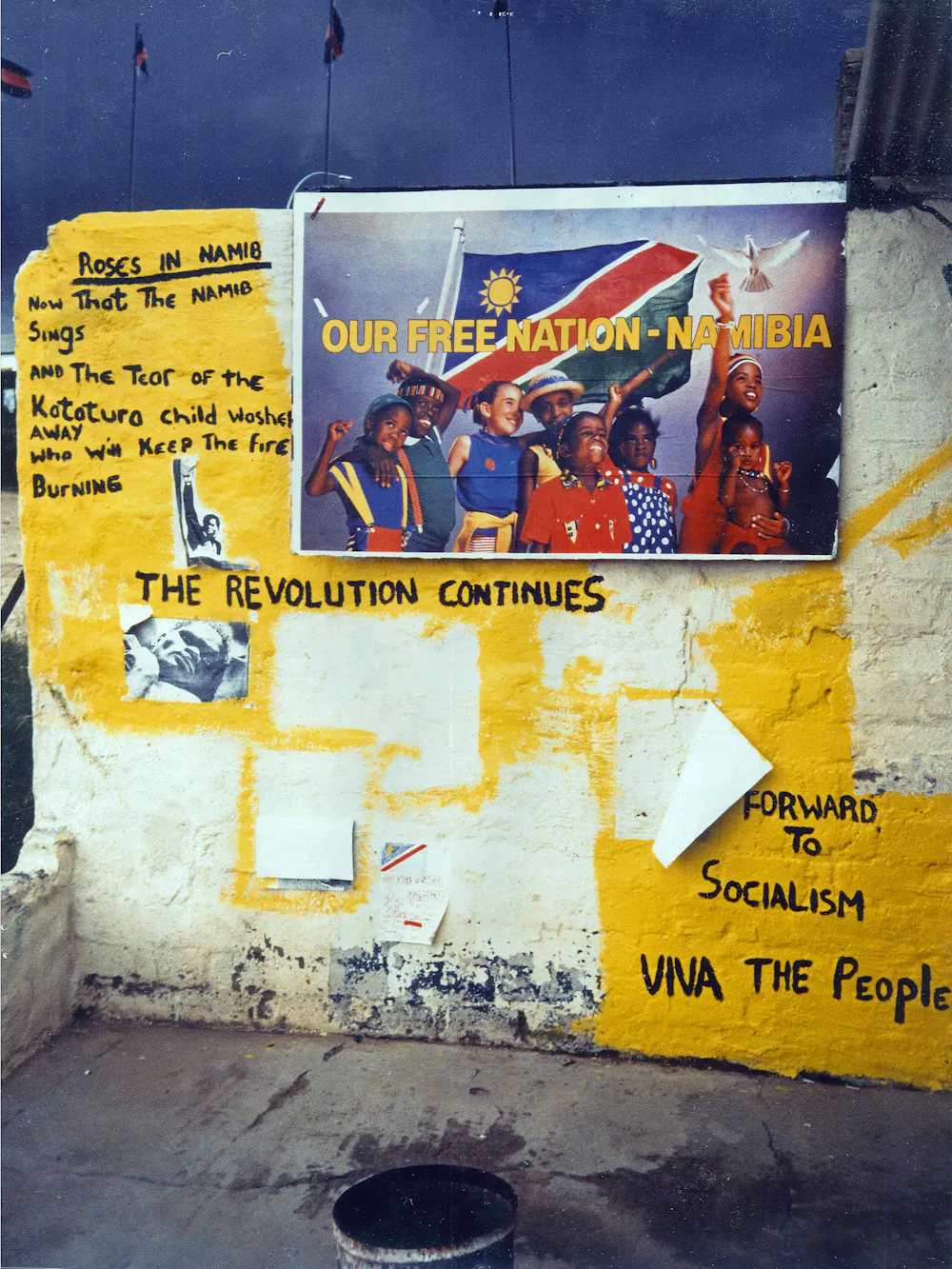
Independence was finally won in 1990.Image: Henning Melber
Swapo was founded in 1960 after the killing of unarmed demonstrators, who refused forced resettlement from Old Location, a residential area for Africans in the city of Windhoek. In 1966 it began an armed struggle. In 1976 the UN recognised Swapo as “the sole and authentic representative” of the Namibian people.
The warfare against the South African regime mirrored the ambiguities and dilemmas of most armed liberation struggles. Swapo’s military command structure in exile enforced a non-democratic, centralised totalitarian mindset and a willingness to violate human rights. But the war was a relevant factor to end the foreign occupation by a White minority regime.
How has the past shaped the present?
Germans and Namibians share the long shadow of German colonialism. Most Germans know little about German colonial history. But its legacy continues to influence Namibian realities.
This is most visible in the inequality of land distribution. For the descendants of those robbed of their land, colonialism remains present. Many consider German development cooperation as another form of injustice.
Swapo transformed into a dominant party in government. It cultivates heroic narratives and a selective patriotic history. A new Black elite justifies its privileges with the struggle sacrifices.
But Namibians live in relative peace and freedom. The constitution protects civil liberties and democracy. It entrenches the rule of law. These essentials have remained respected in governance since independence. Despite all the shortcomings, it is worth it for the colonised to fight for such a society – not only in Namibia but anywhere in the world.
– Namibia: the history of a country shaped from a rich and traumatic past – https://theconversation.com/namibia-the-history-of-a-country-shaped-from-a-rich-and-traumatic-past-277655
The war in the Middle East is creating the largest supply disruption in the history of the global oil market.
The impact is being felt by countries across the globe. African countries are no exception, including those that produce oil.
We asked five scholars from Nigeria, South Africa, Senegal, Kenya and Ethiopia to answer the question: Is the spike in oil prices hurting your country’s economy?
The answer was a uniform “yes”. The universal fear is the effect the rise in prices is having on fuel, a staple commodity in every one of the countries for ordinary people as well as industries. In some cases, such as Ethiopia, the government has already introduced fuel subsidies to shield people from the impact of having to pay more at fuel pumps.
The fear that higher prices and outright scarcity could have damaging effects, notably on food production, was also near universal.
For some there may be a silver lining: Kenya and Senegal are in the early phases of oil production. But they’re some way off reaping the benefits of higher prices. And in the case of Nigeria, the danger is that any windfall that comes its way won’t ease the economic burden faced by ordinary people.
– Oil price surge is hurting African economies: scholars in Ethiopia, Kenya, Nigeria, Senegal and South Africa take stock – https://theconversation.com/oil-price-surge-is-hurting-african-economies-scholars-in-ethiopia-kenya-nigeria-senegal-and-south-africa-take-stock-278679
It is with great sadness that we announce the passing of the Special Representative of the Secretary-General and Head of the United Nations Mission in South Sudan, Nicholas (Fink) Haysom.
Mr. Haysom was appointed by the Secretary-General to his role at UNMISS in January 2021, bringing with him decades of distinguished service to the United Nations across Sudan, Somalia, Afghanistan, Iraq, and New York.
A seasoned mediator, diplomat and constitutional expert, he played crucial roles in progressing peace processes and governance reform in some of the world’s most complex environments.
As the top United Nations official in South Sudan, Mr. Haysom was steadfast in his conviction that the international community stands shoulder-to-shoulder with the people of South Sudan in their journey of nation-building. He was committed to advancing a peaceful, inclusive, and democratic transition for the country, one that placed the aspirations and welfare of its citizens at the very foundation.
Mr. Haysom remained true to the ideals that shaped his early years, firmly believing that the will of the people must be the fulcrum upon which South Sudan shapes its political destiny.
These ideals were rooted in his upbringing and education in South Africa, where he left an indelible imprint as an anti-apartheid activist and lawyer upholding human rights. It is this lifelong passion for justice that fueled his dedication to public service, democracy, and the rule of law.
Mr. Haysom’s principled leadership, wisdom, diplomatic skills, and unwavering commitment to a brighter future for South Sudan inspired not only UNMISS peacekeepers, but the communities we serve and all those whose lives he touched.
We extend our deepest condolences to Mr. Haysom’s family, loved ones, colleagues across the United Nations system, and to the Government and people of South Africa.
He will never be forgotten, and his legacy will continue to be a beacon of hope.
Distributed by APO Group on behalf of United Nations Mission in South Sudan (UNMISS).
Health professions regulatory bodies, education leaders and technical experts from across the African Region have reached a landmark consensus on the Africa Health Professions Education Quality Standards (AHPEQS), establishing a shared continental framework to strengthen the quality, relevance and responsiveness of health professional training.
The agreement comes at a critical time for the Region, which faces a projected shortage of 6.1 million health professionals by 2030, driven by high attrition, outmigration and persistent mismatches between training outputs and evolving population health needs. In many countries, this challenge is compounded by a structural labour market paradox, where workforce shortages coexist with unemployment, particularly affecting primary health care and specialized services, and placing additional strain on fragile and vulnerable settings.
Adopted during a three-day meeting in Potchefstroom, South Africa, the standards mark a decisive shift from expanding training capacity alone toward ensuring consistent quality, accountability and competence across health professions education systems. While the African Region has made significant progress in increasing training output, with more than 4,000 institutions producing over 225,000 graduates annually, concerns remain about the readiness of some graduates to meet increasingly complex health system demands.
Evidence continues to highlight gaps in competencies, including challenges in diagnostic accuracy and clinical decision-making, underscoring the need for stronger, more harmonized education and accreditation systems. Variations in education quality, regulatory capacity and institutional performance have further contributed to inconsistencies in the delivery of safe, effective and people-centred care.
The newly adopted AHPEQS respond directly to these challenges by providing a comprehensive framework structured across nine domains and 35 standards, covering regulatory systems, institutional governance, curriculum and educational processes, student selection and support, academic and support staff, infrastructure and technology, institutional quality assurance, partnerships, and health workforce competence. Together, these standards establish a common reference for countries to strengthen accreditation, improve institutional performance and ensure that health professionals are equipped with the competencies required to respond to evolving health needs.
The consensus, formalized through the Potchefstroom Consensus, reflects a growing recognition among countries and partners that improving health outcomes depends not only on increasing the number of health workers, but also on ensuring the quality and relevance of their education. It also aligns with continental priorities, including the African Union’s Agenda 2063, which promotes the development of a competent workforce and the free movement of health professionals across the continent.
“We are collectively shaping a continental architecture for health professions education that reflects African realities, responds to African health priorities and is built on African leadership and consensus” said Dr Adelheid Onyango, Director of Health Systems Strengthening at the WHO Regional Office for Africa.
Participants also issued a strong call to action to accelerate implementation of the standards. The World Health Organization was urged to work with the African Union, Regional Economic Communities and partners to finalize technical guidance, benchmarking tools and supporting materials, and to support countries in adopting and operationalizing the standards. Member States were encouraged to integrate the standards into national regulatory, accreditation and curriculum review processes, while regulatory bodies and training institutions were called upon to advance competency-based education, strengthen collaboration and leverage innovation to improve learning outcomes.
The AHPEQS form part of the broader Africa Health Workforce Agenda 2026–2035, which aims to educate, employ and retain an additional three million health workers across the continent. Building on the development of regional prototype competency-based curricula launched in 2025, the standards represent a critical next step in aligning education systems with health system needs and ensuring that investments in workforce development translate into improved service delivery and better health outcomes.
“These standards will support countries to strengthen accreditation systems, enhance accountability and improve comparability of qualifications, while also advancing mutual recognition and mobility of health professionals across borders” said Dr James Avoka Asamani, Health Workforce Team Lead at WHO Regional Office for Africa.
With the adoption of the AHPEQS, countries across the African Region have taken a significant step toward ensuring that health professionals are not only trained in greater numbers, but are equipped with the skills, competencies and professionalism required to deliver quality care and advance progress toward universal health coverage and the Sustainable Development Goals.
Distributed by APO Group on behalf of WHO Regional Office for Africa.
IMF staff and the Seychellois authorities reached a staff-level agreement on the policies needed to complete the two final reviews under the 36-month Extended Fund Facility and Resilience and Sustainability Facility.
Seychelles has made strong progress toward key economic objectives, including a reduction of public debt, rebuilding foreign exchange reserves, strengthening the monetary policy framework and financial sector supervision, and advancing climate related reforms.
Supported by strong economic outturns in 2025, these achievements have left Seychelles in a stronger position as it confronts new shocks emanating from ongoing conflict in the Middle East.
An International Monetary Fund (IMF) team led by Mr. Todd Schneider, Mission Chief for Seychelles, visited Victoria from March 4-19, 2026, to conduct discussions for the two final reviews (5th and 6th) under the Extended Fund Facility (EFF) and Resilience and Sustainability Facility (RSF) arrangements and the 2026 Article IV Consultation. Consideration by the IMF Executive Board is tentatively scheduled for May 2026.
At the end of the mission, Mr. Schneider issued the following statement:
We are pleased to announce that IMF staff and Seychellois authorities have reached a staff-level agreement on policies to complete the final reviews of Seychelles’ 36-month EFF and RSF arrangements. Subject to reform implementation and approval by the IMF Executive Board, Seychelles will receive a disbursement of up to SDR 32.9 million (about $45 million), bringing total disbursements to SDR 76.7 million (about $105.1 million) since May 2023.
The Seychelles economy saw robust performance in 2025. Real GDP growth is estimated at 5.1 percent, driven by record tourist arrivals, while consumer price inflation was just below zero. The government fiscal balance for 2025 is estimated as a primary surplus of 2.5 percent of GDP, which helped reduce the level of public and publicly guaranteed debt to 53.6 percent of GDP. Higher tourism earnings helped shrink the external current account deficit to 6.5 percent of GDP—facilitating an increase in central bank foreign exchange reserves to just over 4 months of import cover.
Performance under the EFF arrangement has been strong. All quantitative targets for end-June 2025 were met, and all but one for end-December. The government has implemented (or is expected to finish soon) most structural reforms under the EFF, although two will take additional time. The Central Bank of Seychelles had intended to launch a pilot retail-oriented window for banks to purchase government securities by January 2026, but more time is needed to complete prerequisite reforms, specifically to establish a Real Time Gross Settlement System and a Central Securities Depository. A second reform—to complete pilot functional reviews of the ministries of finance, education, and health by end-2025—is now expected to be completed, with support from the World Bank, before the end of 2026 as an important input to a comprehensive analysis of the size and structure of the public sector.
Climate-related reforms under the RSF have also made good progress. Several measures with respect to managing and reporting climate-related financial sector risk have been completed by CBS. Remaining reform measures related to an analysis of gaps in climate-related data, and publication of a climate risk exposure assessment of the banking sector are expected to be completed before the end of the program. One other reform measure—to establish an implementation framework for a multi-year system for end-use electricity tariffs that are cost reflective—is pending, subject to review and approval by the Cabinet.
The mission held detailed discussions on the outlook for 2026 considering recent developments in the Middle East. Based on conservative assumptions regarding the disruption to air connectivity and tourist spending, real GDP growth is projected to slow to about 1.5 percent in 2026. Higher international prices for oil and food together with rising freight costs are projected to bring average consumer price inflation to 2.6 percent in 2026. The decline in tourist income, combined with higher import prices, could lead to a deterioration of the external current account balance to an estimated 7.8 percent of GDP, and a modest decline in central bank foreign exchange reserves. Lower tourism activity is also likely to reduce government revenues and increase the overall fiscal deficit. These projections are highly tentative given the rapidly changing external environment.
The mission recommends the government consider contingency measures on both the expenditure and revenue side to adjust to these developments, and that any additional spending measures are well targeted to the most vulnerable segments of the population and temporary in nature. Exchange rate flexibility will also be a necessary tool to enable adjustment and maintain external buffers. Emphasis on structural reforms to enhance the business environment, promote diversification, inclusive growth, and stronger resilience to climate related shocks will be critical over the medium-term.
“The mission is grateful for the authorities’ excellent cooperation as well as the candid discussions. As Seychelles approaches the successful conclusion of the EFF and RSF arrangements, the IMF remains committed to supporting Seychelles in maintaining macroeconomic stability in the face of new shocks and advancing its reform agenda to support resilience and sustainable and inclusive growth.”
Distributed by APO Group on behalf of International Monetary Fund (IMF).
The Government of the Republic of Zambia, in collaboration with the Food and Agriculture Organization of the United Nations (FAO) and with support from the Government of the United States of America, has officially launched the Zambia Soil Partnership (ZSP) and the Global Soil Doctors Programme (GSDP) to strengthen national coordination on sustainable soil management and support more productive, resilient and market-oriented agrifood systems in the country.
These initiatives are being implemented under the Soil Mapping for Resilient Agrifood Systems (SoilFER) programme which is operational in seven countries across Africa and Central America. SoilFER is funded by the United States Department of State and the Ministry of Foreign Affairs of Japan. The programme generates and transforms soil science and data into concrete actions, informing the decisions of farmers, governments and agribusiness actors to increase agricultural productivity, improve crop selection, optimize fertilizer use and strengthen agrifood value chains.
The event also marked the inauguration of a soil moisture monitoring station (Cosmic Ray Neutron Sensor – CRNS) under the programme, installed and calibrated by FAO in collaboration with the FAO/IAEA Joint Centre of Nuclear Techniques in Food and Agriculture at the University of Zambia (UNZA). The station forms part of broader efforts to strengthen soil analysis capacity in Zambia through upgrades to laboratory equipment and infrastructure, alongside targeted training for national technical staff.
The launch took place during a national technical workshop held in Lusaka on 17-18 March, officially opened by the Permanent Secretary for Technical Services, Ministry of Agriculture, Republic of Zambia, Representatives of the United States Embassy and Department of State, a representative from the Embassy of Japan and the FAO Representative in Zambia. The event marks the start of a series of activities taking place from 17 to 24 March, including field-based training sessions at the ZARI Kabwe Research Station in Central Province and in Chongwe District, Lusaka Province. During the week extension agents and farmers will participate in hands-on training to strengthen practical knowledge on soil health and fertilizer management.
In Zambia, agriculture is a key driver of rural livelihoods and economic growth. However, soil degradation and declining soil fertility challenge sustainable agricultural production, making improved soil health essential for increasing crop productivity, strengthening local markets and rural livelihoods, and supporting long-term agricultural stability.
The ZSP will serve as a national multi-stakeholder platform bringing together government institutions, research organizations, universities, soil laboratories, farmer organizations, private sector actors and development partners. During the technical workshop, stakeholders agreed on priorities and a roadmap for coordinated soil management actions under the partnership.
The Global Soil Doctors Programme is a farmer-to-farmer training initiative that equips farmers and extension agents with practical tools to assess soil health, identify soil threats and improve soil and fertilizer management.
Speaking on behalf of Hon. Reuben Mtolo Phiri, Minister of Agriculture of the Republic of Zambia, Mr John A. Mulongoti, Permanent Secretary for Technical Services, highlighted the importance of strengthening soil health to support Zambia’s agricultural transformation agenda.
“Healthy soils are the foundation of sustainable agriculture and food security in Zambia. Strengthening soil management and coordination among national institutions is essential to improving agricultural productivity and ensuring the long-term resilience of our agrifood systems.”
The launch also underscored the role of international partnerships in advancing sustainable soil management. Ms Suze Percy-Filippini, FAO Representative in Zambia, noted FAO’s continued commitment to supporting the Government of Zambia and national partners.
“The SoilFER programme demonstrates how investments in data, innovation, technologies, technical capacities and partnerships can transform agrifood systems to become more efficient, resilient, sustainable and productive.”
Highlighting the importance of innovation, soil information, and results from the ground, Ms Julie Kapuvari, Science and Policy Advisor at the U.S. Department of State, emphasized the broader impact of soil health on food systems and nutrition.
“Healthy soils grow healthy crops, and healthy crops nourish healthy people. Soil health matters: it’s not just about productivity, but also about resilience and better nutrition. It ensures that food contains the nutrients families need.”
The establishment of the ZSP and the GSDP aligns with the framework of the Global Soil Partnership, a global initiative coordinated by FAO to promote sustainable soil management, protect soil resources, and contributes to regional efforts under the African Soil Partnership.
The launch of these initiatives marks an important step towards boosting agricultural productivity, expanding agrifood trade and encouraging greater private sector engagement across agrifood value chains.
Distributed by APO Group on behalf of Food and Agriculture Organization of the United Nations (FAO): Regional Office for Africa.