African cities are diverse and thriving, but face many challenges. How to make them healthier

Source: The Conversation – Africa – By Elaine Nsoesie, Assistant Professor, Department of Global Health, Boston University School of Public Health, Boston University

A new book called Urban Health in Africa explores how rapid urbanisation across the continent shapes public health and wellbeing. Drawing on diverse research and case studies, the book reframes African cities not just as sites of challenge, but as places of innovation, resilience and opportunity.

We spoke to global health researcher Elaine Nsoesie and urbanisation and wellbeing sociologist Blessing Mberu, co-editors of the book, to explore why the stories of African cities matter, and what it will take to build inclusive, healthy urban futures.

What’s one thing about urban life in Africa that you think more people should appreciate?

African cities work, but not always like cities in other regions. In the book, we quote the following text by AbdouMaliq Simone, who works on issues of spatial composition in urban regions:

In city after city, one can witness an incessant throbbing produced by the intense proximity of hundreds of activities: cooking, reciting, selling, loading and unloading, fighting, praying, relaxing, pounding, and buying, all side by side on stages too cramped, too deteriorated, too clogged with waste, history, and disparate energy, and sweat to sustain all of them. And yet they persist.

That persistence matters. Too often, discussions about African cities focus only on their problems. These include inadequate infrastructure, rapid urbanisation and informal settlements. What gets lost is their remarkable functionality and their diversity. No single city can represent the entire continent. Lagos is not Nairobi; Accra is not Dakar. Each has its own history, governance structures and contemporary challenges. Treating them all the same flattens this complexity.

Yes, these cities face serious challenges. But they’re also home to innovative urban experts, effective policy solutions and technological breakthroughs designed for their specific contexts. The question isn’t whether African cities work. It is whether we’re paying attention to how they work, documenting how they are addressing challenges related to health and learning from their solutions.

Was there a story or example that really stayed with you?

When we set out to write this book, we knew we had to start with history. You can’t understand health in African cities today without understanding how colonialism shaped the built environment and urban citizenship. We wanted readers to see how historical forces combined with rural-urban migration, population growth and policies created the urban landscapes affecting millions of lives today.


Read more: Harare’s street traders create their own system to survive in the city


Our second goal was to map the social determinants of health – the conditions of the environments in which people are born, live, play, work and learn – shaping African cities. We focused on informal settlements and slums because they’ve become defining features of urban Africa. We examined how residents navigate daily struggles: inadequate housing, water and sanitation; air pollution; transportation; food insecurity. We didn’t want to present these as isolated problems. We wanted to show how they’re interconnected challenges that affect many communities.

One of our favourite chapters is in this section. The chapter explores how transport affects health in African cities – both the risks and the benefits. For example, the availability of transportation increases access to hospitals and schools, while vehicles also cause traffic injuries and air pollution. The authors also discuss distinctive forms of public transport that African cities share that you won’t find in most other parts of the world.

Motorcycle taxis, for example, have different names. They are called boda bodas in Kampala, okadas in Lagos. Commuter minibuses are referred to as poda-poda in Freetown, trotro in Accra, daladala in Dar es Salaam, matatu in Kenya, car rapides in Dakar, kamuny in Kampala, gbaka in Abidjan, esprit de mort in Kinshasa, candongueiros in Luanda, sotrama in Bamako, songa kidogo in Kigali.

Freetown, Sierra Leone. Getty Images

The chapter captures a major theme in the book; while these cities are different, policies that have been effective in one city can be adopted to address the needs of residents in another city.


Read more: South Africa’s minibus taxi industry runs on social bonds – reform must accept this


In addition to the social determinants of health, we had another section that addressed Africa’s unique demographic reality: these cities are young. We dedicated sections to how urban environments shape young lives, particularly around sexual and reproductive health. We also highlighted the growing epidemic of chronic diseases like obesity, diabetes and hypertension. Studies have shown an association between the rate of urbanisation in Africa and an increase in chronic diseases because of issues such as adoption of unhealthy western diets, lack of spaces to exercise, and sedentary behaviours.

To showcase how some cities are addressing the challenges related to the social determinants of health, we included case studies on air quality in Kampala, new mental health initiatives in Yaoundé, an approach to reducing school dropouts in Arusha, integrated planning transforming informal settlements in Nairobi, and digital health innovations. The case studies demonstrate that effective solutions incorporate community voices and the local context.

Your book outlines a future for urban health in Africa. What do you see?

Our final chapters make explicit what we believe must happen next. We need public health professionals, urban planners, physicians, nurses, community health workers, policy advocates and water and waste managers working together. We need educational programmes focused specifically on urban health. Most critically, we need strong local, national and regional governance to turn plans into reality.


Read more: Youth workers are spreading health messages on social media: how to support what they do in South Africa


But we also need to elevate youth voices, ideas and innovations across the continent. According to United Nations estimates, about 40% of Africans were under 15 in 2020, and nearly 60% were under 25 – the largest proportion of young people of any region worldwide.

Young people are shaping African cities and they will live with the consequences of whatever decisions are made today.

What motivated the publication of this book, and why now?

When we started this project there weren’t any books on urban health in Africa written by Africans working to address the various challenges faced by urban residents. An estimated 46% of Africa’s 1.3 billion people live in urban areas. Africa is also the continent with the fastest urbanisation rate, with 50% to 65% of the population projected to live in urban areas by 2050. Despite having urban challenges similar to those in other regions, some of the issues that cities in Africa face are unique.

We wanted to bring together researchers and practitioners with diverse expertise and deep knowledge of the challenges people face in cities. We wanted to look at these challenges, the policies that have been effective and recommendations about what must be done to improve the health of residents.

– African cities are diverse and thriving, but face many challenges. How to make them healthier
– https://theconversation.com/african-cities-are-diverse-and-thriving-but-face-many-challenges-how-to-make-them-healthier-274647

Bad rural roads in South Africa aren’t just a technical problem – they block people’s rights: report

Source: The Conversation – Africa – By Siyabulela Christopher Fobosi, Senior Researcher, UNESCO ‘Oliver Tambo’ Chair of Human Rights, University of Fort Hare, University of Fort Hare

In many rural parts of South Africa, getting to a hospital, school or workplace depends on the condition of a gravel road. When that road collapses during rain or potholes make it impassable, the consequences are immediate: ambulances cannot reach patients, children miss school, workers lose income.

This is the reality for many communities in the Eastern Cape, one of South Africa’s poorest provinces. Here, four out of every five children live in households whose monthly income isn’t enough to meet their basic needs. In 2024, nearly 50% of children in the Eastern Cape lived in households without a single employed adult – the highest rate in the country.

A recent study in one Eastern Cape community documents that the roads are so degraded – from poorly maintained gravel to crumbling asphalt – that they actively cut residents off from healthcare, education and markets.

The problem is often described simply as a failure of service delivery. But this explanation is incomplete. My research as a sociologist with a particular interest in the transport sector suggests that the decay of rural roads reflects something deeper. It is not a breakdown, but a continuation. A regime of inequality continues to shape infrastructure development long after the end of apartheid.

The poor infrastructure is a direct legacy of apartheid’s spatial planning, which from 1948 to 1994 systematically underdeveloped rural “homelands” like the former Transkei (now in the Eastern Cape) to confine and control the Black majority.

Today’s neglected roads still physically isolate communities, restrict their access to markets and services, and demonstrate how the state, through inaction and underfunding, maintains the barriers established by its predecessor.

In my study, I drew on the 2023 inquiry conducted by the South African Human Rights Commission into the state of rural roads in the province. The inquiry was convened in response to a pattern of complaints received by the Commission from rural communities over several years. I served on the panel for this inquiry, which heard oral testimonies from affected community members and farmers, and received detailed written submissions from key stakeholders.

A key finding was that only 9% of the province’s roads are paved, compared to a national average of 25%. The inquiry found that poor road infrastructure limits people’s ability to access essential services enshrined as constitutional rights, such as healthcare, education and social support.

Roads as a system of power

Infrastructure is often seen as neutral – roads, bridges and railways that simply allow people and goods to move. But infrastructure also reflects political choices about who receives investment and who is left behind.

A snapshot of this is evident in the provincial budget for roads in the Eastern Cape. The human rights inquiry report reveals that the Eastern Cape Department of Transport receives an annual allocation of about R2.5 billion (almost US$150 million) for its road network. But the department itself estimates a capital backlog of R30.5 billion just to bring roads up to an acceptable standard.

While the annual budget allows for upgrading only about 42km of road per year (at an average cost per kilometre of R18 million, or over US$1 million), the province has over 36,000km of unpaved roads – a legacy of apartheid-era neglect.

This is not a technical failure. It is a political choice to perpetuate a system where the most vulnerable communities remain isolated.

Three decades after democracy, many of these patterns remain visible. And the effects continue to ripple through everyday life.

The everyday harm of infrastructure decay

For rural residents, road deterioration is not just an inconvenience. It produces what scholars call slow, everyday harm.

Ambulances struggle to reach remote villages, delaying medical care. School transport is disrupted when buses cannot travel on damaged roads. Farmers face difficulties transporting goods to markets. Public transport services often avoid areas where roads are impassable.

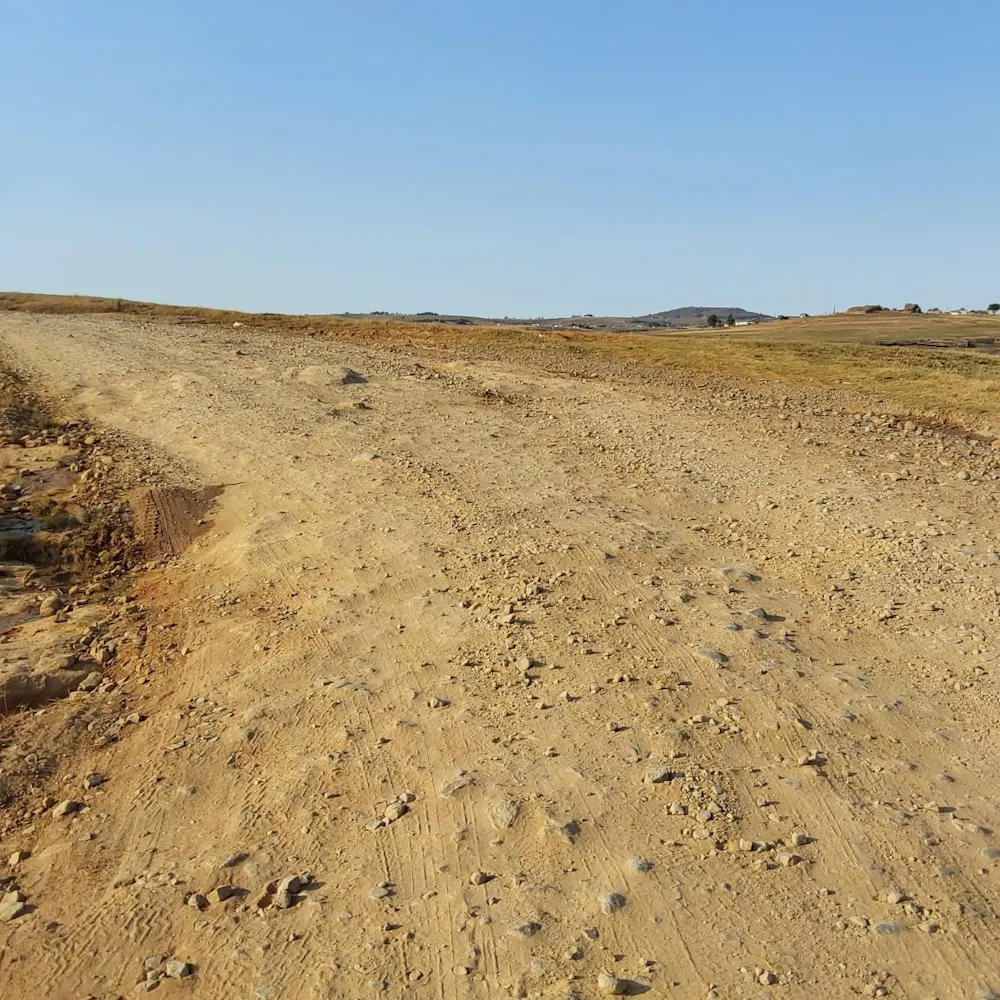
Eastern Cape road. S.C. Fobosi, Author provided (no reuse)

These impacts accumulate over time, affecting livelihoods, health and dignity.

In some cases, residents must walk long distances because vehicles cannot reach their communities. During heavy rains, entire villages can become temporarily isolated.

This situation highlights how infrastructure shapes social inequality. When roads deteriorate, the burden falls disproportionately on people who already face economic and geographic marginalisation.

Why the problem persists

Several factors contribute to the continued deterioration of rural roads.

The first is the massive historical backlog.

Second, the funding model is fundamentally inadequate. The inquiry report details that the Eastern Cape relies almost entirely on the Provincial Roads Maintenance Grant. Provincial Treasury itself argued that the national funding formula, based on population, fails to account for the province’s vast geography and historical infrastructure deficit.

Third, governance and capacity issues are rife. Submissions from the Auditor General highlighted repeated financial mismanagement within the Department of Transport, including fruitless and wasteful expenditure on contracts. Municipalities, tasked with maintaining local roads, often lack the resources and the technical capacity to effectively use management systems.

Fourth, the impact of climate change is accelerating decay. The inquiry heard from multiple municipalities about how increasingly severe weather events overwhelm their ability to respond.

Finally, a lack of coordination and accountability. The report notes that despite clear legal mandates, there is often poor planning between the provincial department, the national roads agency and municipalities, leading to misaligned priorities and slow project implementation.

Urban areas and major highways receive priority funding because they are economically strategic. This is not a uniquely South African phenomenon – it is a global pattern. The World Bank estimates that 80% of the world’s poorest people reside in rural areas.


Read more: Land reform in South Africa is failing. Ignoring the realities of rural life plays a part


Rural roads tend to receive less consistent maintenance. When maintenance is consistently deferred, costs climb.

Meanwhile, funds that could be used for this upkeep are often tied up elsewhere. A recent Auditor-General’s report found that municipal infrastructure projects nationally face average delays of 17 to 26 months, and all South African municipalities combined spend only 4% of the total value of their assets on maintenance.

These numbers show that the deterioration of rural roads is not an accident, but the predictable outcome of political choices not to invest in marginalised communities.

Communities stepping in

Despite these challenges, rural residents are not passive victims of infrastructure neglect.

Across parts of the Eastern Cape, communities have organised to repair roads themselves. Residents fill potholes, clear drainage channels and use local materials to stabilise damaged sections of road.

Rural road, Eastern Cape. S.C. Fobosi

These efforts are often informal and rely on collective labour rather than state support. They reflect what scholars sometimes call “insurgent infrastructure” – grassroots initiatives that emerge when the state fails to maintain essential services.

While such actions demonstrate community resilience, they also highlight the scale of the problem. Road infrastructure is expensive and technically complex to maintain. Community efforts cannot substitute for sustained public investment.

Rethinking infrastructure policy

Addressing rural road deterioration requires more than occasional repairs. It demands a broader rethinking of infrastructure governance.

First, rural infrastructure should be treated as a development priority, not a secondary concern. Reliable roads are essential for economic participation, access to services and social inclusion.

Second, government agencies need stronger coordination to ensure that road maintenance responsibilities are clearly defined and effectively implemented.

Finally, policymakers should recognise the knowledge and experience of rural communities themselves. Residents often understand the local terrain and infrastructure challenges better than distant administrators.

Beyond service delivery

If rural roads continue to deteriorate, the consequences will extend far beyond transport. They will reinforce social and economic exclusion for already marginalised communities.

Recognising infrastructure as part of a broader regime of inequality is an important step towards addressing these challenges.

– Bad rural roads in South Africa aren’t just a technical problem – they block people’s rights: report
– https://theconversation.com/bad-rural-roads-in-south-africa-arent-just-a-technical-problem-they-block-peoples-rights-report-278337

South Africa’s gig economy workers set to get more protection under planned labour law reforms

Source: The Conversation – Africa – By Ruth Castel-Branco, Senior lecturer, University of the Witwatersrand

South Africa’s minister of employment and labour has published a sweeping set of proposed amendments to the Basic Conditions of Employment Act, the Employment Equity Act and the National Minimum Wage Act.

The aim is to

modernise key labour laws and introduce practical measures aimed at improving job security, promoting fairness, and extending fundamental rights to vulnerable and previously excluded categories of workers.

For workers on digital labour platforms, who access task-based work opportunities through an app, one amendment is particularly significant. Amendment 50A introduces expanded definitions of employer and employee that could extend labour and social protections to platform workers. These include minimum wages, paid leave, social security, occupational health and safety coverage, and the right to collectively bargain.

Until now, platform companies have largely avoided national regulations by presenting themselves as intermediaries rather than geographically tethered service providers. But the tide is turning as governments and international standard-setting institutions move to regulate the platform economy.

South Africa’s labour law amendment is a part of this broader global effort. Propelled by platform worker organising, several countries, including Kenya, Egypt and Nigeria, have introduced regulations for ride-hailing services. At the international level, member states of the International Labour Organization are expected to adopt new standards for platform work later this year. However, as one of the South African negotiators recently remarked, “the discussion about the platform economy … {is} like a battlefield”.

For the last five years the Future of Work(ers) research group at the Southern Centre for Inequality Studies has studied how digital labour platforms are restructuring the world of work and emerging efforts to regulate platform companies across Africa. Kenya has taken a sectoral route targeting e-hailing. South Africa’s approach is broader, but has the potential to exclude those who are in fact self-employed.

Our latest paper, Who counts as a worker?, explores the tensions inherent in regulating a sector defined by diverse and shifting work arrangements.

Why definitions matter

How workers are classified determines what rights they can claim, who they can claim them from and what kinds of benefits they can access.

South African labour law establishes minimum standards for employees. These include:

  • minimum wages and deductions

  • working hours and overtime pay

  • paid leave and parental benefits

  • health and social protections

  • disciplinary procedures

  • collective bargaining.

But platform companies have got around minimum standards by classifying workers as independent contractors rather than employees. The result is that working conditions are precarious. Platform workers work long hours, for low and unpredictable pay, with no health and social protections. And they bear the brunt of operational costs and risks. All while paying commissions to the company.

Platform companies insist that workers are self-employed. Yet the companies exercise high levels of control over the labour process through task-based work allocation and algorithmic management. Through a punitive system of ratings, suspensions and deactivations, platforms unilaterally shape the terms of work. In a recent survey conducted by the International Labour Organization, platforms argued that although workers were self-employed, they should not be allowed to refuse tasks or disconnect from the app.

The battlefield of definitions

It is likely that platform companies will challenge attempts to reclassify workers as employees. After all, calling workers self-employed has been integral to their business model. In Kenya, for instance, platform companies launched multiple legal challenges against new regulations. They have argued their cases on the grounds that:

  • the government lacked jurisdiction over their operations

  • labour minimum standards infringed on competition law

  • the regulations discriminated against migrant workers.

These challenges were shot down by the courts.

How will this amendment affect workers’ lives?

The proposed amendment to South Africa’s law does not regulate platform companies directly. Instead, it says that unless proven otherwise, a person who provides services to another is an employee, regardless of the employment contract. This is in accordance with the National Minimum Wage Act.

The employer has to prove that workers are genuinely self-employed. To qualify as self-employed, a worker must be able to exercise autonomy over the labour process and operate independently from the organisation of the employer.

Labour protections can be extended to platform workers in at least two ways.

The first is through sectoral determinations, made by the labour minister. These are useful in sectors where unionisation and collective bargaining is weak. They can be tailored to the specific dynamics of a sector, so that regulations improve conditions for vulnerable workers.

However, the existing sectoral determinations are not well suited to the reality of platform work. For example, workers may earn rates that appear to exceed the national minimum wage. Yet, their take-home pay may fall well below minimum levels, once investment and operational costs are factored in.

Similarly, conventional conceptions of ordinary hours of work may not reflect how the work is organised on a platform. And existing sectoral determinations don’t address questions like:

  • the term of algorithmic management

  • the ownership, governance and use of the vast amounts of data generated by workers

  • the integration of third parties, such as fintechs, on the platforms

  • the regulation of deductions, including commissions and service charges.

A second way to regulate platform work is to establish a bargaining council for the platform economy. This model would give greater voice to workers and employers in shaping the conditions of work in this emerging sector.

Given that governments are still trying to catch up to digitalisation, collective bargaining may offer more innovative and appropriate regulatory responses. Governments can then extend bargaining council agreements to all firms in the sector.

Workers’ voices

Regulations must be designed carefully to ensure that they strengthen rather than undermine platform workers’ power and agency. As our latest working paper notes, the platform economy encompasses diverse forms of work and varying degrees of subordination. As we recently discussed in a webinar, it is critical that platform workers’ organisations be included at the negotiating table. As our working paper argues, these definitional questions are more political than technical.

– South Africa’s gig economy workers set to get more protection under planned labour law reforms
– https://theconversation.com/south-africas-gig-economy-workers-set-to-get-more-protection-under-planned-labour-law-reforms-277858

Iran war could add to Nigeria’s security troubles. What to watch out for

Source: The Conversation – Africa – By Al Chukwuma Okoli, Reader (Associate Professor) Department of Political Science, Federal University of Lafia, Nigeria, Federal University Lafia

The war between Iran and Israel and the US may have far-reaching regional and global implications.

By mid-March, there were signs that it could last longer than many had expected.

The longer it lasts, the greater the effects on the global landscape will be.

Barely three weeks into its outbreak, the violence caused disruptions to the flow of oil, resulting in a spike in oil prices.

But that’s not the only way Nigeria may feel its impact.

I am a security scholar and analyst who has researched and written extensively on aspects of Nigeria’s security challenges. These include insurgency, terrorism and counter terrorism.

This work has informed my view that the Iran-Israel-US war poses three fundamental threats to Nigeria’s national security. There could be:

  • heightened attacks by terrorists affiliated with Iranian Islamists

  • increased violence between Christians and Muslims

  • arms flows into Nigeria from Iran and its ideological allies, such as Hezbollah.

These possibilities stand to add to the country’s present security woes, which have been complicated by external jihadist proxies.

The threat of heightened terror attacks

Iran is believed to be a major sponsor of Islamic radicalism and extremism in Nigeria. Iran has suspected links with the proscribed Islamic Movement of Nigeria, a sect which has been accused of stoking anti-state militantism.

With the escalation of the conflict, agents and militants sympathetic to the Iranian cause may align with terrorists to orchestrate attacks on the US or western targets in Nigeria. Some of the terrorist organisations operating in the country are alleged to have links with extremist groups based in or associated with Iran.

Already, the US embassy and other strategic western interests in Nigeria have been placed on high alert.

There have been protests by the Shia brotherhood in Kaduna, Kano, Nasarawa and the Federal Capital Territory (Abuja) since the killing of the Iranian supreme leader, Ayatollah Ali Khamenei. The protesters have been condemning violence against Iran and the global Muslim populace.

Inter-faith tensions

The war may also rupture the delicate and volatile inter-faith and sectarian balance in Nigeria, pitting Christians against Muslims. The Nigerian population is split in nearly even portions between adherents of Islam and Christianity. There have in the past been incidents of religious violence between the groups, especially in the northern region of the country.

The solidarity protests by Muslims affiliated with the Islamic Movement in Nigeria are a predictor of violence. The sect, which wants an Islamic state in Nigeria, has been involved in a series of religious disturbances in the country over the Middle East crisis. It has often engaged the government security personnel in violent confrontations.

The arms trade

Lastly, the war could lead to an influx of arms into Nigeria.

The Nigerian authorities have, in the past, accused Iran of shipping arms into Nigeria, ostensibly for terrorists, based on some authoritative sources.

Given that Iran counts among the leading illicit arms suppliers to Nigeria, the escalation of violence in the country and the wider Middle East may lead to an influx of arms. Extremist groups in Iran might consider using their franchises in the Sahel to transfer arms to their terrorist affiliates and proxies in Nigeria.

The way forward

Nigeria’s national security apparatus needs to take steps to mitigate the impact of the crisis.

Firstly, its defence and intelligence arsenals need to stay alert. They must be able to detect and respond to threats in a timely and sustainable manner.

Secondly, the country’s borderlands and frontiers need to be protected and policed to avoid the inflow of arms and militants. Tensions in some parts of northern Nigeria, such as Kaduna and Kano, should be carefully addressed. This should not be done with excessive military force, or it could provoke violent backlash.

Importantly, Nigerians should avoid inciting ethno-religious or sectarian violence. Citizens should conduct themselves in a manner that enables peace to prevail.

– Iran war could add to Nigeria’s security troubles. What to watch out for
– https://theconversation.com/iran-war-could-add-to-nigerias-security-troubles-what-to-watch-out-for-278462

Fink Haysom fought tirelessly for justice and reconciliation – in South Africa and on the global stage

Source: The Conversation – Africa – By Hugh Corder, Professor Emeritus of Public Law, University of Cape Town

The preamble of the South African constitution of 1996 starts as follows:

We, the people of South Africa,

Recognise the injustices of our past,

Honour those who suffered for justice and freedom in our land,

Respect those who have worked to build and develop our country, and

Believe that South Africa belongs to all who live in it, united in our diversity.

It is fitting to start with this reminder, given the extent to which these phrases sum up and embody the life and work of Nicholas (Fink) Haysom, who died in New York City on Wednesday 18 March 2026, a month short of his 74th birthday.

Tributes have poured forth from a wide range of people and quarters, appropriately given the geographical reach and indefatigable energy which characterised Haysom’s life’s work.

This tribute is more limited in scope: given my own friendship and shared experiences with him, it focuses overwhelmingly on the first half of his working life, during the last two decades of apartheid South Africa and the transitional phase to the progressive and robust constitutional democracy that came with liberation.

Notwithstanding the significant impact of his work for the United Nations from the year 2000, the qualities forged in Haysom by his intense involvement in the struggle for democratic practices both in the workplace and wider society under the extreme hostility of the apartheid capitalist order shaped his approach to conflict and strife, wherever it occurred.

It would be remiss, however, not to note the main spheres to which he devoted so much of his life.

For the record, his full names were Nicholas Roland Leybourne Haysom. But he was universally known as Fink, to all comers, and most of us who knew him cannot think of calling him otherwise.

His early life

Haysom was educated at a privileged Anglican college in South Africa’s Natal province during the 1960s. He went on to study at the University of Natal in Durban, where he completed an honours degree in politics.

Durban in the early 1970s was the setting for the nurturing and development of a number of students who became significant activists in the anti-apartheid cause. Many were inspired by the views and mentoring of academics like Rick Turner, an academic activist who was shot and killed at his home by the apartheid regime in 1978.

Among them was a future partner in their law firm, Halton Cheadle. These students were involved in supporting the strike action by dock workers in Durban port in 1972/3, which signalled the revival of independent trade unionism among black workers.

Haysom then moved to the University of Cape Town to complete his LLB (law) degree in 1978. It was in these years that he rose in prominence among the ranks of anti-apartheid activists. The National Union of South African Students (Nusas) had long been a thorn in the side of the regime. But it was rocked to its foundations in 1972 following Steve Biko’s establishment of the South African Students Organisation, founded on black consciousness.

The apartheid regime simultaneously convened the Schlebusch Commission of Inquiry into four “radical” opposition movements, among them Nusas. By 1976, only two campuses remained affiliated to Nusas: the University of Cape Town and the University of the Witwatersrand (Wits).

At the annual congress, held at Wits in December 1976, Haysom was elected president, with the task of galvanising support for Nusas on campuses as well as in broader society, in the aftermath of the 1976 Soweto uprising (when protesting black school students were killed by police).

His leadership and energy, as well as his ability to engage meaningfully with people from very diverse backgrounds and ideologies, revived Nusas. The organisation was also able to forge links more broadly across other anti-apartheid organisations within the country.

Haysom was harassed and detained without trial – then and in the ensuing years.

After graduation, he entered the attorneys’ profession. In 1982 he became a founding partner, with Halton Cheadle and Clive Thompson, of the firm Cheadle Thompson & Haysom – still very much thriving today. During the 1980s it was one of the very few firms of “struggle” attorneys.

The firm worked closely with the emergent independent trade union movement among black workers, as well as other civil movements resisting the consolidation of apartheid in urban and rural areas.

Daily life was extremely tough, and it took its toll on him and those with whom he worked. He simultaneously held an appointment as an associate professor at Wits.

The creation of a democratic state

Haysom was a member of the constitutional committee of the African National Congress and played a critical role in the negotiations which led to the constitutional settlement of 1994.

Again, his human qualities of being able to relate patiently and empathetically to so many diverse groups of people, both among the oppressors and the oppressed, and his great capacity to enjoy good social occasions served him – and the cause of freedom and justice – very well.

Many today unjustifiably downplay the dire risks inherent in the negotiations process, and the possibility of a resort to scorched earth tactics by the apartheid regime. If it was not for a few key participants on all sides in the mould of Fink Haysom, such disastrous consequences would have been realised.

President Nelson Mandela’s assessment of the value of Haysom’s qualities and contributions was realised by his appointment as constitutional and legal counsel in the Office of the Presidency, until 1999. Others have written about the myriad ways in which Mandela relied on Haysom in the heady but often tortuous years of his presidency, during which the constitution was drafted and adopted.

The international stage

Haysom was not retained by President Thabo Mbeki. His professional skills and experience were then devoted to mediating conflict and endeavouring to bring peace to many areas in Asia and Africa, in the service of the office of the secretary general of the United Nations.

The list of his areas of engagement reads like a collection of the sites of major conflicts over the past 25 years: Burundi, Iraq, Afghanistan, Somalia, Sudan, southern Africa, South Sudan.

He served under three secretary generals of the UN, the formal title given to his last and incomplete engagement being the Special Representative and Head of UN Mission in South Sudan (from 2021 till his death).

In recognition of such exemplary service in the cause of human rights, constitutionalism and conflict resolution, both in South Africa and internationally, Haysom was awarded an honorary doctorate in law by his alma mater, the University of Cape Town, in 2012, matched in 2019 by the New York Law School.

Haysom was a gregarious, ebullient person, who enjoyed good food and drink and good company. Born to a privileged lifestyle, he responded not by accepting his status and its material rewards, but by devoting his life’s work to addressing conflict and improving the lives of the poorest sectors of humanity.

The burdens occasioned by the blocking of his efforts and the obstinate clinging to brutal power and the unjustifiable resort to brutality and greed by so many with whom he had to engage wore him down: anyone who looks at a photograph of him, even in middle age, and compares it with one taken in the past ten years will be shocked by the changes.

His responsibilities also took their toll on family life and other non-work pursuits. Most people would have been tempted to quit, faced by these odds. Yet he remained in office, as a warrior for justice and reconciliation, until his death.

Especially now, humankind needs many more like him in positions of influence.

– Fink Haysom fought tirelessly for justice and reconciliation – in South Africa and on the global stage
– https://theconversation.com/fink-haysom-fought-tirelessly-for-justice-and-reconciliation-in-south-africa-and-on-the-global-stage-278922

Senegal stripped of title: Afcon ruling is lawful, but it puts Caf’s reputation at risk

Source: The Conversation – Africa – By Fabrice Lollia, Docteur en sciences de l’information et de la communication, chercheur associé laboratoire DICEN Ile de France, Université Gustave Eiffel

The appeals board of African football’s ruling body, the Confederation of African Football (Caf), on 17 March overturned the outcome of the 2025 Africa Cup of Nations (Afcon) final. Afcon is the continent’s biggest tournament.

On 18 January Senegal had won 1-0 in extra time against Morocco in Rabat. But two months down the road Caf declared a 3-0 score in favour of Morocco, citing violations of Articles 82 and 84 of its regulations. (Three points are the mandatory legal penalty.) Senegal has announced it will appeal to the Court of Arbitration for Sport.


Read more: Afcon drama: what went wrong and what went right at the continent’s biggest football cup in Morocco


As a scholar of information and communication sciences, I have studied how social trust and symbolic mechanisms shape and influence organisational dynamics. In my view Caf’s decision to reassign the title to Morocco is not merely a matter of sports law. It also demonstrates how a regulatory decision can clash with the public narrative of an event and undermine a tournament’s image.

A final is not just a result. It is also a narrative, a memory, and a shared collective moment. When an institution later changes that, it destabilises an already established symbolic order.

A final isn’t just played on the field

Research in Information and Communication Sciences shows that an event never exists just as a raw fact. It exists through the channels that make it visible, tellable and shareable. A continental final involves images, commentary, ceremonial gestures, national emotions, digital reactions, and journalistic narratives.

The winner of a final is not merely determined by a rule or a scoreboard. They are also constructed through a chain of communication that publicly sets the event’s meaning. In this sense, victory is not just athletic; it is also narrative.

For the 2025 Africa Cup of Nations, the story had already settled. Senegal won on the field. The images, commentary and immediate memory of the event had begun to embed this outcome in the public consciousness. When Caf stepped in two months later to legally overturn the outcome, it did more than apply rules. It was altering a story that the public had already embraced.

Was it legal?

Let’s be clear. Caf acted within its laws. Its statement is clear that Senegal’s temporary withdrawal from the field (the players walked off for about 15 minutes to protest a penalty decision) justifies the forfeit.

A sports body cannot claim to uphold the integrity of its competition if it fails to enforce its own rules.

But the legitimacy of this kind of decision also depends on how clearly it can be read and understood by the public.

Caf’s reputation under strain

This is where an information communication perspective can help make sense of things. The crisis is about a mismatch between several competing forms of legitimacy, or “truth” – the law, the field outcome, the images of it and how people receive it.

Any sports governing body has to make its rules credible in the eyes of the public. When a decision comes after the symbolic end of the event, it creates confusion in meaning.

The question shifts to whether it can still align its message with what the public understands of the competition.

Research shows this matters deeply. An institution depends on its ability to make its decisions seem coherent and acceptable.

The Senegalese Football Federation’s announcement of an appeal adds fuel to the fire. The final no longer exists as a stable end point. It continues to exist as a controversy, an unresolved matter.

Afcon is not just a football tournament. It is a continental sports brand. Its value does not rest solely on the quality of the play or its audience reach. It is also about story. A major competition produces heroes, images, emotions, memories. It also promises a form of symbolic clarity: in the end, a winner should emerge in a way that is understood and shared.

Its symbolic certainty is a valuable resource in the attention economy.

The controversy does not erase Afcon’s value, but it reshapes it. It shifts the event from a celebration to a dispute. And this shift is never neutral for a sports brand that also thrives on prestige, collective memory and trust.

Business risk

The issue extends beyond sport. It speaks directly to business. Sponsors, broadcasters, investors and tourism stakeholders do not only seek visibility. They also look for a stable, trustworthy and predictable environment.

The Afcon drama sends mixed signals. It demonstrates Caf’s commitment to enforcing the rules. But it also shows that a major event can remain symbolically unstable after it seemed over. This doesn’t always scare business partners away. But it adds reputation risks. It undermines the trust needed to attract investors.

For host nation Morocco, the event brought good economic gains. Hosting such a major tournament is not just about logistics. It also projects the image of a reliable country, able to manage a complex international event.

On the technical side, the tournament strengthened this image, especially ahead of the country co-hosting the 2030 men’s Fifa World Cup.


Read more: Morocco will co-host the 2030 World Cup – Palestine and Western Sahara will be burning issues


But the controversy serves as a reminder that a country can host well technically, yet lose some reputation gains due a crisis of meaning.

Bad for communication

In the age of viral images, instant controversies and reputation economies, legitimacy is not built by rules alone. It is also built on the public interpretations that arise.

A disconnect does not just affect a confederation or two national teams. It is an entire ecosystem of trust that is shaken. That includes the competition, its partners, and, indirectly, the host country as a credible organiser of major events.

– Senegal stripped of title: Afcon ruling is lawful, but it puts Caf’s reputation at risk
– https://theconversation.com/senegal-stripped-of-title-afcon-ruling-is-lawful-but-it-puts-cafs-reputation-at-risk-278855

Namibia: the history of a country shaped from a rich and traumatic past

Source: The Conversation – Africa – By Henning Melber, Extraordinary Professor, Department of Political Sciences, University of Pretoria

Namibia might not be well known in many parts of the world. But the arid southern African country has an extraordinary history.

Rich in indigenous cultural diversity, Namibians lived for more than a century under German and South African rule. Their anti-colonial resistance shaped the country from 1960 to independence on 21 March 1990 and beyond.

Henning Melber is a political scientist who works with this history. In numerous books he has tried to understand Namibia. His latest effort is a history for German speaking readers. We asked him about it.


What is the German connection?

Namibian and German histories have been entangled since the mid-1800s when German missionaries interacted with local communities. German settler-colonial rule followed in 1884.

C.H. Beck

The complicated ties with Germany remain alive today. Namibia’s three million inhabitants include an estimated 15,000-20,000 White German speakers. They outnumber those during colonial times and maintain minority rights, with their own institutionalised identity. Namibia has the continent’s only German daily newspaper and a German radio programme by the public broadcaster.

Likewise, Namibia is the most prominent African country in the German public sphere. Hundreds of thousands of German speakers visit the country every year – almost half of Namibia’s overseas tourists are from German speaking countries.

Before independence, the West German parliament adopted a resolution declaring a special responsibility for Namibia. It referred to the German speakers in the country as the reason, without mentioning the colonial history.

The book includes the role Germans played and continue to play. I came to Namibia as the young son of German emigrants in 1967. When I was 24, in 1974, I joined the South West Africa People’s Organisation (Swapo), the liberation movement fighting for independence. The book is therefore also partly a personal history.

What is Namibia’s early history?

In contrast to the colonial view, Namibia’s territory has neither been uninhabited (terra nullus) nor unknown (terra incognita).

Traces of human life date back over 200,000 years. Known sandstone engravings are 27,000 years old.


Read more: Emperor moths in the rock art of the Namib Desert shed new light on shamanic ritual


The country’s world famous rock art has World Heritage Site status. Some of the paintings date back 3,000 years, created by the Bushmen (San) groups as the country’s first peoples. Migration within Africa added to the local ethnic diversity.

As hunters and foragers with high mobility, Bushmen became marginalised when newer groups claimed land. Like other indigenous minorities, some now earn a living as tourist attractions.

What happened under Germany?

Germany’s first colony was based on fraudulent land deals in 1883 and 1884 by the merchant Adolf Lüderitz, acting under German “protection”. He tricked the local Nama chief into giving away much more land than intended.

German negotiations with the Portuguese and British established the borders of the current state in the early 1900s. The British harbour enclave of Walvis Bay was integrated in 1994.

From the early 1890s, local resistance to colonisation was met with brute force. Leaders were executed, and communities forced into “protection treaties”. In 1893 the massacre at Hornkranz was the writing on the wall. Over 80 women and children of the Witbooi Nama were murdered by German troops.


Read more: Namibia’s forgotten genocide: how Bushmen were hunted and killed under German colonial rule


Settler colonial encroachment became an existential threat. In 1904 the Ovaherero resorted to armed resistance. They were joined by the Nama. The German military response ended in the first genocide of the 20th century.

An estimated 80% of the Ovaherero and 50% of the Nama were killed, plus an unknown number of Damara. German settlers organised hunting safaris to exterminate the Bushmen.

Nama and Ovaherero were imprisoned in concentration camps on Shark Island, in Swakopmund and elsewhere. Their land was appropriated, and strict segregation through laws and reserves was imposed.


Read more: Germany’s genocide in Namibia: deal between the two governments falls short of delivering justice


Apartheid – institutionalised racial segregation – is usually associated with South Africa, where it was entrenched in law in 1948. But I argue it was in fact a German invention.

German colonialism left scars and open wounds, mainly among the descendants of the decimated indigenous communities. In 2015, the German government admitted to genocide. Negotiations between the governments have tried to come to terms with this crime, but reparations remain a contested issue.

How did South Africa end up running the country?

After the fist world war, the League of Nations turned all German colonies into mandates. These were administered by member states of the allied forces until their inhabitants were able to govern themselves.

The Union of South Africa got the mandate over neighbouring Namibia, then named South West Africa. This meant annexation in all but name. South Africa would later refuse to remain accountable to the United Nations (UN) Trusteeship Council, which exercised oversight over the mandates.


Read more: Windhoek’s Old Location was a place of pain, but also joy – new book


This motivated the UN to declare Namibia a “trust betrayed”. In 1971 South Africa’s mandate was revoked by the International Court of Justice.

After long negotiations a one-year transition under UN supervision paved the way for decolonisation. Independence was declared on 21 March 1990 and Namibia became the 160th UN member state.

How did organised resistance emerge?

The genocide had decimated the people needed as labour for the settler economy, so the German administration established a system of contract labour. Workers from the northern region under indirect rule, the so-called Ovamboland, were recruited.

The first coordinated resistance emerged within the ranks of the contract labour movement. It was a nucleus for the formation of Swapo.

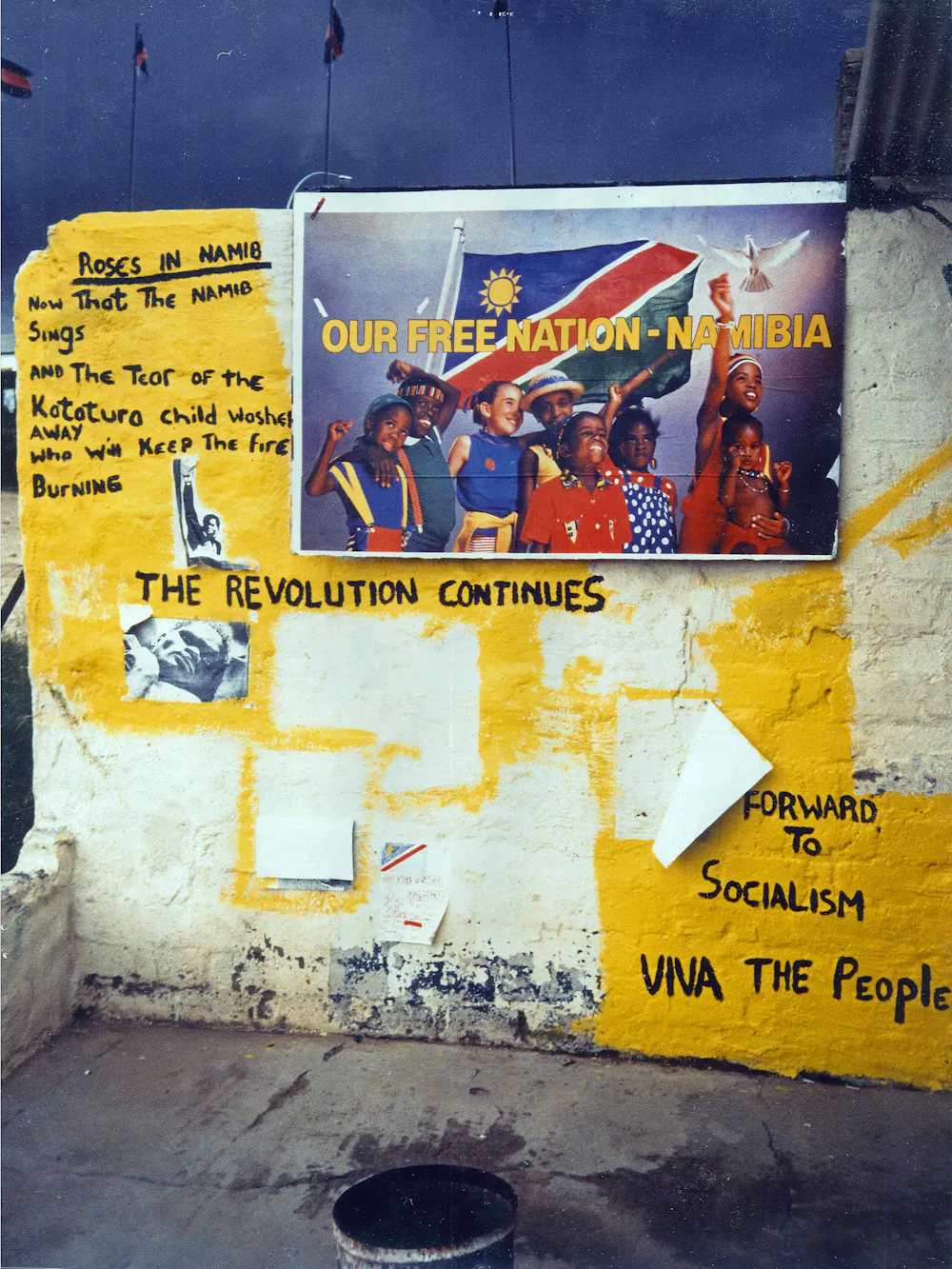
Independence was finally won in 1990. Image: Henning Melber

Swapo was founded in 1960 after the killing of unarmed demonstrators, who refused forced resettlement from Old Location, a residential area for Africans in the city of Windhoek. In 1966 it began an armed struggle. In 1976 the UN recognised Swapo as “the sole and authentic representative” of the Namibian people.

The warfare against the South African regime mirrored the ambiguities and dilemmas of most armed liberation struggles. Swapo’s military command structure in exile enforced a non-democratic, centralised totalitarian mindset and a willingness to violate human rights. But the war was a relevant factor to end the foreign occupation by a White minority regime.

How has the past shaped the present?

Germans and Namibians share the long shadow of German colonialism. Most Germans know little about German colonial history. But its legacy continues to influence Namibian realities.

This is most visible in the inequality of land distribution. For the descendants of those robbed of their land, colonialism remains present. Many consider German development cooperation as another form of injustice.


Read more: Namibia celebrates independence heroes, but glosses over a painful history


Swapo transformed into a dominant party in government. It cultivates heroic narratives and a selective patriotic history. A new Black elite justifies its privileges with the struggle sacrifices.

Namibia has, after South Africa, the highest social inequality in the world. This points to the limits of liberation.


Read more: Podcasts bring southern Africa’s liberation struggle to life – thanks to an innovative new audio archive


But Namibians live in relative peace and freedom. The constitution protects civil liberties and democracy. It entrenches the rule of law. These essentials have remained respected in governance since independence. Despite all the shortcomings, it is worth it for the colonised to fight for such a society – not only in Namibia but anywhere in the world.

– Namibia: the history of a country shaped from a rich and traumatic past
– https://theconversation.com/namibia-the-history-of-a-country-shaped-from-a-rich-and-traumatic-past-277655

Oil price surge is hurting African economies: scholars in Ethiopia, Kenya, Nigeria, Senegal and South Africa take stock

Source: The Conversation – Africa – By Stephen Onyeiwu, Professor of Economics & Business, Allegheny College

The attacks by the US and Israel on Iran, which started on 28 February 2026, upended key supply chains, driving oil prices above US$100 a barrel. The spike followed Iran’s closure of the Strait of Hormuz in response to the US and Israeli action. About 20% of the world’s oil supplies are transported through the strait.

In the words of the International Energy Agency:

The war in the Middle East is creating the largest supply disruption in the history of the global oil market.

The impact is being felt by countries across the globe. African countries are no exception, including those that produce oil.

We asked five scholars from Nigeria, South Africa, Senegal, Kenya and Ethiopia to answer the question: Is the spike in oil prices hurting your country’s economy?

The answer was a uniform “yes”. The universal fear is the effect the rise in prices is having on fuel, a staple commodity in every one of the countries for ordinary people as well as industries. In some cases, such as Ethiopia, the government has already introduced fuel subsidies to shield people from the impact of having to pay more at fuel pumps.

The fear that higher prices and outright scarcity could have damaging effects, notably on food production, was also near universal.

For some there may be a silver lining: Kenya and Senegal are in the early phases of oil production. But they’re some way off reaping the benefits of higher prices. And in the case of Nigeria, the danger is that any windfall that comes its way won’t ease the economic burden faced by ordinary people.

– Oil price surge is hurting African economies: scholars in Ethiopia, Kenya, Nigeria, Senegal and South Africa take stock
– https://theconversation.com/oil-price-surge-is-hurting-african-economies-scholars-in-ethiopia-kenya-nigeria-senegal-and-south-africa-take-stock-278679

Ethiopia’s national dialogue was meant to heal the nation, but divisions are deepening

Source: The Conversation – Africa – By Dereje Melese Liyew, Lecturer, Political Science, Debre Markos University,

Ethiopia launched a national dialogue process in 2022 to address deep political divisions and help steer the country towards stability.

In theory, such dialogues can help societies move beyond war, rebuild trust and agree on new political rules. This has happened in countries such as Kenya, Tunisia and Yemen.

Ethiopia’s process involved setting up a national dialogue commission. It stated it wanted to build national consensus, strengthen nation building and support democratic transition.

The working mandate of the Ethiopian National Dialogue Commission has been extended twice. First for six months in February 2025 and then for eight months in February 2026.

However, the dialogue is not on the right track. I have researched Ethiopia’s political landscape and peace efforts for nearly a decade, and in a recent paper, I examined why the dialogue process is facing a crisis.

I found that Ethiopia’s national dialogue is struggling due to legitimacy deficits, limited inclusion and weak process design. Four years after the process launched, it has produced limited tangible outcomes.

Mesfin Areaya, chief commissioner, Ethiopian National Dialogue Commission. ENA

National dialogues are most effective when they are broadly inclusive, trusted by key actors and conducted in a relatively stable political environment.

Ethiopia’s current context raises doubts on all three fronts.

The process has excluded influential political and armed actors. Opposition groups and civil society actors have also raised concerns about the commission’s independence from the ruling party. Ongoing conflicts further undermine the conditions needed for sustained negotiation.

These issues risk undermining the dialogue before it delivers meaningful results. This matters because national dialogue was meant to resolve Ethiopia’s political disputes peacefully. If it fails, the country risks missing a chance to manage conflict without violence.

Inclusivity

Inclusiveness is a defining feature of successful national dialogues. Key political forces, including armed groups, must see the process as a legitimate forum for negotiation.

In Ethiopia, several influential actors are absent.

Armed groups such as the Oromo Liberation Army, the Tigray People’s Liberation Front and the Amhara Fano have not been part of the process. Yet these groups are central to ongoing conflicts in Oromia, Tigray and Amhara regions. Holding a national dialogue while major armed confrontations continue – and without the participation of those directly involved – raises practical and political concerns.

Some opposition parties and civil society groups have also complained of inadequate consultation during the preparatory phase.

Exclusion weakens ownership. Without ownership, implementation becomes unlikely.

Trust

A national dialogue is usually convened during political crises or transitions. Its purpose is to bring together political forces, civil societies and non-state armed groups to negotiate fundamental questions about the state.

Ethiopia’s political tensions are rooted in unresolved questions about state structure, identity, historical narratives, the constitution and the balance between unity and self-determination.

A genuine dialogue could provide a platform to address these foundational disputes. However, the way the process has been designed and implemented has generated resistance.

One of the most contested issues has been the selection of commissioners.

The 11 members of the commission were appointed by parliament. Critics argue that the ruling party, which holds a majority of seats, dominated the process. Several opposition parties questioned the way the commission was set up.

When major political actors doubt the neutrality of conveners, the credibility of the entire process suffers. In divided societies, even the perception of bias can discourage participation.

In Ethiopia’s case, some opposition leaders have described the dialogue as a government-driven project rather than a nationally owned process. That perception alone is a serious obstacle.

There is also deep societal mistrust. Public confidence in political institutions – including parliament, courts and security institutions – has declined in recent years.

Dialogue requires a minimum level of trust before it can change anything.

Instability

National dialogues can occur during fragile transitions. But they rarely succeed in the middle of active and expanding armed conflicts.

Ethiopia continues to experience violence in multiple regions. In Tigray and parts of Amhara and Oromia, insecurity limits even basic state functions. Under such conditions, it’s difficult to set an agenda and get broad participation.

Ethiopia’s position in the Horn of Africa adds another layer of complexity.

Tensions linked to its Grand Ethiopian Renaissance Dam and shifting alliances involving Egypt, Sudan, Eritrea and Somalia have heightened regional rivalries. Gulf States have also expanded their influence in the region.


Read more: Egypt-Ethiopia hostilities are playing out in the Horn – the risk of new proxy wars is high


National dialogues are domestically driven. However, external geopolitical competition can shape internal dynamics through diplomatic pressure, economic leverage or security alignments. A fragile domestic process becomes even more vulnerable in such an environment.

Experiences with national dialogues from Sudan, South Sudan and Kenya offer mixed lessons for Ethiopia.

In Sudan, dialogue initiatives lacked genuine political openness and failed to create an environment for talks. In South Sudan, there were questions about government interference, and key opposition actors weren’t included. Kenya’s 2008 dialogue, by contrast, succeeded in halting violence and led to constitutional reform. This was largely because it included major political rivals and was supported by mediation that was accepted.

The core lesson is consistent: inclusion, neutrality and timing matter.

Is a reset necessary?

Some Ethiopian scholars and political actors argue for pausing and rethinking the dialogue.

In my view, a reset should involve:

  • re-examining how commissioners are selected to ensure the process is seen as fair

  • expanding engagement with opposition parties and civil society

  • exploring ways to include or at least negotiate with influential armed groups

  • taking parallel steps to reduce violence and build confidence.

A national dialogue is not a magic solution. It cannot, on its own, resolve deep ideological disagreements. But it can help manage them if the process is widely seen as legitimate.

If Ethiopia’s dialogue continues without addressing concerns over trust, inclusion and ongoing conflict, it risks becoming another missed opportunity in the country’s long political transition.

The stakes are high. A credible process could help stabilise the political landscape. A flawed one may deepen scepticism and polarisation.

– Ethiopia’s national dialogue was meant to heal the nation, but divisions are deepening
– https://theconversation.com/ethiopias-national-dialogue-was-meant-to-heal-the-nation-but-divisions-are-deepening-278321

Sierra Leone’s digital ID push: how local brokers help citizens gain legal identity

Source: The Conversation – Africa – By Laura Lambert, Senior Researcher, Leuphana University

An estimated 542 million Africans lack identity cards and potentially face statelessness. Without a legal identity, they can be excluded from basic human rights like education, healthcare and protection.

Most African countries have tried to rectify this by adopting a digital identity system to provide “legal identity for all, including birth registration” according to the Sustainable Development Goal 16.9 by 2030. Digital identity systems use databases to store biometrics and personal identity information together.

These systems claim to abolish identity fraud and corruption, because the identity is permanently fixed in the database and cannot easily be tampered with. In practice, however, creating and maintaining the system relies on many intermediaries. Chiefs, legal personnel, local authorities, teachers, employers, document brokers, family and friends all participate in enrolling, updating and certifying identities. These intermediaries make the system vulnerable to manipulation. But without them, hardly a legal identity could be established.

Within a transnational research project on digital identification, I have done ethnographic research with some of these intermediaries in Sierra Leone. I argue that they act as “brokers of citizenship”. They support people in becoming citizens by establishing an understanding of who is a citizen and what it means to be a citizen in terms of rights and duties.

In Sierra Leone, they have helped more than six million undocumented citizens to be included in the digital civil register and obtain a legal identity. My research in Sierra Leone illustrates that intermediaries have a crucial role in achieving the goal of citizenship for all.

Leave no one behind

Digital identity projects pursue the “one person, one identity” rule. They promise to create a permanent, secure and unique official identity for everyone based on linking a person’s biometrics to a permanent digital government database. Secure ID cards or birth certificates are then delivered based on these data entries.

But the process to obtain this official identity is a challenge for many people in Africa and more broadly the global south. People without sufficient recognised documents like birth certificates have difficulties in proving their identity. Minority ethnic groups, migrants, refugees and borderland communities struggle to prove their citizenship. Those excluded from citizen documents thus risk further exclusion from getting the new digital identities.

ID services are often distant and expensive. In rural populations especially, there is a need to travel far to registration centres. Rolling out digital identification to people in remote areas needs equipment, electricity, connectivity and tech-savvy staff. In Sierra Leone, the new digital ID card for citizens costs 165 Leones (about US$8). It is seven times more expensive than the old paper card.

Despite the promise of the Sustainable Development Goals to “Leave No One Behind” and provide digital identity for everyone, many Africans indeed risk being left out. Intermediaries are crucial for remedying these gaps.

Making identities official

Sierra Leoneans without sufficient documents to register for a digital identity can approach a “justice of the peace”. These usually retired men and a few women are appointed by the government to document oaths. Citizens can swear an oath about their identity to this official or his or her clerks. Against a small informal fee paid by the client, they document the claims about their name, date and place of birth on a form, a so-called “affidavit”. My research shows that this renders the identity claim of the client official.

Citizens can then use these affidavits to get biometrically enrolled at the responsible state office, the National Civil Registration Authority. Officials at the state office told me they widely trusted the declared information: “What you put on it is what we now believe in.” They appreciated this work of the justice of the peace, because otherwise undocumented people would be “disenfranchised” and risk becoming stateless.

As a colonial legacy, justices of the peace exist in many countries worldwide. There’s a risk they can exclude people based on discriminatory understandings of citizenship drawing on race, ethnicity or indigeneity for determining belonging. But they have played a crucial role in the inclusion of underdocumented people as citizens in digital identity projects.

Bridging the state and marginalised citizens

Justices of the peace do not only formalise identities. They are a bridge between the administration and marginalised citizens.

The Sierra Leonean justices of the peace are selected by the president of the republic for their good character and authority in their community as long-term civil servants, pastors, imams or chiefs. They hold a lot of authority and knowledge on the state and the administration.

In contrast to their status, many of them operate from a small table right in the bustle of urban informality. This is crucial for being accessible to marginalised citizens who might be fearful of contact with the administration. They might know little about its workings and experience civil servants as condescending or even authoritarian. They share information with citizens on how the administration works and give them advice on how they should act when they want to get the ID card.

Inclusivity needs intermediaries

In contrast to their promise, digital identities do not abolish intermediaries. Instead, they rely on the intermediaries’ work for identifying people and orienting them in the process. In addition to the justices of the peace, many other relatives, chiefs and state officials get involved in people’s identification. Although their involvement may make the system vulnerable to manipulation, intermediaries will remain important in the years ahead to remedy the civil registration gaps in Africa.

The work of these intermediaries has far-reaching consequences for achieving the Sustainable Development Goal 16.9 and for bringing citizenship into being.

– Sierra Leone’s digital ID push: how local brokers help citizens gain legal identity
– https://theconversation.com/sierra-leones-digital-id-push-how-local-brokers-help-citizens-gain-legal-identity-276336